Showing posts sorted by date for query milliongate. Sort by relevance Show all posts

Friday, 31 December 2021

PAS Second Milliongate: "Press Moment" Over, Now the Public Can Know Again?


A few weeks ago the PAS tried to make out, in what they termed a "press moment", that the facetious Martin Foreman (FLO based in Scunthorpe Museum) had made the PAS database's "millionth record". The Guardian's journalist (Rachel Hall) showed no interest in checking the facts, simply repeated what she'd been told to write, but Paul Barford had been quicker off the mark and had already written before this about the approaching millionth record.... He went to the database to check and pointed out that all the evidence on the (official British Museum-run and public-financed) database showed that there was some considerable doubt whether what the Guardian had reported had been said at the Treasure report launch was in fact at all true. In response the PAS.... actually HID the information on the front page of the number of records. They hid this information from the public that pays for it. They hid the information that contradicted the information they were giving out in their "press moment". There is a name for that isn't there? The British authorities in general seem pretty prone to this sort of thing.  Can't trust them any further than you could throw them. 

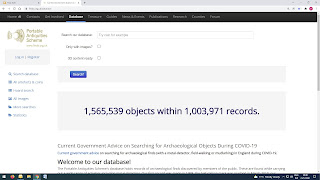
Well, PAS-watchers, you'll be glad to know that PAS have now "come clean" as the front page shows today at the end of the year:


I'm fed up with trying to get their clunky statistics section to work cleanly (it takes ages and prefers to give you an error message than actually provide answers if you ask it to do any real work), so I'm not wasting any New Year's Eve time working out when "3971 records ago" was. Maybe somebody else would like to have a bash. But the statistics section of the database has always tended to give inconsistent results. Searching "Statistical analysis of the database for Monday 1st January 1996 until Monday 22nd November 2021" (the day when they said they'd had their millionth record gives 997494 total records. More than 500 short. If on the 1st January 2021 they had 971873 records in the database and at the end of the year 1003971 (see screenshot above), that should mean there were 32098 records made in 2021. But for some wacky reason, the counter says there were 29422. So something is wrong here with the numbers. It is pretty worrying that there seems to be such a discrepancy (2676 records to be exact). 

What's this about? How reliable IS the PAS public database?  Why does the PAS feel the need to hide information from the public that pay for it and then arbitrarily decide to stop hiding it when they think everyone has forgotten the reasons they hid it? Is that sort of institutional flipflop transparency all the British public and the rest of us can expect these days? 


Wednesday, 15 December 2021

PASt Exploring. Interrogating the PAS Database


          The subject of the PAS's
       "millionth record"? 

I have discussed the claim that the flaky harness pendant NLM-B7AFF3  was the PAS's "millionth" record as claimed at the launch of the Treasure report (see here too). I showed that it was not, it was something like the 997502nd. On querying that, I was told (M. Lewis in litt.) why the PAS had hidden certain information on the home page of the database

We took off the record counter before we got to 1M else (sic) people might spoil the press moment - there were quite a few very keen to celebrate before we were ready.
Not everybody is so keen to "celebrate" the scale represented by the numbers of artefacts removed from contexts and masses of potential knowledge trashed by artefact hunting on such a scale. 

Anyway, the Head of the PAS reveals that they hide from the public the information to secure the "press moment", when they inform the public what should be public information all along. Once again, it looks like PAS is acting as a gatekeeper. It looks like what we are being told is that these are not public data (about the common archaeological heritage) for public use, but PAS data, for the PAS to make its own use of "when we are ready".

Readers might be aware that this has happened before, back in September 2014 when the Portable Antiquities Scheme was claiming (in another “press moment”?) that “the millionth find” had just been recorded. This was far from clear, and I made a number of posts on this so-called “Milliongate” that raised a number of issues that were never properly addressed by this public-funded body. Now the same thing seems to be happening with the numbers of records.
 
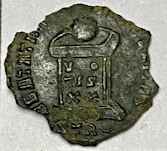
Whatever the claims and counterclaims, it seems that after quarter of a century expensive outreach the PAS database now does have upward of a million records. That's what their own counter says anyway. The number of records in the PAS database from 1st January 1996 to today is 1000458. So when did it cross that magical "million mark"? It seems that on Sunday 12th December there were 999966 records. By the end of the next day the counter says there were 1,000,212. If these figures are correct, it would mean that the 34th find recorded on Monday 13th December (so the day before they announced they'd already passed the mark on 22nd November) is the best candidate for being the real millionth record from 25+ years of liaison. By my reckoning, if you sort the results by date (and I assume the PAS server additionally organises them by time made) that's a pretty scraggy Beata Tranquillitas Roman coin from Badgeworth near Tewkesbury recorded in Bristol GLO-7448F7 and found 19th November 2021 by metal detecting on land of undetermined character.

But then, this is the PAS database after all, matters are not so simple, because to get from 999966 to 1000212 from one day to the next (see above), the PAS daily statistics tell us that on Monday 13th December only 84 records were made... Something here does not match. Check it out for yourselves.

But let's not lose sight of the fact that in the same 25+ years many million more artefacts have been dug up, pocketed and disappeared, all under the umbrella of "responsible detecting". Who is taking responsibility for what?


Wednesday, 2 March 2016

Spin, spin, spin away...


The "Museum of the Citizen" (sic) is trumpeting (with the 'archaeological dumbdown exclamation mark):
The millionth object recorded by was a Roman coin from AD 341, part of a hoard of 22,000 coins!

and
Every year thousands of archaeological finds are discovered and recorded by @findsorguk http://ow.ly/YNf7Q 
Anyone who wants to see the correct finish to both of those sentences can find the information on this blog. You will not be hearing either properly presented to the public (who pays for their cosy offices and petrol) by the staff of the PAS.

1) You will find (try searching "milliongate") my arguments for saying that this "millionth find" (not record) was fudged. Anyway, as Treasure items should be in a Treasure report not a separate database set up to record non-treasure items, this millionth find from a hoard is reported there superfluously leading to duplication of effort as well as finds numbers.

2) With regard to the second fluff-propaganda-head-pat piece, tens of thousands of archaeological artefacts are taken in Britain, some pocketed, some discarded, many sold on eBay, all not recorded. The British archaeological record is being  eroded exploitatively both openly and clandestinely in an unprecedented manner and the PAS consistently refuses to address this issue properly, preferring to fob everybody off with feelgood fluff like the above. Shame on the lot of you.

Thursday, 26 February 2015

PAS PACHI FOI: The Internal Emails - Milliongate


Topic H, 'Milliongate': The bulk of the pdf we received as a result of my FOI request consists of a series of duplicated emails (somebody's not good at inbox-management) on the affair I dubbed 'milliongate' - the smoke and mirrors surrounding the "millionth find" in the PAS database (a 'Late Roman Bronze' coin from the Seaton Hoard). When sorted out there are 18 of these documents - and apparently nothing in the PAS forum. Taken together, they show above all the PAS attitude to information transparency and how a new member of staff is instructed to ignore requests from the Scheme's audience for information.

The sequence starts off with a brief email from me on 8th September 2014. I asked the PAS a question about the sudden jump in statistics on the database home page that day. The reply could have dealt painlessly with my five queries in two sentences giving all the information requested. This, we now know, is what Dr Drost could have written:
*Paul, This is a recently excavated hoard of Roman coins from Seaton, Devon, yes the number is an estimate, we are still in the process of recording and individually photographing these coins. Please do not discuss this find or use this information until after the press conference on 25 September, Best wishes Vincent Drost*
That is what he could have written, it would have taken him less than a minute. He did not though. What happened instead? Well, that was far more time-consuming and led to the generation of the wadge of documents we received. First, my query was ignored. I wrote again politely seven days later, pointing out additionally that there was a problem with the visibility of previously visible information in the database. [After I mentioned I'd spotted the jump in the database, the PAS for reasons best known to themselves attempted to hide the information].

The reply (Vincent Drost [VD] to PMB Sept 16th 5:21 PM), instead of just answering the queries I had, dismissively dodges them (and, despite it being consulted with two other BM employees, lacks one part of the second sentence). It  does not in any way answer the perfectly reasonable questions I had asked more than a week earlier about the sudden jump in publicly available recorded finds figures. VD was clearly being deliberately evasive. I asked again, about the nature of these 'data' recorded at public expense. VD's response to that third attempt to explain this anomaly was again to ignore the query totally.

In fact, I found out that his original fob-off reply of September 16th contained false information. He denied the data were in the database (when as my original request indicated, everybody could see from the overall total on the database home page that they still were!)  and he said they could not/would not be entered until after the inquest. But the inquest had actually taken place four days before his response. This is not the behaviour we should expect from publicly funded heritage professionals (in Poland for this under the Civil Code and Codex of Administration Procedure, such an employee could expect disciplinary measures). I gave up trying to get a straight answer from this guy, obviously a waste of time.

The PAS database is created with public money. Dr Drost works in the BM, publicly funded, the chair he sits on was paid for with public money, his computer and the programs in it too. The material he is employed to process as part of his work for the PAS are finds made by members of the public and made available so they can become part of public record. The public records of the PAS (I have no special access) showed a sudden and mysterious jump of 22000 objects and this was there assigned to something Vincent Drost had done. The total was brought up to over "a million" and this is used by metal detectorists and their apologists at home and abroad as an argument "how useful collection driven exploitation is" meaning we and the PAS have to be very clear what these figures actually represent. Dr Drosts's involvement in this is not as a private individual, so when somebody starts messing a blogger around when he asks a perfectly civil question, Dr Drost really should not be surprised that the blogger blogs about what has happened. That is not "getting personal" as he put it any more than his fobbing me off with weasel words was.

What happened next was simply weird. On 24th September at 9:44 in the morning after a break in the thread of more than a week, Dr Drost timidly writes to Michael Lewis. 
Dear Michael, sorry to bother you. I came across Paul Barford's blog. I know he's a trouble maker [...] Even if this is nonsense [...]
I think that says an awful lot about what the self-anointed demigods in the British Museum and its Portable Antiquities Scheme are probably saying about the Portable Antiquities Collecting and Heritage Issues blog. Troublemaking nonsense- monger. Note the coy "I came across PMB's blog". Dr Drost does seem from this exchange to have a few problems actually admitting what the problem is... Dr Lewis sees through this fluff, barely 20 minutes later he is berating the new boy:
I saw Philippa [Walton] the other day and she said you had replied to him - is that so? Maybe she got that wrong 
Oh dear. Caught out by the office grapevine. Dr Drost contritely replies (Note that in fact before his reply, I had only written once and then sent a polite reminder a week later):
"As he kept asking, I've [sic] sent him a short reply in consultation with Sam and Ian, below is what I wrote [he quotes it in entirety ...] I probably shouldn't have but I don't think this changes anything. I understand now that I have to completely ignore him and his blog.
What an extraordinary and comic exchange!   Like a little boy to his school headmaster, "I know I shouldn't have done, but no harm was done, honest, but he made me do it!" Michael Lewis, as if to reinforce the impression we are dealing with a group of schoolkids, thinks up (24th September 10:50) a way to "irritate him [i.e. me] more". [tee hee]. Anyway, Dr Drost tries to be a good employee and assures Dr Lewis (24th Sept 2014, 10:56): "I am going to ignore him completely from now on. Sorry about that (sorry Sam and Ian to involve you in this)". Mike Lewis soothes him (perhaps in his best Stephen Fry voice):
"Its no ones fault. he is a tricky one to deal with, especially as we feel we ought to reply. But he is so mischievous I think it is fine to ignore him".
I've not been called "mischievous" since I was ten and certainly not by anyone who forgets to use apostrophes in official communications. It is "fine" in the British Museum, apparently, to ignore substantive public enquiries. What on earth is going on here? Involved in what, precisely? A member of the public asks PAS a question, and what exactly is Drost apologising for? The impression you get from some of these emails is that PAS head office is some kind of pretty distopic organization. I was not expecting that, I must admit.

Ian Richardson at first appears to attempt to insert some sanity into the communal self-flagellation and recriminations (24th September 11:21 to ML, VD, copied to SM). He actually sees where the issue arises: "I think what happened was that PB was keeping an eye on the overall counter as it ticked approached a million and when, all of a sudden it went over, he was able to query the database statistics" (bingo - got it in one, see it's not so difficult). Disappointingly he seems unable to go that one step further to thinking outside the institutional box: "it really is frustrating to have such a useful tool, which helps make our work more transparent, used in a mischievous way" . Eh? (See below). No fear, Michael Lewis (24th September 2014, 11:24) assures Ian Richardson, VD, Sam Moorhead, Dan Pett and a person whose name has been redacted out (and where did this person suddenly come into the thread?) that "Dan said that he and [redacted] were going to look at how the counter works". Gotta get that transparency issue sorted out, make sure that they prevent "mischievous people" seeing how many objects were recorded by whom in any particular time period.

[Note, not that he'll see it: I would not bother Dan, the totals are now so hopelessly muddled, the results so periodically inconsistent (and have been since we were discussing them on Britarch and on the PAS public forum which you closed), that nobody who has looked at them carefully really believes any of it any more.]

There is some more chat about not replying to queries from Barfords, more self-recriminations (VD, SM),  then flippancies. Pathetic.

But then, a further redacted person comes into the conversation (Sept 24th 12:08) answering a post in the 'capitalised RE' thread - despite not (?) having been copied in it earlier (suggesting that Christopher Denvir has not actually been able to gather all the relevant material). Actually, I think it is pretty clear from the style who this is and one might be forgiven for thinking that the only reason the name is redacted out is an attempt to hide that he was not copied in the previous correspondence. This person is gloating that since the PAS are keeping information from members of the public what I write is allegedly "ill-informed". Well, whose fault is that if true? In any case, is there only "one Truth" that of the PAS and Baz Thugwit? Is that what the PAS want us to believe? The demigods decide and it is for the rest of us to just accept the crumbs of wisdom that drop out of the clouds which veil the true face of "The Great Social Experiment Which is The Great and Glorious PAS". This Deus ex machina advises his readers to "avoid his blog posts as [...] this is all grist to his mill. Worse still is that regularly viewed blog posts will climb the ranks of Google and be more likely to turn up in search results for your name". Sounds like... the pompous alarmism of a well-known Washington allobbyist Tompa ! Then the sky will fall and the seas turn to blood, no doubt. Thus spake Bloomsbury.  (Of course this is anti-Googlian nonsense, if VD reads a post about looting in Syria on my blog, a Google search will not associate him with ISIL).

To return to what Ian Richardson said, the work of any publicly funded heritage body like the PAS should be 100% transparent. It's not the Ministry of Defence, its about little old ladies finding potsherds in their rose beds and little boys finding Roman glass beads on an allotment. In any case, to follow almost everything you read about the PAS, they consider making the database, and making the database" bigger" is their work. The only thing that is mischievous is (a) including Treasure hoards on the database of non-Treasure finds to boost numbers of 'voluntarily reported finds' (the Treasure Report is the place for them) and (b) hiding the true source of the information behind smokescreens. And it is not me being "mischievous" in trying to find out what the PAS are up to with their artefact hunting "partners". If the PAS is built on the basis of a multivocality of archaeology, then my seeking knowledge of the past has as much validity and rights as Baz Thugwit's. Yet Baz gets patted on the head by the PAS and I get called names and insulted for asking the same sort of questions. I have every right to ask what the PAS and their metal detecting partner are doing with the heritage, my heritage, and  I have a right to get an answer to these questions, and they (ivory tower demigods or not) as a public institution have an obligation to share that information without me having to put in an FOI request.
PACHI PAS FOI: the PAS Forum and the Topic of 'Planted Finds' Being Avoided by the PAS Again


Commentary on the material placed in the public domain as a result of a PACHI FOI request from the British Museum from the PAS hidden forum

Topic D: The Planted Fibula (8th November 2013):
David Williams gives a link on the forum to a Surrey Mirror article about a planted brooch 'found' on a rally. I'd written about what the article said and then asked the archaeologist dealing with the find for information on the type of brooches involved:
There will be an article in the next Searcher. Paul Barford has already picked up on this but all I've done is refer him to the next Searcher - which he won't see.
You almost imagine him tittering as he typed that. Remarkable. Dr Williams is justifying himself like a naughty schoolboy, "all I've done is..." ("don't mention the war, I did it once but I think I got away with it!") and then taunting that I'll not be able to find out more (we see this type of perverse enjoyment of the feeling that these professionals have hidden something from an enquirer in the Drost/Milliongate thread too).

What on earth is the guy writing about that I'll not "see" the Searcher, does he think I live on the moon? True enough the Institute of Archaeology here does NOT get the Searcher, but I did more than "see" it.  Let us note though that he does not say that I wrote asking for details on the two fibulas mentioned and I considered his reply unprofessionally "dismissive". I had discussed this incident and some of the implications, including for the integrity of the records of the major rallies which the PAS had attended previously in the immediately adjacent area and used as showcases for their "partnership". Perhaps that is the problem. You will note that there is absolutely no discussion of the implications for the PAS of this affair in the posts forwarded to me from the BM, just the superficial issue that it was being discussed but Williams assuring fellow professionals that he'd managed to throw me off the trail.

That is not the end of the story, there was a further development in the case of one of the brooches (of which Dr Williams once he'd decided to be a little bit more professionally-archaeological informed me), but I believe this is not in the public domain.  This complicates the story even more and raises other questions of how FLOs vet finds, but that question was not raised on the PAS forum in November 2013.

What was discussed in the thread was the reaction of the metal detectorists (Katie Hinds 8th Nov). This was followed by the reaction (11th November) of Dr Williams "Oh Gawd!!" to this text on my blog: 'Focus on Metal Detecting: Conspiracy, conspiracy... "Dirty Tricks Incident" - NCMD'. But look what is happening. My post relates what is going on over on a metal detecting forum. Why did Williams not supply PAS 'partners of metal detectorists' a link to the MD forum? FLOs very rarely it seems do any of their outreach through the existing forums of their "partners", they just talk about them behind their backs on their hidden forum.

Vignette: planted

Wednesday, 7 January 2015

News of Upcoming PAS Database and Website Changes


If anyone’s interested in forthcoming PAS website changes, here’s some details of what was discussed at the 2014 PAS Christmas meeting. This includes a mention of those Heritage Lottery Fund "volunteers". It seems (pp. 41-2) that there will be two levels of data access for them. Some of them will be "editing data for [FLOs]" while others will be "recording data for [sic] clubs" - this is not only a "data protection nightmare" (p. 43) but also means that instead of outreach on best practice by professional and experienced PAS staff (not that we see much of that going on recently), finders in "clubs" (presumably metal detecting rather than rose-growers' ones are meant) are going to have first contact with these "volunteers". Yet the Scheme still has not been clarified from where this pool of "volunteers" is being drawn. They may well have in mind "citizen archaeologists" like Mr Abbott down in Brighton.

I note a bit (p. 7) where it specifically warns FLOs of PAS policy not to put anything in the database or any other PAS internal document - even the hidden bits - which "casts doubt on the integrity of finders" (as if!). This is to prevent the finders doing an FOI (and I personally know of at least two cases where this has happened) and getting information they can use against the author (actually, as I understand it, in UK law in some cases, it is the publisher that is liable). This means though that the record is constantly being bowdlerised and information like "I suspect he might be lying about where this find comes from, treat with caution" will consistently be omitted through self-censorship. This rather weakens the ability of the FLO to even weigh up the various undocumented claims about circumstances of finding brought in by finders anxious to get their object legitimised by being included on the PAS database. Indeed, it weakens the incentive to even bother, as now the only thing an FLO can do is refuse to put an object they are suspicious of onto the database (we saw an example of that a few years ago with an infamous coin - which seems still not to be in the database). But in that case, to avoid the same legal problems, they cannot say to the finders face why. A really unsatisfactory solution - and one that would in part be resolved by requiring finders to show documentation that a specific landowner has relinquished ownership (or shares in ownership) of that object to the finder who brings it in for recording.  In other words documentation that the find being entered on the database is of licit origins.

In addition, though it is not clear (pp 27-34), it looks like hoards are now coming off the database into their own - good  (#PAS Milliongate). Now what about sorting out the mixing of other compulsorily-reported Treasure and voluntarily-reported non-Treasure data in the same database so we can assess how effective the policies concerning best practice and finders actually is? Let's see if they cannot give us a tab to sort out:
Data origins:
Artefact hunting, non-treasure items voluntarily reported (they came to me)
Artefact hunting, non-treasure items voluntarily reported (I went to them)
Other non-treasure items voluntarily reported.
They have been consistently hiding these data since Nigel Swift and I started a public discussion of them over on Britarch a decade or more ago. It is well past the time for the PAS to 'fess up and allow the non-collecting public (whose heritage PAS-'partners' are using up) to more easily search the database from the point of view of the effectiveness of current policies on artefact hunting and collecting.

[UPDATE Nigel Swift points out something I'd missed - there'll now be a section on "Archaeological context data quality" of hoards. That will be interesting - and how can they do that honestly in some cases without writing negatively of some finders?]

Note the database will be down 21st January -28th January but will emerge shinier, faster (?) and colourful, and easier for the 'partners' to read.


Wednesday, 31 December 2014

PACHI in 2014


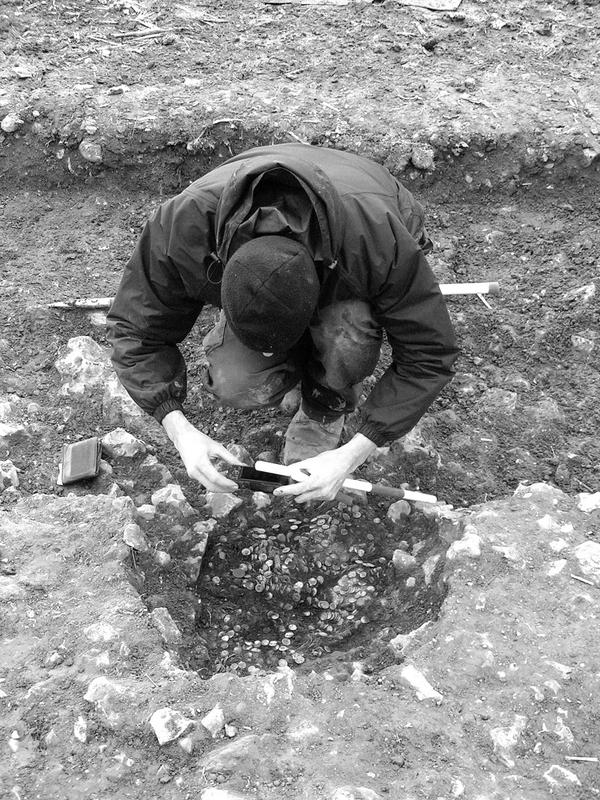
The caption says: "Dr Vincent Drost recording the #pasmillionth object"
on the PAS database" (photo PAS - see here for discussion).

Another year draws to a close and traditionally this is a time for taking stock. I see from the sidebar that this year I wrote just over 1800 posts, which it is quite a challenge to summarise. Some of these were just reporting something going on in the portable antiquities world - summarising a news article of interest with a short comment. Other posts were more substantive and analytical, and took a lot of work to think through, research andpost up. Between these two extremes are texts which fall between the two stools.

The blog in 2014 concentrated on the same issues as in 2013 and preceding years, while new areas of interest/concern also emerged. At the beginning of the year we had the emerging topic of papyrii (Sappho, the mummy-mask dissolvers) and then of course in the middle of the year started to emerge the big story that kept me awake at nights (sometimes literally), the emerging humanitarian and cultural drama in Syria and northern Iraq.

I have continued to challenge the received opinions about collectors and collecting, the ones propagated by the trade and its lobbyists, by apologists for artefact hunting, and more disturbingly - the view of artefact hunting and its effects foisted on the British public by a Scheme they pay for (the PAS).  I show that there is a multiutude of cases - actual people doing actual things and talking about them - which should be prompting us to take a good hard look at the rosy picture everyone wants us to believe.

A few random highlights and lowlights come to mind. In March we were discussing the pre-release material from National Geographic's "Nazi War Diggers" which in the end led to this programme being withdrawn. There was discussion of the excavation at Crosby Garrett where metal detectorists reported they'd found a Roman parade helmet - the hole produced more questions than answers. Both of these issues relate to what is understood as 'best practice' in artefact hunting, a theme which continued to be explored on this blog throughout 2014.

April saw some discussion of the plans of the Portable Antiquities Scheme (PAS) to take recording of artefacts found by members of the public out of the hands of professional archaeologists and turn it over to 'trained' members of the public. I called this 'karaoke recording', but details remain vague. The PAS obsession with boosting overall recording statistics is also a theme that recurs later. April was also marked by a number of UNESCO fails, which began a series of comments on this later on in the year. A post on April 1st raised the issue (the so-called 'Lepidop question) of why - if it is so 'good for the heritage' - archaeologists do not go on metal detecting rallies. Like most issues raised on this blog, that never got taken up anywhere.

May was the period when I was discussing the US-Egypt MOU and in particular the reactions of collectors, following sheep-like the urgings of the dealers to oppose measures intended to impose minimal controls to reduce smuggling.  Collectors like to present themselves as homegrown 'avocational scholars', but some of their mental gyrations at the dealers' bidding  (and in particular on the issue of the circulation of ancient coins outside Egypt) really does cast doubt on their ability to think analytically about anything at all.

June and July saw the sale of the Sekhemka statue (and the mysterious fire at Castle Ashby the night before). SLAM and its acquisition of the Ka Nefer Nefer mask was in the news, while over in the US Congressmen Israel and Rangel briefly supported the coineys.  The decision on the so-called Getty Bronze was deferred and we are still waiting...

In August rumblings about the no-questions-asked market led to a group of dealers setting up yet another dealers' association to bolster the facade - the ADCAEA. After a brief flurry of activity and producing a Code of Conduct (and due diligence guidelines a few weeks later), it settled down to doing about as much as all the rest.

September saw the 'Dunelme hoard' hoiked up, a desultory discussion in the metal detecting and archaeological communities followed by the usual silence. The metal detecting month however was dominated by the bru-ha-ha around PAS recording its "millionth find". This was a disaster ("PAS Milliongate"). the millionth fnd was trumpeted by detectorists as a victory of the voluntary recording that they are doing, but the millionth find boosting the database was in fact from a hoard (Seaton Hoard), so a Treasure items the reporting of which is mandatory. Ridiculous sham. In the meanwhile the Heritage Action Artefact Erosion counter quietly ticked off the five millionth object hoiked since the PAS began.

In October Cuno revived his zombie 'universal museum' arguments and the TV comedy series 'detectorists' aroused great excitement (metal detectorists on their forums are still repeating to each other the jokes like children to show their mates they understood them). November was the apogee of posts here on Syria, trying to untangle plausible from implausible, fact, inference from alarmist invention and misrepresentation on the one hand and the glib dismissals of a dismayed antiquities trade on the other.

These topics all continued to be discussed in December, just recently we had the bad practice of the Lenborough hoard and then the Holt hoard recovered by metal detectorists. These no doubt will be returning in the next few weeks.

I was struck by the number of situations where it was pointed out at the end of a post discussing bad practice in artefact hunting in England and Wales that it would be appropriate as part of its outreach that the PAS commented on something that had cropped up and was being discussed for example on metal detecting forums. In the whole of 2014 this happened only once, when one FLO contacted me and explained about the out-of-place artefact that we'd been discussing (a Danubian brooch found on a rally). In every other case, the PAS did not issue any kind of a statement as part of its "outreach". Indeed, this year has seen a record number of FLOs refusing to even acknowledge that they received a request for further information, let alone answering it.  Perhaps they need reminding what the initial "L" stands for in their job title.

Archaeologists in Britain in general also refuse to discuss any of these issues in any detail. This is a malaise which of course is very much to the advantage of artefact hunters who are secure in knowledge that whatever bad practice they exhibit, only a few 'radical archaeo-bloggers' will ever point it out, and that will get ignored by the whole archaeological community.  The rest will sit quiet and not react.

The picture at the head of this post sums up 2014 in artefact hunting in general. Here we have the facade in operation. Its from the Facebook page (the one they remove substantive questions and comments from) of the The Portable Antiquities Scheme from 2nd October 2014. The caption reads "Dr Vincent Drost recording the #pasmillionth object". Readers of this blog will know that when he did, and the record showed up before the PAS were ready for the press-launch fanfare, Dr Vincent Drost and his records disappeared from the database. What I think is syptomatic about this picture is that the declared "millionth object" in the PAS database should not be there (as it is not a voluntarily reported non-Treasure item) is not anyway the millionth record, and in fact in the photo Dr Drost is not holding anything in his hand. The object in the photo is an imaginary one. That symptomises the discussion of portable antiquities collecting in the English-speaking world. Superficial pap is foisted off on the rest of us by all sides, outright lies are presented as fact, discussion of them is discouraged and suppressed and nobody actually gives a tinkers.

Happy New Year.


Friday, 26 September 2014

PAS Milliongate: Roman Grot is "Millionth Find"


First the announcing tweet:
2 min.
News story: "Portable Antiquities Scheme records one millionth find"
And then the "news" itself:  Author: . Published: 4 minutes ago
On the occasion of the publication of the Portable Antiquities Scheme Annual Report 2013, its one millionth find recorded is announced. The find is a Roman coin in a hoard of 22,000 others dating to around AD341 found in Seaton, Devon. [...] The recording of over one million objects on http://finds.org.uk since the Portable Antiquities Scheme (PAS) was founded in 1997 is testimony to the enormous success of the scheme, which allows finds discovered by members of the public to be recorded for the benefit of researchers and the public alike.
There, I was right, a so-called Roman grot. Pour encourager les autres.
The copper alloy coin, called a nummus, was struck in AD 332 at the mint of Lyon (Gaul). It shows the personification of Constantinopolis on the obverse and a Victory on prow on the reverse. This very common type was struck by Constantine the Great across the Empire to celebrate the inauguration of the new city of Constantinople which was to become the capital of the Eastern Empire.
The rest of the text is a typical piece of PAS-fluff and spin, but interestingly reveals the great extent to which compulsory reporting under the Treasure Act has been responsible for the "wotta-lotta-stuff-we-got" figures. Voluntary reporting by artefact hunters, once held to be the mainstay of the database, now recedes into the background as emphasis shifts from the broader picture of use of the landscape to individual spectacular finds of gold and silver. From the site to object. This is a very worrying reorientation of the conceptualisation and public representation of archaeology.

It is difficult to see how this will help the Scheme achieve an aim which they declare to be
"raise awareness of the educational value of archaeological finds in their context, and promote the care and protection of the historic (sic) environment on a local level".
Artefact hunting in its current form erodes the historical environment and our ability to study and understand it. The PAS is providing very minimal mitigation of its effects on the archaeological record, both at the macro and micro-level. "One million" finds recorded from this is nothing compared to the numbers which may reasonably be thought to be being lost through collection-driven exploitation of the archaeological resource.


But I bet that's not going to be mentioned today in the self-gratulatory speeches and photo calls among the canapés and sparkling white wine in plastic flute glasses in the gallery today.

Tuesday, 23 September 2014

The Bloomsbury Anti-Countdown


Bloomsbury is a funny place, the Portable Antiquities Scheme kids everyone that  they are on the way to getting their millionth object but the runaway counter on their very own webpage shows they are racing away from that number ('Milliongate: PAS Gone Numbers -Crazy'). And you know what? Nobody is paying the slightest bit of attention to their posing and playing about with the numbers as though they've all simply lost trust in them and no longer care.

Over on the PAS public database today, here on the front page, we read 1,024,184 objects within 633,705 records. A million was 2343 records ago.

And as HERs and the people that run them go to the wall, the PAS in their 'outreach' tells people to use THEIR facility to find out about local metal detector finds around their home instead of encouraging an awareness of the local HER. 
 

Monday, 22 September 2014

Milliongate: PAS Gone Numbers -Crazy


Over on the PAS public database, here on the front page, we read 1,023,953 objects within 633,481 records (that should be 633,481 records, mentioning 1,023,953 objects).


Or according to the 'overall statistics' search today:
It is bad enough that two sources of information about the PAS both available from the same page do not correlate with each other. There is no surprise in that for those of us who've been trying to follow the progress of outreach through PAS "statistics", they tend to be very mutable. Yet there is now an even more puzzling development: the PAS spin doctors are now telling the public that pays for all their number games:
Stay tuned for the millionth object this week!
What new trickery is this? So, if they are ignoring the "22000" Treasure items Dr Drost entered on the database on 8th September, why not all the other Treasure items, which brings their total down considerably? Why are the PAS so insistent on representing their figures as something other than what they are? The database says one thing, the PAS says those figures are not correct and are trying to promote other ones. What is going on? How can anyone take the PAS at all seriously when it engages in these games?

* * *

For the record, the search of results from 9th September to the evening of 22nd September reads
The total up to 9th September 2014 minus the estimated 22000 from the unnamed hoard is (on 9th September there were 167 records of 179 objects added):
Adding the two we get:
1,001,674 objects....
which shows that even with Dr Drost's hoard cut out, but not the other extraneous data, the PAS have already over a "million objects" on the database. So what are they playing about at trying to convince us that with a flourish and fanfare they are later going to produce a pre-selected "millionth find" ("but in the meanwhile here are some of our FLOs' favourite objects"). This is very redolent of the apparent rigging of the dumbass competition of "viewers' finds" on "Britain's Secret treasures" that tweets and the weather reports of the day concerned showed had been  filmed prior to the pretended date of selection. 

Let me guess the reputed "millionth find" is going to be something at first sight nondescript, which their narrativisation turns into something more significant. My money is on a "Roman grot" which they've been trying to get their "partners" to report for years.

Maybe instead of these pointless and embarrassing attempts at media manipulation, we can at last see some real transparency, detail and openness from the PAS. Seventeen million quid of public money deserve no less. 


Wednesday, 17 September 2014

'PAS Milliongate', Scheme Records Finds for Commercial Unit on its Database? Why?


The PAS database was set up in 1996/7 to attempt to mitigate the loss of archaeological information due to the fact that members of the public finding ancient artefacts were only required to report a certain group of them ('Treasure' - basically hoards and glittery things of gold and silver). The database was set up as a state-funded resource created through the voluntary reporting by members of the public of non-Treasure items which were normally returned to the finder's own collection rather than going to a public collection. The number of items reported by metal detectorists (artefact hunters and collectors) relative to the number of items being removed from the historical record by collection-driven exploitation has been the subject of intense discussion since 2006 and the PAS has done everything they can to avoid answering that question directly or allow others to use the public database to answer it. In addition, since the televised "Britain's Secret Treasures" fiasco, it has been unofficially claimed that there were "nearly a million objects" in the PAS database reported by members of the public. That number was actually only reached at the beginning of September (in fact the actual number of objects is less important a statistic than the number of records).

The countdown to that "millionth" object was abruptly discontinued at around the 998890 mark with the dumping by Dr Vincent Drost of the British Museum onto the PAS database of a single record referring to a round "22000" objects. This record obviously refers to a substantial coin hoard (if Roman, the fourth largest in the country it would seem). This highlighted that in fact what had been happening, and escaping comment, was that since 2006 at the latest the PAS had been placing increasing numbers of records of Treasure items (reporting compulsory - many destined for public collections) among the voluntarily reported non-Treasure items from scattered and ephemeral  private collections which the database was supposed to be forming a permanent record of. When I looked into the scale of this phenomenon (Wednesday, 10 September 2014, 'Focus on PAS: Trying to get to the Figures' ), it could be seen to be of staggering proportions, and producing a wholly misleading picture of the degree of voluntary reporting by members of the public. Interestingly, the moment this record of "22000" objects began to be discussed, the tab on the PAS website to the objects recorded by Dr Drost disappeared from his personal page on the website, and it is impossible to inspect this record which led to the "millionth find" being entered onto the PAS database. Why the PAS are hiding these data is anyone's guess (but please, go on, try).

More to the point, why is what is clearly an estimate ("22000") being used as the basis for calculating official database figures?

Why are Treasure finds being entered onto the database in the first place? What actually are these "data" and how are they comparable within the database? What is the function of this "database"?

On examining the questions raised by this event ("PAS Milliongate") I came across an even more puzzling data entry. Look at the record for the Beau Street, Bath hoard: GLO-40A9B6. (record created Thursday 12th February 2009).  This is another Treasure case, an estimated 17,500 silver Roman coins buried in or after 274 AD. That'll boost the figures. But this hoard was not found by members of the public. It turned up in a developer-funded archaeological excavation by Cotswold Archaeology Ltd in advance of building work for the new Bath Spa, 16th November 2007.  So why has it been included in the database of non-Treasure finds voluntarily reported by members of the public? More to the point, why has an FLO employed by the Scheme, instead of liaising with and getting through the backlog of artefacts reported by metal detectorists and other members of the public spent a considerable amount of Scheme time sorting, studying and counting 17500 artefacts from a commercial unit's excavations carried out in an adjacent county and adding this information to the PAS database? Who paid for this, or was the service provided  by the PAS to the contractor for free (that is, at everybody's expense )?  Are there any other portable antiquities from the Cotswold Archaeology excavations of Beau Street Bath lurking (under one of their cagey "to-be-known-as" names) on the Portable Antiquities Scheme database?

What on earth is going on here? Just what do the Portable Antiquities Scheme, and do not, record? Or are there no real principles at all, anything goes? What kind of dataset is that, and is the British public getting what the British public, like it or not, is paying for? This is yet another case which shows the urgent need for more transparency and accountability from the PAS.


Creative Commons License
Ten utwór jest dostępny na licencji Creative Commons Uznanie autorstwa-Bez utworów zależnych 3.0 Unported.