Monday, 10 January 2022
UK Archaeology, One Might Ask, Why?
Dr John Naylor (Ashmolean museum) announces gleefully that he's written a post on a publisher's blog about another book in the PAS "Fifty finds..." fluff series giving a flavour of what his book is about. Dr Naylor's book purports to illustrate "the roles that coins played in early-medieval society, all based around finds recorded by the Portable antiquities Scheme". One might ask "why?" Are these archaeological data? (Spoiler: no). The blog goes on about the partnership between PAS and artefact hunters as a "quiet revolution going on in British archaeology" (sic) and "enormous amounts of new evidence from the distributions of objects across the countryside to the analysis of types of objects, their designs and decorations". The aim is to show: "even the smallest of objects can tell the biggest of stories..". So typology, looking at the pictures and dot distributions (the map he uses to illustrate this "revolutionary" new method has well more than "fifty" dots on it). He mentions a coin from an East Anglian grave assemblage dug up by a member of the public, trots out some dubious interpretation about the placing of letters on a coin flan...
If one in nine finds are being reported, his cherry-picked "fifty" turn out to be just a fragment of the material evidence utterly destroyed by artefact hunters. The search engine says the PAS database contains 5,613 records. Since it seems that in England and Wales alone, eight-in-nine finds made by artefact hunters have been hoiked and unrecorded entered private collections or been sold on Dr Naylor's "fifty coins" in fact stands for the amount of information lost by the removal and disappearance of more than 50,500 coin finds unrecorded by the PAS. How can that be seen in any situation at all as a success on the scale that it could be termed a "quiet revolution"? Absolute tosh. Perhaps British archaeology could just STOP producing little object-centred "studies" (mostly at a popular level than real meaty state-of-the-art research) with the sole aim of promoting the PAS (by showing wotta-lotta info we can get from these rows and rows of decontextualised artefacts). That's what all these "fifty finds" do. What these volumes show is what is being hoiked from poorly documented or undocumented archaeological contexts. These books tell us about "collecting bits of the past" rather than about that past - except they don't because the people writing them tend to look for a way to present them as the archaeological data that they simply are not, rather than address (anything BUT address) the issues involving the process by which archaeological evidence is turned into a loose collectable and what is lost thereby. Why is this happening? Well, "don't look up" (or rather, down, into Britain's trashed and gutted archaeological record).
Saturday, 8 January 2022
Scholarship on Staffordshire Pottery Industry Simply Discarded by Philistine Local Government
The city of Stoke-on-Trent in Staffordshire, England was at one time the centre of the English pottery industry and is the centre of a district encompassing the six towns Burslem, Fenton, Hanley, Longton, Stoke and Tunstall. Collectively the area is known as the Staffordshire Potteries (or simply Potteries, the local inhabitants being known as 'the potters').
| Worthpoint |
| Diagnostic artifacts... |
By the late eighteenth century, the success of creamware killed the demand for tin-glazed earthenware [here, here] and pewter vessels alike. The Staffordshire pottery industry was in the vanguard of the Industrial Revolution, there were approximately 130 potteries in North Staffordshire during the 1750s, mostly producing creamware, rising to around 150 by 1763 and employing up to 7,000 people.
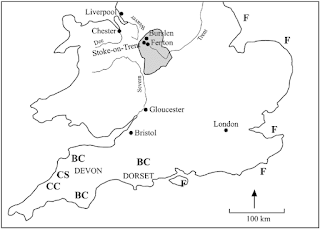
| The potteries and sources of ceramic raw materials. BC = Ball clay, CC = China clay, CS = Cornish stone, F = Flint (Maggetti et al 2015) |
| Bone China (Etsy) |
| The Grade II* Gladstone Museum (Jonathan C K Webb) |
With all this rich heritage putting Stoke and the surrounding region on the map of the development and expansion of British influence in cultural development - one might say, globally - it might be expected that the city would cherish that heritage and support efforts to better understand it and make it known. But this is bonkers Britain, where anti-intellectualist Philistinism places higher values on things other than this. Pots are not golden treasures found by metal detectorists ('Stoke turns its back on pottery heritage with curator redundancies' Arts Industry 7 January 2022).
"Stoke-on-Trent’s two main pottery museums are expected to close after the local authority made all their curatorial and most management staff redundant this week. Twenty-two posts are to go. Curators at the Gladstone Museum, with its famously recognisable brick bottle kilns, and the Potteries Museum have been told that all their posts are to be deleted as Stoke-on-Trent City Council seeks to cut £7.1m from its annual budget. Both were scheduled to re-open on January 18 after a Christmas closure lengthened by the Omicron Covid crisis. Savings anticipated at the museums, which are expected to close to the public, are believed to amount to £580,000 a year. It will mean Stoke, the birthplace and nursery for Britain’s once world-beating ceramics industry, will have no heritage scholarship in place [...] Employees are said to be stunned by the news they received this week, but have been told not to speak publicly about the redundancies".
You can almost hear the "'Oo needs skolarship?" from the city councillors, who allegedly have recently spent millions on the museum display of a "Spitfire, made in the USA that didn't take part in the war, in its new building opened last year and costing millions”.
Also it seems that if these staff reductions go ahead, some resolution will have to be found for the issue of curating the collections and archives they'd been working on. They cannot be allowed to be left without curatorial care. What does the City of Stoke intend to do about tis?
NOW. Gentle Reader, just google some of the terms given above. Go on, Google them and look for example at the images, and think about what you find. The search will most likely be dominated by two classes of in-your-face visual information. The first is that the vast majority of the material will be objects for sale online. This is a feature of almost any search for information on archaeology/ archaeological material. That alone should provoke disquiet. The second feature of note is that when you find illustrations of archaeological material of the types of pottery mentioned above, the vast majority of them come from the substantial number of US sites produced by archaeology departments talking of what can be learnt from the various types of artefacts found in the region. It is here you'll find pictures of sherds. Why is that? Why is the work of British archaeologists on such material less visible in this most public of places? If they are not getting their output into the public domain, is it any surprise that Philistines simply feel they can be dismissed. What are British archaeologists going to do about this?
Thursday, 6 January 2022
UCL Seminar series on 'Researching Illicit Antiquities'
Ethical Challenges in Researching (Il)licit Antiquities (Term II UCL Institute of Archaeology thematic series)
"The goal of this seminar series is to present the multifaceted, multidisciplinary nature of research investigating issues surrounding illicit antiquities – defining what illicit and licit antiquities mean, highlighting the ethical complexities of dealing with such objects archaeologically, including the legal, ethical, and political considerations involved. The series brings together scholars from a range of disciplinary backgrounds to discuss policies, data collection and publication, material analysis, and sociological modelling of trafficking networks, artefact status, and human agencies involved in dealing with looted material nationally, internationally and transnationally. Over a period of 10 weeks we will combine archaeology, museums studies, law, sociology, and heritage research to work towards a better understanding of the analysis, publication and display of global (il)licit antiquities and cultural objects"."Event Information: Open to all, cost: free.
Organisers: Alice Stevenson/Summer Austin/Kevin MacDonald
Mondays, from 4pm GMT, via Zoom
January 10: Sam Hardy (Research Fellow in Cultural Heritage and Conflicts, Norwegian Institute in Rome, University of Oslo) - Cultural property crime and human security: organised crime and conflict financingAll welcome! Any enquiries about the series may be directed to Alice Stevenson. Summer Austin should be contacted for Zoom links".
January 17: Katie Paul (Co-director and founder, ATHAR project) - Title tbc
January 24: Silvia Forni (Senior Curator of Global Africa in the ROM's Department of Art and Culture) - Title tbc
January 31: Sophie Hayes (Detective Constable, Metropolitan Police Antiques and Arts Unit) - The Art of Organized Crime
February 7: Jacques Schuhmacher (Rosalinde and Arthur Gilbert Provenance and Spoliation Curator, Victoria & Albert Museum) - Provenance Research, Due Diligence and Restitution’ or ‘The gold ewer: Provenance Research, Museum policies and Return
February 21: Gail Boyle (Senior Curator - Archaeology and World Cultures at Bristol Culture, Bristol Museums, Galleries and Archives) - Putting the archaeology back into antiquarian: the Dr Fawcett Collection of typology
February 28: Christos Tsirogiannis (Associate Professor, Aarhus Institute of Advanced Studies) - Academics’ responsibilities and the market in unprovenanced and illicit antiquities
March 7: Emiline Smith (Lecturer in Criminology, University of Glasgow) - Title tbc
March 14: Morag Kersel (Associate Professor, DePaul College of Liberal Arts and Social Sciences) - Licence to Sell. The Legal Trade of Antiquities in Israel
March 21: Speaker tbc
While it is always useful to have an open discussion of these issues and hear what researchers in the field have to say, the programme as presented invites a number of comments. First of all, this is the (my old) Institute of Archaeology - yet, from what one can see of the programme and the introductory blurb, this is a very object-centric approach. The subject of the looting/artefact hunting ["meta detecting" plus]/ collection driven exploitation of the archaeological record appears to be going to be treated marginally by the programme as a whole. Yet in archaeological terms, it is the central issue. This is a very British approach, born of the PAS, we even have here an 'Ixelles Six' idea that it does not matter how something left the ground, because "zero gain" can be turned around by "putting the archaeology back into antiquarian". Good luck with that, but what kind of "archaeology" is this?
The number of "title to be announced" presentations does not instil much confidence that this programme has been put together with much thought. Even the title of the series seems to express lack of clarity about what is to be discussed - what are "(il)licit antiquities"? Seems to me that the organisers cannot make their mind up what the subject is going to be.
If the series is called "Ethical Challenges in Researching [illicit, licit, licit-illcit, illicit-licit?] Antiquities", my questions where are these ethics in the titles of the presentations that we know about? It's very trendy to say "we are going to discuss the ethics here..." but where are they? I think this is indeed a question that needs discussion.
In dealing with "antiquities" [ie decontextualised/trashed archaeological evidence/artefacts] what ethical concerns are involved both as archaeologists and also citizens?
- What are the ethics concerned in dealing with dealers whose livelihoods are involved? If you reveal they sell what are clearly fakes or potentially freshly-looted material (or both) what are the ethics of alerting the wider community to that - with the financial consequences that may have for the seller if potential buyers take note?
- What are the ethics concerned in dealing with collectors, whose money and reputation are involved?- If a collector asks a researcher questions about the objects, what are the ethics involved with answering/refusing to answer them?
- Is it ethical to handle (let alone publish) artefacts in a private - or public - collection about which there is doubt about their licit origins? At what stage, if any, is it possible to ignore those doubts?
- Accessing information in "netnographic research" when it involves entering closed communities (social media groups, members-only forums), and eventually later quoting material seen there as evidence?
- What about engagement or lack of engagement as a voice in such situations? How to react to something archaeologically/socially damaging being discussed in such closed venues [which would reveal the researcher's presence]?
- Buying something from an online trader to get access to information (name, address, bank details that can then be passed on) not otherwise available?
- Being witness to potential or possible criminal activity and not reporting it to relevant law enforcement authorities? What about watching a dealer sell what the researcher recognises as the result of their specialist knowledge as fake after fake and failing to report them? This is a disservice to the members of the public lacking that specialist knowledge that are being defrauded through that professional negligence.
- It was in 2021, I received the rudest, most obstructive and dismissive reactions from the Portable Antiquities Scheme to perfectly civil and justified requests for information about items and situations described in the public domain for my research. I can understand that they're not very happy that I am not one of the thousands of PAS yes-men/women - but they are a public funded body and the archaeological resource is a common good, so what are the ethics involved here?
I am sure there are many more, some of which overlap into general professional ethics and responsibilities and some of which occur with varying intensities in different countries (despite the UCL calling itself a "global university", the situation concerning antiquities in the UK is in no way comparable to the situation in the majority of other countries, so perhaps this is not the place anyway to attempt to be a centre of such discussions).
UK Detectorists Stealing from Landowners: "Word it so They Think you are Looking for History Rather Than Anything of Value"
| Search and take |
Why do you think members' answers to this are hidden? ( MDF Post by Alaskerr "Negotiating Ownership of Finds with your Permission" (sic) Thu Jan 06, 2022 8:48 am);
I've just ordered my first detector and I've got a fair few garden plots to start with as well as access to a few Crown estate beaches. I'm happy to search out new permissions as I think a lot of the people in my area are intrigued by what could be found. I was wondering how you discuss ownership of Finds though.Note how the landowner (a person) is represented as an abstract "your permission". Mr Alaskar is completely wrong in saying "if it's Treasure then ownership is 50% finder and 50% landowner", it is the value that is conventionally split like that, and it is odd that this person thinks that the value of any other property on the landowner's land "should be" acknowledged in any other way. WHY should it be? Alaskerr seems to feel entitled to enrich his collection and himself with other people's property in return for merely sharing information on what he finds and takes away. The cheek of it. In any case, he is legally obliged to say what he has found and is taking away, as not to do so would constitute theft. Pure and simple. And of course this is a false argument: "word it so they think you are looking for history rather than anything of value (which is technically true)". All finds (and even a lot of the scrap metal) have of course a value. A random collection of worn George V pennies sold on eBay has a saleable value. And many metal detecting finds, even very common or broken ones, will find a buyer on eBay (maybe for example in the States where Roman brooches and Medieval buckles are not found in their fields). Although the forum has hidden the replies from you and landowners, guess what other members (92 views so far) have been telling Alaskarr... The majority of detectorists do precisely what he is proposing.
I've read if it's Treasure then ownership is usually described as 50% finder and 50% landowner, but what if it's not treasure? I'm guessing the majority of my early finds will be worthless rubbish, but in the event I find buttons and the odd coin, I don't want to have to pay the owner to keep them. I read a guide where they just ask random home owners if they can detect on their land and don't mention the fact that technically anything you find belongs to the home owners. They say to word it so they think you are looking for history rather than anything of value (which is technically true). But I don't want to get all excited over my first coin even if it is common and only worth something to me and then have the owners demand I hand it over.
I was thinking I could say anything that falls under the treasure act will follow the 50:50 rule, but anything outside of this I would get, but always share with them any information about what I find? Do any of you do something similar?
I'd also like to get something in writing if I can get a larger paddock size permission, but would you bother with this when checking out someone's garden? Thanks in advance!
The terms and conditions of the use of metal detectors on Crown Estate beaches [map here] requires all finds to be reported to the PAS - a feature not mentioned in Alaskarr's text here. Also he seems not to have noticed: "The Crown Estate reserves their right to ownership of all or any objects found, and the granting of this permission does not transfer any such rights to you. You may not claim ownership or rights to any objects found on the foreshore by virtue of this consent". The question is why he seems to think that other private landowners have lesser rights to objects he finds on their property.
And just a word to this numpty. If he thinks he's coming into my garden and going to be stomping around my lawns and borders digging holes everywhere... he's another think coming. Even if he were, I'd not be taking my eyes off him for a second, to stop him trampling all over my plants - but then I have no time for that, so the answer would still be no.
Tuesday, 4 January 2022
Archaeology and Artefact Collecting as 'Parachute Activities'
Raja, N.B., Dunne, E.M., Matiwane, A. et al. Colonial history and global economics distort our understanding of deep-time biodiversity. Nat Ecol Evol (2021). https://doi.org/10.1038/s41559-021-01608-8
| Twitter (graphics by Dr Emma Dunne) |
This probably to some degree applies to archaeology, though many communities may place more emphasis on the study of the human past (+identity) of their territory than what happened there in the Upper Jurassic.
One of the associated figures is particularly apposite to artefact collecting and archaeology also:
Monday, 3 January 2022
New York District Attorney: Not Going to be Just About Repatriation Any More?
Four days ago, Cyrus Vance left office as the 36th District Attorney of New York County, a position he'd held since 2010. He has now been succeeded by Alvin Bragg. It seems that not only will the antiquities unit continue under the new DA, but it will be being beefed up. They are already hiring another Antiquities Trafficking Analyst and they want that person to start right away. The 'Antiquities Trafficking Analyst' job advertisment is for a person with a bachelor's degree (in what is not specified) and Covid jabs. A 'background in cultural heritage is strongly preferred' and 'proficiency in a foreign language (particularly Italian, German or French) is preferred'. The latter suggests they are not so much concerned with "analysis" concerning antiquities from eastern Europe or the Arabic-speaking world. In fact what the job entails is:
"providing critical analytical support to the [antiquities trafficking] unit and DANY [...] gathering information via subpoenas, search warrants, and legal research to critically analyzing that information for use in criminal prosecution"...The next bit is interesting:
...criminal prosecution against trafficking participants such as looters/thieves, smugglers, financiers, shippers, gallery owners, restorers, on-line sites, conservators, auction houses, museum curators, and other facilitators, whether individuals or corporations, that allow trafficking to exist.And then we learn that:
Responsibilities include but are not limited to:Note instead of saying "foreign patrimony laws" they say "international" patrimony laws. The one exists, the second does not.
Utilizing all of the tools available to recover looted antiquities and prosecute the offenders.
Working with local, national, and international law-enforcement agencies, non-governmental organizations, academic institutions, and members of the diplomatic corps.
Gathering and analyzing information from all sources, to include subpoenas, search warrants, and witnesses.
Working with prosecutors to ensure efficient processing and eventual repatriation of confiscated materials.
Conducting legal research on New York Criminal Law and international patrimony laws.
[...]
At first sight "criminal prosecution against trafficking participants [...] that allow trafficking to exist" sounds really exciting. It suggests that now the Manhattan DA is going to go after: looters/thieves,
smugglers,
financiers,
shippers,
gallery owners,
on-line sites,
auction houses,
restorers,
conservators,
museum curators,
"and other facilitators",
all this, "whether individuals or corporations".
So, in other words precisely the whole group of people "that allow trafficking to exist" that until now they have in general NOT been going after. Foreign dealers who have allegedly handled material recently seized and repatriated are still at large (Edoardo Almagià, Ayman Ramadan), a New York dealer handling Asian material functioned quite openly from a central NY gallery right under their noses, but was only arrested when he went abroad and is now awaiting trial in India, not New York. The Manhattan DA did not get the foreign dealer living in Thailand that handled a lot of Cambodian antiquities. They did however manage to get a British conservator arrested and extradited to face allegations that he was involved with the handling of antiquities trafficked by both those dealers. It remains to be seen if a NY court in fact does have jurisdiction in the events alleged. The 2008 death during questioning of ceramics expert Roxanna Brown (not a New York DA case) is often swept under the carpet (and the case was dropped). Maybe the DA's office can tell us how many US "museum curators" they've detained for questioning.
Of course, what is important to remember here is that most of the time, the primary emphasis in the USA has been on "repatriation" of items already uproote, decontextualised and circulating in (or just about to enter) the US market. This in no way prevents looting, in no way fights smuggling, in no way prevents teh development and expansion of trafficking networks. It just papers over the cracks of a broken system and presents a facade of "caring about looting and antiquities theft". In reality it only cares about making things look good if somebody is caught. The Kapoor case here is very significant (see also the Sadigh case, and when action was taken).
The motivation of the activities of this department may therefore be questioned. A recent boastful NYT article about the "museum" of objects the DA was "caring for" was illustrated by a photo of various items in various states of preservation pulled out into the open air from the warehouse and stood in a courtyard for a photo op.
| Eight objects seized by the Manhattan district attorney’s office as part of its investigations into the looting of artifacts.Credit...Vincent Tullo for The New York Times |
* "As far as criminal charges, the fate of the dealers involved wasn’t mentioned in the DA’s statement".
The Rhetoric of Furness Metal Detectorists
I got called out yesterday for referring to artefact hunters with metal detectors "bobble hats". I'd like to show the responses given to some perfectly cogent and civil comments by one or more people to an article in a local paper about an artefact hunter that was going to be doing his searching on television with "celebrity" Henry Cole that it was claimed " "show[s] the hobby in a really positive light". Hopefully for them, it's perhaps more than these comments do:
Absolute Prosser User ID: 3787507 1st January 05:21 pmWhat does that last comment mean? It is neither jealousy, nor trolling, to draw attention to some of the concerns raised by collection-driven exploitation of the archaeological record.
Sounds very much like you are suffering from a bout of jealousy! Have you ever met any of the Detectorists? Or are you just happy to troll even on new years day! Word has it that even the samaritains (sic) would hang up on you mrs elitist!!
Absolute Prosser User ID: 3787507 2nd January 08:49 amIs that an invitation to discuss the concerns raised by collection-driven exploitation of the archaeological record over tea and doughnuts in a posh restaurant on the seafront? On it being pointed out that expressing a contrary position on artefact hunting in a public discussion is not "trolling" and from an archaeologist's point of view, the trashing of the archaeological record is not something to be particularly jealous of, the artefact hunter decides against talking face to face:
Well david, instead of hiding behind a keyboard like most trolls do, lets have a face to face meeting? That way you can rid yourself of any hatred you may have towards detectorists, I am a detectorist myself, I know some of the cast members too and I can vouch for them, try getting a decent job instead of "Scratting around" sandhills and waste-ridden ploughed fields looking for "Lost Furness" I cannot abide jealous haters, and you are one...
Absolute Prosser User ID: 3787507 2nd January 05:54 pmNo tea and doughnuts then? Odd way to go about things.
I actually thought you were a decent chap, and speak to you a lot in town, when you are on your bike, I wont anymore and will tell others about your triggered thoughts on detectorists, well done! you ruined it for yourself!