Showing posts sorted by relevance for query Abu Sayyaf. Sort by date Show all posts

Thursday, 15 December 2016

What is going on here?


Good grief: "" (Department of Justice U.S. Attorney’s Office District of Columbia press release).
The U. S. Department of Justice announced today that the United States has filed a civil complaint seeking the forfeiture of multiple antiquities associated with the Islamic State of Iraq and the Levant (ISIL), also known as Da’esh. [...] The action, which was filed in the U.S. District Court for the District of Columbia, specifically seeks the forfeiture of four archaeological items that were depicted in photographs found during a raid of a residence of Abu Sayyaf, a senior leader within ISIL, near Deir Ezzor, Syria, in May 2015. The items include a gold ring, two gold coins, and a carved stone. They date to ancient times and are believed to be worth hundreds of thousands of dollars. The FBI is pursuing recovery of these items.
This is pretty entertaining. Readers of this blog will know that I am highly sceptical about the authenticity of those Abu Sayyaf materials which we saw earlier. This material 'conveniently' fills in some of the gaps pointed out at the time. That rather raises the question why this set of material is being released just now. In addition, we should remember that the whole corpus of Abu Sayyaf material was obtained illegally (by a US team raiding deep within a foreign country from a base in Iraq, killing and abducting residents and taking antiquities and documents away without any authorisation or notification and giving them to Iraq to 'look after'). I do not see how a legal case can be based on material obtained by illegal means and taken from Syrian territory illicitly.

Specifically, the complaint alleges that the following four items are subject to forfeiture by US authorities (it is not explained on what legal basis this becomes a US prerogative). Digital images of these four objects were 'seized from Abu Sayyaf' (well, they walked into his house, blew a hole in his head and snatched his computer and wife) which the US DoJ says is evidence that these objects were 'sold directly by him' (why? Many of us writing about this topic have photos like this in their computer too which come - via journalists in my case - from dealers in the region):

Gold ring with carved gemstone
1) Gold ring with carved gemstone
This ring is believed to be from the Hellenistic/Roman period, dating approximately from 330 BC to 400 AD, and to have come from Deir Ezzor, Syria, which is near where the raid against Abu Sayyaf occurred.
Gold coin featuring Emperor Hadrian Augustus Caesar
2) Gold coin featuring Antoninus Pius
This coin is believed to be Roman, dating to approximately 138-161 A.D., and is sourced to any large, urban Hellenistic or Roman city in Syria, including Apamea, Palmyra, Dura Europos, or Bosra.
Gold coin featuring Antoninus Pius
3) Gold coin featuring Emperor Hadrian Augustus Caesar
This coin is believed to be Roman, dating to approximately 125-128 AD, was probably minted in Rome, and is sourced to any large, urban Hellenistic or Roman city in Syria, including Apamea, Palmyra, Dura Europos, or Bosra.
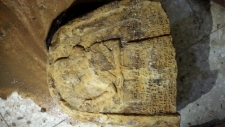
Carved Neo-Assyrian Stone
4) Carved Neo-Assyrian Stone
This is believed to be the upper portion of a round‐topped stone stela (upright stone slab bearing a relief design) carved with an image of a provincial official, most likely a eunuch, facing left, with his right forearm and hand raised. This item is believed to be from the archaeological site of Tell Ajaja in the Khabur region of northern Syria.
Well, Apamea, Bosra cannot have been looted by ISIL as they are outside that group's territory. Palmyra was in ISIL territory for a while, but in that time, satellite photos show no sign of any exctensive looting. As I have shown here, Dura Europos may not have been primarily looted by ISIL. The DOJ is just making this stuff up, if they cannot say where an object came from, they cannot say who looted it. How would Abu Sayyaf have photos of objects from Apamea and Bosra in his computer?

Anyway, the Feds need to get their story straight. According to the DoS, Abu Sayyaf was collecting taxes from middlemen (they showed what they said were documents of this activity). Now DoJ is implying he was involved in the sales himself. So where are the tax receipts from that? The four objects above are from towards the 'higher' end of the market, while the objects (the DoS say were) found in his office in the raid are mostly low end junk. This fishy in the extreme.

UPDATE 16th Dec 2016
Chasing Aphrodite has a blog post on this which supplies added detail from the court documents which were not released at the time I wrote ('Inside the ISIS Looting Operation: U.S. Lawsuit Reveals Terror Group’s Brutal Bureaucracy of Plunder', posted on December 15, 2016). To be honest I am even less convinced.

Among the 'corroborative evidence intended to impart an air of artistic verisimilitude to an otherwise bald and unconvincing narrative'  is another [undated] suggested scheme of how the antiquities service (sic - should be Divan al-Rikaz)) would work. Or rather, not work. Also why is Abu Sayyaf involved in discussing how an antiquities service would operate in Al-Raqqa province, rather than his own? If this is an attempt at creating a 'national' institution, where are the regional offices and regional officers? What is this document, what is its context - and what is its relevance? Since it shows a totally unworkable structure is this something created by people trying to make an existing organization more efficient (Abu Sayyaf was not the first appointee to the post)  or a fake document concocted by people who need some official looking documents to support an existing and faltering narrative? It says that what we see is an original with transcriptions added. Does this really look like an original Islamic State document? Why is it undated and unsigned? Whose 'suggestion' is it?

But looky-here...  over to one side. "workshop supervisors, specialised in their fields". What kind of workshops one wonders. Conservation/restoration workshops maybe? But then further down we see them producing a revenue, not consuming it. I think what this is suggesting is workshops for recovery of bullion from unsaleable scrap metal artefacts. This is interesting in light of past criticism of the snatch squad who came back from killing Abu Sayyaf with a lumpy pot which they thought ancient (because primitive in shape) but which was in fact a modern furnace crucible. But this was a year and half before these documents were read. Is this little box on an undated document purporting to be an original ISIL document some two years old not, in fact, an attempt to answer the critics?

There is an interesting item in attachment E2, the Divan is 'authorised to search for the people who sold relics before the State entered their territories and to collect the 20%'- in other words, the established dealers of the existing black market were taken over by ISIL. Anyone using the same networks as before the ISIL takeover is financing the organization.

Then we come across a 'human interest' story:
Thursday’s filing includes new records from the Abu Sayyaf raid that have not previously been released. Among other things, they include a harrowing account from looters who were extorted by ISIS – Abu Sayyaf ordered their child kidnapped when they refused to pay an low-ball price for a cache of gold and relics they had discovered.
That's quite interesting in light of the fact that the whole reason the US raiding party went after Abu Sayyaf was his involvement in the kidnapping of a US citizen, so why was this story withheld back in May 2015? This story has a background, as Chasing Aphrodite notes:

ISIS’ taxation system for looted antiquities has an obvious flaw: the value of the finds are difficult to know before they are sold on the international market.
Which is why a number of people, myself included, doubted this whole story. So 'conveniently' up pops this yarn (also incidentally explaining the appearance of the gold coins in the assemblage of finds seized and sought).  The document is dated 5th April 2015. The seven women from al-Duwayr were 'looking for relics in Al-Salihiyyah archaeological site' (contra Chasing Aphrodite's identification of the name as a place near Damascus, this refers to Dura Europos (Qal'at es-Salihiye))   'two years' previously. That would be April 2013, precisely when ISIL was being formed in the region. So, if that is true, this digging at Dura Europos would have been before ISIL came into existence. It is interesting to note that, according to this document, when they were trying to negotiate a sale (two years ago) dealers from (then rebel-held) Idlib came all the way to their village to talk it over.

I think this suit has been rushed through to make sure that the incoming Trump administration can be persuaded to see the importance of continuing funding on border controls of antiquities. Mr Trump seems very keen on border security.

Saturday, 18 July 2015

From Erbil to Baghdad: That Abu Sayyaf Nefertiti


While on the question of fakes, that Nefertiti deserves more comment. We do not know what it is made of, hand carved stone |(soft limestone, alabaster) of cast material (resin or plaster) are all possible. I am going to guess that it is 'hand carved in Egypt' and of alabaster.  It is atrocious condition, unlike the other stuff in the Abu Sayyaf stash. I think it never was part of the stash, but added to it by a know-nothing US squaddie searching for anything that looked old in the house. How it got in the house is unknown, but it looks to me as if a tourist piece brought to eastern Syria from Egypt was dropped somewhere wet (alabaster is soluble in water) and lay there for some time before somebody stumbled across it and took it to Abu Sayyaf, maybe he thought it was a real antiquity, maybe as a joke. Maybe Abu Sayyaf kept it as a joke. Who knows? We have absolutely zero proof that Abu Sayyaf or anyone else was trying to sell it as "an antiquity dug up in Syria/Iraq" . 

The same goes for that crucible. A squaddie from Long Island in a hurry in a night time raid could have thought the primitive shape of a pot he found on a shelf or in a cupboard meant it might be old. Abu Sayyaf may have got it from one of the factories as a sample of the sort of thing they needed more of and he was going to procure as connected with the group's finances (the factory could for example have been processing seized jewellery and other items as bullion). We have absolutely zero proof that Abu Sayyaf or anyone else was trying to sell it as "an antiquity dug up in Syria/Iraq" . 

I suggested the plaques might be fakes, and Sam Hardy suggests the bracelets might be. Who knows? At least they look more like antiquities.

It is only a couple of days later that the significance of something I saw on the original German video of the objects arriving and being unpacked became clear. I was puzzled by the fact that the groups of artefacts were bagged with labels that were very vague and non-descriptive and mainly concentrated on the number of the photo on which they appear. Then it dawned on me. These objects were not being repatriated "from America" by the authorities in Washington. They had arrived in the National Museum of Iraq from a US base on Iraqi soil. This was the base (near Erbil) from which the raid had been launched, where Abu Sayyaf's widow was taken, and where presumably the material seized from the house went. The material was not being "repatriated" at all, but sent from one part of Iraq to another. 

What I think has happened is that a team of US (and Iraqi?) intelligence officers has been sitting down and working through the material brought back from the  Al-Amr raid, sorting through it. This would involve preliminary cataloguing and recording (photography  and archiving of the evidence). This is what we see recorded on the labels of the bags of antiquities. The Intelligence team were separating out the categories of material. They ended up with a boxload of "things", rather than the documents they need for their main task. They had a boxload of "things" they themselves were not competent to deal with (none of them were archaeologists - nor did they need to be). They therefore passed it on to the experts. It seems they felt that the expertise that would be able to sort out what is what is found in the National Museum of Iraq in Baghdad, which is where they sent this batch of material, flying it over (or round) ISIL territory.  Apparently it will be the Iraqi museum staff who will inform the army what the material could mean, and determine what should happen to it.

This would explain several of the anomalies of this group.


Wednesday, 22 July 2015

Abu Sayyaf a Metal Detectorist?


Opinions for sale
Context is everything. We have a loose collection of objects seized in a hurried night-time raid that had gone wrong, which made its way first to a US base in Iraq where it was only crudely sorted to be deposited in an Iraqi museum. Let us note that no documentation of the context of discovery of this stash has been made available, no photos of it, for example in situ. Neither do we have any information whether the May 15th snatch squad took a sample of the more portable material which they found in Abu Sayyaf's compound or the whole of it. This (context) is of vital importance in interpreting the significance of the decontextualised objects.

In particular there is a lack of clarity about the nature of this stash. As I have said in this blog, I am of the opinion that this was part of a private stash of artefacts which Abu Sayyaf had created for his own personal future use, taking objects from stockpiles which exist elsewhere (and probably mainly in Iraq still). We cannot know whether he did this in his official capacity (in his reported function in the structures of ISIL funding), or whether this was an unofficial action which would have brought him into conflict with other ISIL officers. The latter is important in assessing whether he had other stuff hidden more carefully around his compound, out of sight of the US snatch squad.

Indeed, did the snatch squad take all they found? For example if they'd found a 200 kg head of a lamassu of Ashurnasirpal II in the garage behind Abu Sayyaf's jeep, would they have got it onto their escape helicopter in time?

This does not bother the apologists for the US collectors-slow-of-brain, who are working overtime trying to discredit the information value of the Abu Sayyaf stash. They are typically not interested in doing any of the footwork of attempting to analyse the available information for themselves, their writing is typically narrow and derivative, aimed only at discrediting anything that might relate to the activities of US dealers and collectors. Thus Peter Tompa writes of "Syrian Treasure Houses: Hype vs. Reality" (July 21, 2015). He seems not really to have done much thinking about the artefact stash and its context(s) itself, so for example reads more into the carefully phrased Department of State phrase than is warranted. What is actually said is that officials believe that it represents "the stockpiling of these spoils for likely sale on the international market".

Tompa interprets that to mean that Abu Sayyaf was allowing the use of his house as the storeroom of looted artefacts from Iraq and Syria going back to 2003 (or that he's moved to such a storeroom when his house in Raqqa was bombed maybe). I do not think there is anything in the information we have available that would support such an interpretation. In the same way as Abu Sayyaf is supposed to have been in the ISIL oil business, yet the snatch squad came back with not a cupful of oil. Tompa asks us to consider that ISIL only sells what Abu Sayyaf had in his own home before it was invaded by the US army (home, Mr Tompa), so where is the oil? What is Mr Tompa thinking?

His purpose is plain, by making us believe that somebody else had said Abu Sayyaf was living in an established looted antiquity cold store, he can then claim that the stash is evidence that such cold stores do not and cannot exist: "the actual quantity, quality and value of what was found falls so far short of what we were led to expect". The logic of that is totally lacking. "Led to expect" in what circumstances? Mr Tompa says the stash disappoints him:
instead of the contents of a "Swiss freeport" we appear to have the equivalent of the small stock of a none too prosperous Middle Eastern antiquities dealer.
Well, he is dead now, killed by US home invaders and his wife kidnapped and some of his possessions stolen, so how well he personally did or could have done from selling antiquities is rather immaterial. The antiquities in the stash came from somewhere, Mr Tompa would perhaps like to propose that Abu Sayyaf himself dug them up, wrote the museum accession numbers on them for himself for fun and was then dealing with them, not too "prosperously"? I do not know, perhaps he'd like to tell us his view - based on the factual evidence - what he thinks the interpretation of this find should be.

Now, the financial value of these items seems to figure highly in Tompa's reasoning. But we note that he's not done the footwork, just builds on what Sam Hardy did a few days back. 
Hardy makes much of the number of coins (236 by his count) in the group, but is that number really that surprising?  Other than pottery shards, coins are the most common artifacts to come down to us from antiquity.  So, the fact there are more coins than anything else in the group should not be deemed significant.

Of course the problem is Tompa is paid to represent the interests of coin dealers. Now, it simply is not true that "coins are the most common artefacts to come down to us from antiquity". Even in such a rich city as Washington DC, it may be observed that the main component of street litter apart from McDonalds wrappers is not one-cent coins strewn liberally among the bushes and plants at the side of the road. People generally - not even rich Republicans - do not throw money away (and if they do, "the 99%" don't leave dropped coins just lying there for them to get into the archaeological record). I really would like to know, since he is so fond of telling us all what archaeological sites "look like", if Peter Tompa has ever been on an archaeological excavation and seen at first hand what artefact types are the more common on ancient sites. As somebody who has worked on many sites (including a stint as a finds assistant on two urban sites and one other), it certainly is not coins. The paid lobbyist is apparently being paid to spread false information.

The real reason why the prevalence of coins in this stash is not "surprising" is that there is a huge market out there full of people who will buy no-questions-asked and it would seem a lot of dealers only too happy to supply them, once they've unburdened them of any proof of where they come from.

Tompa says there were  236 Umayyad dirhems, the DoS gallery shows 103. Tompa suggests "Common Islamic silver sells in the $30-$75 range", yet a few minutes on eBay shows that this is a manipulation, the Buy now prices of comparable coins cluster between 100 and 200 dollars each (whilst some can be bought for the lower range Tompa quotes). I suggest Mr Tompa updates his numismatic knowledge. There were, according to the DoS gallery, at least 44 dinars. Tompa says "common Islamic gold coins typically retail here in the US for $300-$600 depending on condition". But then ones which are not common sell for much more. Mr Tompa assumes that all the coins gathered by Abu Sayyaf are "common" ones; it helps deflect the criticism, but how do we know this is the truth? Anyway, just to take a median value 100x150 dollars is 15000 dollars, plus 44x450= 19800. That'd be something like some 34000 dollars worth of coins there. Then there are cylinder seals, beads stone rings, 36 bracelets, etc etc. Note that Mr Tompa does not take the whole assemblage over to the Tim Haines' Ancient Artifact discussion list and ask the dealers there for a breakdown of the current market value of all the little bits sold individually. I'd do it myself, except like most dealers, Mr Haines is more than a little thin-skinned about who uses his discussion list for information-gathering about the true face of the antiquities trade.

Anyway, that is beside the point, if this is a private stash, it has no bearing on the "amount of rocket launchers" (because at least some of the guns came from the US) ISIL can buy by selling antiquities.


Wednesday, 15 July 2015

Abu Sayyaf's Wife Held by Americans in Iraq


A bit of background to the antiquities stash story. Although US forces in a night-time raid in Syria managed to blow his head off, little is actually known about Abu Sayyaf and why he was targeted by this extraordinary May 15th/16th raid. U.S. officials have said that he was Tunisian and his real name had been Fathi ben Awn ben Jildi Murad al-Tunisi. He "was suspected of overseeing the Islamic State’s illicit oil and gas operations" and he was found to have had a stash of 500 antiquities and a crucible at home (not a capital offence anywhere outside China I think).

The US raiders also captured his wife, whose name is given only as 'Umm Sayyaf', a title rather than a name. She was taken over the border (how?) and detained in a U.S. base near the Iraqi Kurdish city of Irbil. A team known as the High Value Detainee Interrogation Group, which includes officials from the FBI, CIA and Pentagon, was sent to Iraq to question the detainee. Now the US are preparing charges against her for alleged participation in holding hostage Kayla Mueller abducted near Aleppo, Syria in August 2013. In later media accounts she was reported to have been "the personal captive of a senior Islamic State figure named Abu Sayyaf" ("The 26-year-old Arizona native was often seen in the company of an ISIS commander who was being tracked actively by US intelligence" Daily Mail). After she was abducted, her case was kept from public view in hopes that she would be released. She was killed in February this year. This was reportedly by a bombing campaign (perhaps targeting Abu Sayyaf?) in Raqqa where she was held though this has been disputed by the US.

See now: Adam Goldman 'U.S. preparing charges against woman accused of holding American in Syria' Washington Post July 15 2015.


And here from a May 19th newspaper report (Associated Press, 'Dead ISIS leader may have held slain American hostage Kayla Mueller' New York Post May 19, 2015, based on an earlier account by Karen DeYoung and Missy Ryan, 'Senior ISIS leader killed in U.S. raid in Syria', WaP May 16) is an account of the raid:
A US official also provided more details on the Friday night raid. The commandos who flew by Black Hawk and V-22 Osprey aircraft into Syria under cover of darkness quickly met resistance on the ground. They blew a hole in the building where Murad was believed to be staying and as they ran into the building and up the stairs, they encountered more insurgents. The official said that at that point, the US forces waged close-quarters combat, including some hand-to-hand fighting. The goal of the mission, which had undergone months of planning, was to take Murad and his wife alive, in the hopes that he would provide intelligence on the group’s operations, finances and information on whom they do business with and potentially on their leader, Abu Bakr al-Baghdadi. Another part of the plan was to free an 18-year-old girl who is a Yazidi and was believed to be kept as a slave by the Islamic State leader and his wife. The girl was found and freed by the commandos and is expected to be returned to her family after she is debriefed by the US. A team from US intelligence agencies is poring over the laptops, cellphones, computer drives and other data recovered at the site.
Another account suggests that "The Delta Force team of 24 men killed 12 IS fighters". In Washington, a Defense official described Abu Sayyaf as “fairly high up” in the Islamic State hierarchy "but not among the four most senior militants tracked by the United States".

The Washington Post gives the location of Abu Sayyaf's 'compound'  as Al-Amr. Google Earth has no such place but a place name for Al-Bo-Amr at 35°13'31.21"N  40°15'28.09"E. There is nothing on that spot which would house an ISIL boss, his wife and slave girl and have 12 guards. There are however a number of walled compounds 1.5km to the northeast nearer the main road which might fit the bill as the sort of remote place you'd move to if your house in Raqqa had been targeted by a bombing raid a few months ago.

UPDATE 15th January 2018;
Abu Sayyaf's wife was later named as Nisreen Assad Ibrahim Bahar 

Map, from Washington Post

Friday, 11 September 2015

More Background on Abu-Sayyaf Raid


Information is dribbling out (in what could be a controlled manner) about the background Abu Sayyaf raid. The latest is an interview by Atica Shubert (in Berlin?) with a Yazidi slave girl held by Abu Bakr al-Baghdadi and also Abu Sayyaf - but interestingly not the one rescued as a result of the May raid. This one, "Zeinat" talks on camera of her time in the Baghdadi household and escape. The timeline is not too clear, she seems to have been captured by ISIS in the early days of August 2014 (at the foot of Mt Sinjar), and estimates that she was in captivity  for about "two and a half months", which would place her escape in mid to late October 2014. During her time in captivity still in the 'summer' she met Kayla Mueller in a detention cell after she (Zeinat) had tried to escape from Baghdadi's house. It seems quite probable that Zeinat was an informant used in planning the May 2015 raid on Abu-Sayyaf, though she admits that she did not know the identity of Baghdadi himself until after she had escaped.  At the time Zeinat was in Abu Sayyaf's keeping after detention, Mueller (who was killed at the beginning of February 2015) was not in Abu Sayyaf's household.

Atika Shubert and Bharati Naik, with Bryony Jones, 'Convert or die: ISIS chief's former slave says he beat her, raped U.S. hostage', CNN September 11, 2015.

Saturday, 5 December 2015

Ludicrous Lies and False Premises in New York 'The Real Value of the ISIS Antiquities Trade'?


Part of Abu Sayyef's private stash
(Thaier Al-Sudani / Reuters/Landov)
There is some excitement in certain circles about an article by Ben Taub (a very recent graduate of Columbia’s Journalism School), 'The Real Value of the ISIS Antiquities Trade' New Yorker December 4, 2015. It is however a rather pedestrian and derivative piece and clearly confuses what the Abu Sayyaf haul was (his private stash, not the entire stocks of the ISIL “Diwan al-Rikaz”). The value of the items in that assemblage therefore quite obviously have no real bearing on the matter of the "real value of the ISIS Antiquities Trade". There is however some additional information about the Abu Sayyaf receipts:
At the Metropolitan, the State Department displayed only three out of the eight unique receipts found in Abu Sayyaf’s possession. It seemed odd that these three accounted for a mere twenty-four thousand dollars in taxes, less than a tenth of what Keller had declared as the cumulative tally. When a State Department press officer sent me partially redacted copies of the remaining receipts, I noticed that two of them accounted for eighty percent of all antiquities sales, and that the figures—a hundred and sixty-one thousand dollars and forty thousand dollars—had been recorded in dollars, while other accounting had been done in Syrian pounds. Did these two sales represent a vast haul of low-quality objects, or a few of extraordinary value? Did the eight handwritten receipts account for all antiquities sales over a six-month period, or was Abu Sayyaf a lousy accountant? After the State Department gave me the Arabic copies of Abu Sayyaf’s antiquities documents, I showed them to Bernard Haykel [...] [who] examined a section of Arabic text that hadn’t been translated for Keller’s slideshow at the Met. The document describes various roles within the antiquities division. It says, unambiguously, that the excavation teams should extract not only antiquities but also metals and minerals. Tamimi, the analyst who collects ISIS administrative documents, recently published new evidence that the group is desperately seeking and confiscating valuable metals and minerals. It is especially hungry for gold. In August, ISIS announced its financial system would return to the gold dinar of centuries’ past.
Taub was at the meeting at the Met at the end of September this year where the problem of "stemming the illicit antiquities trade" was discussed to “disrupt the group’s [ISIL's] ability to finance its operations and activities”.
Shortly afterward, an ancient-art dealer named Randall Hixenbaugh took to the microphone to express his bewilderment at the government line. “It seems odd to me that we’re this concerned about this as a money stream,” he said. “Of course it’s a major concern for cultural heritage, but it seems to be probably among the smallest revenue streams that this criminal organization has.” There was a pause. A moderator from the State Department replied, “We’re aiming to cut off all their revenue streams, however small it may be, to try to stop their activity.” With no apparent plan to quell the looting in Syria and Iraq, the government’s approach seems to be to scare or prosecute unscrupulous buyers. But Hixenbaugh argued that an “insatiable demand in the West” for looted Near Eastern antiquities does not actually exist. “There are hundreds of thousands of legally acquired antiquities from Mesopotamia in the United States,” he said. “Palmyra reliefs are generally unpopular. They often go unsold at auction.” A reporter who writes about the art market was unimpressed with Abu Sayyaf’s hoard. He leaned over and whispered to me, “The idea that there’s a shadowy mass of collectors interested in purchasing crap that they can never sell again is absolutely ludicrous. Nobody wants esoteric, untraceable numismatics.”
Ha, ha. Oh yes they do, the whole ACCG for a start. They do not care to 'trace' - still less document - anything, quite happily trading stuff which has "somehow lost" its paperwork. Once again we see the dealers attempting to deny the undeniable. Bare faced lies. That is what is ludicrous, utterly ludicrous about the US antiquities trade and its supporters. If the coins are untraceable to looting (because someone has got rid of any paper trail) the coins are eminently saleable on today's no-questions-asking market. I suggest Taub's unnamed journalist informant is not really all that well informed himself.

I guess Mr Hixenbaugh was art the wrong meeting, you'd hardly hold a gathering of people to discuss moves to disrupt ISIL's fossil fuel sales or tax policies in the Metropolitan Museum of Art.

Quite what the New York journalist means by the US government having "no apparent plan to quell the looting in Syria and Iraq", is unclear and muddling concepts. The US government runs the US, not Iraq (we see what a balls-up they made of that after 2003) nor Syria. What Iraqis and Syrians do in Iraq and Syria is not for the US to restrict or control any more than it is the Japanese or Russian right to stop Dick Stout or any other US citizen from artefact hunting an old 1880s schoolyard. What neo-imperialist ambitions hide behind Taub's words? What however is the remit, the role, of the US Government is indeed to prosecute unscrupulous buyers - how many have they actually charged to date? (actually in the case of post 2011 Syrian artefacts from ISIL, the answer is a big fat American hypocritical zero).

Mr Hixenbaugh, where'd you say those incantation bowls are from? "No demand" eh? But you've already sold three of the four.

This text is an egregious example of the sort of foggy and superficial thinking that seems to  accrue to the issue of looted items from the MENA region in the USA and concentrated mainly in the triangle New York-Boston-Washington (the aptly-named Foggy Bottom) which infests the rest of the debate. Will we see some straight talking and straight thinking from the USA on this issue, or not? What a pathetic muddle.


Thursday, 16 July 2015

The Whole Point of No-questions-asked and "Ooops-somebody's-lost-the-paperwork' Antiquities Trading.


The numbers given in various accounts of the Abu Sayyaf antiquities stash vary wildly, the first account said 'seventy' artefacts were repatriated (the reference was to packets of artefacts) then 400, 500 and the US Department of State said 750, but the page that the tweet links to says "700". What a mess. Sam Hardy attempted to count them for himself ('Reassessing the balance of antiquities and forgeries in Abu Sayyaf’s stash'). He justifies this:
I fear that unguided journalists’ professional effort to capture the variety of objects may have incidentally foregrounded the fakes, of which there is a far greater variety than there is of coins and beads. And archaeologists and criminologists (myself included), then, focused on the outliers instead of the the overwhelming majority of objects. It appears that most of Abu Sayyaf’s illicit antiquities were ancient coins.
He counted "at least 236 coins" in the video frames, and concludes that "the early Islamic coins alone must have constituted the majority of the antiquities in Abu Sayyaf’s stash".
But these counts show that most of Abu Sayyaf’s stash consisted of genuine, highly-portable antiquities (which could have been transported both by the Islamic State and by U.S. commandos in one small container). Once these coins had been uploaded to eBay or or VCoins or Facebook, or laid out in a dealership in Istanbul or London or New York, how would dealers and collectors have distinguished them from so many others?
And that is the whole point of no-questions-asked and "Ooops-somebody's-lost-the-paperwork' antiquities trading. Got it in one.

Thursday, 1 October 2015

ISIL Antiquities Trade "Smoking Gun"?


I have hinted earlier that I am less than convinced of the authenticity of the documents which the US authorities assert were among those seized in their illegal raid on Abu Sayyaf's house and "prove'' the approved story that ISIL are making lots of money from sale of looted antiquities. Only a selection of documents have been presented to the public, and the same photos are depicted in several places, a convenient place to look at them all with a commentary and the background for those not following the story is Christopher Jones' Gates of Nineveh blog.

Here, I want to concentrate on the 'smoking gun' receipts which aroused my suspicions. We are shown three of them, consecutively numbered 101-103, dated 6th, 11th and 15th December 2014 - six months before Abu Sayyef's killing. All three were issued personally by Abu Sayyaf al-'Iraqi as 'Head of Antiquities Diwan of natural Resources', a  position to which other documents in the collection say he was appointed before (recte Jones who says 'on') November 21, 2014. [There is an excavation permit in the collection issued by him dated 16th October 2014]. He was given the job due to being “very knowledgeable in this field” and because “people in the Levant who work in the field of antiquities are weak of faith and Abu Sayyaf has experience in dealing with them”. He certainly was not "knowledgeable" enough to spot the fakes in (what I persist in seeing as) his own private cache of antiquities also seized by the Americans from his house.

Note that there is no hint in earlier reports that, even though they knew enough about the guy to know where to find him and plan (no doubt meticulously) a mission to capture him, that they thought/knew he was involved in antiquities. The story was then that he was involved in illicit oil and was wanted in connection with a US hostage issue. The finding of antiquities in Abu Sayyef''s compound seems to have come as a surprise, the people collecting the 'evidence' on the ground do not seem to have been prepared for this beforehand, and thus collected up all sorts of extraneous material (such as that crucible and the Nefertiti).

The first question I have is where these documents are now. Are they in Iraq together with the antiquities seized in the illegal US raid in Syria?  Were the translations supplied by the Iraqis and if so were they verified against the originals by US scholars? Or are the documents themselves in the US? On what legal basis?

How many documents like this were found? Where were they in relation to the antiquities, fake antiquities and the crucible seized? In what way were they ordered /stored in Abu Sayyaf's house? As with a archaeological finds, documenting context of discovery is important in interpreting this evidence - indeed establishing that it really was in the place where it is said to have come from. Why were the several specific documents presented selected for showing and what has not been shown yet?

Why have all the names been redacted out? When the US authorities are announcing a five million dollar reward for information which will allow them to disrupt the illegal antiquities market, why do they hide the evidence of who they say is involved in it? To whom was the letter reminding of Abu Sayyaf's appointment sent? Are the three consecutive receipts we are shown issued to the same "brother" or three different ones? The latter in particular is important evidence of the scope and scale of the circulation of antiquities.

What the receipts are for is "1/5th of the value of the antiquities sold in Al Khayr governorate". The Al Khayr governorate (wilayah) is more or less the renamed Deir ez-Zor governorate (33,060 km2).  The city itself remains in Syrian government hands (these documents were issued at the time of the Deir ez-Zor offensive) and a few months after the massacre of members of the Shaitat tribe in the region. The "receipts" were allegedly found in Abu Sayyef's house, which was in Al Amr  just to the SE of Deir Ez-Zor in this wilayah. 

But is the wording not rather strange? Imagine a tax receipt to me:
I the undersigned head of taxation of the Republic of Poland received from Paul Barford the sum of xxx PLN [being] 18% of earnings in the Institute of Archaeology [signed by recipient and submitter]
What's missing? Quite clearly is missing the information linking that document with any means of calculating how much I earned (for example a tax return) and for what period this tax is paid. 

This text looks almost as if written to order to prove an assertion that ISIL is selling antiquities to get the taxes and not as a working document intended to protect the 'brother' dealing in antiquities that he's not paid the state its dues on them all (here continuity of receipts stretching over a stated period of time is needed).

Why would the receipt be telling me that income tax in Poland (for my pay bracket) is 18%? I know that and do not need that information on a receipt confirming I've paid that sum to the Treasury.

But this weird phrasing of an alleged administrative document has the appearance of being specifically written to confirm the story (originating from just one US hearsay source)  of the khums tax which ISIL are alleged to be taking on all antiquity sales.

Why also would I be paying taxes directly to the national head of taxation, rather than in my local tax office? This is especially odd in that the documents presented by the US authorities indicate that under the head of antiquities are two regional offices, for eastern and western governorates. Why are these not the offices to which the three tax-paying 'brothers' would go? 

The next question concerns the phrase "the value of the antiquities sold in Al-Khayr province". Which 'brothers' are selling antiquities for hundreds of thousands of dollars in the middle of ISIL land and to whom? Were the antiquities sold in Al Khayr governorate to other local dealers/middlemen, or are we talking here about sales to foreign dealers/middlemen coming into ISIL-land to do business? Who established the value of those sales (and where is this documented) and on what basis?

One possibility cannot be checked until we know the names blacked-out. Are the three recipients of the receipt over ten days, not individual dealers, but the same man?  If so, that would suggest that the person passing the money to Abu Sayyef was the head of the provincial antiquities office who'd collected the payments locally from individual operators and passed them higher up the hierarchy. If that was the case, note the turnover every three or four days. But we cannot check that until an unredacted version of the 'evidence' is released.

In the meanwhile, let's look at the values (1 Syrian Pound today reportedly equals 0.0053 US Dollar/ 1 USD = 188.7818 SYP):
101: 6th Dec 2014: one fifth of the total sum sold is 2,960,000 SYP (= $15679)
102: 11th Dec 2014: one fifth of total sales is  2,152,000 (= $ 11399)
103: 15th Dec 2014: one fifth of total sales is 191,560 SYP (= $ 1015)
So in a space of ten days, ISIL raised the equivalent of 28,093 USD in tax from the sale of antiquities in one governorate, and that is one fifth of the total value of sales. The value of the sales therefore declared in just those ten days by whoever it is declaring them totalled something like 140,465 USD. Here it is a problem that we do not know how long a period these tax dues are supposed to have accumulated. (I do not see how Christopher Jones comes to the conclusion on the basis of these three receipts "Totaling all the receipts indicates ISIS has made at least $1.25 million from antiquities smuggling").

"We have proof"
But are these documents not "too convenient" to accept without question? Where are the originals, what proof is there that they are authentic material and not some mystification?  There are problems with the documents as presented, their form is strange as administrative documents, but fits perfectly the bill as something that can be used as "proof" of something US authorities have been claiming for a long time but unable to come up with evidence of.  Remember WMD in 2003, they "had documentation" then too, and on that basis took the rest of us to War in the Middle East which, as everyone can see, is why we are now in the mess we are. 

All very odd. This material deserves more than a "gottcha" slide show at a conference produced like a conjuror pulling a rabbit from a hat. It needs presentation in a proper and full report. Are the US authorities who want to use this information capable of doing that? We will see.

UPDATE 2nd December 2015
I was gratified to see that Neil Brodie Senior Research Fellow in the Scottish Centre for Crime and Justice Research at the University of Glasgow is also highly sceptical of these documents (n.d., 'Thinking on Policies', EUNIC - European Union National Institutes for Culture online):
They include a book of 11 receipts purporting to show profits made by ISIL though taxing the antiquities trade. The authenticity of these receipts has been questioned. They seem to be too convenient, providing as they do for a US and indeed international audience clear, material confirmation of previously unfounded media reporting that ISIL is profiting significantly from taxing the antiquities trade in areas under its control. It is convenient, for example, that the sums of money received are expressed numerically using “European” Arabic numerals so that they are immediately comprehensible to an American or European reader rather than, as would be expected in a handwritten Arabic document, “Arabic” Arabic numerals. Why would ISIL do such a thing for internal accounting purposes?
Why, indeed?

Wednesday, 15 July 2015

More on the Abu Sayyaf Stash


Loveday Morris,  Beirut-based correspondent for The Washington Post has a derivative piece on the 'Artifacts looted during the Iraq invasion turned up in the house of an Islamic State leader',
"The United States handed over more than 400 ancient artifacts to Iraq on Wednesday, part of ongoing efforts to repatriate the country’s looted heritage. But this latest batch has a particularly intriguing back story — the antiquities were seized by U.S. Special Operations forces members as they raided the house of a leader of the Islamic State militant group".
The mission, she says, had been to capture Abu Sayyaf but failed, the target was killed in an ensuing firefight.
But as the commandos scoured the compound for documents and laptops that could provide intelligence about the organization, they stumbled across artifacts  [...] There were hundreds of coins — some of them gold from the Abbassid era, others silver pieces from the Umayyad period. There were stone cylindrical seals from the ancient city of Nimrud and fragments of pottery.
One object gets specific mention:
Among them was a religious text written in Aramaic [...] An official at the National Museum of Iraq in Baghdad said Wednesday that it was about 500 years old but has not yet been properly dated. (Museum officials also said that, as with many of the items found, they could not be sure whether the text was of Syrian or Iraqi origin.)
So why was the whole lot returned to Iraq? Just because the US is assuaging a national feeling of guilt over the 2003 looting of the Baghdad Museum and other stuff? This manuscript is figured by the journalist:


This manuscript is discussed by Sam Hardy, who thinks it is a fake. Noting the presence of other fakes among the returned items (citing Donna Yates), Loveday Morris adds that the:
Iraqi authorities said that they had not had time to properly date and verify the items, and that it was too early to tell whether any of the artifacts recovered were recently excavated from those archeological sites controlled by the Islamic State. 
One would have thought though that the US authorities, before deciding to hand them over to Iraq, after themselves illegally removing them from Syria (because I cannot imagine the USA recognizes the 'Islamic State') would have done the groundwork. There is one other interesting piece of information given in her account:
Some, though, had been changing hands in the region for years, they said. Receipts that were also handed over with the items documented illicit sales dating to the 1980s, suggesting that if they were Abu Sayyaf’s, he may have been in the smuggling game for decades [Alternatively he could have got them from somebody who had PMB].  [...]  Among the items found in the house were three Babylonian stone seals, which officials said were stolen in 2003 from the National Museum of Iraq in Baghdad during the chaos that followed the U.S.-led invasion of Iraq. Their museum numbering is still visible. Exactly how they ended up in Abu Sayyaf’s compound in Syria, no one knows.

ISIL Antiquities: Looking at that "Smoking Gun"


[UPDATE: This post needs to be read in the light of a later one, which modifies some of the conclusions I drew at the time the news first surfaced].


US assassination squad in action?
"Smoking gun" is what they are calling the latest batch of antiquities to go back to the Middle East. These to Iraq. They were on display today at the Baghdad National Museum ("in a war zone" the dealers say - maybe that's why the museum staff look so unhappy). Note that this is another batch sent back by the US to Iraq just over a week from the last one.  The difference is that it took 12 years for some of last week's stuff to go back. The new stuff was picked up 66 days ago - in Syria, yet is going back post-haste to Iraq. Last week's lot was said to have been lost due to the US-led invasion (boo), this lot has been heroically saved by the Americans (hooray).

Here we go with some more churnalism:
Reuters (Saif Hameed ) 'U.S. delivers Iraqi antiquities seized in raid on Islamic State' Reuters Wed Jul 15, 2015 11:07am EDT [with a video]  followed by 'US Returns Antiquities Seized in Raid on ISIS' NBCNews.com - 4 hours ago, followed by  Daily Beast 'U.S. Returns Antiquities Taken by ISIS' [with ICE stock photo] and lots more of the same ilk. I expect there will be more tomorrow. Then a second variant: 'Iraq Receives Artifacts Found by US Special Forces in Syria', Associated Press [in New York Times for example] July 15th 2015, 8:50 A.M. E.D.T.

What's the story? I refer you back to my blog post of Sunday, 24 May 2015 'Antiquities Seized in Abu Sayyaf raid' - stirring 'Ripping Yarn/Captain America/ stuff. A top secret boots-on-the-ground raid by U.S. special operations troops on the 16th of May 2015 behind enemy lines south-east of the city of Deir al-Zor, assassinates a suspected ISIL leader at point blank range. So helicopter(s), perhaps some flares, a bit of shooting. Wake-the-neighbours, dogs-barking type of attack. Yet after blowing a hole in somebody they are calling Abu Sayyaf (which might not have been his real name and nobody really is sure who he was or what he did but he was probably an enemy of America, right?...) they calmly searched through his cupboards and found... a trove of antiquities. Oh yes, and a Bible. I noted at the time:
Is it not a little convenient for the US-propagated "antiquities fund terrorism" narrative? What, actually, was found? What "Bible"? What kind of coins? Where were they found in a rushed raid in the middle of ISIL territory, lying laid out on a sideboard by the TV guide in the sitting room?
Anyway, these antiquities seized in the mysterious 'raid' (where is the proof it happened?)  are what has just gone back to Iraq. That's what the US Government says.

(c) Thaier al-Sudani, Reuters, 15th July 2015
Now lets just get this straight, there is a massive great Black Hawk (or other) helicopter parked, rotors turning, engines running, outside an ISIL officer's house, there's  strangely dressed folk with laser sights running around outside, there's been shooting. At that moment several jeeps loaded up with ISIL fighters are (could be) on their way to intercept them, and these guys are going through the house picking up... cruddy bits of pot (as well as looking for the memory sticks, papers etc)? When you see the video with them all laid out on the table, this is not something you can gather up - even if it IS all in one place - in a minute. This lot will take a bit of time to pick up, pack roughly into a bodybag or whatever.... (and note how few seem broken). The news reports say there are 500 artefacts here. Some of the pretty small, difficult to pick up one would have thought with an automatic cradled in your elbow.

That's the first problem with the story. Now the legal bits.

Now I may have got this wrong, but if a US soldier takes something from a war zone, even if he blows the head of the owner off first, it still is not his to give anyone. By what law did the US authorities claim ownership of artefacts seized from a private citizen (or person) in Syria? Has there been a forfeit procedure to attain ownership? Without it, this is stealing, it is stealing of cultural property which is a war crime. What is the name of the commanding officer of this raid?

In order to end up in America, these objects were taken out of Syria. How? Is there a Syrian export licence?  If not, the Americans were handling smuggled goods, and have handed them over to a third party without sorting out the legal issues.

And then (all?) the artefacts nicked from Abu Sayyaf's place went back, not to Syria, but Iraq. Why? Presumably there will be some kind of expert report on the material stating that the material that was returned was for one reason or another, more likely / certainly / probably of Iraqi rather than |Syrian origin. Can we see it? Looking at the objects seized (stolen) I cannot see how they can possibly say that.

The third problem is what was put on display.

(c) Thaier al-Sudani, Reuters, 15th July 2015
The reports of the handover are pretty revealing. The Reuters one: 'U.S. delivers Iraqi antiquities seized in raid on Islamic State'  has photos, rather small, but which say enough. A disparate load of crap on a table. Most of the photos are fuzzy. Not fuzzy enough to obscure the fact that over on the far right is a dirtied up miniature fake bust of Nefertiti.

The three objects at the back are those Old Babylonian terracotta plaques, but the straightness of the edges suggests to me that these are plaster casts. The object behind Nefertiti looks for all the world like a modern crucible - form, wall thickness and as far as one can tell from the photo, fabric. There is what looks like a brown 'flint' flake on the left, how can US experts tell a brown Iraqi stone  flake from a Syrian brown stone flake? I'd love to know. What the little doggie is at the back I could not say. Anyone?

(c) Thaier al-Sudani, Reuters, 15th July 2015

The video (for example as published on Yahoo) raises as many questions. We cannot see all the objects in detail. On the left are what seem to be papers laid out, no explanation is offered about what they are (the German video gives the information that on them are mounted old museum labels in arabic). Then we have two blue trays of bracelets. Then a blue tray of 'something' (these could be the coins).


Then three long red trays with stone beads, stone rings and cylinder seals (the one with the visible carving... is it real?). The news reports say there is somewhere in this lot a group of glass sherds from what appeared to be a coloured vase, but they are not visible in the video. Then the triangular blue sheet with assorted ceramic objects, a battered animal figure [the only figurative art in the group apart from the seals and plaques), a complete lamp (David?), a battered foundation cone and two pieces of pottery that I'd guessuggest (though no expert on Mesoptamian/Levantine pottery) are not ancient. [UPDATE David Knell, on his own blog takes up the subject of that lamp: "It appears to be authentic and is a Syro-Palestinian type of the 3rd - 4th centuries AD. In other words, the lamp which was seized in Syria is likely to have been made and found in Syria"  'US "returns" Syrian lamp to ... Iraq', Ancient Heritage Thursday, 16 July 2015 ].


Then the area containing the Crucible and Nefertiti. It is not clear what, if anything was on the table to the right of them.  Have the two most dubious objects been deliberately placed by the museum staff at the far end of the table, to be discretely separated from the rest when the US ambassador has gone home?

The Ambassador looks like Peter Tompa, but more rubbery around the jowls. He is on the Yahoo film (40s) and quoted by the newspapers saying "the haul was proof the militants were funding their war by smuggling ancient treasures." The quote appears in several forms, in one "indisputable evidence", in another:
"This is the first tangible evidence that Daesh are selling artefacts to fund their activities," U.S. ambassador Stuart Jones, said, referring to Islamic State by its Arabic acronym."Their goal is to sell these antiquities on the global black market," he told reporters at Baghdad's national museum where the items were handed over.[...] "The list of Daesh atrocities and crimes is long, and it includes the theft and smuggling of your heritage and culture," U.S. Ambassador to Iraq Stuart Jones said, using the Arabic acronym for the extremist group. "Daesh is stealing your antiquities, and we are giving them back to you."

Friday, 17 July 2015

Abu Sayyaf Stash - "maybe all fakes"?


Writing on the Abu Sayyaf stash recently revealed by the US in Baghdad Museum, the Observer (Alanna Martinez, 'US Returns Looted Artifacts to Iraq—But Are Some Fakes?' 17th July 2015) quotes Donna Yates:

Some experts have even questioned the authenticity of the objects all together [sic]. An archaeologist in the criminology department at the University of Glasgow, Donna Yates, posted a side-by-side comparison of the world famous bust of Neferiti from the Egyptian Museum of Berlin to a small, stone version found in the raid to Twitter, writing: “some (maybe all) of the ‘Iraqi antiquities seized from ISIS in Syria’ are fakes.”
Dr Yates for some reason has long been an ardent opposer of the notion that ISIL are using antiquities sales as a source of revenue, continually stressing the "lack of proof". Fair enough. But now something has been presented by the US which purports to be that missing proof, she apparently immediately dismisses the material out of hand (and specifically addressed to the media) as "maybe all fakes". Of course, as a source of funds it makes no difference whether the antiquities are real or fake.

Sam Hardy was prompted by this to look at the issue of fakes in this assemblage and concludes that most of the material shown seems to be authentic material, despite several obvious misidentified objects in the presented assemblage of 'antiquities' which we saw on Wednesday. The question is rather whether they really had been picked up during an ongoing lightening strike in Abu Sayyaf's house, or whether this is an assemblage of items put together elsewhere to look like they had. What proof is there that the objects have the provenance assigned to them by the US authorities?

UPDATE 17th July 2015

Dr Yates has clarified
do I ever [sic] regret that "maybe all". Twitter bad for nuance. point was that some totally are, and can't see the others so maybe.
The others were shown in a video (referenced in his first post on the topic by Sam Hardy) released the day before and a video online (referenced by me) by the time Yates wrote. It is a shame that this misled at least one trusting journalist. This is the kind of loose talk we should be avoiding in discussing these issues, let's leave that up to the other side.


Wednesday, 7 October 2015

Leaked documents Indicate ISIL Revenues for Deir-az-Zor Province in Jan 2015


Aymenn Jawad Al-Tamimi has published on the 'Jihadology' blog a text called 'Unseen Islamic State Financial Accounts for Deir az-Zor Province'. He points out that there is little support for the idea that private Gulf Arab funding lies behind ISIL, it now seems that the group is not dependent on foreign donors in any meaningful way. It now seems that it gains funding from resources within the territories it operates, including taxation, sales of oil and gas, antiquities and the like. Somehow (how?) he has obtained some leaked documents from ISIL’s Diwan Bayt al-Mal (financial ministry) in oil-rich eastern Syria’s Deir az-Zor province (Wilayat al-Kheir) giving "a first time view of IS budgets by its own account for the month of Rabi’ al-Awal 1436 AH (c. 23 December 2014-22 January 2015)". There is a breakdown of figures indicating that 28% of the revenue comes from oil and gas (c. 66,000 dollars a day), 24% from taxes and 44.7%  of the income actually comes from confiscations of property and money. But 64% of the expenditure of the 'state' is on its security apparatus - soldiers' salary, police, and military bases.

Al-Tamimi points out that these figures suggest that "conceptions of IS income need to have a more sober and realistic perspective on the role oil and gas revenues" and "one should dismiss accounts that portray IS’ predecessors as being suddenly enriched from eastern Syrian oilfields and antiquities beginning in late 2012, based on hearsay about alleged computer flash sticks".
The sale of antiquities under the authority of the antiquities subdivision of the Diwan al-Rikaz is not explicitly mentioned in the accounts here, but it is most likely included within taxation as part of the IS bureaucratic structure.
The total suggests that income is 1,988,000 dollars a month, which means taxation would be about 765000 dollars, or which some would be the "khums" postulated for antiquities. What proportion is difficult to say, but note the values suggested by the receipts in the Abu Sayyaf cache for the same period as this leaked document. "Two of the individual transactions presented from December 2014 illustrate tax payments of more than $10,000, while [a] third constitutes a little over $1000" but these are just three receipts which account for an unknown proportion of the antiquities trade in the same province for a period of ten days. This would suggest that at least 30000 dollars of tax (so that's about one sixth of the total taxation) comes from the sale of antiquities.  According to Zack Beauchamp:
ISIL's reliance on extorting the people under its control isn't sustainable. That's not just because it is likely alienating those populations and exacerbating the risk of any uprising. It's also because you can only tax and steal from Syrians and Iraqis for so long before there's nothing more to take. [...] ISIL, then, can't keep up this funding model forever. "It is theft that is filling ISIL coffers, not any kind of functioning economy," reporters at Germany's Die Zeit concluded after a separate, weeks-long investigation into ISIL funding. "The caliphate is unsustainable."
More importantly, where did the  Al-Tamimi documents com from? Are they authentic? Can they be relied on? Were they 'leaked' from the Abu Sayyaf archives? Can they be treated as independent sources, or do they come from the same sources as the Abu Sayyaf material? 

See also: Zack Beauchamp, 'These leaked records cast light on how ISIS makes its money', Vox October 7, 2015.

Vignette: Jihadist money tree.
 

Friday, 14 August 2015

Umm Sayyaf in hands of Iraqi Kurds


Umm Sayyaf
Abu Sayyaf was killed in a Delta Force raid of his Syrian compound in June, which resulted in a treasure trove of intelligence about the Islamic State group. Umm Sayyaf has been turned over to the Iraqi Kurds for trial.
Why, if she was seized in an illegal US raid in Syria? Why was she not handed over to the Syrian authorities for trial on whatever happened in Raqqa? On what grounds was she detained by foreign fighters illegally on Syrian soil in the first place? It is also an expression of the recognition of the independent Kurdish state by the US. State Department? Note the way this is dressed-up.

UPDATE 9th Feb 2016

A  25-year-old Iraqi woman. Nisreen Assad Ibrahim Bahar, also known as Umm Sayyaf, the widow of the slain ISIS leader was accused this week of taking part in the 2013 abduction of Kayla Jean Mueller.
The Justice Department said she is in Iraqi custody for terrorism-related activities. "We fully support the Iraqi prosecution of Sayyaf and will continue to work with the authorities there to pursue our shared goal of holding Sayyaf accountable for her crimes," said John Carlin, assistant attorney general in charge of the Justice Department's National Security Division. "We will continue to pursue justice for Kayla and for all American victims of terrorism," he said. Prosecutors said Umm Sayyaf threatened Mueller and two other women who were being held, "telling them she would kill them if they did not listen to her."

 
Creative Commons License
Ten utwór jest dostępny na licencji Creative Commons Uznanie autorstwa-Bez utworów zależnych 3.0 Unported.