Showing posts with label Bulgaria. Show all posts

Thursday, 6 February 2014

Smuggled Cultural Property Returned to Bulgaria from Italy


Daniel Nikolova, 'Stolen cultural artifacts returned to Bulgaria', Standart 6th Feb 2014:
A large collection of illegally trafficked historical artifacts has been seized by the Italian police while in the process of being sold, bTV reports. The collection, consisting mostly of coins and statuettes, will be returned to Bulgaria [...] The valuables were seized by Italian law enforcement agencies in cooperation with Bulgaria's State Agency for National Security (DANS). Both the Bulgarian and Italian sides underscored their satisfaction at their good joint work in the interception of trafficked culture and historical artifacts, said Dimitrov. The returned valuables will be presented at a press conference at the National Museum of History in Sofia in the coming days, he added.
Internationally famous cultural property legal specialist Peter Tompa is believed to be on a plane to Sophia at this moment. "There has been a terrible mistake", he told reporters on the tarmac before he boarded the IAPN-chartered private jet, "the Bulgarians have got the law totally wrong. These coins were not "illicit" but are openly sold in Bulgaria, I'm going to sort them out". A welcoming committee of the Bulgarian Brotherhood of Totally Legal Artefact Procurers is believed to be waiting to greet him.


Monday, 12 March 2012

Bulgaria to be Discussed by CPAC

.
On 24th April, the Cultural Property Advisory Committee (CPAC) will hold a meeting in line with the to continue its discussion about Bulgaria's earlier request for a bilateral agreement under the 1983 Cultural Property Implementation Act (CCPIA). That session will be a confidential meeting. As the Federal Register announcement of the CPAC meeting states, this is authorized by 19 U.S.C. 2605(h), which permits private discussions when "the President or his designee [determines] that the disclosure of matters involved in the Committee’s proceedings would compromise the government’s negotiation objectives or bargaining positions on the negotiations of any agreement authorized by [the CCPIA]."

See: Rick St Hilaire, 'Mali, Guatemala, and Bulgaria Up for Discussion by CPAC - Public Session Slated for April 24', Cultural Heritage Lawyer, March 11, 2012.


UPDATE 14.03 12
It seems some dugup antiquity collectors do not understand anything much. Paid coiney lobbyist Peter Tompa moans about the Bulgarian meeting - following an earlier public meeting at which coineys were represented - being closed (and for some reason illogically blames it all on "archaeoblogger" St Hilaire). Dealer Dave rants away like a stuck record. He goes on and on about some alleged "obsessive secrecy and anticollecting bias" in the US administration - a conspiracy against collectors ("the CCPIA has gradually been twisted into a tool for restricting and suppressing private collecting of antiquities and the trade that supplies it").
The CCPIA actually regulates just the import of items which have no documentation of lawful export acceptable to current US law . If you tried to import a car or Dutch cheese without the proper documentation would you argue that customs scrutiny of your cargo means Obama is trying to stop people using cars or eating foreign cheese? In car users and cheese eaters, that would be treated as a symptom of certifiability - but in coiney circles such rhetoric is the accepted norm. Dealer Dave predicts:
One day the pro-collecting advocacy movement will finally have its day in court, and the true story of what has taken place behind the scenes at Cultural Heritage Center will be made public. In my opinion, the public and our legislators will be shocked by what will be disclosed.
Not half as much as I think they would be learning about what actually happens in the dugup antiquity trade. Dealer Dave reckons:
Freedom of information is essential to the preservation of our liberties and our democratic society. Every US citizen should understand that obsessive secrecy and refusal to make mandated freedom of information disclosures may indicate that something which cannot stand the light of day is being concealed.
One might say exactly the same about the dugup antiquity trade- including that which US dealers continue with Bulgarian dugup antiquities. Who are the middlemen in this trade?

Friday, 10 February 2012

Bulgarian Metal Detectorist Shows His Finds

.
On a Facebook page "metal detecting" a reader drew my attention to a series of posts by a Bulgarian "treasure hunter" going under the screen name "Imperator Caesar". I'll not post his photo here: think "Asparukh" on a bad night without the horse. He posted three You Tube videos of his finds ("nahodki na imperatora caesar") which he says are "roman armor that i found in grave-vishovgrad bulgaria". (Elsewhere he claims the finds came from Gabrovo, a place to the south.)

. .


Metal detectorist Warren Parry from Brownhills (Staffordshire Hoard land) is fascinated by grave robbing:

Warren Parry: "fantastic, was that from the grave?"
Warren Parry "wow, how did you find the graves?"
Imperatora Caesar "in bulgaria europe"
Warren Parry "was it the only grave? or are there more?"
Imperatora Caesar "excavations continue"
Warren Parry "do you find many coins?"
Imperatora Caesar "and to sell a lot".
While other tekkies are more excited by the hardware:
Stephen Llewellyn: "what machine is that ur using?"
While other detectorists pretend they are not a bit jealous, but their main concern is the image of the 'obby: Samantha Jane Nye ("Cheekygirl") , Middlesbrough, England - a Sales Distributor in the firm Kleeneze (a job obviously not requiring much in the way of literacy skills):
"Really think its dissapointing too find out detectorist's are keeping amazing finds too them selfs when they should be reported and gona down the proper channels...its people like them that spoil it for us genuine detectorists...".
and a bit later:
"It has come too my attention that this detectorist does not report any finds too the authoritys..its people like this man that spoil it for the rest of us and give us a bad name...we cant let this go on..lets do some thing about or at least try too protect our history from people like this man...".
Well, here's one for Raimund Karl then, this poor "amateur archaeological" waif cannot report his finds to the "authoritys" because ... (despite what Peter Tompa thinks about artefact hunting there not being "regulated" in any way) in Bulgaria, they'd most likely throw him in jail for what he's seems to be admitting he has done.

But...

Well, first of all the sword is not "Roman", but what the museum catalogues and dealers' sites would probably call "Illyrian" or "Thracian". The armour is not Roman.

Secondly in my opinion its all fake.

Ancient warriors did not go into battle with the metal bits superglued to their chests and shins. If you look at what purports to be a full set of body armour deposited in a grave (ie we presume on a body) then where are the straps? The lining of the helmet? There are a lot of copper alloy salts on that metal - so at least traces of organic tissue would be preserved. Can you see any? Instead we see the copper alloy covered in an even coat of spotty salt deposits, virtually the same right across the objects, and the same inside the concave elements as outside. If the helmet had really been buried, it would have different corrosion products on the inside from the outside, the upper surface from the lower and so on. In my opinion, for a couple of other reasons too, this is modern chemically-induced corrosion. The masks on the greaves and breastplate are not very convincing either.

The bust here too is, I am pretty sure, a fake. Bulgaria is of course notorious in collecting circles for the large number of fakes traded alongside genuine dugups.

In my opinion this is a wind-up, though possibly the intent is not just Internet trolling, or attempted tekkie one-upmanship, but an attempt to persuade a collector to approach the finder with an offer to buy the objects (which of course would be illegal anyway). Caveat emptor an' all that.

So, who has been buying those "coins" from him, and where are they now? Surely not hiding among the undocumented "but still legal" coins Mr Lueke has been going on about?

UPDATE 11.02.12
Within a (very) few hours of this post going up, Mr "Imperator" from Bulgaria hid both the photo of him holding his (I think pseudo-) helmet and the Julio-claudian style Roman emperor bust I commented upon. Let us see whether they re-appear. Some of these artefact hunters, collectors and dealers can be SO touchy when you cast an archaeological eye over their "antiquities". The You Tube videos are still up though. Enjoy.

Saturday, 19 November 2011

The "Chamelon Antiquities" Supplier Game

.
"Hi Group", blithely warbles your friendly internet dealer "Alex" [Alex Stanichev, Winettka, United States]:
Here is the link to all the fine ancient coins and artifacts ending soon. http://stores.ebay.com/cameleoncoins-and-artifacts
Let us have a look, and perhaps we can play a game. The dealer does not for a single one of these items give any information about the place it "surfaced". The buyer is expected obviously to part with his money no-questions-asked. Which ones of them (including the fakes) could not have come from a heavily looted country like Bulgaria and adjacent regions of the Balkans and Danubian limes? (Stanichev is a Bulgarian name - there is a famous politician with the same surname at the moment). Do the ones for which such a source is not likely fall into any sort of a group?

Most of these so-called "minor antiquities" offered by "Cameleon" are of metal (copper alloy mostly), how are they located and gathered up? Cameleon coins and artefacts has for a long time specialised in supplying the so-called "minor antiquities market" with complete pottery and glass vessels all of Roman date. Where can one most frequently dig up complete Roman pottery and glass vessels? Ask an archaeologist.

How are these objects getting into (UNESCO 1970 Convention member state since 1983) the United States of America? Ask the US Customs. The choice of name "Chameleon" may not be accidental. How come they (like the products of a dozen or so gentlemen of the Trade with similar commodities) have been openly sold under the noses of US archaeologists on EBay under that name since the end of March 2004? Ask US archaeologists. The AIA supports an MOU with a country like Bulgaria now, but we'd all like to know what active public outreach they had been doing before that about the open no-questions-asked sale of material like this in the long years of the open sale of material like this under their noses.

Vignette: Ćmielów chameleon.

Wednesday, 2 November 2011

Numismatic News Nonsense on Bulgaria

.
Mark Fox ('Bulgaria Seeks Import Restrictions', Numismatic News/Numismaster October 31, 2011) writes about the Bulgaria bilateral cultural property agreement request. I cannot say it is a very impressive summary:
Several prominent coin dealers and auction houses, including Classical Numismatic Group (CNG) and Harlan J. Berk, Ltd., have already alerted their customers about Bulgaria’s request for an MOU with the U.S. and its possible implications on the hobby if implemented. Use of this public venue to influence the outcome of the upcoming deliberations is also supported and urged by the American Numismatic Association. Without proper records tracing their chain of ownership to before the dates the MOUs were implemented, ancient Cypriot and Chinese coins, including some issues of medieval Chinese, as well as ancient coins of “Italian type,” are all subject to possible confiscation if imported into the US. In practice, it matters little if, for example, a collection of ancient Cypriot coins assembled a century ago in Germany are shipped to the U.S. If there is no paperwork to prove that they had left Cyprus before July 16, 2007, (the date the latest MOU with Cyprus went into effect), then the coins are vulnerable to seizure.
But, the CCPIA states very clearly what paperwork is needed to enable this without a hitch. Dealer Dave Welsh says it cannot be "blue crayon on the back of an envelope", but what is needed is not much more sophisticated than that. More to the point, Fox points out that:
"The area of what now is Bulgaria was home to numerous ancient peoples who struck coinage under the direction of early Greek cities (such as Apollonia Pontika, Mesambria, and Odessus), Thracian tribes (as in the Derroni and Orreski) and kings (Kotys I, Seuthes III, Lysimachus, etc.), various Roman emperors, and later by Byzantine and other medieval rulers. For many new collectors, the first ancient coins in their collections were likely unearthed in Bulgaria, whether they were coins of Lysimachus, Roman provincial issues struck for the city of Marcianopolis, Nicopolis ad Istrum, Serdica, or Philippopolis, or Roman imperial bronzes minted during the time of Constantine or later.
And it is precisely the scale of the looting and smuggling which has led to this proliferation of these coins in foreign markets which is the source of this concern. How many of them were excavated and exported in accordance with the law of the country they were dug up in? Fox admits the aim of the MOU is laudable, but "to hinder important numismatic research afforded by coin collecting is a hard pill to swallow for most". This serious research surely can be carried out on the hundreds of thousands of freshly dugup coins that have already entered the US market (or are they all useless for research purposes, if so, why?) or those that enter it from legitimate, documented sources. What other "serious research" relies on data of illegal origin?

Coineyistic Squirrelling in Bulgaria?

.
There is a fragment of the text by Mark Fox ('Bulgaria Seeks Import Restrictions', Numismatic News/Numismaster October 31, 2011) about the Bulgaria bilateral cultural property agreement request discussed in the post above which deserves some attention. Fox reports that "one Bulgarian numismatist" gave him an account of "what recently happened" in Bulgaria:
This recent MOU-request of the Bulgarian government is directly linked with the new 'Antiquities Act' in Bulgaria-enforced since 10th April 2009 (published in 'State Gazette', no.19, of 13 March 2009; full text here: http://www.lex.bg/bg/laws/ldoc/2135623662- in Bulgarian, Google it). It was harshly criticized and much debated on all sides and parties; there were a couple of great public disputes; nobody liked it, but it was finally accepted by the previous government (dominated by BSP-the former communists). More recently (in July 2011) two to three minor amendments of that law were passed by the National Assembly, but in effect it is enabled un-changed, however useless and incomplete it is.

According to its regulations, everything found in the lands of modern Bulgaria dating from the Neolithic period to the early 1900s is defined as "national cultural values" equal "antiquity" belongs to the state and cannot be exported (without a special permission by the Ministry of Culture [very hard, nearly impossible to get in fact]).
But all was not darkness and gloom for collectors, one could register collections to legitimise thee ownership of the objects in them (I wrote about this at the time as I recall, this was the situation we had in Poland as a result of the 1962 cultural property law). Sadly Bulgarian collectors did not like this idea any more than western ones:
The law also obliged all collectors to declare all their possessions within a some six- to nine-month period (with an expensive and very slow bureaucratic procedure). Do you know what happened in reality? Of the some 50,000 coin collectors in this country (enlisted in the early 1990s at the numismatic clubs), only around 150-200 collections were de facto declared by this law. The rest simply vanished, buried in bank safes, hidden in the ground, etc. The owners just did not want to bother. Much of it will be exported/smuggled and will finally reach the market, no doubt.
This is supposed to be reason NOT to prevent illegally exported material into the United States? It will all be "up for grabs" to anyone willing to buy illegally exported material, and the US dealers and collectors don't want to miss out?

Fifty thousand members of "numismatic clubs" in the Bulgaria of the early 1990s before the law was changed does not equal 50 000 collectors of illegally dugup ancient coins of course.

So, rather than legitimise their collections, the unregistered Bulgarian collectors have buried their coins "in the ground"? That seems rather atavistic behaviour... Like squirrels.

My Bulgarian Comment

.
Having moaned about everybody else's I thought it was time to put my money where my mouth is and write my comment to the CPAC on Bulgaria and Belize. It turns out that the limit of "2000 characters" is "2000 characters and spaces" so what got sent had to be scrunched-up version of what I'd drafted earlier this morning.

So here's what I'd intended to write, it is a bit abrupt and does not mention everything I wanted to say but it will do. It did not quite come out the same way on the website either, but no matter, the coineys are sure nobody actually reads them.
I support the request from Bulgaria to do as much as possible to curb the movement of illicit antiquities across US borders by increased scrutiny of imports as per Art. 3 of the 1970 UNESCO Convention and the CCPIA.

Bulgaria’s rich archaeological heritage is seriously threatened by looters who, in defiance of antiquity preservation laws, are systematically and clandestinely stripping sites (particularly Thracian and Roman ones, as well as the Greek colonies on the coast) of collectable items many of which are destined for sale on foreign markets. US sellers for almost two decades have been openly offering „minor antiquities” stripped by metal detector and bulldozer from sites like this (and even candidly identified as such) in huge quantities. The artefacts are sold in the US in bulk-lot bags (coins) or by the kilogramme (fragments of artefacts) which are then sorted and sold on individually. A whole sector of the „minor antiquities” trade in the US and the dug-up ancient coin trade in particular, have been founded on the amount of fresh material entering the market from these sources. Despite the vehement protests of those involved in this trade and supplied by it, it is time for the US to get tough with this abuse taking place across its borders to help make international controls on the movement of illicit artefacts more effective.

Bulgaria applies the measures envisaged in the Convention to combat this looting. While it is true that the efforts of the authorities to prevent the destruction of the heritage are seriously hindered by economic, socio-demographic and political factors, this is no reason for the international community to turn its back on a plea for help. The seizure of illicitly-exported material of this type at the US borders would not only be in accord with the measures envisaged by the 1970 Convention, but the consequent investigation of those at source and destination of each instance of attempted illicit activity will obviously be of potential assistance in unravelling chains of international criminal activity.

Closer scrutiny of archaeological and ethnographic material of Bulgarian origin crossing US borders is a non-drastic means of providing this help and respecting the obligations of the USA and other states parties under the 1970 UNESCO Convention.
Well, let us sit back and see what happens.

The Belize one (apparently it is code 80f644db) was shorter but in much the same vein, without the 'criminal' theme...

Gentle reader, you have but a few hours to make your thoughts known to the CPAC.

Thursday, 27 October 2011

SAFE's "Say Yes to Bulgaria" Petition

.SAFE now has a petition on the aptly-named "Change.org" website which people can use to show their support for measures to prevent antiquities smuggling from Bulgaria. So far it has about a third as many signatories as the supporters of buying smuggled artefacts have comments on the Regulations.gov website, which is odd. The petition allows comments, I wrote this:
The US is a state party of the 1970 UNESCO Convention and as should do its part to prevent the illicit trade in antiquities from other states parties (irrespective of article 9). What is happening now under everyone's noses on the US antiquities market (in which artefacts removed from archaeological sites in Bulgaria have figured prominently) fills me with disgust. It is well past time for the US to step in and do something about this.
And it is. It is telling that it needs Bulgaria to actually ask and SAFE start a petition before anyone over there will lift a finger to do anything about this totally open trade in looted archaeological artefacts.

SAFE also has a poll on its webpage which poses a question "Are all nations obligated to protect one another's cultural heritage?". There are four choices, one especially for the naysaying extremists.

Wednesday, 26 October 2011

Washington Lawyer Tompa and Metal Detectors, "Regulate Them!"

.
Over on his CPO blog (in a deliberately provocative post: "SAFE: Say Yes to the Corrupt Bulgarian Status Quo?") Peter Tompa proposes the "regulation of metal detectors" in Bulgaria which goes against (as British-based collector Kyri noted in his comments on CPO) what he'd been saying about their use for searching for collectable 'portable antiquities' in England and Wales. His reply to Kyri is notable:
The use of metal detectors is regulated in the UK through the Treasure Act and scheduling archaeological sites. On the other hand, there does not seem to be any effective regulation of them in Bulgaria at all.
So the use of metal detectors to hunt for collectable archaeological objects on archaeological sites in Bulgaria according to this cultural property lawyer is totally unregulated by law? I suggest the cultural property lawyer go back to cultural property law school. The use of metal detectors in Britain is NOT "regulated" through the Treasure Act (which applies to dog-walkers and truffle-diggers who find Treasure), the only place in the UK where metal detector use is regulated (by a permit system) is in Northern Ireland, but that is under different legislation. I find it somewhat odd that the Washington lawyer is calling for a "regulation" of something in one EU country where he praises the lack of regulation of use of the same thing for finding archaeological material in England and Wales.

Peter Tompa reports: "
Mr. Barford [....] does not provide me the courtesy of publishing my comments on his own blog".
Really? There do seem to be quite a few comments below many of my posts on this blog signed by some "Cultural Property Observer" guy; is Peter Tompa now denying any relationship with that blogger? I have just checked this allegation and find it foundationless. "Cultural Property Observer" has in the whole time the Portable Antiquities Collecting and Heritage Issues blog been online sent the grand sum of 11 comments to 8 posts here. Despite what Tompa alleges, on checking I find that every single comment I have received from him has been approved and is visible under the post to which they refer and in most cases has even been replied to. If he sent a comment recently which was not posted, I clearly did not receive it (it happens with Blogger sometimes). Mr Tompa is invited to send it/them again.

Vignette: Ralph Wiggum depressed by all this talk about metal detecting.

Tuesday, 25 October 2011

Corruption Fosters Illicit Antiquity Trade?

.
Quite obviously, no-questions-asked trading US coin dealers have decided their best bet to fight measures intended to stop antiquities smuggling from source countries like Bulgaria is now to continually point out how "corrupt" the antiquity-source countries are. This is the "two wrongs make a right argument" that we observe is quite common in the antiquity-collecting world ("its OK for me to steal from the Wongawongians because they are all bad citizens anyway who do not deserve a heritage"), especially in the US. This however is the rhetoric of the playground.

Peter Tompa in a number of blog posts (here for example) and comments on other people's blogs (here for example) relishes in revelations contained in a report on organized crime in Bulgaria (a report which was being discussed by Nathan Elkins - who found it - and myself here several years ago) and blames the situation on that old McCarthyist bogeyman, "Communism". The topic has been taken up with much excitement by other coineys on their discussion lists and blogs. An example is Dave Welsh's post: "Perpetuating Corruption":
In these nations, import restrictions tend to postpone and perhaps even avert development of public outrage such as that which has recently toppled several oppressive and corrupt dictatorships. US import restrictions are not a solution to the problem of looting - they are in reality part of the problem.
[Of course the US backing some of these "oppressive and corrupt dictatorships" have received in the past is conveniently here forgotten, also they were not toppled by public outrage about looted antiquities - on the contrary.]

Certainly, seen from the perspective of our own political systems, "corruption" is a problem for much of the world's population. The Berlin-based NGO 'Transparency International' is dedicated to monitoring political and corporate corruption. Their famous Corruption Perceptions Index keeps track on (perceptions of) this problem.The 2010 Index shows corruption on a scale from 10 (highly clean) to 0 (highly corrupt). The results for 2010 can be shown graphically (red is bad, yellow better).
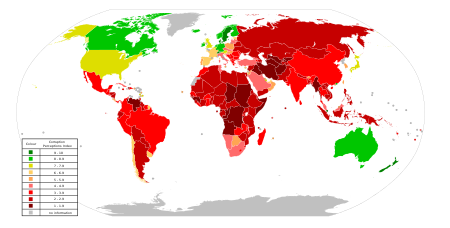
Readers may go to Transparency International’s website for full details of the list and an interactive world map. North Americans and Western European collectors obviously have grounds here for "I'm all right, Jack" complacency. These results indicate a serious corruption problem, nearly three quarters of the 178 countries in the index score below five. At the bottom are the most corrupt states in the world (like Somaila and Burma but also the puppet governments set up following US-led invasion in Afghanistan and Iraq). At the top of the ranking are mainly the Anglophone and Germanic language zone 'protestant work-ethic countries' of Western Europe and the Commonwealth. In this ranking, the UK came at 20th place in the list, while the US has been ranked as more corrupt, dropping to 22. Another notable result is Russia, rated as among the worst for corruption, in 154th place, antiquity collectors will notice no doubt that Italy, down in 67th spot, now comes below Rwanda.

So, let us have a look at where ancient coins are coming from in these terms.


Coineys claim they are reviving in their coin cabinets "the glories of Greece and grandeur of Rome" but it becomes clear that the legacy of that classical world today in the regions that were the core of their territories are governments classed by this index as 'corrupt'. Any familiarity with the places of origin and circulation of the majority of the coins offered through Internet portals such as V-coins, eBay and individual dealers' offerings (such as ACCG's Dave Welsh's Classical coins and Wayne Sayles' online shopfront) as well as bulk uncleaned lots will immediately recognise that the patterns match. It is suggestive that the largest quantities of ancient coins (and artefacts) on sale in the US today are most likely coming from the regions countries coloured red and orange on this map. Coins of the Greek, Celtic and Roman world from sources in Spain, Portugal, France, southern Germany and Austria and, what is most interesting, PAS recorded items from metal-detector-infested England and Wales are much less common (exactly the same patterns occur when you look at Medieval hammered coins offered by these sellers). That is despite major markets in Germany (Munich), Switzerland and London. So how are these coins - some of them being offered online still encrusted in soil and dirt - leaving those countries with high indices of corruption, and why are the coins from countries with low ones conspicuously much less common? Is there a connection between government corruption, at federal, state and local levels and smuggling for example? We have already noted that very few sales offers of ancient artefacts on the US markets (even from countries also party to the 1970 UNESCO Convention - see its article 3) make any mention of the seller possessing any export documentation whatsoever, should that not make the buyer somewhat suspicious in the circumstances?

Mr Welsh claims that restricting imports to the US to only items which have documentation of licit export is "not a solution to the problem of looting" but "in reality part of the problem". Surely this is wrong. If a person in a source country looking for a way to make money knows that he cannot get a valid export licence for looted material ("where did you get it from sir?") and that one of the world's biggest markets for this sort of thing cannot import it without one, he may well decide instead to abandon a life of culture crime and go into politics. It is only in the knowledge that there is a huge no-questions-asked market out there making such activity profitable, that criminal activity of this sort flourishes.

An impartial observer would be struck by the number of names of obvious Balkan , Bulgarian and Serbian most likely, origin in certain areas of the US (and UK) ancient coin and artefact trade. Some of these people are able to supply (and have been supplying) the market with huge quantities of coins to their clients - who often in turn sell them on to other dealers after sorting through them. One wonders about the nature of the contacts between these individuals and their own suppliers, purely business, family? From whom, and by what route are these kilogrammes of dugup artefacts coming onto the market?

Mr Welsh has changed the wording describing the bulk lots of coins on his website since I first discussed them on this blog . Nevertheless they are still on sale (they are the same coins, aren't they?). Where did they come from? How did they leave the source country, and how does that square with the high corruption index of all the countries now occupying the regions ("Moesia and Thrace" in the original more candid description) where coins like this circulated and were buried? If Mr Welsh is - as his blog post enthusiastically makes clear - so aware of this corruption, why is he buying and handling coins precisely from these regions of Europe?

Also, despite the high index of respectability given Mr Welsh's country by 'Transparency International', not all of us would see the 'holier than thou' US as a country completely free of corruption, not least citizens of that country [here too, but Googling "US corruption" brings an unedifying mass of material to light]. Mr Welsh himself as well as Peter Tompa accuse the State Department of corruption. On the day Tompa's blog article was published, it was announced that several US policemen had been arrested for corrupt practices, not involving antiquities like the Bulgarian cases mentioned gleefully by Tompa, but guns. Then we have believable reports of corruption in the US Customs service, apparently involving financial rewards and sexual services for turning a blind eye. I'd also question a system where 12 Congressmen and a New York senator can be induced (somehow) to lending their names to antiquity dealers' attempts to challenge the Administration's efforts to clean up part, at least of the antiquities market. That may be called "lobbying" in the US and perfectly acceptable, but it looks pretty corrupt to this European.

I think if US collectors are at all concerned about corruption, they should beware of transactions that may involve supporting corrupt practices. What evidence (export licences for example) does each have that their favourite dealer is taking active steps to avoid this?

Finally, through whose hands did Dave Welsh's "specials" from "Moesia and Thrace" actually pass?

PS. Let us note that two potential source countries of lots of illicit coins (Turkey and Makedonia) have corruption indices not much removed from that of the country where I write this. Both however have a severe looting problem. Poland has a looting problem though I myself (pace my local colleagues) would not describe it as 'severe'.


Are Coin Collectors Getting a "Fair Hearing" in the US?

.
Californian dugup ancient coin dealer Dave Welsh ("Classical coins") has published his "letter to Congress" online. In it he moans about how coin dealers and collectors like him are ill-served by the administration, and that the legislative intent of a group of philistine 1980s lawmakers is being thwarted to the detriment of the no-questions-asked US trade in dugup artefacts from other countries. He suggests that:
[the] rights of concerned citizens interested in ancient artifacts are ignored [...] Everyone on every side of the antiquities collecting issue ought to be able to agree that collectors are entitled to a fair hearing. We are obviously not getting it, [...].
Is that true? That rather depends how one interprets that word "we".

The ACCG claim that there are 50 000 collectors of dugup ancient coins in the US. When there is an MOU request in the pipeline they have been able (by fallacious insinuation, outright lies and misdirection it is true) to get at the most about 2000 of them to comment - all saying "no". What about the other 48 000 who choose not to comment?

If we break down the CCPIA and the 'MOU process' to its fundamental element, it is about illicitly exported cultural property from a member-state of the 1970 Convention. If an importer has an export licence from the source country, the object asses through US borders and into a coin dealer's shop without a hitch. If the object was dug up in that source country and exported to another country and then somebody in the States buys it, a declaration (as far as I can see as far as the CCPIA is concerned could be handwritten in blue crayon on the back of a envelope) is needed that it was exported before the MOU came into force. Basically nothing could be simpler. Especially since EVERY country which becomes a state party to the 1970 UNESCO Convention by doing so accepts Article 3, any transaction not involving the proper export procedure (which is what the whole convention is about) is ILLICIT. Since the US accepted the document in Septemeber 1983, every transaction involving smuggled artefacts from Bulgaria (ie objects that left Bulgaria illegally without following the export licencing procedures) has been illicit, and (since that is the type of vesting legislation Bulgaria had for most of that period) involved property stolen from the bulgarian state and Bulgarian people.

Everybody who sends a comment saying "no" to the proposal (even if they restrict it "just" to coins) is basically saying that they want the trade in objects with no documentation of legal export from the source country to continue. Put simply, they are saying that they want to be able to (continue to buy) artefacts smuggled into the US from Bulgaria. (Let us bear in mind that Bulgaria is one of the clearest examples where this smuggling is in the hands of organized criminal gangs, and that US dealers doing business with them and their middlemen are obviously putting US money into the hands of these criminals.)

Are these the collectors Congress is "not giving a fair hearing to"?

Should Congress be giving a fair hearing to such people?

[Or should they be placed on a watch list and their future mail from abroad closely scrutinised for illegal items?]

What about the other 48 000 collectors who want no part in the ACCG's "Say no to an anti-smuggling MOU" campaign? What is the reason they are keeping out of the public comment process? Do they too want the US market full of smuggled goods flowing unchecked straight from the looter, criminal middlemen and straight onto the US market which we are told is probably the biggest in the world for this type of commodity? Or would they like to see the US market supplied with material of wholly licit origins? Are they afraid to express a contrary view to the ACCG lobbyists because of censure in the coiney community? That they'd end up being excluded from coiney forums? Are they afraid that defending their view against the loud and probably aggressive philistinism that it would provoke is not worth the trouble? Is this why they are keeping quiet?


What therefore we are seeing is a loud 4% of the estimated total (50 000 collectors) who are shouting their heads off that they do not want to see coin smuggling from Bulgaria stopped. They are invited to submit public comment so the CPAC can take their views into account in its deliberations (which are restricted in scope by the CCPIA).

When we analyse what they are saying however, most of them do not take the opportunity to do that, to inform the CPAC in a manner that the information can be used in their deliberations, but send a whole load of other comments. Some of them are based on a total misapprehension of what the MOU involves (some collectors see it as a total ban on ALL coins from Bulgaria, some are concerned that it requires the "provenances from auction houses" of the coins to be known). Others feel they must inform the CPAC that there are already "lots" of these coins in the US (totally irrelevant to the purpose of the CPAC, since it is asked to consider what to do about fresh imports, not the coins already on the market in the US). basically it becomes clear once you start reading through these comments that the people writing have not taken any time at all to find out just what it is they are commenting on, or pay any attention to the background (reasons for) and scope of the original request. Are these the people who are "not getting a fair hearing"?

It seems to me that every collector in the US with a computer and the ("no child left behind") ability to read has every opportunity to find out exactly what the whole MOU matter is about. No "books" involved, just a few mouse clicks. It seems to me totally clear that the percentage that have actually even attempted to do that in the United States of America is painfully low.

Are the rest the ones who are "not getting a fair hearing"? If they have not even gone to the bother of finding out what it is they are asked to comment upon, not even bothered to work out why, not even bothered to think of something on their own to say, but merely copy and paste what a dealers' lobbyist told them to, then what kind of a "fair hearing" do they want? Perhaps what should be accorded attention is that for some reason, if past trends are repeated, despite repeated pleas from dealers and their lobbyists, upwards of 48 000 US collectors of ancient coins will stay well out of the ACCG-run campaign which has the ultimate effect of portraying the whole milieu as bootleg coin buying, plank-ignorant, could-not-care-less philistines.

Vignette: What say the 48 000?

Monday, 24 October 2011

Saving Antiquities for Everyone: "Say YES to Bulgaria"

.
The US based voluntary heritage organization SAFE (Saving Antiquities for Everyone) urges: Say YES to Bulgaria. The government of the Republic of Bulgaria has requested a Memorandum of Understanding (MoU) with the United States of America to restrict imports of illicit archaeological and ethnological materials from Bulgaria. This request is a substantial step toward enabling the US government to help stop the looting of archaeological sites and cultural monuments in Bulgaria and the smuggling of the products to the international market.

Somebody at SAFE has been very busy and produced a very clear 'advocacy' page which I'd like sympathetic readers to make as well known as possible before the 2nd November. It sets out very clearly the major issues in relation to the "section 303(a)1" issues on which the public are invited to comment. In terms of making informed comments, that puts the White Hat Guys at an advantage over coineys and the suchlike who have only been fed inflammatory lies and misleading misdirection by the dealer's paid stooges.

The SAFE page has four main sections which make it easy to understand the whole issue and why we should be concerned about it:

What is at stake?

Bulgaria's cultural heritage endangered

The devastating effects of illegal excavations

A huge U.S. market for Bulgarian antiquities

What is Bulgaria doing to protect its cultural heritage?

This text includes a bibliography of just a few of the news items that have been coming out of the country in recent years about the successes of the Bulgarian authorities in apprehending smugglers and looters, and the sort of items that have been involved.

Please spread the word and draw people's attention to this page and get them to submit a public comment in good time to show the world that there are more voices in America than those of greedy and self-serving takers of history.

[I doubt it will do any good, but it would be only fair to also bring this page to the attention of the coin and antiquity collectors' discussion lists so they at least have a chance to see what some of the issues are as the preservationists see them].

Why Coineys Don't Want the US to Help Bulgaria With Antiquity Smuggling

.
SAFE urges: Say YES to Bulgaria

One might legitimately wonder why the coin dealers and collectors of the United States of America are so anxious that the CPAC gives a negative opinion on the request of the government of the Republic of Bulgaria for a Memorandum of Understanding (MoU) with the United States of America to restrict imports of illicit archaeological and ethnological materials from that country. The SAFE webpage on the request has some details which might help unravel the mystery of why people who claim they are "interested in history", "learning about the past", "preserving relics of the past" and are "all against looting" in fact do not want to see the smuggling of artefacts out of Bulgaria stopped - at least not when it comes to stuff going into the USA. Certainly other people who are "interested in history", "learning about the past", "preserving relics of the past" and are "all against looting" do want to see the smuggling of artefacts out of countries like Bulgaria stopped as soon as possible.

The SAFE text includes a bibliography of just a few of the news items that have been coming out of the country in recent years about the successes of the Bulgarian authorities in apprehending smugglers and looters, and the sort of items that have been involved. Here we read for example:
The United States continues to be a major market for antiquities, especially those from the Greek and Roman world and particularly for coins. Quantifying the flow of goods in an illicit market is difficult; nonetheless, a handful of important recent studies show how the US market for antiquities which originate from Bulgaria remains strong.[...] looters in Bulgaria are eager to meet the international demand for antiquities with materials from their country. How much of this Bulgarian material do we know is bound for the United States? This is very difficult to say from the looting itself as often the looters on the ground do know the ultimate destination of the materials they find. Some recent border seizures, however, especially in the case of coins, have provided strong evidence for large quantities of fresh Bulgarian antiquities entering the United States for sale.
Of course if the US border authorities had been more vigilant (since 1983 the US has been a state party of the UNESCO Convention on the Means of Prohibiting and Preventing the Illicit Import, Export and Transfer of Cultural Property) and caught a larger proportion of those smuggling illicit artefacts into the the US and those importing illicit artefacts, we'd have a better idea of the US involvement in this trade. Despite huge numbers of 'erdefrisch' artefacts and coins being sold (sometimes sold in bulk by the kilogramme like potatoes) by dealers based in the US to US and foreign collectors, very few shipments have so far been challenged by the US authorities, and it would seem, none of the dealers handling this stuff been investigated.

As we can see it is US coin collectors and dealers who are most concerned that US does not pay more attention (through the issue of fresh regulations confirming US resolve to honour the obligations due to a fellow member state under the 1970 UNESCO Convention) to who imports what from Bulgaria and whether it is accompanied by the requisite export documentation. They claim that "coins are not cultural property" in the terms of the 1970 UNESCO Convention (which merely show they've not actually read the document) and curbing the imports of coins freshly smuggled from a foreign source country like Bulgaria would "destroy the hobby" and prevent collectors from getting their hands on ancient coins.
In an important study of the material and intellectual consequences of the trade in unprovenienced coins, it is reported that in 2002 one individual shipped approximately one ton of coins (approximately 340,000) from Bulgaria, through Frankfurt bound for the US (pg. 4). The same study points out another seizure which occurred in 2006, when the Bulgarian police unit for Combating Organized Crime intercepted a smuggling shipment of approximately 14,000 coins on a train from Sofia to Vienna, with the ultimate destination being the US (pg. 2). These reports point to two facts. One, that there are well-travelled illegal shipping routes which bring archaeological materials from Bulgaria for sale in the US. The second fact is that coins constitute a substantial proportion of this trade.
THIS would appear to be why US coin dealers are so concerned that their clients bombard the CPAC with negative opinions about curbing the trade in smuggled artefacts, or at least exclude smuggled coins from the list of items scrutinised at the US border for legality of origin.

UPDATE 24.10.11: In what must be, surely, the absolute peak of the stupidity of the arguments used by the dealers' lobbyists to justify the continuance of a bootleg trade in smuggled coins in the US, we now learn that one of them thinks (though whether sincerely is difficult to ascertain) that SAFE's advocacy of the US reinforcing its commitment to honouring its existing obligations under the 1970 UNESCO Convention is in reality a conspiracy to support corruption.
But, what will SAFE's campaign (and that of the AIA) for "no questions asked" import restrictions really do for Bulgaria and the protection of its cultural patrimony, but help support the corrupt status quo?
Tompa draws on a report on the involvement of organized crime in Bulgaria in the illicit antiquities and illicit drug trade and human trafficking (among other ) to suggest that "before" US dealers are required by their government to import only licit dugup artefacts, the Bulgarians should adopt the measures set out in this report. Oddly - though he gives page references to the places in the report supporting his case for the wholesale corruption the trade involves - he fails to do that for those recommendations. Probably this is because they included regulating the market (including a mention of the importance of the 1970 convention in this) page 188-9 and two sections on regulating the market in antiquities (pp 189-197). The measures which Tompa mentions are only part of the recommendations of the report as a whole. I presume Tompa is relying on the fact that coineys are not going to actually check for themselves whether his summary is a fair one of what it says or not. His blog however is not read only by shallow coineys. The rest of us will find that, on looking at the text to which Tompa refers, he covers up the fact that near the top of the list is this (page 196):
Improve international coordination to prevent the sale of contraband antiquities from Bulgaria at auction houses in Western Europe. This would probably deter attempts to traffic local cultural goods across the Bulgarian border.
Well, equally improving international coordination to prevent the sale of contraband antiquities from Bulgaria by dealers in the even bigger market in the United States of America would be an effective deterrent of attempts to traffic local cultural goods across the Bulgarian border. So sending a request to the US government asking for an MOU - which the Bulgarians have just done - is entirely within the scope of the recommendations of this report.

Tompa concludes that:
Under the circumstances, the US could best help Bulgaria(sic) by tabling any talk of import restrictions to allow Bulgaria time to act on the CSD report's recommendations. Though any looting of Bulgarian archaeological sites is regrettable, it is best addressed in Bulgaria itself through the regulation of metal detectors and serious consideration of CSD's other suggestions before import restrictions are imposed.
In the meanwhile US dealers can carry on buying coins and other antiquities from the market which Tompa has described in detail in his blog post. Some readers with a better grasp on reality than a ranting lobbyist may feel that Bulgaria can better be helped by could-not-care-less Americans being prevented from financing the illicit international deals of Bulgarian criminal groups.

On the basis of that text Tompa presumably would advocate the same about the other problems raised in the same report on transnational organized criminal activity, that the Bulgarians should be left to deal with their own drug, human trafficking and stolen vehicle problems by themselves and the American authorities should not lift a finger to stop these criminal gangs move their commodities across US borders. After all why punish consumers ("see what Prohibition did") and American free enterprise and small businesses when there is money to be made and obviously the sole fault anyway is those corrupt ex-commies over in Europe?

Vignette: Bulk lots of dugup ancient coins from the Balkans and Danubian regions are sold like potatoes in the US.

Photo: Bulgarian "tirówka" (roadside prostitute) a few years ago in Poland. Polish police fortunately do not follow the Peter Tompa "let the Bulgarians sort out their own problems with criminal gangs and not expect us to do anything at our end" school of thought, and a drive along the more notorious routes is now less colourful for lonely long-distance drivers.

Meg MoUs for Belize and Bulgaria; Let's all Mou for Belize and Bulgaria

.
Busy student Meg Lambert "I MoU, you MoU, we all MoU for Belize and Bulgaria" urges,
it's not often that we're ALL given the opportunity to lend our voices to the creation of these laws. Please, take some time to write a little something something to help save the world's history from disappearing completely.
It is nice to see that somebody spent a few hours actually reading up on the issues before deciding what to write - unlike the first hundred people that have sent some fuddled ill-thought-out kneejerk nonsense in support of keeping smuggled artefacts in circulation on the US market.

Thursday, 20 October 2011

CPAC Comments: Lost for Words? A How-to Guide for Conservationists (and coineys)

.
[I vowed never to get involved in another US MOU campaign, it costs me too many nerves and personally, as I have said many a time, I do not believe the US are using the 1970 UNESCO Convention in any laudable way. However the fact that this next one is one I have long dreamt of, the looting of archaeological sites in Bulgaria is a something I take very personally, and has historical connections with the rise of the US "minor antiquities" trade, it seems I cannot ignore this].

In my analysis of the coiney contributions to the debate yesterday, it became clear that virtually none of them actually addressed the issue at hand and this is because they were to a large extent cutting and pasting (if only mentally) from the [I now think deliberately] misleading propaganda given out by the dealers and their lobbyists.

So after being pretty negative about the coineys, I thought a positive contribution would be to give the people on my side of the fence something to help them put together something addressing the same issues. There is of course no reason why coineys cannot use this too, to make sure that they are addressing the actual issues in hand, please feel free, let's get some proper debate going on in place of the sad apology for one propagated by the ACCG and Moneta-L and their ilk.

In the public notice, comments were specifically and exclusively requested on Section 303 (a) 1 A-D of the Convention on Cultural Property Implementation Act, 19 U.S.C. § 2602, pursuant to which the Committee must make findings. This Act is pretty badly written as prose and its layout and section numbering are tragic, but not too many minutes work suffice to untangle it. But some people are too busy to do that, so I thought it might help somewhat if I set out the main issues it raises and some guidelines to what one might consider saying in response. I am going to use Bulgaria as the example, but please use this to write a similar response for Belize too. Show the world you care.

Let us start off by noting:
(a) there is no "conspiracy",
(b) the aim is not to stop "collecting" but to halt at the US border, as far as is possible, the import of archaeological material and ethnographic objects which have been illicitly exported from Bulgaria [including, as far as possible, those cynically 'laundered' by being sent via other countries - such as Dubai],
(c) the United States has been a state party of the 1970 UNESCO Convention for 28 years, and according to article 3 of the Convention, any such transactions were all that time (and are) illicit in terms of the Convention (a fact most coineys conveniently ignore).
(d) for the same reason (190 countries are states parties) there is no "discrimination" here. The US is simply implementing the Convention it accepted in September 1983.
(e) the Act is intended to implement the Convention for all types of cultural property covered by the term "archaeological material and ethnographic items", most of the comments to the CPAC have concerned excluding one type of archaeological material (collectable numismatic material) from its scope. There is no authority for that either in the text of the Convention or the CCPIA.

Section 303 (a) asks (in fact, the US President) five questions. Let's go through them in detail.

303 (a).1A: Is the cultural patrimony of Bulgaria in jeopardy from pillage? Sadly, the archaeological sites of almost all (if not all) countries which have a 'productive' archaeological record are subject to this threat. Tragically this applies particularly to Bulgaria where whole sites such as the Roman city of Ratiaria (look it up on this blog) have been stripped on an industrial scale to produce "minor" artefacts and coins which have been OPENLY sold on the US market through internet shops and auction sites (eBay in particular - there's quite a bit about that on this blog too) for year after year with nothing being done about it by UNESCO-Convention-state-party the United States of America. How many arrests have there been in the US for this in the past twenty years? Yes, the cultural patrimony of Bulgaria is indeed in jeopardy from pillage, and much of it done by looters affiliated with criminal groups who organize the transport of the loot to foreign markets (Shentov, O., Todorov, B. and Stoyanov, A. 2007, 'Organized Crime in Bulgaria: Markets and Trends', Sofia, Center for the Study of Democracy - this thought-provoking report figures the antiquities trade alongside trade in drugs, prostitution and human trafficking, and vehicle thefts).

Coineys: here you have to answer "no, the archaeological heritage of Bulgaria is not in peril because of looting", but you are on your own justifying that in the face of all the evidence, and what the Bulgarian authorities are now saying in submitting this request. Also it seems to me you would have to come up with some pretty hard evidence to trump the conclusions of the Bulgarian archaeological authorities monitoring these sites lying behind this request.

303 (a).1B: Has Bulgaria taken measures consistent with the Convention to protect it?

It should be noted that the CCPIA refers ONLY to measures consistent with the context of the Convention which it implements. The Convention has a number of articles devoted to what states parties should do to protect the cultural patrimony of its territory. Bulgaria complies with the following: Art. 2, 1-2; Art 3, Art. 4, Art 5 (which the US has not); Art. 6 (which the US has not); Art 8; Art. 9 (it has just done so, please also note the obligations of the US already now invoked at the end of that article!); Art 10 (a) and (b); 14 (despite the typical economic difficulties common to most states in that regard, and we know the US also has its own problems there with regard the preservation of the archaeological heritage from looting)
[Articles 7, 11, 12, 13, 15 do not apply to this question, articles 16 onwards to the state party's relations to UNESCO - equally irrelevant here]
Coineys: here you have to answer "no, Bulgaria taken measures consistent with the Convention to protect its archaeological", and give your reasons for saying so. Please though distinguish between intent and effect. The Bulgarians have for decades been faced with political difficulties and financial restraints, and criminal gangs with bulldozers and a lot of determination to profit from a lucrative market. Should their cultural heritage be penalised (stolen by outsiders) because of it?

303 (a).1C (i): Would the application of the import restrictions proposed be of substantial benefit in deterring a serious situation of pillage?

The ACCG claims that there are 50000 collectors of dugup coins in the US. ACCG officer, coin dealer Dave Welsh asserts confidently that it is "credibly estimated that roughly half of all ancient coin collectors in the world reside and half of the world's numismatic trade is carried on" in the United States. If true, that obviously means that if illicit exports can be prevented from getting to this half of the market, this would cut down the profits that ensue from such an activity. Most of the other countries of the other half of the market are already parties of the Convention and the sale of illicitly-exported archaeological artefacts is already illegal there (for example Britain with its 2003 Dealing in Cultural property (Offences) Act). Obviously vigorously prosecuting these policies in each of these state parties (Convention Art 3 and 13a-b) will substantially reduce the possibilities of smuggled goods finding a market.

Coineys: here you have to answer "no, the application of the import restrictions proposed will not deter a serious situation of pillage", and then trot out the old argument that it has never been proven that no-questions-asked collecting actually has any relationship to looting. I doubt whether the CPAC will accept that, but you can try.

[303 (a).1C (i) additional point: "if applied in concert with other nations having a significant import trade in such material" other nations already have legislation rendering trafficking in illegally and illicitly exported items of this nature illegal. While it is true that with no-questions-asked one can buy such material in countries such as the UK and Germany, it is not, in fact, legal to do so (see here, point 2 - the lawyer has not yet provided the list of countries). It is like driving faster than the speed limit, staying parked longer than the time limit, or jaywalking, you can do it, and generally nothing happens - unless you are caught doing it.]

303 (a).1C (ii): Are there available (to Bulgaria or the USA) other measures less drastic that would achieve the same aim?

Well, what is proposed is that US customs look at the paperwork concerning export of certain types of cultural property. That is hardly "drastic", it's what customs officers are for - to check that what is coming into a country complies with the law. In this case, articles 3 and 13a of the 1970 Convention should be being applied by the customs services and border guards of the US as a state party of the Convention since September 1983 in the case of cultural property from all other countries party to the Convention. Is there anything less "drastic" than customs officers taking more care to do what customs officers should be doing anyway? Once again, it is worth stressing, in terms of the CCPIA, articles with kosher paperwork pass through without a hitch and dealers and other importers should be encouraged (Art 6c, 7b, 10a and 13a) to strive for kosher paperwork.

Coineys have in the past suggested that a "less drastic" measure would be to have the source nations set up something which they characterize as "like the UK's Portable Antiquities Scheme and Treasure Act" which would allow lots of artefacts to enter the market licitly - in other words simply redefining what is "pillaging/ looting". Apart from the fact it is not their place to imperialistically tell other sovereign nations what they "should" do to suit US collectors, this is irrelevant. The setting up of such schemes and attendant legislation are not within the scope of the measures covered by a Convention on the Means of Prohibiting and Preventing the Illicit Import, Export and Transfer of Cultural Property. What we are talking about here is export controls. The home of the PAS and Treasure Act, the UK, has quite stringent export controls on all dug-up archaeological material. A collector buying fresh dugup coins from Great Britain which have been exported without an export licence is committing an act as illicit as if they came from Greece or Bulgaria(and those coins too should have been stopped at the US border). The PAS and Treasure Act do not create an "export free-for-all", and certainly do nothing to protect the sites of England and Wales from looting by artefact hunters.

303 (a).1D: Would the application of these measure be consistent with the general interest of the international community in the interchange of cultural property among nations for scientific, cultural, and educational purposes?Obviously, yes. The large-scale importing of stolen and illegally exported cultural property by one country from another - while no doubt profitable for individuals - is not in the general interest of the international community. This, surely, is particularly the case when it seems it encourages or facilitates international criminal activities. Stopping the traffic in illegally exported cultural property would not have any negative impact on the "general interest of the international community in the interchange of cultural property among nations for scientific, cultural, and educational purposes" since this can surely be satisfied better through mutual licit and legal interchange of such items through the legal art market, museum loans, travelling exhibitions and other means. we should bear in mind that the Bulgarians themselves are part of the international community.
Coineys would have to show that curbing the large-scale importing of stolen and illegally exported cultural property by one country from another is not in the general interest of the international community, and that this would have a wholly negative impact on the "general interest of the international community in the interchange of cultural property among nations for scientific, cultural, and educational purposes". You are on your own there.

So that is five relatively simple questions that the CPAC is currently asking for some public comment on. The answers seem relatively straightforward. Given the scale of the damage already inflicted on the accessible parts of the Bulgarian archaeological heritage through the no-questions-asked buying of the ancient coins dug up by the bucketful from Bulgarian sites, I think the CPAC owe it to the international community to recommend the President apply import restrictions on archaeological artefacts (and let us not forget the ethnographic material - where stolen icons must probably figure highly on the list of priorities) as soon as practically possible. Let it also roundly condemn those that want to continue the disgusting bulk trade in freshly dugup archaeological material like this no-questions-asked.
.
Vignette: How to...

Tuesday, 18 October 2011

“Beat-the-archaeologist” Berk Tries to Enlist Gullible Collectors in the Fight

.
Chicago coin dealer Harlan J. Berk is an avid supporter of the ACCG and appears to have a deep seated resentment against people who study the past through sources other than ancient coins, maybe because they ask too many questions. Whatever the reason, in a recent mail sent to the “responsible artefact collectors’ discussion list” (Yahoo’s “AncientArtifacts” run by Tim Haines) he reaches out to “Fellow Numismatists” forwarding an email from Peter Tompa containing the text also posted on his blog addressed to sawdust-for-brains collectors (the ones that cannot reason their way through the CCPIA for themselves nor unaided see the reasons why importing illegally exported coins is not what a responsible US collector would be supporting).

In his covering letter to collectors, Berk warns that there is a conspiracy by an unspecified “they” to “blind side us into restrictions on Roman Imperial and Greek coins”. He says they are doing this “by using a small seemingly unimportant country like Bulgaria”. (Bulgaria however as we all know, partly by the activeness of local organized criminal groups, is by no means such an “unimportant” supplier of freshly dug up ancient coins to the global market for numismatists and ancient coin fondlers).

“Beat-the-archaeologist” Berk insists that (despite the country becoming a state party in the early 1980s of the 1970 UNESCO Convention regulating such things) the fight to keep importing illegally exported coins into the US (which is what the CCPIA combats) is “an ongoing battle” and Harlan J. Berk Ltd wanted “fellow numismatists” to be aware of “how this legislation” (sic) “can greatly effect collecting in the future”.

Vignette: Collectors being led by the nose by dealers' lobbyists again.

Keeping an Eye on the Collectors

.
I have added a link in the sidebar over to the left to the webpage Cultural Property Advisory Committee Meeting - Bulgaria Docket ID: DOS-2011-0115 Agency: DOS where the coineys will be exhibiting the fruits of their deepest reflections on portable antiquity collecting issues for the benefit of the CPAC and the international community. At the time of writing, none of them has dared become the first philistine to complain his collectors' rights to buy illegally exported coins are being violated by do-gooders.

Coiney Teacup Storm

.
I asked ('Coiney Silence: Capitulation or Calm Before Storm?') whether the several days' silence from the coiney camp on the Bulgarian MOU request was the calm before another storm of philistinic coineyish protest. Now we've seen what they intend to do, it is difficult to say. It's all a bit pathetic really, and of course once again shows that they are being induced to write about things that are not in the CPAC's request for comments and indeed not in the CPIA. (What's new?) They complain that their comments have not been listened to by the CPAC on previous occasions where coin imports have been discussed. There is a very good reason for that, when you look at what they actually wrote (where that is available, and I spent a while posting about them on this blog) virtually NONE of it was actually on topic. In any administration, that will lead to it being binned rather than considered.

This time is no different. This time though the coineys are being urged to comment mainly on the alleged "maladministration" of the Department of State. The "evidence" for this is that "they" did not consider coiney complaints and that they gave "short notice" of the comment gathering period. Two weeks is however not really all that short for a person of adequate literacy to submit a comment. These pathetic individuals however are being urged to write comments to a presidential advisory committee containing a complaint against the DoS. Where is the logic in that? More to the point, if you look at the CCPIA with any care, you will see that nowhere in the description of the operation of the CCPIA is there any mention that it has to be swayed by any public input. In its composition, both the public and the antiquities trade are adequately represented in the statutory composition of the Committee. When the Act was written internet-lobbying was still unthought of.

With reference to the text I discuss below, coineys might like to look at the CCPIA (section 305) to see at what stage of the process the definition of what is and what is not covered is added or revised, and by whom. They might be surprised, because lawyers for the coin trade apparently do not consider they need to be kept informed of details like that in order to make a meaningful contribution to the public debate. that seems not to be their function in the tactics of coiney lobbying.

The coin trade's professional lobbyist Peter Tompa has created a text called: "Bulgaria: Call to Comment" which begins "Please consider sending this to any coin collector you know". One wonders why he only wants coineys to comment, surely this affects anyone who deals in and collects "minor antiquities" coming from recent metal detecting in the Balkans and Bulgaria in particular, why does Tompa feel that these collectors will not support the coineys? Tompa's text has the following sections:

What is at issue? [which of course fails to say what is at issue in fact, which is restrictions on import of coins which cannot be documented as legally exported from the Bulgaria]

Why bother?
[...]
and the all important for those with sawdust instead of brains:

"What should I say?"

This section for the collectors unable to work out for themselves why they are writing to the CPAC is priceless:
Tell the State Department and CPAC what you think about the bureaucracy’s efforts to deny you the ability to collect common ancient artifacts that are available worldwide. You might also consider noting that coins from Bulgarian mints are common and often very inexpensive. Tens of thousands or hundreds of thousands exist in collections around the world, and because of the low price the vast majority of these coins will never have been through an auction and will have no verifiable provenance.
Comments:

1) Perhaps sawdust-for-brains folk might need some prompting to work out why these particular coins are so plentiful on the market. Is it because Petrarch and nineteenth century Maryland rural parsons collected coins from Bulgarian ploughmen? Or is it because sites in Bulgaria have been trashed on a massive and industrial scale in the last two decades to allow hundreds of thousands of freshly (and illegally) dug up coins and other artefacts to enter the global (but most especially the US) market? Is it because at least one container-load of such dugups is known to have passed through Frankfurt on its way to the international market, of which the US sector has been estimated by an ACCG dealer as comprising a half? Let's have long lingering look at the Google Earth pictures of Archar. Let sawdust-for-brain people unable to work it out for themselves have a long lingering look at the Wikipedia Commons photo gallery showing the massive scale on which this site has been turned over by gangs with metal detectors and bulldozers to produce the coins and "minor antiquities" that not just one of the US "small businesses" supporting the ACCG and V-coins was started with. Then let them write to the CPAC what they think about that.

2) These coins may be "available worldwide" on a market that is notorious for asking no questions. In which country or countries, the lawyer does not say, are coins illegally dug up and illegally taken out of the country (without an export licence) on sale licitly? Could Peter Tompa provide us, either via his blog of as a comment here, with the names of the other countries that would go on this list:

Table 1: Countries where selling freshly dugup artefacts smuggled out of Bulgaria is licit
(UNESCO 1970 Art. 3 and 8)

3) While he is at it, Peter Tompa can no doubt supply his coiney protégés with the actual reference within the CCPIA which speaks of "provenance". All that is of issue in the whole CCPIA is in fact when an item left Bulgaria. Nothing to do with "auctions" or how much an artefact "costs" or where it was dug up. It is precisely the mass scale of the removal of items (the factor which lowers the cost) which is the problem.

4) Somehow Peter Tompa has forgotten to keep coineys appraised of just what specific aspect of the request the Presidential Advisory Committee has asked for public comments on. Comments on anything else will not be taken into consideration. Get your section 303 thinking caps on coineys - Tompa's not going to help you out there, he wants you writing something else... (his motives for that are not easy to guess).

Finally, how many fresh coins do Tompa and his dealer mates want to see on the market? If people in the US have been collecting coins "since Petrarch", and we hear of container loads of them arriving there (and from another dealer mentioned on this blog about a "tonne") then when is enough is enough? Can the US coin trade quantify roughly how many freshly dug up coins imported from Bulgaria it will need in the next decade? How many have been coming in over two decades? How sustainable is that by current mechanisms?

Why are the dealers and their supporters not urging the coiney community to insist Bulgaria install a Portable Antiquities Scheme in places like Archar (Ratiaria) to voluntarily record the coins and artefacts coming out of the ground of this heavily trashed site? This is surely what they were suggesting for other countries instead of closer US scrutiny of imports, why not here? A little consistency please guys...

In an earlier post, dealers' lobbyist Tompa grumbles:
One must again unfortunately conclude that the State Department and its Cultural Heritage Center really are not looking for informed public comment from the broadest number of stakeholders possible. And doesn't such a tact merely confirm the suspicions of many that the State Department bureaucracy views CPAC as little more than a rubber stamp for imposing the broadest import restrictions possible? While I'm sure Bulgaria's former Communist rulers would have approved of such a farce, what does it say about our own State Department's commitment to the democracy it preaches so loudly to others?
Bulgaria ceased to be a "Communist" state quite a long time ago, and a lot has happened there since. It seems going more than a little too far to compare the US DoS with the totalitarian regime of Todor Zhivkov on present evidence. Methinks Tompa has not the slightest idea what he is talking about here. To what extent are the coineys commenting on the bilateral cultural property agreement well informed by people such as Mr Tompa about what it involves? We will see.

Vignette: Bulgarian ethnic ceramic teacup; Photo, what is left of the archaeology of Ratiaria after the artefsct hunters have been over it (photo by Widintourist Wikipedia Commons do have a look at the whole gallery, it is quite shocking)

 
Creative Commons License
Ten utwór jest dostępny na licencji Creative Commons Uznanie autorstwa-Bez utworów zależnych 3.0 Unported.