Showing posts with label Zahi Hawass. Show all posts

Thursday, 22 September 2011

Hawass Apologises

.
Dr Zahi Hawass was scheduled to hold a public lecture in Brussels on the 15th of July 2011 as part of the accompanying program of the exhibition ‘Tutankhamun – His Tomb and His Treasures’. The lecture had been postponed to a new date, 23rd of September, but Dr Hawass has informed the organizers that he would be unable to attend. It will be delivered now as a live transmission from Cairo via satellite, with free entrance. In his statement, Dr Hawass said today:
“I am writing to apologize that I will not be able to give my scheduled lecture in person in Brussels. Due to the difficult situation here in Egypt, I am not currently able to travel. I am very sorry about this, and appreciate your understanding. I do hope very much, that my lecture, which I will hold live at 25TV’s “Nile Studio” in Cairo this Friday night, will be acceptable".
Dr Hawass is currently banned from leaving the country because procurators are continuing their investigations of charges which have been brought against him.

Tuesday, 13 September 2011

Collector: "Archaeology Big Business"

.
In a post below this I questioned the use of the term "trade group" referring to bodies like the European Archaeological Association, and said it was sloppy terminology. Nevertheless the author of those words is insistent that it is true:
archaeologists certainly advocate for the business purpose of monopolizing control over antiquities, and let's face the fact that archaeology is a big business now-- what with TV deals, government contracts and the like.
Leaving aside the emotive (and untrue) formulation "monopolising the control of antiquities" (sic) - which basically means, doesn't it, trying to keep them off the market for illicitly obtained items...

Does archaeology have a "business purpose" (ie commercial purpose) in protecting archaeological record from destruction? Can one say that rhino wardens in national parks are preserving rhinos for commercial reasons (because once the rhinos are gone nobody will pay their salaries to guard them)? Its the same argument, isn't it? I think there are a number of reasons why people make huge efforts to protect a resource and encourage others to help them. Commerce - doing business with it - does not necessarily play a part in it. Make money out of protected wild orchids growing in a field, or an osprey's nest. Perhaps the writer of those words finds it difficult to envisage there being other aims in conducting an activity, or running an institution, than making money. I do not know anyone who has entered archaeology thinking they'll get rich - you've much more of a chance of getting rich buying a metal detector and looking for a hoard or two in likely spots.

In the sense that developer funding plays a large part these days in financing so-called archaeological heritage management (in particular rescue archaeology) and this is contracted out by normal means to commercial archaeological bodies which undertake the work (so none of the institutions we are discussing), archaeology has become more commercialised. But in fact what money is being made from here is the controlled destruction of archaeological context. Perhaps then archaeology could be accused of having commercial interests in retaining context until such a time as commercial groups can be paid to take them apart methodically rather than, as was said above, loose "antiquities"? This however seems to be pushing coiney conspiracyism to its limits. In any case describing commercial archaeology as big business seems rather an exaggeration when the work is tendered out and often the cheapest option gets chosen, and the cost of an excavation is often only a fraction of the cost of a development. I know very few archaeologists who get rich doing rescue work, the ones I do know here in Poland are currently sitting out a jail sentence.

As for "government contracts", I wonder how much money the writer of those words thinks governments hand out to contractors in the field of culture and environment worldwide? These too are frequently tendered out and are often (as we see in the case of Britain's PAS for example) subject to stringent cuts. Thinking about some of the more lucrative UK government contracts I know of, they have been for creating policy documents, surveys or reports, and nothing whatsoever with either having or not having "antiquities" or excavation, just simple paperwork. The contracts in question also went to archaeological entities which have nothing to do with the kind of lobbying about which the anti-archaeological critic was writing.

TV deals, now we get to the crux of it. We all of us of course make a packet from our TV appearances, day after day in the studio and out of it. The makeup, tight filming schedules, paparazzi, autograph hunters... its a terrible life. Now, the PAS - on the back of Treasure hunters - reportedly has made a TV deal, but I do not think the average commercial archaeology makes much money out of filming its work.

Perhaps there is just a hint of jealousy there. One can imagine it now: "Chasing Denarii" presented by Zanny Harris III, Wisconsin coin collector, BBC2 8:00 pm Saturdays. "Come and explore with Zanny the treasures of the ancient world he has in his back bedroom":
"and here's another one, now this may look very much like the other 23 I showed you, but this one is really quite interesting, it was struck just a few years before his death, note the fine cabinet toning. I'll just put it down so the cameraman can zoom in on some of the details of the leaves on the wreath on the forehead [...] and here's another, but this time minted in Antioch! See, there's the mintmark just there..."

Vignette: Men in ties

Tuesday, 19 July 2011

Sicut erat in principio, et nunc, et semper, et in sæcula sæculorum?

.
This saga is getting more than a little farcical, you really could not make this up... Martin Bailey, 'Zahi Hawass remains antiquities minister—for now', The Art Newspaper 19 Jul 2011. "Egyptian antiquities boss Zahi Hawass still remains the minister, despite reports that he has been sacked. On 19 July he told The Art Newspaper that prime minister Esssam Sharaf has asked him to continue to go to work. However, Hawass’s future is now very uncertain. Prime Minister Sharaf has not yet finalised his new cabinet".

The same can be found here.

Hawass was appointed minister by President Hosni Mubarak on 31 January. He resigned on 5 March. Alaa El Din Shaheen was named as Hawass’s successor, although the appointment was never confirmed. Hawass was reappointed minister on 30 March. The Art Newspaper article seems to be suggesting that he was not actually formally dismissed on Sunday.

Wednesday, 13 July 2011

Guardian of the Pharoahs Tells a New Story

.
There is an interview with Zahi Hawass in the August number of Scientific American, it's quite notable for the way he dodged answering most of the questions. Most of it is fairly predictable, except this:
You said 31 objects from the Cairo museum are still missing at this point. What are the most significant ones?
[ZH] The only significant one from the museum is a small head of Queen Nefertiti—a few centimeters high. [...] We brought back the statue of Akhenaton holding a stela. And we’ve brought back most of King Tut’s objects that were stolen.
And where were they? Where did you find them?
[ZH] Those were taken by the looters who entered the museum on the night of January 28. We got the objects of King Tut because there was someone working for the antiquities department who came to me and said that there were looters who wanted to return these objects to me. And the next day he brought a bag with four objects.
And these looters approached the department official anonymously
[ZH]It's a long story. He was sitting in a café, and heard them talking, and they said they need to return these objects to Zahi Hawass because they trust him.

Now of course that is not the story that was put out at the time, or rather not either of the stories that was put out at the time. So now we have at least three different versions of the same event, found in a bag by named person (chance), handed in by unnamed person (delberate act), conversation overheard in a cafe by named person (chance). And these men "trust" Hawass?

Also, what does it mean "Those were taken by the looters who entered the museum on the night of January 28"? Were there any other raids on different days we did not hear anything about? So this Ministry employee (here unnamed - but the finder was named as Salah Abdel Salam earlier) has had contacts with the 28 Jan looters? Why were they not arrested? Did the handover take place in the Shubra metro station, or in a cafe?

[By the way Dr Hawass is not quite presenting the facts saying: "most of the items looted on 28th January were returned". The number of items still missing is still greater than half of those taken. Perhaps he has in mind the total number of items taken out of their cases that night, the majority of which were left in the museum on the floor or thrust into other cases.]

Jeffrey Bartholet, 'Zahi Hawass, Egypt's Indiana Jones and One-Time Mubarak Ally, Tries to Cozy Up to Pro-Democracy Activists', Scientific American July 13, 2011
.

Wednesday, 18 May 2011

Get a Job With Zahi Hawass

This is quite a revealing text, its a job advert from the Office of the Minister of the Egyptian Ministry of Antiquities. It is not clear what happened to the two young ladies that were in these posts earlier on in the year. It says nothing about the salary.

Vacancies for Administrative Assistants
The Ministry of State for Antiquities in Cairo, Egypt (MSA, formerly the Supreme Council of Antiquities), seeks to hire Administrative Assistants for two one-year positions, renewable on an annual basis. Both positions are under the direct supervision of the Minister. [...]
1. Administrative Assistant (Media Content)
This Administrative Assistant offers support to the Minister for media content requiring native proficiency in the English language and a background in Egyptology. The tasks associated with this position include, but are not limited to: · accompanying the Minister on site visits and to press and cultural events, and keeping a photographic record of them
· editing and organizing images for the Ministry’s Image Bank database
· creating and posting content on the Minister’s personal website in the form of blog entries, event information, photos, publications and press releases
· answering fan mail received through the Minister’s website and Facebook
· researching Egyptological and administrative topics in order to support the Minister in his activities and decisions
· compiling and presenting information in the form of database records, spreadsheets and narrative reports
· assisting with the gathering of content, editing and uploading of material for the English MSA website
· coordinating with Egyptian colleagues to carry out other assignments as necessary
Desired skills include: [...]

2. Administrative Assistant
This Administrative Assistant offers support to the Minister in administrative tasks requiring native proficiency in the English language and a background in Egyptology. These tasks include, but are not limited to:
· editing written correspondence in English from handwritten drafts or dictation
· editing English language reports, articles and other written material prepared by the Minister or his staff
· researching Egyptological and administrative topics in order to support the Minister in his activities and decisions
· compiling and presenting information in the form of database records, spreadsheets and narrative reports
· building and maintaining a database of images for use by the Ministry, including basic manipulation of digital images and identification of images for database records
· assisting with the gathering of content, editing and uploading of material for the English MSA website
· coordinating with Egyptian colleagues to carry out other assignments as necessary
Desired skills include:[...]
the full advert can be seen here. It is interesting to note that this suggests that all those texts covering the events of 28th January onwards on his "personal blog" might not have been written by Hawass at all, but were ghost-written by a temporary employee in his ministry. I wonder how many other ministers of culture anywhere in the world use state funds to employ an administrative assistant to deal with "fan mail"?

Sunday, 1 May 2011

Haines Accuses Hawass

.
Antiquities collector and AncientArtifacts discussion list owner Tim Haines unjustly accuses Egyptian official Zahi Hawasss of "smoke and mirrors". He says:
Hawass reports that some "stolen antiquities" were found by the authorities in Gaza, their owners arrested and jailed, and the items "returned" to Hawass [...] It is an outrage that people can be jailed for possession of such items and astonishing that a 'committee' needs to be raised in Egypt to determine that these are not authentic.
Mr Haines seems not to realise that it was not Hawass who arrested these men in another country, and when a Palestinian diplomatic mission turned up in his office with these two fakes it must have been an awkward moment requiring quite a bit of diplomacy to break the news that it was all a big mistake on the part of the Palestinian authorities. I suspect the solemn convening of a commission will have been a device to save the face of the co-operative Palestinians. Mr Haines seems to suggest it implies that the Egyptians (not the Palestinian delegation) are not as able as the smug British collector to recognise that these were not authentic antiquities.

Mr Haines might well be worried about people getting into trouble for selling reproductions as originals, take a look at what he has listed in the : Antiques - Antiquities- Egyptian section of eBay (there is a section on eBay for tacky costume jewellery and other such geegaws).

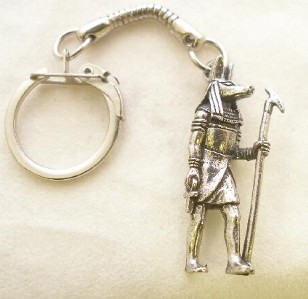
Egyptian God Anubis Keyring keychain English Pewter BN

Like this one from Paul-from-England (not me, honest) honestly featured in the collectables keyrings category, not "Antiquities, Egyptian" with the fakers.\

Tuesday, 19 April 2011

Concern About Antiquities Gone Mad

.
The world is full of idiots it seems:
Egyptian activists and media professionals launched a signature-gathering campaign to sue former Antiquities Minister Zahi Hawass for “endangering Egyptian artifacts”. Haitham Yahia, an activist and blogger, posted a form on his Facebook and Twitter accounts for people wishing to join the campaign to sign. Yahia then plans to file a report with the attorney general against Hawass, [...] Yahia said Hawass allowed the illegal use of Egyptian artifacts for the promotion of a menswear fashion line that carries his name [...]. Photographer James Weber, who carried out the photoshoot, posted the pictures and an interview about them on his blog on 23 November last year. He said the crew was allowed into the King Tut exhibit in New York City on 7 October.
wait... this is the New York exhibition centre (Discovery Times Square Exposition 226 W. 44th St. (between 7th and 8th Avenues), New York NY 10036) that Zahi Hawass runs? The extraterritorial New York exhibition centre where Egyptian law obtains in place of US law? What on earth is this about? A male model poses in a public museum gallery in New York. What is "illegal" about that? Many people pose daily for photographs standing in front of Egyptian sculptures and monuments, in Egypt and elsewhere. Do "activists" intend to accuse them too of “endangering Egyptian artifacts” and filing a report with the Egyptian attorney general about it?

Does Haitham Yahia and all those Facebookers making a fuss about this live in some backward place where they believe that if you take a picture of something you remove a little of their soul, and in this way they perceive damage to the objects if you take their picture? The photographer has already explained the precautions that were taken to avoid his lamps damaging the objects, and yet the fuss is still being whipped up by the Hawass-bashing Facebook wannabes.

Maybe first they should be writing to the Director of said centre and organizers of the exhibition to express their concern - and ask what their insurers said about this night-time visit.

There are many examples of the use of images of antiquities in commerce, some sexy, some tasteful, some bad taste. There are books written about this (mostly by Cornelius Holtorf it seems to me). Surely this is an expression of the relevance of the past to our lives, the use of ancient sites and monuments (things) evokes a response in ordinary members of the public - though not usually the one we see by the objectors here.

I see nothing wrong with a brand of clothing being named "Zahi Hawass". Astronomy professor the late Carl Sagan has products bearing his name, Like it or not, pop-has-been Bill Wyman has his metal detectors, sports personalities and other celebrities have clothing lines, cosmetics and all sorts of other goods named after them. Where is the problem? Because he is an archaeologist? Hawass, probably foreseeing such a storm, is donating the profits from this line to a Cairo childrens' cancer hospital (that by the way has been confirmed by the Director of that hospital), which is I am sure more than we can say for any of the bloggers and groups criticising him.

I see nothing wrong with photos whether for advertising or not being taken in a museum gallery with permission. I see nothing wrong with that permission being granted in the case of suitable products and assuming precautions are taken not to inconvenience other users and not to damage any of the objects or their surroundings. I see nothing wrong with fake or reproduction antiquities (as here) being used to give the ambience while not subjecting originals to any stress. What on earth is this whole fuss about?

I'm not going to link to the silly petition and the blog post about this. This is not at all about concern for antiquities, that is just a cover for something else. I note that Haitham Yahia's name does not appear on the online petition to the Egyptian government to do more to stop the looting - indeed one might wonder about the motivation of some of those, both in Egypt and outside, that would like to see the back of Zahi Hawass and are trying all sorts of slime attacks - like this one - to achieve his demise.

[Statement of interest: as I have mentioned in this blog, I have an authentic Zahi Hawass hat, it was a present from the States, and sits on the shelf behind me as I write, and - despite having myself had occasion to question some of Hawass' statements about a number of things - I see absolutely nothing wrong with having it, or him marketing them, or anything else. With the exception of "Zahi Hawass metal detectors"]

Photo: "Illegal" photo from New York exhibition.

Friday, 15 April 2011

Ancient Treasures as Fashion Accessories

.
Harrods apparently have a new line in menswear: It's named after a famous TV Egyptologist and got a mutant four-legged dung beetle in the logo. The blurb announces:
Rich khakis, deep blues and soft, weathered leathers give off a look that hearkens back to Egypt’s golden age of discovery in the early 20th century.
That's Egypt's golden age, or the European golden age of digging up Egyptian stuff? I rather think the Egyptians working for the European explorers in the early twentieth century wore something else... they only started adopting European dress styles later in an attempt to shed their identity as an 'other'.

The "Karnak Shirt" has been "hand painted (with grime?) washed and repaired to recall (sic) the rugged experience of excavating the ancient tombs of Egypt". In "Karnak" that is, the Egyptians are apparently keeping the lots of "tombs" there a secret from the rest of us, but hey, if we buy one of these shirts, we can "recall" excavating them.*

An Egyptian blogger writing in English has however picked up the discussion going on about this (Zeinobia: 'Our ancient treasures are not accessories ya Doc !!!', Egyptian chronicles - the Egypt that you don't know, April 15th 2011). It is referring to a November 2010 photo shoot which James Weber a NY photographer did in the visiting Tutankhamun exhibition in New York in connection with the promotion of this new line. She seems not to be very pleased about it, but clearly seems to be confusing the director of the New York museum with the director of the Cairo Museum. She also seems to think that the antiquities used as props and to provide background are ALL real (they clearly are not).

I see Kate Phizackerley has picked up the story Zahi Clothing Line - Shocking Photos). Kate raises the question of the destination of royalties for those photos in association with the new law in Egypt about such matters.

Apart from the general laughable premise of the collection itself (surely though just a bit of fun and not worth getting worked up about) and effect of the whole project, I am not sure there really is so much of a problem using antiquities in product promotion. It actually happens quite frequently - in fact is it not a sign that these "things" actully mean something even to the consumerist materialist fashion junkie? Frankly it does not seem particularly worrying that an archaeologists should have a brand named after him, it happens to sportsmen and actors, I do not see why astronauts and astronomers or archaeologists should not have the same status. Perhaps we should be grateful that Ms Flaugh did not decide to do a Simcha Jacobovici line, or a Mick Aston/Phil Harding line.


* Actually if they are to depict what a shirt looks like after exploring the West Bank tombs, my fashion advice to Lora Flaugh is they should have a long rip down the back and smell vaguely of bat excreta.

Vignettes: Egyptian explorers of the Valley of the Kings in the 1920s, below, non-Egyptian explorers of the Valley of the Kings in a slightly earlier 'golden age'. Ties and jodhpurs seem to be in order for the men, can't see Lara Croft (perhaps the fashion-house's next project) in a dress like that though.

Sunday, 10 April 2011

"About 1,000 relics stolen during Egyptian unrest"

.
A number of newspapers are covering the story:
"Thieves stole around 1,000 relics from Egypt’s museums and archaeological sites after public protests against the country’s government broke out in January [...] Egypt's minister for antiquities Zahi Hawass told Spain’s El Mundo".
Firstly the number of artefacts known to have been stolen from storerooms may (or may not) have been around "a thousand", but the number of items looted from sites is unknown (but "number of items stolen" is not the important statistic, though easier to count than "amount of archaeological information destroyed"). Secondly of course the "uprising and the weeks of unrest thereafter" has not by any means ended yet. Egypt has much political turmoil ahead precipitated by the sequence of events begun in January 2011.

We are faced with the same problem as before, all the information that is coming out of Egypt about any aspect of antiquities and archaeological resource preservation is being filtered by a single person. We note that among the new posts being announced in the revived Ministry of Antiquities, press officer is not one of them. Which is a shame.

While the authorities there persist in their approach that the people out there looting are criminals "looking for gold or mummies and who lack knowledge of the value of the items they stole”, then they are not going to get anywhere with combating the problem.
Hawass told the Spanish daily that the thieves were not organised. “They lived near the archaeological sites where the objects were kept. They would take advantage of the night to enter the archaeological sites and pillage," he said.
I suspect we'd find that the truth is somewhat different if we had access to more information than that which Dr H. is putting out. This is odd because he himself was fighting several organized groups trading Egyptian antiquities before 25th January 2011. Why does he want western journalists to forget this and think the problem suddenly disappeared with Mubarak?

It is also notable that western internet egyptologists, who at the beginning were logging all the reports of looting so the scale of the activity was emerging, seem to have bored of this and are now apparently making only a desultory effort to keep up the service they were doing for the rest of us. Keeping the ongoing development of the problem in the international public eye is the way to help get something done through international co-operation, constant assurances from an office in Cairo that nothing is happening and its all under control is not. What is happening in the fields and sand dunes?

Vignette: Various "Egyptian antiquities", like those that fill the no-questions-asked market.

Wednesday, 2 February 2011

Hawass Assures: Egypt's Antiquities are Protected


*

*
Zahi Hawass, Egypt's new antiquities minister, assures us that ancient sites and artefacts are protected.

Everything is safe, because the police have come. But, in the case of the antiquities/tourist police, where were they earlier? Who sent them away and why? Will any of them be punished for dereliction of duty?

So let's get this right, these criminals as soon as they just happened to have simultaneously "escaped" from jail hitched a lift to the nearest archaeological site and started looting artefacts. To my mind the first place I'd go to loot while on the run would be a food shop. I think looting whopping great fragments of statues and reliefs from the Memphis museum for example while on the run would be pretty far down on my list of priorities. I could not guarantee that I'd run into anybody to buy them from me later. Its pretty difficult running with a knapsack full of stones [oh, you'd have to loot a sports goods shop first to get the knapsack].

The events surrounding this looting certainly seem to beg a lot of questions. Let us hope somebody in the new government gets to the bottom of it to ensure the further protection of the monuments.

http://abcnews.go.com/International/video/mummies-safe-egypt-12812079


Photo: Dr Zahi Hawass.

Monday, 16 August 2010

Trophy Relics, the Egyptian Shopping List

.
Over on Andie Byrnes' Egyptology Blog a commentator (one "Mercury") says s/he has never heard of "another country ardently demanding the return of artifacts or even a nation of native people", and that anyway "institutions cannot be held responsible for the return of artifacts".

According to this writer it is just Egypt that is being "ureasonable", and this is all because of a single person:
It is important to note that one person is the instigator of this movement...Zahi Hawass. He appears to be on a crusade to not only retrieve artifacts but enhance his persona and accumulate wealth from the media.
"Mercury" seems unaware of something called the "Parthenon Marbles", the "Euphronios Krater" and all the rest, far from being just Egypt" there are many countries that would "like some of our cultural heritage back please": Italy, Greece, Cyprus, Turkey, Nigeria, Peru, Guatamala, China, India for starters. Britain of course does not, it alone could not care less what collectors swipe, but then that's tit-for-tat as its antiquities market and "wannabe-universal" museums are one of the prime swipers.

As for the Egyptian government, should not the return of the chunks hacked off the walls of TT15 which the Louvre bought have been requested?

Should not the mask of Ka Nefer Nefer which was bought by the St Louis Art Museum although it should be in a Sakkara excavation storeroom be returned?

The import of the paperless "Miami coffin" should not have been stopped?

The probably mummy of Ramsses I from the Niagara Falls museum?

Hawass' Antiquities "Shopping List"

Hawass is currently spearheading a movement to return to Egypt from collections in various other countries many prominent unique and/or allegedly irregularly taken Ancient Egyptian artefacts. The six antiquities on his shopping list are:
1) the Rosetta Stone at the British Museum,
2) the bust of Nefertiti in Berlin's Neues Museum,
3) the Dendera zodiac ceiling from the Dendera Temple now in the Louvre in Paris,
4) the bust of Prince Ankhhaf in Boston's Museum of Fine Arts,
5) the statue of Hemiunu, in Hildesheim's Pelizaeus Museum,
6) the statue of King Ramses II in the Turin Museum.

What is "wrong" with the Egyptians trying to get these things back for display in their own museums where surely they belong as much as in London, Boston or Hildesheim? Are the items in these western collections on Hawass' "shopping list" actually anything more than trophies in the foreign museums? Is that why people get so up tight about surrendering them when it is suggested?

See post below about Rosetta Stone, see also Heritage Key: Is Repatriation Good for Archaeology? Zahi Hawass' Quest for Egypt's Antiquities with its neat image by Prad Patel.

Saturday, 10 April 2010

Hawass accused of not having finger on the pulse of the modern antiquities market

In a post on his blog, Larry Rothfield ( Memo to Zahi Hawass: Museums are not the main source for buying stolen antiquities ) comments on Zahi Hawass's remark at the Cairo Conference: "Museums are the main source for buying stolen artifacts. If museums stopped not to buy artifacts, actually, the theft will be less, and we can control that". I must admit when I read that I thought the same. Rothfield correctly points out: "Museums make up only a small percentage of the buyers on the antiquities market worldwide. And most museums in the West have now already stopped buying illicit or even just dodgy antiquities. That is not going to put an end to collecting of illicit antiquities". As he observes, the main problem is now private collectors, and unless the indiscriminate market is cleaned up the problem will continue to get worse. Rothfield has a solution, but personally I feel that rather than increasing policing at the sites (very difficult to organize even in a rich country like the USA on BLM land) we need to concentrate on combatting those who are buying artefacts "no questions asked" which is the way the illicit goods end up on international markets.

.

Wednesday, 7 April 2010

Countries Discuss Recovering Antiquities

.
Antiquities officials from around the world are gathering in Cairo today a two-day conference hosted by Egypt's Supreme Council of Antiquities (SCA). The aim of the forum is to discuss "the protection and restitution of cultural heritage", and will primarily be concerned with mapping out a strategy to recover ancient artefacts which have been pillaged from their countries and displayed as trophies abroad.* Delegates will also draw up lists of artefacts missing from their countries and displayed in museums abroad, treasures they have been demanding be returned, the SCA said.

The conference may also call on the United Nations cultural body UNESCO to amend the Convention on the "means of prohibiting and preventing the illicit import, export and transfer of ownership of cultural property" to take account of developments in the field that have appeared since it was drafted in the 1960s.

The delegates are antiquities officials, deputy culture ministers and museum directors from 21 countries that have seen some of their national heritage stolen over the centuries. The countries represented are from the Americas - Bolivia, Chile, Ecuador, Guatemala, Honduras, Mexico, Peru, the United States ; Asia - China, India, South Korea, Sri Lanka; Africa - Egypt, Libya, Nigeria; The Near East -Iraq, Syria; and Europe - Austria, Italy, Cyprus, Greece, Poland, Russia, Spain. Reportedly 9 other countries were invited to attend but did not send delegates.
Britain, France and Germany which have been repeatedly accused by Egypt of illicitly holding Pharaonic artefacts are not attending.

Greece, one of the countries attending the conference, will chair a session devoted to "problems facing the countries in their attempt to retrieve their antiquities", no doubt drawing on its experiences with its decades-long struggle with London to retrieve the Parthenon Marbles from the British Museum.

Since becoming head of antiquities in 2002, Director Zahi Hawass has made reclaiming illegally exported items from Egypt one of the cornerstones of his policy to bring Egyptian archaeology more firmly into the hands of Egyptians. He insists that "what has been stolen from us must be returned", and it is hard to argue with that. Which of course does not stop dealers and some museum directors with atavistic views attempting to do precisely that. This stance is one of the reasons why Hawass is the subject of such a virulent hate-campaign by the lobbyists for an indiscriminate trade in antiquities and its supporters.

* The France 24 video shows some confusing images of replicas of material from Tutankhamen's tomb to accompany thir news report. Most of the many press releases circulating today and yesterday have an identical text.
.
Photo: Nefertiti's "I am tired and want to go home" expression.

Monday, 5 April 2010

Dorothy King Calls Zahi Hawass a "Nazi" and Accuses me of "Probably Applauding" the Holocaust - What Nonsense is This?

Just after midnight on April 4, 2010 Dorothy King PhDiva surmises that the author of this blog is not only anti-semitic but also mentally incapacitated:

Some of the comments are clearly from an idiot, and whilst I appreciate efforts to argue against them - they are a waste of time. Those kinds of people would probably have applauded the confiscation of paintings during the Holocaust - and claimed they were German 'cultural property'. [...] It's pretty clear cut that he's anti-Semitic, and I find it distasteful that anyone would try to justify his views - unless they themselves share them?
In which case ["unless"] it is not something she would "find distasteful" (eh?).

Well, the subject of discussion was whether a synagogue restored in Cairo should be handed over to the miniscule Jewish community that let it fall down when they cannot look after the one they already have. I raised the point that emotional language was being used in what was essentially a discussion about the use of a disused building -a fairly common heritage management problem. Read the thread and the whole sequence of comments for yourselves and judge who is behaving like the idiot.

It would seem that bloggers who get their news from Jewish sites like the Elders of Zyon Blog might be getting a somewhat distorted view of things. In fact there was a religious dedication ceremony at the restored synagogue on March 8th to which the local Jewish community were invited. According to sources in Cairo, they however committed a diplomatic faux pas, because although not the hosts, they then invited delegates from the Israeli government over the heads of the Egyptian organizers of the opening. What would have been a local event of religious significance was thereby turned into one that invoked international politics; the Egyptian government officials that were supposed to have turned up - after having funded the whole project - decided not to attend alongside the Israelis, putting Hawass on the spot. That rather provocative infringement of diplomatic protocol by the Jewish community - which surely is not without significance in the development of this sorry business - of course is ignored by Ms King and her collecting supporters over on the PhDiva blog.

It is undeniable that many Egyptians both in the wider community as well as in government circles have a certain attitude towards the Israelis and Jews generally, something Ms Diva and her oh-so-"cosmopolitan" artefact collecting supporters would like to ignore. It is precisely for combatting such prejudices that the restoration of the built Jewish heritage is applauded by the rest of the international community - militant Jews excepted. While I understand that these attitudes exist in Egypt (and why), that does not mean I condone them or share them. Nor of course does it mean I would "probably applaud" the Holocaust, a suggestion I find more than "distasteful", it is downright offensive as it trivialises the Holocaust.

We will note though that PhDiva has not actually answered the heritage management question I posed. Like the rest of them she can only call people names. Now she has added "New comments are not allowed" at the bottom of the thread indicating that she has no intention of (or perhaps ability to) address those questions.

Sunday, 7 February 2010

The Zahi Hawass Hat

[this post is not really heritage related] Before I set off for Egypt, an Internet pal in the States announced he had something he would like me to "take to Egypt". I agreed (thnking it would be something like pork scratchings for an expat friend living there), but the package did not arrive in time. I learnt from copies of correspondence that were forwarded to me that the supplier had problems "meeting demand" because their suppliers in Hong Kong were unable to fulfill the orders. Also looking up the supplier in the Internet, I had an inkling what was on its way to Poland....

In the event the package did not arrive in time, and I had to go without it. At home however a few weeks later my nearest and dearest received a spanking new Zahi Hawass hat by courier. The real McCoy with his signature inside and everything. I only saw it yesterday when got home, it is magnificent. The label attached says "Tutankhamen/ DR ZAHI HAWASS REPLICA EXCAVATION HAT/ This is an exact replical of my famous excavation hat. All profits from sales of this hat will go to fund the Suzanne Mubarak Children's Museum in Cairo (100% wool, made in the people's Republic of China". The website given is of Exhibit Merchandising LLC [Streetsboro Ohio 44241] which is where my hat comes from, it is connected with the Tutakhamun exhibition in Toronto and San Francisco (where I hear from other sources that the museum shops were doing extremely well, being sold out of many things faster than anyone expected).

On the reverse of the label is a picture of Hawass smiling away in a hat... not (it has to be said) quite like the one I have which is said to be an "exact replica". The hatband is stitched and mine is not, neither would I think the original Hawass headband is plastic. The rim of the Hawass'hat is turned under, while mine is turned up (important if you are going to "be an explorer" in a country where rain actually does fall). In fact, however if you start to look into it Hawass appears in photos in at least three different "Zahi Hawass hats". So, being pedantic about the use of the term "exact replica" is looking a gift horse in the mouth. It was a great thought and a great present, which I shall treasure as an interesting object in its own right.


Zahi Hawass is a cultural icon in his own right. Sadly, I never got to meet him when I was in Egypt (few do), but met a number of (non-Egyptian) archaeologists who did great Hawass impressions. I also met a number of Egyptian archaeologists who had some varied opinions of him. Not all of them, I got the impression, were as frank as others. Still, it was a good talking point. He also has a blog, and indeed fan-club. Certainly he is a figure (one might say phenomenon) which cannot be ignored.

These hats are themselves an interesting phenomenon, and in certain parts of our milieu have become a part of the archaeological dress code. A few years ago I did a count of the archaeologists working in Europe and beyond who habitually wore them and it came to (as I recall) sixteen (more than Mick Aston striped sweaters). Then there is the fictional one, Indiana Jones who might to some degree have started the fashion trend in this particular milieu. I guess however much we may deny it, there may well be a little of the Indiana Jones in all of us - and I might do a post here later about my own "Indy Moment" in a Theban tomb a few days ago.

Now I have to admit I too bought an "Indy hat" before I went to Egypt. I have extremely fair skin which is not at all sun-tolerant and the wide brim protected my nose, ears and neck from some of it. I admit I also had in mind its use as a sunscreen in the course of the siestas I was sure I would be taking in the lunch break. My old canvas wide-brimmed hat had seen too many rainstorms and too many better days to take. I went into an outdoor wear superstore and chose (much against my conscience) a Bavarian wide-brimmed felt huntsman's hat. When I went to see what it looked like on, the only mirror was in the horse riding section, I noticed three models of leather stetsons, obviously for cowboy fantasists, and I bought one of them instead. In grey-buff suede type leather ("wallaroo Suede" made by Jackaru in Australia). It turned out to be very practical indeed. What I did not count on was the number of times I'd be scraping my scalp on the roofs of tombs in the dark, and wearing a strong high-crowned hat saved me from some nasty cuts by bat-poo stained rocks. It did the job of keeping the sun off and my head cool and was the sort of colour that when it got dirty (quite often in archaeology), all you had to do was rub some more Theban dust into it and the stains disappeared (the Zahi hat is not that sort of colour - maybe why he has three). I note though that after three months in the abrasive dust the stitching is going.

I am not really a hat person, I rarely wear one, so I am not too clued up on their typology or terminology. I'd always assumed that these were all the same, but in fact the Zahi Hawass hat is not the same as an Indy Jones hat. I now note that the latter is taller and has a much wider hatband, and is pinched more sharply in the front (sorry if those are the wrong technical terms). Both seem to be of felt however while certain of my archaeologist friends have leather ones. Leather is not so good when you are sweating I find, though might give the illusion of being more low-rock-proof than mere felt. Perhaps now I have one of both I will give them a field trial and see which is best - now where can I find a bat-filled cave, swirling dust clouds and mercilessly baking sun in central Warsaw in February? But then, do I really want to get my new Zahi Hawass hat dirty?

Picture: from the supplier's website.

Sunday, 14 June 2009

Egypt to prove Germany stole Nefertiti bust

Over the past few days, various news outlets have been carrying stories about a new (?) fuss brewing about the Nefertiti bust (AFP):

Egypt will soon provide evidence that the 3,400-year-old bust of Queen Nefertiti was taken illegally out of the country by Germany, Egyptian antiquities chief Zahi Hawass said on Sunday. "We are still gathering information, but I expect we will shortly have enough to place a formal request to the Berlin Museum for the return of the bust," Hawass told the Tagesspiegel in an interview”.

I suspect this is nothing more than an extension of the news story covered here a few weeks back. If so this seems more likely to be aimed at public opinion than building a case to be solved by international law. One wonders whether this type of posing and strutting is not ultimately harmful. Eternally playing the victim does not do the wider cause any good. Sure, lots of antiquities left Egypt under highly dubious and regretable circumstances, this bust perhaps being one of them. In my opinion though the Egyptians cannot expect every single Egyptian antiquity to end up back in Egypt, even if questions arise how they were removed. Even though the Egyptian Antiquities Service has huge numbers of staff, concentrating on the wrongs of the past may well be taking energy and resources from dealing with problems of the present, and those matters which certainly need to find a resolution.

For example, instead of gathering documentation about the Nefertiti bust, it is suspicious that nothing much seems to be happening on the Ka Nefer Nefer front, Dr Hawass seems to find more possibilities in engaging in a paperchase with what may be seen as a partage gone wrong at the beginning of the century than displaying the paperwork proving a theft from a museum storeroom in the 1950s. Have they got such documentation or not?

Every so often the antiquities showman Hawass brings out into the light of publicity a royal mummy or some such item which had lain forgotten in a dusty corner of a museum somewhere or other. Perhaps the Egyptians should first concentrate on getting the archivisation of what they have already got in order before trying to accumulate more. In my opinion, Hawass should be chasing up items on the market now (like the Wenneb... shabti discussed here a few weeks ago) and finding out how they got there than worrying at the moment what went wrong in 1912. Protecting the archaeological resource which is threatened now rather than chasing objects safely archived in museums. Of course there is less easy publicity in that...

Perhaps like Athens, Hawass should go through the old spoilheaps and museum storerooms (or perhaps now search among the private collections) to find the missing eye from the famous bust, and then display it in an otherwise empty showcase to make the point.

Photo: the one-eyed Queen seems calm in the knowledge that she'll be staying in Berlin for a while yet (AFP).

Monday, 19 January 2009

Hawass Biding Time?

There was much discussion about the recent appointment (Sept. 29th) a few weeks before his departure by President Bush of Brent Benjamin as one of his cultural property advisors despite his St Louis museum being famously involved in a scandal over an item which seems to have been stolen from a museum storeroom in Egypt. The Bush regime in this way seemed to be thumbing its nose at world opinion concerned by the apparent rapaciousness of US collections for looted and stolen archaeological artefacts of which this was seen by some of us as symptomatic.

One of the puzzles about this whole affair was that Egypt's Minister of Culture and the usually very vocifereous Zahi Hawass had remained relatively silent on the issue. It now turns out that (according to recent reports) they probably knew that extradition proceedings were under way for Ali Aboutaam, since the beginning of September 2008 sitting in detention apparently in Sofia, Bulgaria.

Aboutaam not only had been convicted in absentia in a 2004 hearing in a Cairo court for alleged involvement in a smuggling ring, but was also the seller of the Ka Nefer Nefer mask in question in the St Louis case. No doubt Egypt thought that very soon they would have the opportunity to question Mr Aboutaam personally about how he got his hands on this object and obtain more details about the collectors which Pheonix Antiquities says gave the object a watertight alibi.

At the beginning of this year, however, it appears that Bulgaria refused to hand over Mr Aboutaam to the Egyptians. Soon after that, the Egyptians made their announcement that he had been detained, presumably in order to provoke discussion of the case.

Thursday, 15 January 2009

Arrrest of Antiquities Dealer

Egyptian Minister of Culture Farouk Hosni announced, apparently yesterday, that antiquities dealer Ali Aboutaam had been arrested by Interpol in Bulgaria (Batoul Helmy, "Interpol arrests antiquities smuggler", Daily News January 15, 2009).

Readers of this blog will probably know that Aboutaam, who is Lebanese but currently resides in Geneva, Switzerland, was accused of being one of eight people involved in the case of Tarek El-Suesy (transliterated al-Seweissi in some accounts), arrested in 2003 for illegal export of Egyptian antiquities outside the country. He was alleged to have aided El-Suesy in smuggling a substantial number of Egyptian antiquities (labelled as glass utensils, children's toys and electronic appliances and then shipped under the name of a well-known export company). For his part in this operation, Aboutaam's case was tried in absentia in an Egyptian court in April 2004, and he was declared guilty and sentenced in absentia to 15 years in prison and a fine of LE 50,000. Aboutaam had remained at large until his arrest.

Zahi Hawass, Egypt's chief archaeologist, said in a statement that Aboutaam's arrest was a "concrete step toward stopping the trade in illegal antiquities around the world".

What however is totally unclear is when this arrest took place, and where Mr Aboutaam currently is. Is he being held in Sofia? Is he being taken to Egypt to answer charges there? I found some rather surprising allegations on the museum security network which may be related to this for example. Is the public announcement now an attempt by Egypt to get some more concrete information from the Bulgarian government?

Perhaps more information will be available later.
 
Creative Commons License
Ten utwór jest dostępny na licencji Creative Commons Uznanie autorstwa-Bez utworów zależnych 3.0 Unported.