Showing posts with label Cultural property law. Show all posts

Sunday, 25 March 2012

American Ancestors: Mine and Yours

.
Who spotted the discrepancy? Over twenty people were convicted in recent years as part of an antiquities bust of digging up collectable and saleable antiquities including in some cases desecrating countless graves - and amassing huge (in at least two cases, 'lorry load' huge) collections of complete pots, baskets and personal items, some of which they sold for substantial sums. Over in the Four Corners area the collectors got no jail time and merely a few months probation from Judge Waddoups and later counterparts.

As part of another antiquities bust, a single unemployed guy was convicted under the same laws of running a metal detector over a battlefield, and possibly disturbing some graves into the bargain. John Jeffrey Santo, was sentenced by U.S. District Court Judge James Spencer to 366 days in prison followed by three years of supervised probation, he lost his collection and was ordered to pay hefty fines, reportedly $7,346.

Two different countries? No, both in the (supposedly) United States of America. Both groups of looters were white, too. The convictions were made under the same legislation. The only difference is that the first group of people were digging up "injun" graves in the archaeological resources of the USA and the second guy was digging up the White Man-past of the USA. Cases like this suggest to me that the US justiciary recognize two distinct types of heritage in their territory. One that they are prepared to accept the responsibility of protecting and concerning which they will enforce the law, and that of "the Other" where it seems they are not.

Monday, 6 February 2012

Coveting Others' Property

.
When they are not maliciously sniping at fellow numismatists who raise the alarm about the damage done by the atavistic attitudes of the no-questions-asked antiquity collector, we have seen the coiney makes all sorts of excuses for what they do. All of this is aiming to deflect attention away from one simple fact, what they want to take is not theirs to take. They proclaim all laws and mores which stand in the way of them getting their hands on what they want as illogical, ill-conceived and in some way not applicable to them and what they want to take. Thus it is we learn the view of US coin collector Jorg ( "put the ethical argument aside") Lueke that the "pot hoards" containing the antiquities he would like to add to his personal hoard of geegaws
are usually not found in places excavated, based on the archaeological reports I have read coins when found are not often what anyone would consider treasure.
So up for grabs. This ignores the fact that more often than not, the cultural property laws of the place where these "pot hoards" and other coins are dug up do indeed "consider them as Treasure", and removing them to private possession is illegal, is theft. Not that such a thing would concern a selfish US collector of course.

Lueke considers that the coins dug out of archaeological sites which he dismissively calls "Roman junkers" are "ultra common" (in the soil of his OWN country, surely not) and thus
one wonders if they can really be considered cultural property at all.
But they are, aren't they? In the law of the source countries they, like any archaeological find, are considered to be cultural property - a view to which the citizens of those countries are perfectly entitled (as embodied in, among other places, Article 1 of the 1970 UNESCO Convention), whether or not the US collector thinks it is "fair" to foreign would-be collectors. The collector assures us that he would "look after" at home such coins as "certainly wouldn't be found in any museum", whether or not the laws of the country they come from allow that or not. It does not concern the self-centred foreign collector that removing such items from the archaeological record to private possession is illegal, is theft. Not that such a thing would concern a US collector of course.

Where do such attitudes of entitlement to the property of others come from? When is theft not theft? I am sure many common thieves can come up with excuses as good as any coiney why they steal. The two do not really seem so far apart do they? Who'd feel comfortable however attempting to be an advocate for tolerating culture theft in a state where criminal court cases can be checked online? After all, somebody could do a search for such people who may (or may not) already be on a Gubn'mint watch-list, and find that it is public record that somebody with that same Christian and surname apparently has a 1994 conviction for theft (Case No. 55-K1-94-001769, it does not say what of, but a guilty plea apparently warranted a sentence of ten months so it was not a packet of fags).

Coincidence, no doubt, a case of mistaken identity perhaps. Nevertheless it seems to me that those individuals who indulge in trying to trash the reputations of fellow (though academically better qualified) coin scholars ought to watch out in which direction they are hurling their mud and rocks, lest they find themselves getting injured by flying glass.

Vignette: Glass houses.

Sunday, 15 January 2012

Doing Due Diligence but not Knowing the Law?

.
There is a revealing post over on the Forum coiney discussion list. The author is one "bpmurphy" (list status given as "Procurator Monetae", "Caesar") who invites members to "Visit my V-Coins store". This is clearly Barry Murphy, Willow Street, PA 17584-0496 one of the Moneta-L moderators. What he writes about the Weiss case is pretty astounding:
[...] I'm not up to date on stolen property laws, but if Mr. Weiss bought the coin in good faith, other than perhaps having to forfeit the coin, I wonder if he can be held criminally liable?
One aparently ovelooked comment in this complaint, at least not discussed here, is the fact that Italy is claiming title to anything that may have come out of Italy since 1909. This has nothing to do with the recent Mou's. This was an expensive coin so it brought a lot of attention on itself. Can we forsee a time in the near future where Italy starts to claim everything that may have come out of Italy that doesn't have a pre-1909 pedigree?
[Reply #80 on: January 12, 2012, 09:45:12 am] The 1909 reference is to the date when Italy established by law that dugup antiquities were state property, later reinforced in the 1939 legislation. It is rather odd to learn that somebody in the coin business does not know about this as the 1939 law is a favourite among coiney ideologues, who love to refer to it 9and thus by extension all like it) as a "Fascist Law". What is interesting is how a US dealer can go on a public forum and admit he does not know current stolen property laws (in his own country) or the relevant foreign legislation of a country producing some of the coins he regularly buys and sells. So if he does not know the law, how is this dealer doing due diligence to make sure the items he acquires were obtained in accordance with those laws? Can one imagine any other business involving commerce in objects produced in other countries where the dealer would not actually know very much about the laws concerning such commerce? Selling meat and dairy products for example.

What is also odd is that only now does it appear that US dealer Barry Murphy waking up to the fact that the problems of illicit artefacts go well beyond "the recent [CCPIA] MOUs" which is the sole topic that the ACCG is banging on about all the time.

Perhaps, in the light of his admission, Mr Murphy should do a bit more reading before he sells anyone else any more coins with insufficient knowledge of the legal background to what he is doing.

Vignette: I bet when seeing it in the context of their purchasing activities, the coineys interpret this coin design differently from the rest of us.

Saturday, 17 December 2011

Commentary on the Nov 16th Public Session of the CPAC

.
The Archaeological Institute of America has published on its website two first-hand accounts of the November 16th public session of the CPAC concerning the initial requests for Memoranda of Understanding (MoU) between the United States and Belize and between the United States and Bulgaria under the Convention for Cultural Property Implementation Act (CCPIA). There are two of them, the second is by Nathan T. Elkins (Assistant Professor of Art History, Greek and Roman Art, Baylor University and member of the AIA’s Cultural Heritage Policy Committee.

He gives details of the presentation of several speakers, starting with Stephen J. Knerly ( an attorney who represented the Association of Art Museum Directors [AAMD]), then Peter Tompa (another attorney "and lobbyist representing the International Association of Professional Numismatists (IAPN) and the Professional Numismatists Guild (PNG), two international trade organizations for dealers in ancient coins"). As such, he of course "opposed Bulgaria’s request outright and suggested that if a MoU is signed, the designated list ought not to include ancient coins. Mr. Tompa began by pulling out a wooden ruler...." [Uh-oh...]. He apparently "insisted that looting [...] is no worse than a traffic violation" [ever seen a kid knocked off his bike by a speeding car Mr Tompa?].
Mr. Tompa [...] believes that recent cultural heritage legislation in Bulgaria in 2009 should not be taken seriously by the committee as it was “rammed through by ex-communists only with input from archaeologists.” He stated that metal detectors should be targeted as as opposed to collectors. In his view, there is too much undocumented material in American collections and dealer inventories to force such a burden on American collectors and tradesmen.
[See article 10(a) of the UNESCO Convention - one of the many the US refuses to implement]

Kerry Wetterstrom, a former auction director for Classical Numismatic Group (CNG), offered comments on behalf of the Ancient Coin Collectors Guild (ACCG), an organization governed by American dealers in ancient coins and with a broad base of collector membership. Mr. Wetterstrom made points similar to Tompa’s, although he added that it would be a better approach if Bulgaria were to adopt a scheme similar to the Treasure Act and Portable Antiquities Scheme (PAS) in England and Wales. Under such a scheme, metal detectorists would be allowed to operate and would be encouraged to report their finds to the authorities, which may in turn record or remunerate them for their finds.

So Tompa says metal detectorists should be "regulated" (as if they are not in Bulgaria anyway) and another ACCG representative wants to see a liberalisation.

Elkins spoke next:

I indicated that Bulgaria is a primary source country for freshly discovered ancient coins and minor antiquities that enter the trade in the United States. In view of the precedents of Cyprus, China, and Italy, I suggested that a designated list include coins as there is great demand for fresh supplies of ancient coins in the United States and there is also a great deal of plunder in Bulgaria to feed the trade; I pointed to numerous seizures of ancient coins and metal artifacts that were smuggled from Bulgaria and destined for the U.S. as evidence. I also indicated that coins coming from Bulgaria are indeed the fruits of organized plunder and not casual or chance finds of isolated hoards as opponents of import restrictions have claimed in the past. This is illustrated by bulk lots or wholesale lots of ancient coins from Bulgaria that are advertised on dealer websites and eBay. I held up printouts of eBay auctions that were online at the time of the meeting; one dealer had numerous lots of earth-encrusted metal artifacts such as arrowheads, jewelry, and parcels of thousands of mixed Greek, Roman, Byzantine, and Ottoman coins. Such a mixture of objects from a diverse range of chronological periods represents multiple layers of archaeological sites, not isolated hoards or casual finds. In fact, the American eBay seller explicitly stated in many of his auctions that he received the material directly from “excavators” and metal detectorists in Vidin Province in Bulgaria. Vidin Province is an area that has historically been subject to a large degree of looting and which is also home to Colonia Ulpia Traiana Ratiaria, an important archaeological site that has been systematically targeted by looters. Restricting the flow of all other archaeological materials except coins would solve nothing as it is clear from the seizures and from wholesaler inventories in the United States that the material is derived from the same sources and from the same sorts of organized metal detecting activity.

Elkins then summarises what Christina Luke (Lecturer in Anthropology at Boston University and chairperson of the AIA’s Cultural Heritage Policy Committee), Brian Daniels (Fellow of the Penn Cultural Heritage Center of the University of Pennsylvania Museum), Kevin Clinton (Professor Emeritus of Classics at Cornell University and President of the Board of Trustees of the American Research Center in Sofia). All of these spoke in favour of the US helping Bulgaria stem the flow of unlawfully exported dugup antiquities and other cultural property from the country, which - despite efforts in Bulgaria being stepped up - was still a problem.

Elkins and his colleagues believe that:
those who support a MoU with Bulgaria made a compelling case for its enactment [...] proponents of the MoU better articulated their arguments with regard to the four determinations [of CCPIA art 2602[a](1) PMB] and the actual situation in Bulgaria. We trust that the CPAC will carefully weigh the substance of the commentary provided to the committee and will make a decision that will aid Bulgaria in the preservation of its cultural heritage.
It is quite remarkable that not only are the coineys quite incapable of addressing the actual directions of the CCPIA and CPAC about the nature of public comments required (something I have commented upon too, looking at the public records of their submissions), but that they cannot even agree among the members of the board of directors of their most active lobbying group the ACCG whether metal detectorists are to be encouraged and rewarded (the Wetterstrom-PAS approach) or punished (the Tompa-numismatic dealers approach). So what is teh ACCG's policy towards metal detecting, and the purchase of artefacts which derive from metal detecting?

Tuesday, 13 December 2011

Focus on the CCPIA: US Dealer Stubbornly Flogs a Dead Horse

.
In addition to his earlier suggestion that the 1970 UNESCO Convention is actually about something other than what its title and contents proclaim, "[offensive pejorative term deleted]" Dave Welsh " now adds to that his constatation that the "real purpose" of the 1983 Convention on Cultural Property Implementation Act. This was, he assures collectors on Tim Haines' "Ancient Artifacts" discussion group not actually to implement the 1970 Convention the US had just become a state party of, but instead:
to protect the interests of collectors and the trade from zealots such as [Barford] and Kouroupas [ Maria Kouroupas, a Department of State official].
I suppose it could be said that keeping illicitly exported and illicitly traded articles off the US market does indeed protect the interests of the American collector, but I am equally sure that this is not what Dealer Dave had in mind. He assures collectors who are too lazy to think it through for themselves that what I wrote earlier is "utter bosh" and therefore there is no need to "inflict a detaioled refutation of each upon the longsuffering reader" which is a mercy I am sure they are thankful for. I stand by what I have written and it is all there for anyone who wishes to analyse the coin dealer's counter-arguments and attempts to insert further misunderstanding into the argument. His approach seems to me to be a good illustration of the adage that "there is nothing worse than flogging a dead horse except also trying to ride it".

Keep your eyes on the public comments on the Cyprus MOU renewal on the Regulations.Gov website, I am sure we will see more of this clownishness from the US dugup dealing and collecting communities before 3rd January.

Tuesday, 6 December 2011

Coiney Prays for Change

.
A contribution to the Numismaica-L coiney discussion forum gives an insight into the workings of a coiney mind. Greg Rehme from Missouri (St Louis area) says:
Germany and France are trying to clean up Greece's mess of over spending and over borrowing now. Maybe the EC will force Greece and other EC States to cut these culture guys from the payroll. We can only pray.
So over in the US Mr Rehme is not one of those collectors who claims they are passionately "interested" and "concerned" about history and culture. All he wants is the cultural heritage preservation systems of what he calls "EC states" to be abolished so he and his fellow collectors can get their hands on lots of the stuff (he seems from the Uncleaned coin list to be a "coin zapper"). Mr Rehme's knowledge of "Yurope" seems to largely be based on an incomplete stereotype and he seems not to have noticed the passing of the Treaty of Lisbon, under which the "EC" became the European Union.

It may have escaped the notice of people like Mr Rehme that the culture of Greece has a more general aspect than whether or not he, personally, can buy packs of unsorted uncleaned coins in Missouri by the kilogramme as though they were potatoes. Greek music, literature, theatre, film and dance are an integral part of European and world culture, and removing institutional (and with that financial) support in answer to the self-centred prayers of US collectors like him would have tragic consequences for us all. That is why, here in Europe we have for example the 1954 European Cultural Convention. Has the USA such a document supporting "US culture"? If it has, I am sure many over here will be "praying" that whatever culture the people of America have is adequately preserved, supported, given facilities for development and properly appreciated by its citizens.

So how many other US collectors think that "Yurope" would be better off without cultural preservation?

UPDATE 7.12.11: A "reply" from coiney discussion list moderator (I use the term loosely). He considers as some form of harassment a European commenting on a heritage blog about a truly philistine US opinion on the value of culture to European society ("one of them finally had much more than enough of that, and brusquely blew him away. Hmm ... a word to the wise perhaps?")

What is the cause of the underlying thread of violence in antiquity collecting? UK metal detectorists threaten people's families and homes for discussing metal detector use, coin dealers use violent metaphors throughout their comments on the workings of the market, a pastor threatens to blow away anyone who comes near his coins, a metal detectorist threatens setting fire to a rival's car and so on. What problems do these people have, and are they using the collecting of ancient artefacts as a route to escape from them?

Vignette: a gun in an angry man's hands.

US Dealers Offering Dodgy Artefacts Can be Reported Online

U.S. Customs and Border Protection has established an on-line procedure by which concerned individuals can report illegal import and export activity. By completing and submitting the form on the following page, you can help CBP prevent international trade violations.

If you have knowledge of a violation of United States trade law, please click the "Report Trade Violations" button after reading the Privacy Policy. You will be asked to fill out a short form explaining the infraction. Once you have submitted the form, a confirmation e-mail will be sent to the address you provided if you gave one.

You may also report trade violations by calling 1-800-BE-ALERT.

Report Trade Violations

CBP's privacy policy

e-Allegations Frequently Asked Questions

Comments or complaints

The Report Trade Violations button is to be used only to report illegal trade activity, such as quota circumvention or misclassification of imports, intellectual property rights infringement, and health and safety issues.

Monday, 21 November 2011

Punishing Illegal Artefact Hunting in England and Wales

.
This is what happened to the car of a metal detector user caught red-handed illegally looking for artefacts on a site protected by law. A court ruled his motor was to be crushed following his sentencing. A Judge at Cloud Cuckton Crown Court ordered that the Audi A3 belonging to defendant 21-year old Barry Thugwit, of Lower Darkmess, Barsettshire be forfeited when he was sentenced to three years in prison last month. He had previously admitted metal detecting on protected sites using the car on three occasions between June 21 and 24 of this year. The vehicle, which was seized following his arrest, was handed to the police after the order from court and a decision was made to crush it. Detective Inspector Lancelot Goodguy, who ran the operation that led to the arrest of Mr Thugwit, said: “This car was used to facilitate the metal detecting and was forfeited to the police by the judge. By crushing it we are sending out a very clear message to others that we will not tolerate culture crime Barsettshire".

Source: Bedfordshire on Sunday, 'Ever wondered what happens to a drug dealer's car? Judge sends out a clear message that this is a crime that will not be tolerated',20/11/2011 (slightly amended).

Meanwhile in wilder Wales, metal detector users seem more prone to use other methods to deal with the 'black sheep' in the metal detector-using artefact hunting community. Such is their feeling of a bond with 'their' sites, that they declare publicly that they are willing take the law into their own hands to punish offenders without involving law enforcement. According to one "Detecting Wales" list member, people were suspected to be artefact hunting a hoard findspot by night and without the permission of the (hunting-shooting-and-fishing) landowner:

They were spotted by the game keeper who has night vision glasses. I think I will join him on a night time hunt, see who it is. I should be able to spot them, in the light of their burning car.
The use of violence among metal detector using artefact hunters in competition for access to 'productive sites' is an aspect which I wonder if Felicity Winkley will be covering in her NCMD-backed survey of the attitudes of metal detector using artefact hunters "to landscape and objects' findspots".
.

Sunday, 23 October 2011

Experiences with Customs Procedure

.
The public submissions to the CPAC deliberations over a cultural property MOU with Bulgaria continue to enlighten us about coiney mindsets and concerns. Two of them discuss attitudes to customs procedures. Charles Goergen is flat-out "against import restrictions on coins from any country". He says since coins "were designed as ancient methods of trade", trying to reclaim them is illegal seizure of property" (1933 double eagles come to mind). Not all coins (in the ancient world too) of course really were were "designed" for trade, or long-distance trade, many coins and collectable forms of 'primitive money' had a local circulation. Goergen's main gripe seems to be:
US Customs seized a $450 shipment to me from Spain without any notification. Just disappearing into the customs black hole. The country of origin claiming the cultural property should return the goods and services the coin originally purchased. That would be equitable.
Mr Goergan really wants 2000-year old wheat and salted pork? It would be interesting to know more about this shipment from Spain and why it was seized at the US borders if all the export paperwork was in order.

Of quite a different order was a contribution from Germany. Dr Hubert Lanz is a big-time German coin dealer (Numismatik Lanz München) and President of FENAP - I've blogged about this mysterious organization before. He writes as follows:
Bulgaria is a member of the EU (European Union) therefore the EU regulation for export of cultural property is valid also for Bulgaria. Export licences from any other member state cultural agency are valid in all EU countries. An import restriction from any EU member state would break European legislation. Please read: EC regulations on the import and export of cultural objects Council Regulation (EC) No 116/2009 of 18 December 2008 on the export of cultural goods (previously Council Regulation (EEC) No 3911/92 of 9 December 1992 on the export of cultural goods) and Council Regulation (EC) No 1210/2003 of 7 July 2003 concerning certain specific restrictions on economic and financial relations with Iraq and repealing Regulation (EC) No 2465/96 govern the import and export of cultural objects into and out of the EU’s economic area. These regulations are intended to prevent the illegal import and export of cultural property. Imports and exports in trade with third countries Council Regulation (EC) No 116/2009 of 18 December 2008 on the export of cultural goods is intended to ban the illegal transfer of cultural property from the EU’s economic area to countries that are not EU member states (third countries). It contains provisions on the scope of the regulation, on the definition of protected cultural property, and on competences and procedures. So do not make any separate treaty or agreement with any single EU member state. Regards Dr. Hubert Lanz
Well, oddly enough the whole underlined passage of this text appears to be taken verbatim from this webpage. So basically had Dr Lanz of FENAP given a link to the source of the information, his contribution to the debate would have consisted merely of the statement:
An import restriction from any EU member state would break European legislation. ...So do not make any separate treaty or agreement with any single EU member state.
Now I am at a loss how a firm with as long traditions as the one which Dr Lanz runs can have been exporting coins - presumably worldwide - for such a long period without establishing what the EU legislation on this actually is. How is this possible? Could Dr Lanz please state for the benefit of us all exactly where in EU legislation (name of the act/regulation/ directive, article, paragraph) this is forbidden? While it is true that the EU is about free markets between state members, this does not exclude imposing regulations on certain categories of goods - including cultural property. It simply is not true that an EU state cannot issue its own export licences for cultural property. The UK reserves the right to ignore EU directives on this in the case of excavated archaeological objects (including coins) and there is nothing "illegal" [pace dr Lanz] in that. Indeed the text to which he himself refers (Council Regulation (EC) No 116/2009 of 18 December 2008 on the export of cultural goods) preamble point 4, articles 1 and 2 state quite clearly, "Such a system should require the presentation of a licence issued by the competent Member State prior to the export of cultural goods covered by this Regulation", and that competence is assigned to: "a competent authority of the Member State in whose territory the cultural object in question was lawfully and definitively located on 1 January 1993". This is (art. 2.4) "subject to the national law of the Member State of export". Penalties are also established by individual member states (art. 9). The regulations referring to Dr Lanz' own country areset out in English here: Guidelines for importing and exporting cultural property into and out of Germany A. National rules to protect cultural property against export where is there the evidence in any of this that EU legislation forbids any kind of agreement with Bulgaria concerning the import of cultural property such as archaeological material with or without a Bulgarian export licence?

Until Dr Lanz and his FENAP come up with the actual article of law which he implies exists, and in the absence of any evidence that such a thing exists, we may safely regard this as another of those numismopathetic pull-the-wool-over-everybody's-eyes red herrings.

But Dr Lanz is right, it would save everybody a LOT of time and money if the USA instead of fiddling around with individual member states of this European "common market", would sign a cultural property MOU with the whole of the EU, protecting the cultural property of all the member states from illicit import, export and transfer of ownership at the hands of greedy and unconcerned US dealers and collectors and those who profit from this greed and lack of concern.

Vignette: Dr Hubert Lanz

Thursday, 6 October 2011

Two Falats Return to Poland: Collectors Beware

.
Rick St Hilaire has an interesting article about two paintings by Falat which have been returned to Poland: 'Stolen Art Repatriated to Poland Following Default Judgment in U.S. v. One Julian Falat Painting Entitled “Off to the Hunt” and One Julian Falat Painting Entitled “The Hunt”..'. I cannot say Falat excites me greatly, but the case is worth mentioning here for another wholly different reason, the legislation used to deprive the collector/owner of their property and send it (back) to a foreign state. This may not be irrelevant to those in the US who collect dugup artefacts and are not too keen on getting the requisite documentation.
The U.S. Attorney’s Office filed an in rem forfeiture action against the paintings on December 13, 2010 in order to acquire the artworks. (In a court proceeding for civil forfeiture, the defendant is the property, not a person.) In its complaint, the prosecution alleged that there was probable cause for forfeiture. [...] The paintings surfaced when Christie’s and Doyle New York, respectively, offered them for auction. [... “Off to the Hunt” ...] The consignor had no purchase records and no import paperwork, according to the complaint. Additionally, HSI’s own search of customs records could not find any information related to the import. [...“The Hunt.”...] HSI itself could find no importation records relating to the painting, according to court papers. [...] The U.S. Attorney’s Office argued that the paintings could be lawfully forfeited under four alternative legal theories. First, the works of art could be forfeited under 18 USC 981(a)(1)(C) because they were proceeds arising from a violation(s) of the National Stolen Property Act. Second, they could be forfeited under 19 USC 1497(a)(1) because there was no declaration of entry made on any customs form when imported into the United States. Third, they could be forfeited pursuant to 19 USC 1595a(C)(1)(a) because there was probable cause to believe that they were imported in violation of the federal smuggling law or the National Stolen Property Act. Fourth, the paintings could be forfeited because there was “probable cause to believe that they were brought to the United States contrary to law, the possessors of the Defendant Paintings [were] aware that they were stolen and are attempting to offer the Defendant Paintings for sale . . . .”

The lobbyists working for the international dealers in dugup artefacts are careful not to alert collectors (the clients of the dealers) about the implications of cases like this. Dugup artefacts taken out of the source country without following the proper procedures are also stolen artefacts (and thus their posession in the US is a violation of the NSPA), they often enter the US without any documentation being created (thus should any future investigation sought evidence of legal import, none exists). The third and fourth legal conditions mentioned above therefore can be said to exist . Furthermore all collectors and dealers are well aware that national cultural patrimony laws exist ,making such items state property in many countries, and thus by handling them without confirmation that they are legally on the market they are guilty of knowingly handling items brought to the US "contrary to law". A few more cases like this setting a legal precedent may be the catalyst we need to persuade collectors that its not worth buying dugup artefacts and other such items no-questions-asked from dealers unwilling or unable to provide verifiable documentation of legal origins and legal transfer of ownership. But I do not expect, for obvious reasons, we will see the coin dealers' lobbyists discussing that in any detail in the near future ...

Saturday, 27 August 2011

What is the matter with these people? (3) the Coiney Lawyer

.
Peter Tompa, "ACCG Board Authorizes Appeal" says:
concerns about how the State Department and US Customs treats collectors, the small businesses of the numismatic trade, and institutions that collect coins won't go away, and indeed will likely only increase as more and more collecting areas become largely off limits to all but the wealthy who can afford to purchase the few coins with established collecting histories.
What "established collecting histories" does the CCPIA require to IMPORT dugup coins from Cyprus, China, Italy and Greece?

I think it is high time the ACCG produced an authoritative "guide to purchasing dugup coins" for its collector members, setting out what precisely the law says, what pieces of paper a coin has to have to be legally exported from each of the fifty or so source countries for coins, and what pieces of paper they need to be legally imported into the US according to legislation like the CCPIA. It's beginning to look like it should not be Peter Tompa who writes it.

Tuesday, 9 August 2011

A Dealer's Questions About Licit and illicit Importation of Ancient Coins into the USA

.

As might be expected a coin dealer based in California and active in the ACCG is not at all pleased by the judicial decision in the Baltimore Coin Case. this was intended to challenge the US government's authority to put restrictions on the import of illegally exported coins, and obviously that is something that US coin dealers feel is threatening the supply of fresh material to the US market. From this point of view apparently, he calls this "A Disastrous Legal Decision". Personally, not being associated in any way in the trade in illegally exported dugup ancient coins, I am of another opinion.

The judgement is a significant one because it is a clear signal to US dealers and collectors that the no-questions-asked buying and selling of dugup artefacts cannot be sustainably continued, there has to be increased hygiene on the antiquities market, increased vigilance to prevent illictly-obtained items being sold. The US market is a particularly important on since, as the blogger discussed here notes: "At this point the USA comprises about 50% of the worldwide market for ancient coins". It follows from this that fifty percent of the looted material freshly surfacing on the global market is being bought by collectors in just one country. Obviously doing something about the consumption of illicitly obtained dugups in that country is going to have a substantial effect on the global market in illicit antiquities, at the least disrupting it.

Dugupdealer Welsh asks rhetorically "What does this decision mean to us coin collectors and the numismatic trade that supplies them(sic)". This is his answer:
The 1970 UNESCO Convention and the flawed 1983 CCPIA that implements it in the USA, have been sustained as the law of the land. US coin collectors must realize that this decision is extremely adverse to their collecting interests, and that the archaeology lobby, in collusion with the anticollecting Kouroupas regime in the State Department, may now be expected to aggressively pursue further import restrictions that will in effect (over a period of years) make it impossible to licitly import most ancient coins into the USA.
I had to laugh at the next bit, written I suspect tongue in cheek - though I know from previous discussions that Mr Welsh is unaware of the distinction between 'licit' and 'legal' in the (real) English language. According to US-English dictionaries and US usage the two terms are totally synonymous, while they are not in Queen's English. He expands on the implications of this decision:
From a practical perspective, this means that importation of ancient coins into the USA will shift from being a licit activity to an illicit activity which the US Government does not have the power or means to control. This situation poses very serious ethical questions for US collectors and dealers.
Now, frankly, I see nothing 'licit' in the way fresh coins are imported onto the US market from the archaeological record of other countries and traded there. We might cite here the container load of dugups from metal detecting archaeological sites in Bulgaria on an industrial scale that went through Frankfurt and was immediately absorbed onto the US market, the Elmali hoard, countless other groups of coins that surface at the same time in various bits of the US market that seem likely to indicate the discovery and scattering - through being smuggled abroad by criminals - of an otherwise unknown new hoard somewhere (and openly discussed as such on the numismatic forums closed to outside view), the upcoming Holyland Coins case and associated investigations still ongoing may shed light on the mechanisms operating.

In fact, the decision implies quite the opposite, through attention paid to the documentation of licit and legal export from the source countries, an important step is being taken to instill a little hygiene on the market. this process can only benefit the responsible colector, and the truly ethical dealers that cater for them,. it is bad news for those who just import dugup antiquities in bulk, through dodgy suppliers who do not bother with little details such as where the commodity they are dealing in come from and how and when they left the ground or the source country. There are no prizes for guessing through which of these two channels the vast numbers of dugup artefacts we know looting is producing reaches the market. There should no doubt at all in anybody's mind that the illicit trade is facilitated by (if not actually driven by the demand of) the no-questions-asked market which is a sepsis that must be removed from the legitimate sustainable trade in antiquities.

Welsh goes on:
adversaries of private collecting have now temporarily obtained the power to legally divorce the US free market in ancient coins from the international free market in ancient coins.
If you think about what precisely and specifically it is the MOUs restrict, the definition of a free market for this dealer is one on which one can buy coins illegally exported from the source country or one in which no attention is paid to whether an item left the source country before or after legislation was introduced restricting such transfer of ownership. The free market he speaks of here is one where licitly-obtained dugup artefacts have equal status with illicitly-obtained ones. That may be a "free" market, but it certainly is not one with any claim to legitimacy - whether or not (a technicality) "no US law was broken".

Dealer Welsh soothes his customers:
Licit possession of, and licit free trading in ancient coins within the national borders of the USA are not affected by (and cannot possibly be affected by) any regulations or agreements that the State Department, in unethical and anti-American collusion with the archaeology lobby, can unilaterally impose.
But how licit - or legal - is possession of an item that cannot be - because of its status as stolen or illegally removed from the country of origin - legally owned by anyone? We have seen the US Department of Justice argue this in the case of the SLAM mummy mask (see here too, suggesting this may set an interesting precedent). Welsh considers the US government expressing concern (on behalf of decent and enlightened US citizens) for the preservation of a precious and threatened resource in the common interest of the global community "un-American". I have earlier raised the question of the "American values" represented by the advocates of no-questions-asked collecting of dugup antiquities. Whatever they are, they are not positive values, and the stance of US collectors in these matters does their country no service in the eyes of the international community.
.

Tuesday, 5 July 2011

Coiney Lawyer: "These coins could have been found in America"

.
Peter Tompa continues his 'gottcha' exploration of Chinese antiquities preservation legislation. In referring to my post about the ACCG Baltimore cash coin seizure that Tompa's firm are being paid lots of money to steer through the courts, Mr T. says I am "silly". He asserts this based on two considerations. The first is that:
doesn't the fact that the standard work on them predates the Chinese law suggest they were widely collected in the West before 1930?
No. Schoth's work to which I referred was the first proper guide to collectors (as the author in his preface points out) which means serious collectors could not follow the old adage "first buy the book" until its publication in 1929. Once however a type series was in circulation, the popularity of the serious collecting this material would have been increased, which would be reflected in the stocks of dealers only after that time. I think collectors in the Ancient Coin Collectors' Guild might cringe at the person who is represents them in their fight against measures intended to clean up the US market referring to Schjoth 1929 as "the standard work"!

The other reason Tompa asserts I am "silly" is:
Chinese cash probably exist in the millions, if not billions. They circulated widely outside China, as far as West Africa. They even find them in the US brought there by Chinese immigrants. [...] In China, they were likely still treated as media of exchange as opposed to relics at the time the statute was written. (They were made until the end of the Chinese Empire, c. 1911.) Even in China today, they are widely collected without any provenance information whatsoever.
well, the last assertion is meaningless, since the question that Tompa was discussing at the beginning when he was mean-mindedly hounding somebody at the beginning of this series of posts was export and export licences. He seems to want us to forget this now.

Now, Chinese cash coins of the type Tompa's clients imported through Baltimore did not "circulate widely" in West Africa. Later cash coins are found there, but unless the context shows otherwise, I cannot see why Tompa sees them as evidence of monetary circulation. This is "Gavin Menzies stuff". Whether or not they were made in thousands or millions is neither here nor there when we are talking not about thousands, but the particular coins that came through Baltimore and their origins with reference to Tompa's own (incomplete) presentation of the Chinese legislation.

If we look at the ones that were figured in a coiney magazine article about the seizure (top photo) we see three Ban Liang coins, and two Wu Shu coins at the bottom (some have been photographed upside down and on their side).


In an effort to claim that that the 1930 law he himself applies to other artefacts does not apply to them, Tompa suggests it is possible they could have been in circulation even in the twentieth century - in other words taken out of circulation and into a western collector's pocket before 1930. Really? So why then do they have corrosion products on them? (Leaving aside the issue of what those corrosion products actually look like). If these were Han (or at any rate pre-Sui dynasty) coins which had still been in circulation until 1929 as Tompa says is "possible", they would not look like this, they would be worn, and have brown oxide patinas.

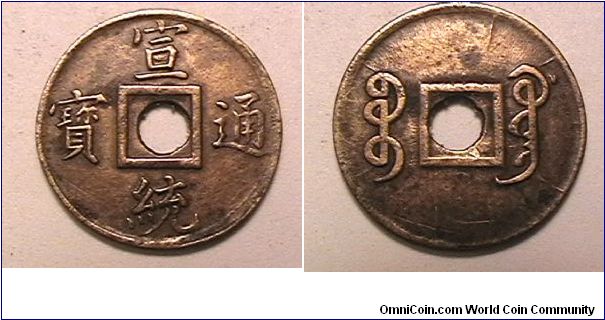
Like this one: This is one of the cash coins made and circulating at the end of the Imperial period of China. It is of a completely different type (above all it has an inscription on both faces) and has a completely different patina from the Baltimore ones. How can the coiney's lawyer claim they cannot be distinguished? Tompa has announced:
I will publish no more comments from Mr. Barford and Ian on this subject. Others may feel free to comment ...
It is perhaps not surprising to find that he does not want to actually answer the questions raised by the material he attempts to use to entrap others. Cultural Property Observer is I would argue a liability for the "collectors' rights" avocacy movement. May it long continue to function as such.

Photo top: the actual coins imported by ACCG dealers through Baltimore, did they leave China before 1930?

Photo, bottom: The coins coiney lawyer Tompa apparently cannot distinguish from the above: Pu Yi (throne name Hsuan-T'ung 1908-1911/12) Not the same coin at all
!
.

Monday, 4 July 2011

Baltimore Seizure Cash Coins: When did they leave China?

.
Running away again.
I will publish no more comments from Mr. Barford and Ian on this subject. Others may feel free to comment ...
writes Washington legal expert Peter Tompa. So I shall just have to ask him about the implications of what he has just added to his website here, and he can pretend he did not see it. But the other coineys will and wonder just what kind of a lawyer they have representing their interests.

Peter Tompa in mean-mindedly hounding SAFE's Cindy Ho has now posted on his website an extract in translation of the Chinese law on archaeological relics from 1930 which was the precursor of the stiffer legislation of the People's Republic of China (see J. David Murphy (1994), An Annotated Chronological Index of People’s Republic of China Statutory and other Materials Relating to Cultural Property, Int’l J. Cultural Prop. 159 for some of the items Tompa does not cite).

The Washington lawyer uses the 1930 law (Art. 6 and 13 taken out of context) to suggest that artefacts sold to "aliens" and which are outside China are stolen property, illegally removed from the country. He concludes:
China's 1935 law may indeed be applicable. It covers artifacts from "other cultures" and bars their sale to "aliens." Barford claims the law does not apply, but is that all that clear?
well, it is clear to me, but Tompa seems to be of another opinion. OK, he's the lawyer - let's follow his argument through to its logical conclusion.

Let's first reflect a moment about the collecting of Chinese antiquities in the West. In particular cash coins (the ones with the square hole in the middle). That this was not very prevalent in the west before the first decades of the twentieth century seems to be very strongly suggested by the date of the appearance of the first basic catalogue for western collectors, Frederick Schjoth's "Chinese Currency: The Currency of the Far East" in 1929 - still treated by some US dealers as the standard numbering system. So, though there must have been such coins in circulation earlier, it is really only after the date of the publication of this work that one might expect to see increasing numbers of imports of these artefacts into western (European and North American) collecting circles from China. So basically the date of import of coins of this type currently on western markets is far more likely to be post 1929/1930 than before that date.


Readers may remember that Peter Tompa is the lawyer participating in the Baltimore Illegal Coin Import Stunt organized by the Ancient Coin Collectors Guild and supported by the Professional Numismatists' Guild and the International Association of Professional Numismatists. The subject of an ongoing lawsuit include some Chinese cash coins bought from a London dealer and imported into the United States in that stunt. I've discussed this disgusting self-serving stunt many times on this blog. But now looking specifically at those "cash" coins, I presume Peter Tompa can document that these artefacts left China before the Relics Act of June 1930 which he himself cites and which he says absolutely prohibits the sale of relics to "aliens" and their removal from the country. Has he done his "due diligence"? If they were removed subsequently, by his own arguments they are stolen property and therefore as 'tainted' goods, cannot be legally sold in the US (Stolen Property Act).

In that case, what Tompa himself has published on his own website now makes it very difficult for the ACCG to argue that the Chinese cash coins should be handed over to them, since in all likelihood (and in the absence of any documentation to the contrary) they left China after 1930, when the legislation which Tompa applies to the material Cindy Ho was handling was already in force (or later versions with the same basic idea). How can the ACCG, PNG and IAPN (represented by Peter Tompa's law firm) ask state authorities to hand over to them material consisting of dugup antiquities which in all probability are stolen in the light of the law of the country from which they came cited by their lawyer Mr Tompa. I bet the ACCG and its lawyers cannot demonstrate each of these specific items not to be post-1930 exports. So that would rather mean their whole case with regard to the cash coins falls flat on its face.

[I know you chaps at the State Department read this blog. If you have not already done so (as I can see you are already running circles round and one step ahead of the dullard dealers) please make sure your legal team know about Mr Tompa's blog post on this topic and bring it up at any hearing there may be as it well shows the hypocrisy and double standards that obtain in the antiquity market which is precisely why upholding legislation like the CCPIA is so necessary].

Photo: Reportedly, the actual coins imported by ACCG dealers through Baltimore, did they leave China before 1930?

Saturday, 2 July 2011

Cultural Property Lawyer: Library of Congress Manuscripts "Stolen" by President's Grandson?

.
In a post about hypocrisy, Washington cultural property lawyer Peter Tompa has accused the Library of Congress of holding a collection of what he says might be "stolen" documents illegally removed from the Republic of China by the grandson of President Theodore Roosevelt. This is an interesting development, given that not so long ago twelve US Congressmen signed a letter attacking the US International Cultural Property Protection program. The suggestion by a Washington lawyer that US Congress itself may be directly involved in the trafficking of stolen objects raises a number of questions which I think decent US citizens should be asking its lawgivers about their policies towards the trade in illicitly 0obtained artefacts.

But how true is this allegation, which must be very upsetting for the family concerned? It transpires from the accuser's own blog that in fact in writing what he did, he had not actually done the victim of his remarks the courtesy of actually ascertaining what the legal situation concerning export licenses for antiquities was at the time this alleged act was committed. Peter Tompa is a "cultural property lawyer" of the Washington firm Bailey & Ehrenberg (which "handles the most sophisticated legal matters", "our partners are experienced attorneys with solid reputations as strategic problem solvers, skilled negotiators..."). What kind of a cultural property lawyer is it that when asked for the legal basis of his insinuation of illegal activity, replies:
I could do all the research you ask, but I'm afraid I'd have to charge for it and I'm not sure you would pay.
Too right I would not, because unlike Mr Tompa, before I questioned what he said I checked the legislation pretty thoroughly, and determined that there was no legislation for that region of the Republic of China which applied to the export of folk art and antiques in the period when the collection concerned left China. Mr Tompa seems to have thrown out accusations without actually checking there was a law which applies to the situation he was "observing" (I use the term loosely). The law of 1950 does not act retrospectively, and the requirement to institute an export licencing system was a proposal of Article 6 of the 1970 UNESCO Convention - which I am sure (even though the US ignores it in their own half-hearted "implementation" of the Convention) Mr Tompa is - or at least should be - aware.

Mr Tompa's accusation of illegal activity by Quentin Roosevelt III with respect to the creation of a collection of artefacts of the Naxi (Nakhi) people are fabrications and crude insinuations with no basis in legal fact.

Followers of the hapless Mr Tompa might be interested in a website which sets it out in simple language for those who don't like books. Here are SOME of the laws concerned of the Kuomintang government, it can be seen that no mention is made of export licences and a distinction was being made between relics in state custody and those in private ownership, registered and unregistered. If Mr Tompa would do some "research" (to enlarge his own professional knowledge rather than for my benefit), I think he would find that export licences were only introduced into Chinese antiquities preservation legislation later, in the People's Republic.


UPDATE 5/7/2011: See the implications of Tompa's further development of his "argument" Baltimore Seizure Cash Coins: When did they leave China?

Sunday, 26 June 2011

Collectors' "Rights": We Gotta Amend the Constitution!!

.
According to a dugup antiquities dealer in the USA, the preservation ethic is a:
malignant cancer gradually penetrating, pervading and corrupting the heart of our Government [which] must be removed at any cost and at all hazards, or it will inevitably destroy everything we stand for and all that we hold dear - including what we think of as the American way of life.[...] Only when the right to collect is indelibly embedded into US law by a Constitutional amendment (or some equivalent measure to the effect that the right to collect trumps any and all interests of archaeology and cultural affairs) will continuation of our traditional right to collect coins and other antiquities be permanently secured.
So, sort of an extension of the 1973 Hobby Protection Act then? Would it make the trade in illegally exported coins and coins deemed stolen from state (common) ownership according to the laws of the country where obtained legal or illegal in the US? So why would the US pass laws which jeopardise its international relationships?

So are they going to repeal the Archaeological Resources Protection Act to allow the looting of collectables from ancient sites at home? Read the above with looting 'Injun' graves (and Judge Waddoups) in mind.

.

Thursday, 23 June 2011

Trafic d'art : le trésor de guerre du terrorisme

.
Vendredi 24 juin 2011 de 12h30 à 13h25 sur Canal+ Décalé
Trafic d'art : le trésor de guerre du terrorisme - Une enquête de Romain Bolzinger.
Berceau de l'une des plus anciennes civilisations au monde, l'Irak est une mine d'or pour les archéologues : le sous-sol de Mésopotamie regorge de vestiges qui se négocient très cher dans les salles des ventes occidentales. Or, certains objets sont issus de fouilles illégales. A la chute de Saddam Hussein, le chaos a permis le pillage des musées de Bagdad. Au Liban, berceau de la civilisation phénicienne, le trafic d'art finance le Hezbollah. Le monde très fermé des collectionneurs d'art ne s'embarrasse pas de ces «détails». Milliardaires passionnés, galeristes fortunés et antiquaires sans scrupules font affaire. [...] Ironie de l'Histoire : les descendants des Sumériens, Assyriens et Babyloniens, fondateurs de notre civilisation, participent involontairement à sa destruction via un trafic d'antiquités qui finance le terrorisme le plus sanglant ! C'est la piste suivie par cette enquête passionnante et rigoureuse qui nous mène d'Irak au Liban, en passant par les salles de vente les plus réputées et les moins scrupuleuses à travers deux exemples très concrets.

En 2005 se vend à Drouot une statuette sumérienne d'une provenance douteuse, accompagnée d'un certificat suspect. Un cas d'école. Le commissaire-priseur auteur de cette forfaiture siège au Conseil des ventes volontaires censé sanctionner ces pratiques... L'Irak réclame en vain la restitution de la statuette. Personne ne bouge, alors qu'il a suffi d'un coup de fil à Romain Bolzinger pour vérifier, auprès des héritiers du collectionneur auquel aurait appartenu cette statuette, qu'ils ne l'ont jamais vue. Tout comme, d'un saut d'avion à New York, le journaliste débusque le galeriste trafiquant ayant pignon sur Madison Avenue et coutumier des descentes du FBI. Puis Romain Bolzinger se rend au Liban, dans le fief du Hezbollah, qui se comporte en parrain des transactions issues du pillage des sites archéologiques. Le mouvement terroriste est le plus gros fourgue de la collection du milliardaire américain James Ferrell, capable de publier sans état d'âme, et en toute impunité, un catalogue de deux cents pièces maîtresses sans pedigree.

And here's an estimate of a "statistic" for David Gill's current survey of opinions:
Avec 6 milliards de dollars, le trafic d'oeuvres d'art arrive en troisième position, juste après la drogue et les armes.
There is a video interview with the programme's author here:

Here is the book to which he refers: Treasures of the Ferrell Collection by Jeffrey Spier.
.

Tuesday, 21 June 2011

Canada Makes the Bulgarians Pay

.
Peter Tompa suggests that in writing about the return of stolen antiquities to Bulgaria archaeobloggers might have 'Misplaced Priorities', CPO, June 20, 2011. This is because "Bulgarian authorities are spending up to 320,000 Euros to repatriate minor Bulgarian artifacts" recently seized in Canada.* Tompa argues that this cash could have been better spent in Bulgaria on protecting sites and issuing artefact hunters rewards for handing finds in (see below).

Well, if we are going to take that attitude, I would ask why the Canadians made the Bulgarians travel all the way to Canada to pick up the stuff and call it "repatriation"? Have the Canadians no diplomatic post of their own that they could send the goods safely to their consulate in Sofia to be handed over there? Or was the whole point not so much getting the artefacts back, but through holding a ceremony on Canadian soil making a big political show of what good guys they are for keeping an eye on what crosses their borders?

*(We may note that Tompa, quite correctly for a lawyer, says "allegedly smuggled", because "As is the case with many similar reports, we'll never know the actual facts because the importer abandoned the property". Let us note that the reported value of the shipments seized was 707,000 euros ($1 million), and my feeling is an importer would have to have a pretty good reason to shrug his shoulders and simply abandon such a haul - surely it can't cost that much in Canada to send your lawyer along to the customs office with a copy of the export licences. So if there had been export licences issued for this shipment (ie the objects were not smuggled), what conceivable reason is there for him to simply abandon his purchase? I really am curious to know).

Thursday, 21 April 2011

Senator Schumer accepted ACCG award, but attempts to halt coin sales

.
On January 30, 2007, the dealers' lobby group the Ancient Coin Collectors Guild awarded Senator "Do What Torturing You have To Do" Chuck Schumer (Democrats -New York) its Friend of Numismatics Award. Senator Schumer was involved in the questioning of the bilateral cultural property agreement with China on the grounds that coineys suspected there "may have been irregularities in how the State Department processed a Peoples Republic of China (sic) request involving a wide variety of cultural artifacts dating from Neolithic times to AD 1911".
Senator Schumer and Jeff Hamond of his staff hosted a meeting where the concerns of New Yorkers, including collectors and the small businesses of the numismatic trade, were raised directly with a high ranking State Department official.
Schumer and now Gillibrand (Democrats -New York). In receiving this award, Senator Schumer joined Senator Kit Bond of Missouri and Congressmen Green, Petri and Ryan from Wisconsin and others in accepting this token of appreciation from the ancient coin collecting community for their help and support for the no-questions-asked market in dugup antiquities.

Of course supporting US dealers selling dugups no-questions-asked is not a problem for Senator Schumer, he'll lend his name to that, no problems there about American people stealing the archaeological heritage from the brown-skinned guys abroad. He has no problems therefore with US collectors putting money into the pockets of culture criminals and organized criminal groups involved in antiquity smuggling to the US. But modern commemorative coins, now THERE is a problem worthy of his attention, there's something to fight for. Gotta stop collectors putting money into the pockets of small US businesses producing commemorative coins and medals. Obvious.

Thursday, 31 March 2011

My Letter to Senator Gillibrand

.
New York senator Kirsten Gillibrand prides herself on transparent dealings with lobby groups, that's nice. So I am posting here my letter to her about her apparent patronage of the recent CPRI anti-CCPIA conference here, and I am hoping she will allow me to post here too any answer she may give. Maybe some readers would like to add their voice to mine, especially those from New-York-Based SAFE. Let us see how she justifies her apparent support for those in and around the US antiquities trade who we would be forgiven for believing are hell-bent on undermining what semblance of international cultural heritage protection the US has to offer, rather than strengthening it.

Dear Senator Gillibrand,
you have been named in connection with the organization of a conference in Washington under the title: „The Convention on Cultural Property Implementation Act (CCPIA): Is it working?”.

Given the tone and content of that meeting (summarized here http://www.cprinst.org/Home/issues), may I ask therefore whether you yourself actively support the International Cultural Property Protection program of the US government (http://exchanges.state.gov/heritage/culprop.html)?

Would you like to see a strengthening or weakening of the ability of the US to set a moral lead by helping stamp out the international trade in illicitly acquired cultural property and related criminal activity?

As you are no doubt aware, the CCPIA serves to regulate the import into the United States of certain designated groups of cultural property which is threatened by illegal activity from specific states. This is done by temporarily restricting items newly coming onto the US market from those states to those which have been legally exported. In this manner, responsible collectors purchasing items on that market can be assured that they are not running the risk of purchasing illicitly acquired material, with all that this may entail. I am sure you will have the same difficulty as me in seeing why any discriminating, responsible and ethical US collector would object to that.

There is however a group of US dealers in and collectors of antiquities and coins – together with their lawyers - who are actively challenging the US Government’s application of these measures. The motives of this group for wanting to challenge measures intended to keep illicitly-obtained material off the US markets can only be guessed. I can only hope that you were unaware that there were people associated with members of this milieu among the organizers of the conference you are named in connection with.

Senator Gillibrand, do you yourself, or those in your immediate environment, collect antiquities, or have any other connection to the global antiquities market and their other advocacy groups?

In the interests of transparency, may I post a copy of your office’s reply here: http://paul-barford.blogspot.com/2011/03/my-letter-to-senator-gillibrand.html?

Thank you for giving your time to reading this
Paul Barford

Thank you


I've just posted a brief note on this on the SAFE blog. Perhaps someone there might invite her and other politicians to in some way show some support for SAFE and its aims?

I note that in the list of topics in the Senator's contact form to choose from, there was no mention of culture or cultural property theft, suggesting this was not a matter about which Senator Gillbrand was expecting to get correspondence from citizens.

*PS because Americans can only imagine that the rest of the world's postal service works like theirs and nobody at all would want to ask a US Senator anything from outside the country, you can't send anything from outside without giving a Zip Code. It blocks you if you put a real postcode of another type. I therefore appended a random Washington DC one to my address. I do not expect she'll be writing back anyway, the letter is longer than it should be.
 
Creative Commons License
Ten utwór jest dostępny na licencji Creative Commons Uznanie autorstwa-Bez utworów zależnych 3.0 Unported.