Showing posts with label US State Department. Show all posts

Thursday, 12 January 2012

"It's Your own Fault": Chasing Aphrodite on the Significance of the Weiss Investigation for Militant US Coineyism

.
The "Chasing Aphrodite" blog has some details of the allegations against Arnold-Peter C. Weiss in relation to transactions involving two Greek coins from Sicily. After noting that the investigation was in its early stages, the blog authors surmise that "given Weiss’ prominence in the numismatic community" (the former treasurer of the American Numismatic Society, chairman of the board at Rhode Island School of Design’s art museum and on the collecting committee of the Harvard Arts Museums), the case:
bears some early similarities to the criminal case against Fred Schultz, the head of the national antiquities dealers association, who was convicted in 2002 of knowingly trafficking in looted antiquities from Egypt. The Schultz case proved a watershed in the art world, underscoring the fact that trafficking in looted antiquities was a violation of American law.

The blog's authors also note the "on-going battles over whether coins should be included in bilateral agreements between the US and foreign nations aimed at preventing the traffic in looted antiquities" and suggest that if brought to court, this case could potentially have a profound effect on the US discussions on this topic. As they note:

Numismatists have long argued that coins should be exempted from import restrictions. As the American Numismatic Society states on its website, “…Because most coins in private collections have been traded and held without any provenance, it is unreasonable to assume that a coin is stolen, illegally exported, or illegally imported merely because the holder cannot establish a chain of custody beyond receipt from a reputable source.” That position may be more difficult to maintain in the face of a criminal case against Weiss, who was treasurer of the ANS from 2005 – 2009.

There is as yet no mention of this series of events in the "News" section of the Ancient Coin Collectors' Guild website, which is a bit odd, isn't it? Certainly, given the intransigence of the ancient coin collecting (scil. dealing) community led by lobbyists employed by the PNG, IAPN and ACCG to attempts to clean up the US numismatic and antiquities market, and their blatant and damaging opposition to US policies on the matter (including an attempt to sue their own government), a high profile arrest or two were on the cards. I guess collectors will be left waiting to know whether there will be any more, and who is next. Who could be on the watch list?

There is an interesting coincidence in the timing of this event. As all coineys will know, midnight of January 3rd was the deadline on the Regulations.gov website for the final public comments to existing laws on import controls on unlawfully exported artefacts from Cyprus (including coins like those many of the people expressing their objections themselves collect). I suppose conspiracy theorists might wonder whether there was a connection between this and the rather late intervention of Federal law enforcement authorities in this matter - also on 3rd January (but at two in the afternoon, rather late for the news to reach all those planning to voice their support for the import of unlawfully exported coins on the last day). Could there have been an ulterior motive for the delaying of the intervention? That might give some coiney conspiracy theorists pause for thought, I guess.

Sunday, 8 January 2012

Another US Collector Loses Property Without Documentation of Lawful Import

.
Claude Hendrickson, president of Dixie Equipment in Woodstock, Ala., bought himself a Douglas AD-4N Skyraider aircraft with full equipment (log books, four 20mm M3 aircraft cannons and assorted aircraft parts) abroad. It is one of relatively few [airworthy] machines of this type still in existence. He then had it flown into the US in August 2008:
without the required authorization from the U.S. Department of State. The pilot, who was hired by Hendrickson to fly the plane from France into the United States, provided false information to U.S. Customs and Border Protection (CBP) officers at the Port of Buffalo, N.Y., to gain admittance into the country.
Nevertheless it seems even a small warplane can be smuggled through the barrier of bubbles that is the US border security. Hendrickson kept it at the Bessemer Airport, Jefferson County, Alabama. The collector had a few problems with getting the cannons through the border though.
The 20mm cannons arrived at the Port of Savannah, Ga., on Oct. 8, 2008, inside two 40-foot shipping containers being imported by Dixie Equipment. CBP officers discovered the cannons concealed in a wooden box, hidden under aircraft parts in the nose of one of the containers, although the cannons were not listed on the entry form, bill of lading, invoice or any other documentation submitted by Dixie Equipment.
It was only after the discovery and seizure of the cannons on Oct. 15, 2008 that Customs and Border Patrol officers noticed the plane. An ICE HSI investigation revealed that the Skyraider aircraft had entered the United States illegally, and as a result the following year ICE HSI agents seized the plane (through a court order of April 24, 2009). As a result, on Dec. 21, 2011, Judge William M. Acker, Jr., U.S. District Judge for the Northern District of Alabama, ordered that the aircraft, log books, four 20mm M3 aircraft cannons and assorted aircraft parts be forfeited to the government as property brought into the United States in violation of U.S. law.
"The Skyraider aircraft, its cannons and parts are all subject to import licensing requirements as ‘defense articles' under the Arms Export Control Act. Federal law prohibits the importation of defense articles without a license or permit," said Raymond R. Parmer, Jr., special agent in charge of Homeland Security Investigations (HSI) in New Orleans. "ICE aggressively investigates these cases in order to deter this type of illegal activity and protect those who abide by our nation's laws."[...] Neither the State Department nor the Bureau of Alcohol, Tobacco, Firearms and Explosives (ATF) had granted a permit, license or other written authorization for the importation of the Skyraider, the cannons or the aircraft parts at the time they entered the United States.
It is now reported that the ICE HSI is currently
working to transfer the Skyraider aircraft, cannons, and assorted aircraft parts, including three Wright engines, to the U.S. Department of the Navy, National Naval Aviation Museum in Pensacola, Florida, for the purpose of preserving the aircraft's value as a significant and lasting part of our nation's Naval aviation history.
Once again, we see another example of US collectors losing their property due to the failure to document lawful passage across international borders. I don't know how much Hendrickson paid for his plane, but suspect he is quite a bit out of pocket through the failure to get the required bits of paper to bring this piece of cultural property into the United States. Again, the CCPIA was not involved at all in this affair, and it seems to me that dealers' lobbyists who claim to be working "in the interests of collectors" really ought to be drawing collectors' attention to the dangers of ignoring acquiring artefacts without paying attention to securing documentation of lawful export and import. They could well find people "coming for their coins" and it is nobody's fault but their own.

Source: Jim Douglas, 'Illegally Smuggled (sic) Military Aircraft, AD-4N Skyraider To End Up At Naval Museum', AvStop Online Magazine January 8, 2012

Vignette: I am not sure if this is the actual plane, but it flies.

Saturday, 17 December 2011

Commentary on the Nov 16th Public Session of the CPAC

.
The Archaeological Institute of America has published on its website two first-hand accounts of the November 16th public session of the CPAC concerning the initial requests for Memoranda of Understanding (MoU) between the United States and Belize and between the United States and Bulgaria under the Convention for Cultural Property Implementation Act (CCPIA). There are two of them, the second is by Nathan T. Elkins (Assistant Professor of Art History, Greek and Roman Art, Baylor University and member of the AIA’s Cultural Heritage Policy Committee.

He gives details of the presentation of several speakers, starting with Stephen J. Knerly ( an attorney who represented the Association of Art Museum Directors [AAMD]), then Peter Tompa (another attorney "and lobbyist representing the International Association of Professional Numismatists (IAPN) and the Professional Numismatists Guild (PNG), two international trade organizations for dealers in ancient coins"). As such, he of course "opposed Bulgaria’s request outright and suggested that if a MoU is signed, the designated list ought not to include ancient coins. Mr. Tompa began by pulling out a wooden ruler...." [Uh-oh...]. He apparently "insisted that looting [...] is no worse than a traffic violation" [ever seen a kid knocked off his bike by a speeding car Mr Tompa?].
Mr. Tompa [...] believes that recent cultural heritage legislation in Bulgaria in 2009 should not be taken seriously by the committee as it was “rammed through by ex-communists only with input from archaeologists.” He stated that metal detectors should be targeted as as opposed to collectors. In his view, there is too much undocumented material in American collections and dealer inventories to force such a burden on American collectors and tradesmen.
[See article 10(a) of the UNESCO Convention - one of the many the US refuses to implement]

Kerry Wetterstrom, a former auction director for Classical Numismatic Group (CNG), offered comments on behalf of the Ancient Coin Collectors Guild (ACCG), an organization governed by American dealers in ancient coins and with a broad base of collector membership. Mr. Wetterstrom made points similar to Tompa’s, although he added that it would be a better approach if Bulgaria were to adopt a scheme similar to the Treasure Act and Portable Antiquities Scheme (PAS) in England and Wales. Under such a scheme, metal detectorists would be allowed to operate and would be encouraged to report their finds to the authorities, which may in turn record or remunerate them for their finds.

So Tompa says metal detectorists should be "regulated" (as if they are not in Bulgaria anyway) and another ACCG representative wants to see a liberalisation.

Elkins spoke next:

I indicated that Bulgaria is a primary source country for freshly discovered ancient coins and minor antiquities that enter the trade in the United States. In view of the precedents of Cyprus, China, and Italy, I suggested that a designated list include coins as there is great demand for fresh supplies of ancient coins in the United States and there is also a great deal of plunder in Bulgaria to feed the trade; I pointed to numerous seizures of ancient coins and metal artifacts that were smuggled from Bulgaria and destined for the U.S. as evidence. I also indicated that coins coming from Bulgaria are indeed the fruits of organized plunder and not casual or chance finds of isolated hoards as opponents of import restrictions have claimed in the past. This is illustrated by bulk lots or wholesale lots of ancient coins from Bulgaria that are advertised on dealer websites and eBay. I held up printouts of eBay auctions that were online at the time of the meeting; one dealer had numerous lots of earth-encrusted metal artifacts such as arrowheads, jewelry, and parcels of thousands of mixed Greek, Roman, Byzantine, and Ottoman coins. Such a mixture of objects from a diverse range of chronological periods represents multiple layers of archaeological sites, not isolated hoards or casual finds. In fact, the American eBay seller explicitly stated in many of his auctions that he received the material directly from “excavators” and metal detectorists in Vidin Province in Bulgaria. Vidin Province is an area that has historically been subject to a large degree of looting and which is also home to Colonia Ulpia Traiana Ratiaria, an important archaeological site that has been systematically targeted by looters. Restricting the flow of all other archaeological materials except coins would solve nothing as it is clear from the seizures and from wholesaler inventories in the United States that the material is derived from the same sources and from the same sorts of organized metal detecting activity.

Elkins then summarises what Christina Luke (Lecturer in Anthropology at Boston University and chairperson of the AIA’s Cultural Heritage Policy Committee), Brian Daniels (Fellow of the Penn Cultural Heritage Center of the University of Pennsylvania Museum), Kevin Clinton (Professor Emeritus of Classics at Cornell University and President of the Board of Trustees of the American Research Center in Sofia). All of these spoke in favour of the US helping Bulgaria stem the flow of unlawfully exported dugup antiquities and other cultural property from the country, which - despite efforts in Bulgaria being stepped up - was still a problem.

Elkins and his colleagues believe that:
those who support a MoU with Bulgaria made a compelling case for its enactment [...] proponents of the MoU better articulated their arguments with regard to the four determinations [of CCPIA art 2602[a](1) PMB] and the actual situation in Bulgaria. We trust that the CPAC will carefully weigh the substance of the commentary provided to the committee and will make a decision that will aid Bulgaria in the preservation of its cultural heritage.
It is quite remarkable that not only are the coineys quite incapable of addressing the actual directions of the CCPIA and CPAC about the nature of public comments required (something I have commented upon too, looking at the public records of their submissions), but that they cannot even agree among the members of the board of directors of their most active lobbying group the ACCG whether metal detectorists are to be encouraged and rewarded (the Wetterstrom-PAS approach) or punished (the Tompa-numismatic dealers approach). So what is teh ACCG's policy towards metal detecting, and the purchase of artefacts which derive from metal detecting?

Saturday, 10 December 2011

Clowns Need to Check the Law

.
Dealer Dave has excelled himself, with one of the longest deranged comments on the doings of the preservationists in a long time, cross posted in several places. Mind you, most of it is, as is usual, cut and pasted from my blog with a bit of the traditional lowbrow vindictive coiney sniping and anti-gubn'mint rabble rousing (this time with a nautical theme) thrown in. I must have touched a nerve with the post about the first of the coiney comments on the Cyprus MOU renewal. As a result of the usual misdirection introduced by this particular blogging "Professional Numismatist", a number of matters of fact need to be straightened out:
----------------------------------------------

I) Dealer Dave, counting on the fact that they are too lazy to check for themselves, tries to convince his coiney readers that Paul Barford:
does not understand the 1983 CCPIA, which essentially anticipated that nearly all MOUs would NOT be renewed and would instead be allowed to lapse unless very convincing evidence could be shown, to the effect that the proposed continuation of what was presumed to be a temporary emergency justifying extraordinary measures would be justified. Congress did not ever intend that MOUs should automatically be renewed unless some extraordinary situation intervened.
[There is no question here of "automatic" renewal of course, this whole discussion is taking place because the process of the renewal of the Cyprus MOU is being referred to the CPAC].

But did the US Congress never intend renewals as Welsh asserts? The one-click approach to finding out the ACTUAL WORDING of the Act (as Public Law 97-446; or as 19 U.S.C. 2601 et seq. I'll use the latter, but the wording of the other is the same, note that Welsh cites no such references) pretty quickly reveals :
2606 (e) Extension of agreements
The President may extend any agreement that enters into force with respect to the United States for additional periods of not more than five years each if the President determines that --
(1) the factors referred to in subsection (a)(1) of this section which justified the entering into of the agreement still pertain, and
(2) no cause for suspension under subsection (d) of this section exists.
That's actually completely the opposite of what Welsh asserts. How is it possible that a coin dealer in the US apparently gets so muddled about the wording of the main law which has any effect on what he does?

Most other nations when they became state party to the Convention did so with the intent of applying its measures permanently (or until they denounce the Convention as per its Articles 23 and 24). As far as I am aware [and I am sure Peter Tompa can provide the other examples if they exist] only the USA considers that it is something they can chose to abide by only when THEY please, and most of which they can choose to ignore except for temporary occasions when they might (perhaps), if you ask them nicely, and convince them that they really should, consider applying a few of the principles to their international trade in artefacts for a while before they stop.

----------------------------------------------

II) Dealer Dave reckons that I am unaware that:
the title of the 1970 UNESCO Convention does not really describe what it is about,
yes, I would indeed be surprised about that, because the title and the contents are quite clearly by the same hand(s) and the title describe the contents of the Convention. According to Dealer Dave the "actual" purpose of the 1970 UNESCO Convention on the Means of Prohibiting and Preventing the Illicit Import, Export and Transfer of Ownership of Cultural Property:
"is very clearly to control "looting" in all its forms, from stripping a nation of ethnological and historical artifacts that have never been buried, to smuggling antiquities that might once have been buried.
No it is not. Just look at it, read it. It is about the Means of Prohibiting and Preventing the Illicit Import, Export and Transfer of Ownership of Cultural Property, in other words, smuggling. The reference to "looting" (actually "pillage") comes from the US legislation supposedly "implementing" it which refers to the single article (9 of 26) which mentions archaeological looting as PART of the problem of illicit trade. Again we see an attempt by the US to impose its own values on the rest of the world.

It is Mr Welsh who does not understand, the Convention covers movement of cultural property across international borders which a state party to the Convention wishes to regulate the passage of, and not just that which is looted and pillaged. It is the legitimacy of that movement (and not merely the origins of the objects themselves) which is the subject of that Convention (see Art. 2, 3, 5, 6, 7, 8, 10-15, 17). "As any fule can see".

----------------------------------------------

III) Dealer Dave asserts that the CPAC is "entitled to recommend to the US Government that the requests of the Cypriot government are not in the best interests of the USA". Is it? Is that its actual mandate? I thought that was what the CCPIA leaves up to the President to decide and the task of the CPAC is something else, that's what the CCPIA says.

----------------------------------------------

IV) Dealer Dave apparently thinks its awfully important to regulate metal detector use to prevent archaeological artefact looting (here we are agreed). In answer to what I wrote, he asks whether I can "establish that Cyprus is doing anything effective to actually regulate use of metal detectors on that island?" Well, despite the fact that it has nothing to do with the smuggling of antiquities, I suppose we could ask metal detectorists what they know about that. Here, for example, is a thread on a European metal detecting forum talking about beach detecting (not archaeological sites, shallow beach detecting is not - I would say - in general archaeologically destructive): "the local police [...] told her that anyone detecting on the beach or land would be scooped right away" (interesting to note another detectorist saying something quite significant in the circumstances: "Try the Turkish sector" since it is the looting following the Turkish invasion which is behind the whole fuss over Cyprus).

Dealer Dave is confused (and showing his woeful ignorance on the matter) when he says that metal detectors must be regulated because:
"metal detectors can only be used to search for buried metal artifacts"
Metal detectors are used in airports, schools, government offices and museums to check people entering the building, in food processing plants, sawmills, they are used by contractors to search for pipes and cables before using a mechanical excavator (or under plaster), they are used to search for lost change on beaches and fairgrounds (there are lots of You Tube videos of US detectorists getting excited by finding 1930s wheaties), they are used by meteorite hunters, gold prospectors. They can be used in token hunts on rallies, and childrens' games at English fairs, US exhibitions, and on the PAS website. All of which are archaeologically harmless (well, except - I would say - the PAS website one). This is one reason why I think the term "metal detectorist" is ambiguous and why when I am trying to be more lucid, I tend to speak of the problem I am concerned about as "artefact hunting".

----------------------------------------------


V) Neo-colonialist Dave says "
nations such as the Republic of Cyprus must solve their own problems, and that it is unfair and unreasonable to create difficulties for US collectors because foreign governments are unable to control the behavior of their own citizens. A government that cannot do that, ipso facto stands indicted as being incompetent to be the steward and guardian of cultural property of any sort.
Let's leave aside that obvious fact that (just as the looting of Iraqi sites when the country was under US/UK-led occupation), the problem of looting on Cyprus is not actually always a problem of the Cypriot government "not controlling" its OWN citizens; Mr Welsh apparently needs reminding that part of the island is under foreign occupation. Also I'd be interested to learn of a nation that has no criminals or ofenders - equally when it comes to making money out of ancient collectables.

Taking the sort of isolationist attitude expressed by Welsh above to its logical conclusion, Welsh would presumably then have the US withdraw from all international conventions involving international co-operation to achieve a common aim. For the rest of us, the illicit trade by culture criminals in items which form the world heritage is not the problem of any one government, but one of those problems that all thinking people should be concerned about and decent people should be joining in to do something about. That antiquity dealers and collectors see themselves as somehow above all that and even actively oppose it is a shame. I personally think they should indeed be shamed and ashamed of themselves for this and the way they go about it.

----------------------------------------------

I leave it up to the reader to decide the degree of intellectual honesty revealed by this polemicist. The original coiney commentator had in a brief text written at the behest of the dealers quite clearly got it wrong in several places. ACCG spokesman Welsh could have agreed and written something addressed to coineys to avoid a situation where they are all repeating the same nonsenses, wasting their own time and that of everyone else. Instead of doing that, Welsh sets out to convince his readers (among other things) that both the US law (CCPIA) as well as the Convention say something other than what they mean, though he provides not a smidgen of evidence (still less any kind of a link to the original text) to substantiate his claims.

Vignette: Dealer Dave thought it necessary to explain to his US readers what an ovicaprid is, for their information, this is not an ovicaprid, just looks a bit like one.

Tuesday, 6 December 2011

AIA Commands American Museums to "Stop Collecting"?

.
A fundamental element of the dogmas and mantras of US no-questions-asked collecting of dugup artefacts is that archaeologists (except the ones who themselves collect) are bad guys who are rabidly opposed to collecting. In an institutionalised form, this is expressed in the alleged anti-collecting ideology of the Archaeological Institute of America. It is necessary for the no-questions-asked dealers and their lobbyists to create an "Other" as a scapegoat and an object of hate in order to create internal unity within the group, and this is the role fulfilled by the caricature image of the "anti-collecting archaeologists" in the process of programmatic misinformation by the dugup dealers' lobbyists.

It is no matter that there is not a single statement on the AIA website supporting the interpretation that the AIA is out to abolish all private collecting of archaeological artefacts. I've analysed them exhaustively and one (one) collector was convinced of that fact. The rest of them however could not care less what the truth is, like sheep they'll happily believe whatever nonsense the dealers and their lobbyists want to force upon them, and obviously are not going to look for themselves. Presumably they think the absence of any indications of the AIA's (alleged) "real" aims in the material it produces are all part of the great Satanic Conspiracy of the "Elders of Archaeon" against collectors.

Coiney Conspiracy Theorist Number One, the paid lobbyist of the numismatic associations, has dug up new "evidence" to support his theory. It comes from an article published in "Cleveland.com" which as Larry Rothfield correctly observed long before Peter Tompa noticed the text "takes a rather parochial view of the issues based on the Cleveland Museum's insistence that it will continue to buy antiquities". In passing in his comments in a session at the meeting: “Saving Cultural Heritage in Crisis Areas”, Rose said that current changes in the context of the acquisition of museum objects, and the ongoing processes of repatriation of items from US museums which apparently left source countries in a less-than-legal manner, means that "he felt the era in which American museums can collect antiquities is coming to a close". Not least is the fact that through negligence of previous owners and dealers, most of the antiquities currently on the market have not collecting histories adequate enough to meet the now much-more-stringent criteria for ethical acquisition that US museums now apply (in response to the crisis brought about by them having allowed too much obviously-looted material into their collections). I think, given some of the news emerging from the US museum world in recent months, his comments of course could equally be applied to paintings and manuscripts and not just ancient dug up artefacts (so-called "ancient art").

With a gleam in his eye, cat-like, Tompa jumps on this, and deftly twists it round:
Brian Rose, the AIA's immediate past president, has been quoted as telling America's museums to stop collecting antiquities. [...] Despite such quotes, archaeo-blogger Paul Barford continues to claim that the AIA is really not against collecting.
This really is an incredibly blatant non-sequitur. Pointing out that something may in future be less easy for museums than it was in the past is not the same as commanding them to stop doing that thing. It will be noted that - in order to find tenuous support for his allegations - the lobbyist snipes at an English blogger working in Europe about AIA policy (on the basis of a biased report on a US website about a meeting that took place in Rome), instead of contacting the AIA or Dr Rose (whose reported 'feeling' he would no doubt confirm is a private opinion). Will the coiney trade associations' lobbyist "Cultural property Observer" be seeking clarification of his position from Dr Rose? I doubt it, after all this is not about the truth is it?

Despite the fact that the comment abstracted from its context (coin collectors are happy to study things abstracted from their context) is not evidence of an otherwise secret conspiratorial policy known only to a few adepts from the higher circles of the AIA and Peter Tompa, this does not stop the coineys from drawing conclusions. This is how one of the ACCG dealers reacted to the "revelation":
The AIA really is dead-set against private collecting. It instead wants all "archaeological artifacts" including minor antiquities such as ancient coins to be locked up in institutions and warehouses where they will never again
be touched by the public, and can only be studied by archaeologists and artifact studies specialists who serve archaeologists.
This is beginning to look like a cult. The affirmation of faith: "The AIA really is dead-set against private collecting (it will not admit it, but we know better don't we brothers?)". The claim that the "Other" is an arcane elitist organization ("where they will never again be touched by the public") which therefore must be opposed by all means, fair or foul. As in militant "metal detecting" circles in the UK, the opposition has started in coiney circles in the US:
The AIA is completely out of step with public opinion. It has alienated US collectors to the point where these once enthusiastic supporters of archaeology have come to think that archaeology has grown into such a malignant cancer upon society that they have consequently not only stopped supporting it, they refuse to allow their children to study archaeology, they are looking for ways and means to stop all public funding of archaeology, and they are seeking ways to reform the State Department's Cultural Heritage Center to end its slavish affiliation with the AIA.
Archaeology has grown to be a "malignant cancer" which must be stopped? Collectors affiliated to the ACCG and its lobbyists are praying for someone to put a stop the cultural heritage protection establishment in Yurope, it is stated that they are turning their children against the discipline (does that apply too to the "ANCIENT COINS FOR EDUCATION" (sic) program (sic) which Dave Welsh's ACCG so avidly supports?), now we hear that US collectors "looking for ways and means to stop all public funding of archaeology". Why? Because archaeologists are among those who signal that the archaeological record is severely threatened by the ongoing commercial and erosive exploitation to fuel the no-questions-asked market for collectables? Because the US promulgated a law back in 1983 the application of which is now causing problems to those who want to import ancient artefacts from source countries without having the bother of documenting how they got to the US? This is beyond silly, this is simply cretinous.

If there is a legitimate trade in ancient artefacts (and I am constantly told by those engaged in it that there is), then why is there such rabid resistance to the requirement (a LEGAL requirement in the US) that part (just part) of the trade is indeed being carried out licitly in accordance with the international convention to which the US willingly became a state party back in the early 1980s? If "US collectors" cannot abide and are so unwilling to abide by those rules, then let them lobby Congress for the US to withdraw from that Convention. Then we will see whose side US and world "public opinion" is on.

Thursday, 3 November 2011

CPAC Comment "Statistics"

.
Over on the US coin fondler's blogs they are discussing the end and final results of the online comment-gathering session on the Regulations.gov website for the Cultural Property Advisory Committee on the request from Bulgaria for the US to enter into a bipartite cultural property agreement to more fully respect the principles of the 1970 Convention on the Means of Prohibiting and Preventing the Illicit Import, Export and Transfer of Cultural Property. Dave Welsh reports (Thursday, November 03, 2011 "Bulgarian MOU Comment Statistics") on the basis of a summary created by ACCG employee John Hooker that:
The actual total of relevant comments was 499 (not 504 as recorded on the DOS website) -- a couple of people (including one AIA member) were so confused that their comments indicated they thought they were replying to the Belize request instead of the Bulgarian request.
As though this was some kind of popularity contest (or viewers' votes in "Dancing with the Stars" - ugh) he reports: "353 commented disapproving of the MoU" and among them "342 commented registering an objection to coins being included in the MOU". On the other hand: "146 commented approving of the MoU" and it was presumably among them that "13 commented [specifically] supporting coins being included in the MOU". Thus: "The result to the nearest percentage point is 71% Against, 29% For". The coineys still manage to spin the figures, despite the falling numbers of coineys commenting: "Responders opposing the Bulgarian MOU and its prospective inclusion of coins improved slightly upon the 70% of responders who had objected to the Greek MoU". You have to laugh.

Both Welsh and Sayles jubilate that at least one person wanting to see an exclusion of coins from import controls is an AIA member (more on this below since the coineys made such a meal of it)One has to laugh at the next bit of Welsh's tub-thumping: Most of the late AIA generated responses were due to a late email campaign by the AIA -- the majority clearly having been hastily written by cut and paste methods from templates provided for them by the AIA. That sharply contrasts with the clearly thought out posts from US collectors (and a few coin dealers such as myself) protesting the expected inclusion of ancient coins in the forthcoming Memorandum of Understanding. These pro-collecting comments are well worth reading. All of them express genuinely sincere, individually composed opinions.No they do not. They repeat the same claptrap they were told by dealers that they should consider (in a text drafted by Peter Tompa disseminated by several major dealers). Most of them contain the telling phrase "that tens or hundreds of thousands of these coins existing in collections around the world have never have been through an auction or other transaction where precise provenance has been recorded". of course the CCPIA says nothing about provenances or auction houses, it is merely about proper export procedures. What is perfectly clear is that the vast majority of those that tried to go beyond the schema supplied by Tompa and frame their thoughts in their own words, in fact had no real idea what the CCPIA says, what it is about, what it is for, and what the issues are. Most of them (probably as a result of earlier ACCG "cultural property nationalism" claptrap) clearly see the issues as the "retention" of loose "antiquities" in "museums", rather than efforts to curb commercial looting of sites. These people exhibit a total lack of real knowledge abouyt the archaeological side of the issues, probably because they only go on what they are told by the dealers and their lobbyists (reading around an issue clearly not being the forte of most of these collectors). The dealers and lobbyists of course have an interest in keeping them uninformed (I see Sayles claiming he did archaeology 101 - from what he now shows of his "knowledge" by what writes, I suspect he'd not have passed any exam I marked).

Also amusing is the comment on the "late AIA responses", of which nine were noted as having "mentioned coins", and one AIA member did not want coins to be included in the MOU.
In all, only 14 members of the AIA seem to have understood the issues well enough to mention coins,
Of course whether coins go in the MOU or not is in effect a minor issue (either the MOU covers all the sorts of things looters are extracting from archaeological sites with metal detectors and bulldozers, or it does not) - the question is whether an MOU is the best way to deal with the problem under consideration which is what the CCPIA section 303(a)(1) on which comments were invited was about. The next much more important question for America is whether the 1983 CCPIA is in fact the best way to "implement" the Convention. I think we all, all countries, need to look much more carefully at the ancient (1970) Convention on the Means of Prohibiting and Preventing the Illicit Import, Export and Transfer of Cultural Property and the way we all "implement it" and make some changes in response to the way the market has changed since the 1970s and 1980s. All of us, not just America (but that is no reason why the USA cannot start now). Looking at the other UNESCO Conventions, it is striking that the 1970 Illict antiquities Convention is one of the few of the older ones that has no updating and clarifying protocols. Let's press for one or two before a complete and effective rewrite.

I agree with Welsh that the response of the AIA was:
a really pathetic response, considering their huge claimed membership (the circulation base of Archaeology magazine).
Really, really pathetic. It seems that when faced with actually thinking about and doing something about portable antiquity issues, archaeologists both sides of the Atlantic feel no compunction to get involved in any way at all. Yes, they are complex issues - is that any excuse for sitting back and let others do all the work? Just 146 had anything positive to say to the CPAC in response to this request. The rest obviously cannot give a monkeys. Unlike the coineys they have no personal interest in stopping any illegal trade in artefacts from far-off Yurope.

Europe is a country and everyone speaks French there(You tube video posted by Makulature)

Welsh's conclusion seems drafted to become the mainstay of future antiquity dealer opposition to the implications of the US being a state party to the 1970 UNESCO Convention:
Once again, US citizens interested in ancient artifacts have made it clear that they strongly disapprove of import restrictions, especially the prospect of import restrictions on coins. Once again, the State Department's Cultural Heritage Center had already negotiated the details of recommendations that will eventually be made by the CPAC supporting what the Bulgarian government has asked for, prior to the submission of Bulgaria's request. There is every reason to expect that it has long since been decided that ancient coins will be included in the Designated List.
The facts are that among those "interested in ancient artifacts" in the US are the collectors of the hundreds of arrowheads, Roman fibulae, Byzantine crosses and encolpions, finger rings, earrings harness bosses and military equipment fittings (etc.) which also come off these Bulgarian sites by the same process of metal detecting and bulldozing and are shipped to the US in the same containers as the coins and sold on the same internet venues. These collectors on the whole did not come out in "strong disapproval" of import restrictions. it seems they have more of a conscience than coin dealers and maintained an embarrassed silence, with only a few individuals weakly protesting that what they do does no harm to the European archaeological record (Mark Hogan: "I do not beleive that coins, bronze crosses, Byzantine religious metals, etc. should be classified as culturally significant").

Welsh adduces not a single shred of proof that (let's quote that again):
[DoS] had already negotiated the details of recommendations that will eventually be made by the CPAC supporting what the Bulgarian government has asked for, prior to the submission of Bulgaria's request. There is every reason to expect that it has long since been decided that ancient coins will be included in the Designated List
. Since the first meeting of the newly-constituted CPAC will be taking place a few days from now, I really do not see how they can have been "instructed" what recommendations to make. I suspect coins will be in the list, but not because Washington bullied Bulgaria into putting them there, but because the metal detecting of ancient sites for saleable minor objects for sale on the international market is doing unacceptable damage to archaeological sites in the region. The flow of coins onto the international market are part and parcel of that destruction. What is a more important question is how it is possible that in a nation which has a large educated middle class (though see above) and is a state party f the 1970 Convention, how the trade in coins and other artefacts which everybody knows have been coming from Bulgaria has been going on on such a scale
for so long without anyone doing the slightest thing about it. What image of the United States of America (freshly rejecting its obligations to UNESCO too) does all this present the outside world? Certainly not one that I'd be proud of if I lived and worked in archaeology there. Do something about it, wake up America. Take this trade down and all who are involved in it.

Vignette: What 'American' ideals lie behind the US no-questions-asked trade in artefacts taken without any kind of documentation of licit origins from foreign "source countries"?

Wednesday, 26 October 2011

State Department Clarifies US-Egypt MoU

.
Further to my earlier attempts to help hasty ranting coiney buffoons (see here too) understand that one can have many types of Memoranda of Understanding about dealing with illicit antiquity movements, I post this statement which the Department of State has produced in response to the confusion being spread by certain parties in the collecting milieu (and the Cultural Property "Research Institute"):
"Potential Memorandum of Understanding between U.S. Immigration and Customs Enforcement and Egypt's Ministry of State for Antiquities

The Department of State's Cultural Heritage Center has become aware that confusion exists concerning a potential MOU between U.S. Immigration and Customs Enforcement and Egypt's Ministry of State for Antiquities. Such an agreement would differ from the type of MOU made under Article 9 of the 1970 UNESCO Convention for import restrictions on certain categories of cultural materials. The Department understands that the MOU presently under discussion by U.S. Immigration and Customs Enforcement concerns information exchange and not import restrictions. If the Government of the Arab Republic of Egypt requests an agreement pursuant to Article 9 of the 1970 UNESCO Convention, the Department of State would announce receipt of such a request in the Federal Register. This procedure is the only means currently available to a country wishing U.S. import restrictions on its cultural property."
As I said earlier, the US Administration must be getting heartily fed up with the antics of these dugup coin collectors wasting everybody's time when there are far more important issues to deal with.


Hat tip to Rick St Hilaire.

Sunday, 23 October 2011

American-Egyptian Memorandum of Understanding on Antiquities Smuggling "to be Signed Soon"

.
An American-Egyptian memorandum of understanding making the Customs and National Security Department in the USA responsible for tracking and catching antiquities smugglers in the United States is to be signed soon reports Al Ahram and Al Masry Al Youm. Of course this is what becoming a state party to the 1970 UNESCO treaty obliges America to do anyway, so its good to see them formally confirming that they do intend honouring just a little bit more of those obligations, though 28 years later than one would have hoped. So it seems my map may well need another red area.

Dealers' paid lobbyist Tompa complains:
Such MOU's (sic) are only supposed to be decided after a formal request from a State Party to the State Department. CPAC is then supposed to make recommendations to the President's designee at the Department of State, Bureau of Educational and Cultural Affairs, who in turn is only supposed to agree to import restrictions if specific statutory criteria are met.[...] If the reports emanating out of Egypt are true, its just more evidence that the whole CPAC process is but a bad joke.
Yes, the way the United States of America "implements" the 1970 Convention is indeed a bad 1980s joke. A very bad and damaging joke, given the voracity of the US no-questions-asked market for antiquities. It's good to see some evidence that the US is at last changing its attitude to the cultural property rest of the world. Probably dealers like the ACCG have done their part in bringing home just how much damage can be done to international relations by continuing to ignore the problem.

In any case, Tompa is being misleading when he says that such measures always need CPAC input, emergency regulations do not, do they? Anyway, the Cultural Property Research Institute (sic) is already on the case.

Thursday, 20 October 2011

How is Belize doing?

.
It might be interesting to compare the coiney naysayers' efforts to preserve the import of paperless dugup artefacts into the US with the comments received on the proposed MOU with Belize. There are currently just six.

Possibly part of the reason is that the AIA webpage neglects to display in an obvious place the link to the public comments webpage which seems a silly omission if it is serious about drumming up support. Here it is:
Link for Comments on Belize MOU.
The list of people who have so far submitted comments is as follows:
Polly Peterson [attachment with eloquent informed letter], Carolyn Freiwald (U. of Wisconsin), Cynthia Robin (Northwestern University, brief, but addresses precisely what was asked unlike the coineys in the other folder), Elizabeth Graham (UC London, also addresses section 303), "Arian", Mary Pohl.

It is notable that the first four have clearly taken note of the scope of the call for comments and that it refers to section 303 of the CCPIA. I would not have thought that one needed to have higher education to comprehend a simple notice - so there must be some other reason why in the other (Bulgarian) folder US coin collectors are consistently showing they have simply not understood what they have been asked to comment on. Perhaps there is something in the corrosion products of dugup coins (benzatriazole?) which befuddles the brain.

Vignette: Belize has the highest concentration of Mayan Ruins in the World, with over 600 sites identified.

Thursday, 6 October 2011

Washington may cut UNESCO funding over Palestinian Vote

.

US collectors who cannot see the relationship between the State Department's "cultural property protection program" which they so bitterly oppose and the furthering of US foreign relations and policies should take heed of ongoing events concerning Palestine. UNESCO, the UN’s Educational, Scientific and Cultural Organization based in Paris, is expected to vote whether to accept the Palestinians as a member state. US Secretary of State Hillary Clinton hinted Wednesday the US may withhold funds to UNESCO if it takes this vote. Apparently the US contributes some 22 percent of the organization’s yearly budget and the overnight loss of these funds would cripple UNESCO. House Foreign Affairs Committee Chairwoman Ileana Ros-Lehtinen (R-Florida) has already called for a cut-off of US funding to UNESCO if the Palestinian request is approved. We recall that Ronald Reagan, pulled the US out of UNESCO in 1984 because of its "anti-American agenda" and Washington did not rejoin until 2003. The US has tried these bullying tactics before in 1989 they prevented the PLO from gaining entry into UN-affiliated bodies by the same means. Voting on Wednesday on the proposal from Palestine in the 58 state representatives on the Executive Board of UNESCO (14 nations abstained, but only the US, Germany, Latvia and Romania voted against), leading to them putting the proposal forward to a full vote.
Clinton urged UNESCO’s governing body to “think again before proceeding with that vote, because the decision about status must be made in the United Nations and not in auxiliary groups that are subsidiary to the United Nations.” “What is the boundary of this state that is being considered by UNESCO?” she asked.“What authorities does it have? What jurisdiction will it be endowed with? Who knows?
So basically the US considers that a foreign national born one side of a contested line on a map on the other side of the world by reason of the place they are born has no fundamental rights of access in any form to international institutions promoting education, scientific and cultural co-operation. They are to exist in a US imposed cultural and educational ghetto?

What happened to "we hold these truths to be self-evident, that all men are created equal, that they are endowed by their Creator with certain unalienable Rights"? Basically, it seems at times that the state that is (allegedly) founded on that principle shows itself to be hypocritical at every step in that regard, both within itself as well as its relations with the outside world - especially when we see the way it is applied to other peoples' rights to cultural self-determination. Let us note that what the US actually wants to prevent here is other countries taking a VOTE, just in case the vote shows that the majority of the other countries do not all want to follow US directives in this matter. Scandalous.

So US collectors opposing US policy on cultural property as created by their State Department are in fact engaging in moves contrary to the interests of their state. Can the ACCG therefore be considered an anti-American organization?

Herb Keinon, 'Clinton: UNESCO should 'think again' on Palestinians', Jerusalem Post 10/06/2011

Vignette: Palestinian children.

Tuesday, 9 August 2011

Reactions to the Baltimore Illegal Coin Import Stunt Case Decision

.
The news that a decision had been reached in the ACCG Baltimore Illegal Coin Import Stunt Case seems to have reached Peter Tompa yesterday (Monday) morning. The news went up on the ACCG website yesterday at an unspecified time: "Decision Released in Baltimore Litigation ACCG website, 8th August 2011.

Dave Welsh was one of the first to write at length about it with his usual fire-and-brimstone approach (no mention of stringing people up this time) at 12:16 AM PT: He calls it "A Disastrous Legal Decision". Since this is the only comment so far which looks to the future, I would like to discuss some of the things he suggests in a later post.

Peter Tompa on his own Cultural Property Observer blog writes at 5:19 AM: "Not for Me to Decide...", referring to the District Court's judge's assessment that she has not the authority to judge the President of the USA.

Then it was Rick St Hilaire's turn at 1:01 AM EST: "Judge Dismisses ACCG Challenge to Cultural Property Import Protections - Acknowledges President's Foreign Policy Role in MoU Process". he notes three important points about the decision.

David Gill has a short note: Baltimore Test Case Rejected

I wrote a piece between trying to plough through the 52 pages of the Judge's decision (not there yet) and a rather nice bottle of red which I'd opened to celebrate.

Wayne Sayles, who we may suspect was in fact the main instigator of the whole action, has a surprisingly magnanimous approach to the whole affair, at 11:31 AM EST: "The Morning After"

Then Peter Tompa again: "Legal Times Blog About ACCG Decision" about a blog by Zoe Tillmann "Coin Collectors' Guild Loses Bid to Import 1,000-Year-Old Coins"
Blake dismissed claims brought under the Administrative Procedure Act, writing that decisions made pursuant to presidential authority weren’t subject to judicial review. Regarding whether the State Department exceeded its authority, Blake found that the law put the burden on the importer to prove the artifacts are legitimate, “and prohibits the importation of those objects if they cannot meet that burden.

The guild also argued that the restrictions amounted to a violation of the First Amendment because the inscriptions and motifs on the coins are “information or speech” and convey content [which has got to be one of the stupidest justifications for no-questions-asked collecting on the planet - PMB]. Blake disagreed. “Even if ancient coins convey information about ancient societies, the government’s interest in combating the pillage of archaeological materials is unrelated to the suppression of the flow of that information,” she wrote.

I'm interested to see what Kimberley Alderman ("Cultural Property Law Deathmatch: The Ancient Coin Collectors Guild v. The State Department" - "it's the equivalent of cultural property lawyer porn"), Derek Fincham, and a few others will make of it.

Vignette: Nice bottle of Italian red to celebrate.

UPDATE: Kimberley adds her comments: Ancient Coin Import Restriction Test Case Dismissed "While the precise basis for the dismissal is a little different than what I had explored, it arises out of the same problem with this particular test case. The Plaintiffs weren’t just asking for a limited decision about a specific seizure; they were looking for a broader decision about coin import restrictions. The Court determined it didn’t have the authority to issue one". So how much did making the gesture of submitting a useless complaint cost US collectors and dealers who donated the coins for the "benefit auctions"?
.

Tuesday, 5 July 2011

Coiney Lawyer: "These coins could have been found in America"

.
Peter Tompa continues his 'gottcha' exploration of Chinese antiquities preservation legislation. In referring to my post about the ACCG Baltimore cash coin seizure that Tompa's firm are being paid lots of money to steer through the courts, Mr T. says I am "silly". He asserts this based on two considerations. The first is that:
doesn't the fact that the standard work on them predates the Chinese law suggest they were widely collected in the West before 1930?
No. Schoth's work to which I referred was the first proper guide to collectors (as the author in his preface points out) which means serious collectors could not follow the old adage "first buy the book" until its publication in 1929. Once however a type series was in circulation, the popularity of the serious collecting this material would have been increased, which would be reflected in the stocks of dealers only after that time. I think collectors in the Ancient Coin Collectors' Guild might cringe at the person who is represents them in their fight against measures intended to clean up the US market referring to Schjoth 1929 as "the standard work"!

The other reason Tompa asserts I am "silly" is:
Chinese cash probably exist in the millions, if not billions. They circulated widely outside China, as far as West Africa. They even find them in the US brought there by Chinese immigrants. [...] In China, they were likely still treated as media of exchange as opposed to relics at the time the statute was written. (They were made until the end of the Chinese Empire, c. 1911.) Even in China today, they are widely collected without any provenance information whatsoever.
well, the last assertion is meaningless, since the question that Tompa was discussing at the beginning when he was mean-mindedly hounding somebody at the beginning of this series of posts was export and export licences. He seems to want us to forget this now.

Now, Chinese cash coins of the type Tompa's clients imported through Baltimore did not "circulate widely" in West Africa. Later cash coins are found there, but unless the context shows otherwise, I cannot see why Tompa sees them as evidence of monetary circulation. This is "Gavin Menzies stuff". Whether or not they were made in thousands or millions is neither here nor there when we are talking not about thousands, but the particular coins that came through Baltimore and their origins with reference to Tompa's own (incomplete) presentation of the Chinese legislation.

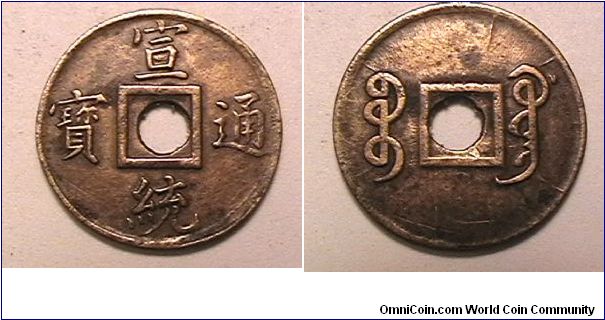
If we look at the ones that were figured in a coiney magazine article about the seizure (top photo) we see three Ban Liang coins, and two Wu Shu coins at the bottom (some have been photographed upside down and on their side).


In an effort to claim that that the 1930 law he himself applies to other artefacts does not apply to them, Tompa suggests it is possible they could have been in circulation even in the twentieth century - in other words taken out of circulation and into a western collector's pocket before 1930. Really? So why then do they have corrosion products on them? (Leaving aside the issue of what those corrosion products actually look like). If these were Han (or at any rate pre-Sui dynasty) coins which had still been in circulation until 1929 as Tompa says is "possible", they would not look like this, they would be worn, and have brown oxide patinas.

Like this one: This is one of the cash coins made and circulating at the end of the Imperial period of China. It is of a completely different type (above all it has an inscription on both faces) and has a completely different patina from the Baltimore ones. How can the coiney's lawyer claim they cannot be distinguished? Tompa has announced:
I will publish no more comments from Mr. Barford and Ian on this subject. Others may feel free to comment ...
It is perhaps not surprising to find that he does not want to actually answer the questions raised by the material he attempts to use to entrap others. Cultural Property Observer is I would argue a liability for the "collectors' rights" avocacy movement. May it long continue to function as such.

Photo top: the actual coins imported by ACCG dealers through Baltimore, did they leave China before 1930?

Photo, bottom: The coins coiney lawyer Tompa apparently cannot distinguish from the above: Pu Yi (throne name Hsuan-T'ung 1908-1911/12) Not the same coin at all
!
.

Saturday, 2 July 2011

Cultural Property Lawyer: Library of Congress Manuscripts "Stolen" by President's Grandson?

.
In a post about hypocrisy, Washington cultural property lawyer Peter Tompa has accused the Library of Congress of holding a collection of what he says might be "stolen" documents illegally removed from the Republic of China by the grandson of President Theodore Roosevelt. This is an interesting development, given that not so long ago twelve US Congressmen signed a letter attacking the US International Cultural Property Protection program. The suggestion by a Washington lawyer that US Congress itself may be directly involved in the trafficking of stolen objects raises a number of questions which I think decent US citizens should be asking its lawgivers about their policies towards the trade in illicitly 0obtained artefacts.

But how true is this allegation, which must be very upsetting for the family concerned? It transpires from the accuser's own blog that in fact in writing what he did, he had not actually done the victim of his remarks the courtesy of actually ascertaining what the legal situation concerning export licenses for antiquities was at the time this alleged act was committed. Peter Tompa is a "cultural property lawyer" of the Washington firm Bailey & Ehrenberg (which "handles the most sophisticated legal matters", "our partners are experienced attorneys with solid reputations as strategic problem solvers, skilled negotiators..."). What kind of a cultural property lawyer is it that when asked for the legal basis of his insinuation of illegal activity, replies:
I could do all the research you ask, but I'm afraid I'd have to charge for it and I'm not sure you would pay.
Too right I would not, because unlike Mr Tompa, before I questioned what he said I checked the legislation pretty thoroughly, and determined that there was no legislation for that region of the Republic of China which applied to the export of folk art and antiques in the period when the collection concerned left China. Mr Tompa seems to have thrown out accusations without actually checking there was a law which applies to the situation he was "observing" (I use the term loosely). The law of 1950 does not act retrospectively, and the requirement to institute an export licencing system was a proposal of Article 6 of the 1970 UNESCO Convention - which I am sure (even though the US ignores it in their own half-hearted "implementation" of the Convention) Mr Tompa is - or at least should be - aware.

Mr Tompa's accusation of illegal activity by Quentin Roosevelt III with respect to the creation of a collection of artefacts of the Naxi (Nakhi) people are fabrications and crude insinuations with no basis in legal fact.

Followers of the hapless Mr Tompa might be interested in a website which sets it out in simple language for those who don't like books. Here are SOME of the laws concerned of the Kuomintang government, it can be seen that no mention is made of export licences and a distinction was being made between relics in state custody and those in private ownership, registered and unregistered. If Mr Tompa would do some "research" (to enlarge his own professional knowledge rather than for my benefit), I think he would find that export licences were only introduced into Chinese antiquities preservation legislation later, in the People's Republic.


UPDATE 5/7/2011: See the implications of Tompa's further development of his "argument" Baltimore Seizure Cash Coins: When did they leave China?

Friday, 24 June 2011

"Heritage Auction" Director Korver on His Failed Role in the CPAC

.
Former CPAC member Robert B. Korver has an article out in the coiney press under the inflammatory and oddly punctuated title "Congratulations! Your government believes... If You Collect, Coins You Are No better Than A Tomb Robber" (Celator June 2011, pp 30-32) supposedly to illustrate that its not just the brown-skinned folk which US coineys want to relieve of their archaeological heritage who have corrupt governments. All it shows me is how unsuitable the choice of Korver was as a Presidential advisor on cultural heritage in the first place - but we all know the younger President Bush was ill-served by his advisers in many areas. The text is the typical loosely structured ranty numismatic cant that we are used to meeting when coin fondlers get all riled up. If this is typical of the way Korver addressed fellow Commitee members, one can imagine he was not met with much understanding. Korver describes his exit from the CPAC in the following words: "Once the lunatics figured out how to seize control of the asylum, it was time to quit". I wonder that with his extreme coiney views expressed in overtly anti-archaeological and anti-establishment ACCG-lingo, it was not politely suggested to Korver that he had outstayed his welcome as a cultural "adviser".

Let's have a look at a few typical passages:

"Imagine today America claiming all $100 bills circulating abroad as our "cultural patrimony"...' is supposed to be an analogy to source countries objecting to the illegal export of archaeological material to fuel the US market.

"These MOUs are not your friend" - they restrict the number of illegally exported antiquities US importers can bring into the country. The point is of course that the MOUs were not designed to be the "friend" of those who wanted to profit from foreign criminal activity, were they? Surely that was the whole point of them?

"I was asked by the Bush White House to join the CPAC in July of 2003, and I served the interests of the collecting community faithfully" - note not objectively advising the state on the cultural matters under consideration as part of a team of eleven members. Mr Korver seems to project here the image of somebody who imagines he alone was a one-man CPAC, and one furthermore with a mission to place the interests of the dealers in ancient dugups before that of the protection of the cultural heritage, rather than seek some kind of responsible compromise.

We remember an earlier text in which Korver suggested the place for the CPAC is not the Bureau of Educational and Cultural Affairs (ECA) of the U.S. Department of State, but the Department of Commerce(!) This casts considerable doubt about his view of what the Committee's tasks actually were.

"Just in case nobody else has told you this before, professional archaeologists own ancient history, not criminals like you". It is odd that Korver thought the subject of CPAC deliberations was "who owns history" and not the US taking a moral lead and doing its part to combat the erosion of the world's historical record and the depletion of another country's cultural property due to illegal activity. I do not think anyone considers coin collectors to all be "criminals", just the one who knowingly and carelessly buy illicitly-obtained dugup artefacts. They are the real looters of the past and make its study by more responsible amateurs as well as professionals of this and future generations impossible. This is why the US - one of the world's largest markets for this kind of material - should be taking the moral lead and trying to curb this. They are not going to be able to do this if a member of the CPAC is by his own admission sitting there continually "advising" the rest that the US should not be doing this because - as he admits above - his loyalties lie with the no-questions-asked market (Korver is a Director of Heritage Auctions, America's largest collectibles auctioneer and third largest auction house in the world - turnover last year $716,664,649 including ancient coins of unclear provenance and collecting history).

Like all the rest of the "Cultural Propert Internationalists" spawned by the ACCG movement, Korver (p. 31) "much prefers Britain's Portable Treasure scheme which allows duplicate material to enter the market". The former "cultural expert" appointed by Bush can't even get the name of his preferred system right. Its the Portable Antiquities Scheme, which "allows" nothing; that is Britain's legislation (the Scheme is a result of the legislation not the other way round Mr Korver, and neither has anything to do with "duplicates"). The Treasure Act is something else, and has nothing to do with "duplicates". One would have thought that the guy could have found out more at least in the years after his appointment to the role of expert advisor, about how these things work. Another reason perhaps for us thinking that Mr Korver was an unsuitable candidate for the role to which George Dubbya appointed him.

Korver says that "CPAC guided previous administrations in their response to the cultural property demands (sic - "requests" is the word Mr Korver) made by foreign governments, and had previously agreed that while the import of certain antiquities and works of art should be relegated, ancient coins should be exempt from such restrictions". On the grounds presumably that they are neither antiquities nor works of art being looted? - surely some mistake? In point of fact, Bolivia, Canada, Colombia, El Salvador, Guatemala, Honduras, Mali and Peru are not noted for being source countries of ancient coins. That is the reason why these coins were not in the MOUs reached with those nations, Mr Korver. One might have thought that a presidential appointee as cultural advisor would have understood that.

As further justification why nobody should be concerned about the illicit movement of cultural property, Korver - who claims he himself has been trained in "ethno-history" - trots out the "Petrarch collected coins argument". He threatens coineys that one day he "may write a history of how archaeologists who stand on the shoulders of two centuries of numismatic research (sic) have turned on their former friends". I suggest he does not bother if it is going to be as Amerocentric and full of ranty bluster and mistakes as the text he wrote for the coiney broadsheet "Celator". It should be noted that there are three adverts for Californian dugup coin dealers in the body of his article.
.

Monday, 30 May 2011

New York Senator Gillibrand and Cultural Policy

.
Readers may remember that on March 21st the Cultural Policy Research Institute (a thinly disguised reformation of the American Council for Cultural Policy ACCP) organized under the patronage of New York senator Kirsten E. Gillibrand a "seminar" in Washington attacking the Convention on Cultural Property Implementation Act. About two months ago I wrote to the Senator asking for clarification of her views on the international trade in illegally exported dugup archaeological artefacts.

I noted at the time that in the list of topics in the Senator's contact form to choose from, there was no mention of culture or cultural property theft, suggesting this was not a matter about which Senator Gillibrand was expecting to get correspondence from citizens. Although I did not receive an answer to my letter, I note that the Senator has since that time engaged in activities suggesting she is taking an interest in promoting culture and the arts after all. On March 23rd at the Brooklyn Museum there was a workshop sponsored by the Office of Senator Gillibrand "Promoting the Arts, Cultural Institutions and Historic Sites: An Economic Development and Grants Writing Workshop". On April 27th a related programme was offered at the Albright-Knox Gallery Auditorium, Buffalo, New York there was a session on “Promoting the Arts, Cultural Institutions and Historic Sites: A Strategy for Economic Growth and Job Creation". On 17th May, a similar event ("Promoting the Arts, Cultural Institutions and Historic Sites: A Strategy for Economic Growth and Job Creation") was held at Cornell University, Ithaca, New York (Daniel Aloi, 'Panelists promote culture, tourism benefits to regional economy development', May 26, 2011).

Based on the promotional material to these events I imagine that has Senator Gillybrand done me the courtesy of replying, the Senator's office would have sent a reply to my letter that looked something like this:
Dear Mr Barford,
Thank you for your interest in the work of this office. Senator Gillibrand considers culture is very important, and was pleased to be involved in the organization of a discussion in Washington of the Cultural Property Research Institute on the efficiency of the Convention on Cultural Property Implementation Act.

The Senator of course supports the State Department’s initiatives on cultural protection and is certain that Secretary Clinton and the staff for which she is responsible fulfil their duty with integrity and the best interests of America's international standing as their highest priority.

Senator Gillibrand is definitely a champion for the arts and takes great interest in what is going to happen in this regard in the next legislative session, it is important that we work with lawmakers to pursue aggressively and creatively the promise of partnerships between industry and the world of culture. She embraces the view that there are economic reason for creating efficient policies concerning culture and the arts in our country. Culture is a mighty tool for economic development which is a No. 1 priority for the senator.

To this end, the Senator’s office willingly assists arts organizations as well as small businesses, with letters of support and other services.

I hope this answers your questions. Thank you for your expression of interest in the work of this Office, /.../ bla bla

well, of course its pretty obvious that its the use of historic sites and what is in them for promoting economic growth and job creation in the United States that is at the basis of the cultural policy represented by the Gillybrand workshops. Promoting the preservation of foreign sites as a resource for economic development in the wider world seems not to be her concern. But helping US "small businesses" is of importance to her - like the US coin trade (V-Coins today 151 Dug-up Ancient Coin Dealers advertising 110,412 Items with a total value of $24,348,909). That is probably why she went along with their lobbyists' proposal to organize a meeting in Washington examining the concept of restriction of imports of dugup antiquities into the US market to those with documentation of legal export.

Here is the Senator being interviewed at the Turkish Cultural Centre's Annual Friendship Dinner, March 24, 2011:


Here she again links cultural heritage with economy: "...economic development, economic opportunity, cultural exchange, the cultures of both countries can enhance everything that we have to offer here in America". Well, cultural exchange is not very fruitful when one nation's citizens are busy making money from the sale of cultural property plundered in the other and illegally exported. Is she really of the opinion that the Turkish cultural heritage is only of value when it is being used to "enhance everything that we have to offer here in America"?

It is a great shame that the Senator refused to clarify her involvement and explain why she would allow her name to become associated with the criticism from the antiquity dealers' lobby of the efforts of the United States to curb the trade in illicit antiquities.
 
Creative Commons License
Ten utwór jest dostępny na licencji Creative Commons Uznanie autorstwa-Bez utworów zależnych 3.0 Unported.