Showing posts with label China. Show all posts

Monday, 2 January 2012

Supplying the Collectors' Market: Tomb-Robbing in China

.
"China's extraordinary historical treasures are under threat from increasingly aggressive and sophisticated tomb raiders, who destroy precious archaeological evidence as they swipe irreplaceable relics", reports Tania Branigan in Beijing ('China's tomb raiders laying waste to thousands of years of history', Guardian Sunday 1 January 2012). Scholars in some regions say that almost 95% of ancient tombs have been raided to supply the collectors' market:
Experts say the problem became worse as China's economy opened up, with domestic and international collectors creating a huge market for thieves. [Professor Wei] Zheng [archaeologist, Peking University] said a phrase emerged in the 1980s: "If you want to be rich, dig up old tombs and become a millionaire overnight."
The provinces worst hit are those with a particularly rich archaeological heritage – Shanxi, Shaanxi and Henan.

These tombs are not being dug out, as the dealers' propaganda would have it, by impoverished subsistence-digging peasant farmers who stumble across them but increasingly professionalised gangs specialising in tomb robbery and passing them material generated onto the antiquities market.
One researcher estimated that 100,000 people were involved in the trade nationally. Wei Yongshun, a senior investigator, told China Daily in 2011 that crime bosses often hired experienced teams of tomb thieves and sold the plunder on to middlemen as quickly as they could. Other officers told how thieves paid farmers to show them the tombs and help them hide from police. Local officials have insufficient resources to prevent the crimes and often do not see the thefts as a priority. Others turn a blind eye after being bribed by gangs.
"The thieves use dynamite and even bulldozers to break into the deepest chambers – and night vision goggles and oxygen canisters to search them. The artefacts they take are often sold on within days to international dealers". The Guardian notes the simple truth that collectors and dealers deny:
international collectors bear as much responsibility for the crimes as the actual thieves: the high prices they offer create the incentive for criminals. Wei said: "Stolen cultural artefacts are usually first smuggled out through Hong Kong and Macao and then taken to Taiwan, Canada, America or European countries to be traded." The sheer size as well as value of the relics demonstrates the audacity of the raiders – last year, the Chinese authorities recovered a 27-tonne sarcophagus that had been stolen from Xi'an and shipped to the US. It took four years of searching before China identified the collector who had bought the piece – from the tomb of Tang dynasty concubine Wu Huifei – for an estimated $1m (£650,000), and secured its return.
The plague of robberies caused by the failure of the international community to regulate this no-quuestions-asked trade is costing countries like China dearly:
Luo Xizhe of the Shaanxi provincial cultural relics bureau told China Daily: "If we don't take immediate and effective steps to protect these artefacts, there will be none of these things left to protect in 10 years." He said provincial and national authorities planned to spend more than 100m yuan (£10m) on surveillance equipment for tombs in Shaanxi over the next five years. But video surveillance and infrared imaging devices for night-time monitoring cost 5m yuan for even a small grave, he added. Spending on protecting cultural relics as a whole soared from 765m yuan in 2006 to 9.7bn in 2011.
A crackdown by authorities was helping to contain the problem to an extent.
According to the ministry of public security, police investigated 451 tomb-raiding cases in 2010 and another 387 involving the theft of relics. In the first six months of that year, they smashed 71 gangs, detained 787 suspects and recovered 2,366 artefacts. Those caught face fines and jail terms of three to 10 years, or life in the most serious cases.
Obviously though we need to do something about the people who are buying this stuff in the absence of any documentation showing it has been legitimately obtained and legally exported. It is precisely such measures that groups of collectors (like America's Ancient Coin Collectors' Guild) are actively opposing. SHAME ON THEM.

Update: I thought I'd blogged this before, I was right, it's very similar to this article which I blogged at the beginning of September 2010.
Vignette: Who'd buy dodgy antiquities from those who deal with Chinese criminal gangs?

Saturday, 20 August 2011

Dealer SS: "Clean Trade Means a Vaccum Cleaner at the Border"

.
Alarm, alarm, watch out the enemy is at the gates, hysterically shouts Scott Semans dealer in dugups and numismatic books from Issaquah, WA 98027:
American collectors in future may have to ask shippers from outside USA to declare ancient & medieval coins as "reproductions" or U.S. Customs will confiscate them. That's right, fakes are illegal to own under the "Hobby Protection Act" but it is unenforced, while retentionists such as Paul Barford and his allies have converted U.S. Customs into a vacuum cleaner which will suck up coins and antiquities coming into the USA and return them to any foreign government that wants to warehouse or resell them. To learn more about this disturbing and under-reported situation, I suggest that listmembers join Unidroit-L@yahoogroups.com, or visit this site: <http://www.accg.us/home.aspx>. The future is almost here.
As for whether the alleged threat to collecting is "underreported", I would say it is being deliberately misleadingly reported by US coin dealers like Mr Semans and his equally hysterical colleagues. I'd say the two web-resources he sends collectors to are the last place to go to find out what these import restrictions are all about. I'd suggest collectors instead read the CCPIA for themselves with understanding and then find responsible dealers willing to comply with the law instead of kick against it.

Of course American collectors and dealers instead of importing mislabelled packages to avoid customs scrutiny (how often do they do that already? Also a crime, see the Windsor Antiquities Bust in NYC), they could just make sure the coins they import from certain countries have a piece of paper accompanying the package indicating that the coins were legally exported from the source country (two varieties to choose from). Wary collectors buying from such dealers would be well advised to get a copy of this paper to indicate that the procedures were followed.

I note on Mr Semans website the misleading information:
Radical archaeologists and nationalistic politicians in source countries have succeeded in placing bans on the import of coins from Cyprus, China, and Italy. Other countries are lining up to use U.S. Customs against American citizens. MORE:
I would not bother going there, its the ACCG website. I wonder if Mr Semans (who seems otherwise to come over as an intelligent man on his website) actually believes what he writes here. The only person given the authority to impose import restrictions under the CCPIA is the President of the United States of America who may delegate it to another branch of government under his authority, so no "archaeologists" at all. Whether or not Barack Obama is a "nationalist politician" I could not say. But of course no "ban" is in place, there is a restriction on coins of certain types from certain countries unaccompanied by export documentation or a declaration as laid down by the CCPIA. Like Mr Semans can't come to visit me without having a passport. That's not a travel ban in any shape or form - unless Mr Semans is unable to obtain a US passport because he is illegally in the country of course. But I trust that is not the case and most people accept it as understood that you need a piece of paper to cross borders - or more specifically to confirm your right to return to the place you came from, but also to go to a new one. US passport and visa regulations only act as a "vacuum cleaner" for illegal immigrants. I am sure Mr Semans would not want or tolerate any illegal immigrants in his stockroom, would he?

Funny, since we are on the topic, Mr Semans is extremely knowledgeable about Chinese coins, has handled thousands of them, but somehow has avoided as far as I am aware expressing any professional opinion on the authenticity of the coins the ACCG originally pictured as being the ones they illegally imported through Baltimore. Would Mr Semans have no problems selling those coins as authentic dugups staking his reputation on it? With those 'corrosion products'?

UPDATE: The post above about misinformation and the illicit trade in dugups seems to have struck a raw nerve with one coin dealer (link to my answer). Basically it does not need a degree in logic or philology to see that the words being used by dealers here bear absolutely no relation to what the CCPIA actually says. Check it out.

Thursday, 18 August 2011

Soil Encrusted Lohan Heads "Stolen" by by whom, and where from?

.
Mystery surrounds the whereabouts of two sandstone heads of Lohan:
The FBI have joined a hunt for two ugly Chinese head sculptures - valued at $800,000 each which were stolen from a private collection. The two Louhan sculptures, which are approximately 1,000-years-old, were stolen from an undisclosed location in Westport, Connecticut. The sandstone works of art are two of only a handful known to exist and both date to China's Tang Dynasty. The sculptures are 15 inches high and 15 inches long and weigh between 55 and 70 pounds each. Westport is a coastal town of about 25,000 residents and one of the wealthiest locations in the US. Police are not disclosing when the sculptures were taken or the exact location of the private collection.
The Tang dynasty was 618 to 907 AD, so a little before Chinese settlement in America. The place of the Lohan in Theravada Buddhism is described here .


This story has received a lot of attention in the press, mostly because of the ugliness of the heads and their valuation and alleged scarcity (can't see it myself, there were 20 lohan, perhaps they mean scarcity on the US market now US has an MOU with China which includes such things).

The identity of the person from whom they were taken is for some reason being kept a mystery, is this so the Chinese don't know who has their stuff? There is however the additional question of where they came from. Now wherever else they came from, these things are unlikely to have been dug up in Westport Conn. by local pot-hunters. The released photos do not really show the items to their best advantage. What they do show are two heads covered in (to use the proper archaeological technical term) grey crap. To judge by the photos, these heads actually have soil on them. Now why would that be if the objects passed through some distinguished nineteenth century collection? The one on the left here seems to have a relatively fresh break at the neck, this has not been knocking around in a scree slope of rubble for any time.

I assume that before the FBI start looking for where these items are now, they looked into where they should be, after all if they find them they surely cannot give them back to a person who cannot document that they are indeed their legal possessor. Would US authorities release this information if the Chinese (as I think they should) asked for it? So, how did these items enter the USA, and when? Why are there just the heads of what were clearly at one time complete figures? What happened to the rest? Did the art collector throw them away, or the dealer who sold them to him? What can having just the heads tell anyone about "Chinese art of the Tang period" or anything? These are just geegaws, trophies. Symbols of personal (purchasing) power and status for their "owner". Questions should be being asked.


Tuesday, 5 July 2011

Coiney Lawyer: "These coins could have been found in America"

.
Peter Tompa continues his 'gottcha' exploration of Chinese antiquities preservation legislation. In referring to my post about the ACCG Baltimore cash coin seizure that Tompa's firm are being paid lots of money to steer through the courts, Mr T. says I am "silly". He asserts this based on two considerations. The first is that:
doesn't the fact that the standard work on them predates the Chinese law suggest they were widely collected in the West before 1930?
No. Schoth's work to which I referred was the first proper guide to collectors (as the author in his preface points out) which means serious collectors could not follow the old adage "first buy the book" until its publication in 1929. Once however a type series was in circulation, the popularity of the serious collecting this material would have been increased, which would be reflected in the stocks of dealers only after that time. I think collectors in the Ancient Coin Collectors' Guild might cringe at the person who is represents them in their fight against measures intended to clean up the US market referring to Schjoth 1929 as "the standard work"!

The other reason Tompa asserts I am "silly" is:
Chinese cash probably exist in the millions, if not billions. They circulated widely outside China, as far as West Africa. They even find them in the US brought there by Chinese immigrants. [...] In China, they were likely still treated as media of exchange as opposed to relics at the time the statute was written. (They were made until the end of the Chinese Empire, c. 1911.) Even in China today, they are widely collected without any provenance information whatsoever.
well, the last assertion is meaningless, since the question that Tompa was discussing at the beginning when he was mean-mindedly hounding somebody at the beginning of this series of posts was export and export licences. He seems to want us to forget this now.

Now, Chinese cash coins of the type Tompa's clients imported through Baltimore did not "circulate widely" in West Africa. Later cash coins are found there, but unless the context shows otherwise, I cannot see why Tompa sees them as evidence of monetary circulation. This is "Gavin Menzies stuff". Whether or not they were made in thousands or millions is neither here nor there when we are talking not about thousands, but the particular coins that came through Baltimore and their origins with reference to Tompa's own (incomplete) presentation of the Chinese legislation.

If we look at the ones that were figured in a coiney magazine article about the seizure (top photo) we see three Ban Liang coins, and two Wu Shu coins at the bottom (some have been photographed upside down and on their side).


In an effort to claim that that the 1930 law he himself applies to other artefacts does not apply to them, Tompa suggests it is possible they could have been in circulation even in the twentieth century - in other words taken out of circulation and into a western collector's pocket before 1930. Really? So why then do they have corrosion products on them? (Leaving aside the issue of what those corrosion products actually look like). If these were Han (or at any rate pre-Sui dynasty) coins which had still been in circulation until 1929 as Tompa says is "possible", they would not look like this, they would be worn, and have brown oxide patinas.

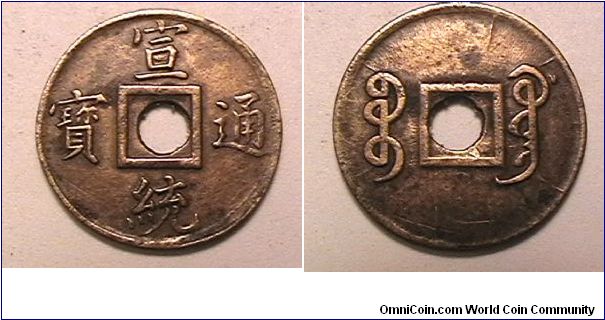
Like this one: This is one of the cash coins made and circulating at the end of the Imperial period of China. It is of a completely different type (above all it has an inscription on both faces) and has a completely different patina from the Baltimore ones. How can the coiney's lawyer claim they cannot be distinguished? Tompa has announced:
I will publish no more comments from Mr. Barford and Ian on this subject. Others may feel free to comment ...
It is perhaps not surprising to find that he does not want to actually answer the questions raised by the material he attempts to use to entrap others. Cultural Property Observer is I would argue a liability for the "collectors' rights" avocacy movement. May it long continue to function as such.

Photo top: the actual coins imported by ACCG dealers through Baltimore, did they leave China before 1930?

Photo, bottom: The coins coiney lawyer Tompa apparently cannot distinguish from the above: Pu Yi (throne name Hsuan-T'ung 1908-1911/12) Not the same coin at all
!
.

Monday, 4 July 2011

Baltimore Seizure Cash Coins: When did they leave China?

.
Running away again.
I will publish no more comments from Mr. Barford and Ian on this subject. Others may feel free to comment ...
writes Washington legal expert Peter Tompa. So I shall just have to ask him about the implications of what he has just added to his website here, and he can pretend he did not see it. But the other coineys will and wonder just what kind of a lawyer they have representing their interests.

Peter Tompa in mean-mindedly hounding SAFE's Cindy Ho has now posted on his website an extract in translation of the Chinese law on archaeological relics from 1930 which was the precursor of the stiffer legislation of the People's Republic of China (see J. David Murphy (1994), An Annotated Chronological Index of People’s Republic of China Statutory and other Materials Relating to Cultural Property, Int’l J. Cultural Prop. 159 for some of the items Tompa does not cite).

The Washington lawyer uses the 1930 law (Art. 6 and 13 taken out of context) to suggest that artefacts sold to "aliens" and which are outside China are stolen property, illegally removed from the country. He concludes:
China's 1935 law may indeed be applicable. It covers artifacts from "other cultures" and bars their sale to "aliens." Barford claims the law does not apply, but is that all that clear?
well, it is clear to me, but Tompa seems to be of another opinion. OK, he's the lawyer - let's follow his argument through to its logical conclusion.

Let's first reflect a moment about the collecting of Chinese antiquities in the West. In particular cash coins (the ones with the square hole in the middle). That this was not very prevalent in the west before the first decades of the twentieth century seems to be very strongly suggested by the date of the appearance of the first basic catalogue for western collectors, Frederick Schjoth's "Chinese Currency: The Currency of the Far East" in 1929 - still treated by some US dealers as the standard numbering system. So, though there must have been such coins in circulation earlier, it is really only after the date of the publication of this work that one might expect to see increasing numbers of imports of these artefacts into western (European and North American) collecting circles from China. So basically the date of import of coins of this type currently on western markets is far more likely to be post 1929/1930 than before that date.


Readers may remember that Peter Tompa is the lawyer participating in the Baltimore Illegal Coin Import Stunt organized by the Ancient Coin Collectors Guild and supported by the Professional Numismatists' Guild and the International Association of Professional Numismatists. The subject of an ongoing lawsuit include some Chinese cash coins bought from a London dealer and imported into the United States in that stunt. I've discussed this disgusting self-serving stunt many times on this blog. But now looking specifically at those "cash" coins, I presume Peter Tompa can document that these artefacts left China before the Relics Act of June 1930 which he himself cites and which he says absolutely prohibits the sale of relics to "aliens" and their removal from the country. Has he done his "due diligence"? If they were removed subsequently, by his own arguments they are stolen property and therefore as 'tainted' goods, cannot be legally sold in the US (Stolen Property Act).

In that case, what Tompa himself has published on his own website now makes it very difficult for the ACCG to argue that the Chinese cash coins should be handed over to them, since in all likelihood (and in the absence of any documentation to the contrary) they left China after 1930, when the legislation which Tompa applies to the material Cindy Ho was handling was already in force (or later versions with the same basic idea). How can the ACCG, PNG and IAPN (represented by Peter Tompa's law firm) ask state authorities to hand over to them material consisting of dugup antiquities which in all probability are stolen in the light of the law of the country from which they came cited by their lawyer Mr Tompa. I bet the ACCG and its lawyers cannot demonstrate each of these specific items not to be post-1930 exports. So that would rather mean their whole case with regard to the cash coins falls flat on its face.

[I know you chaps at the State Department read this blog. If you have not already done so (as I can see you are already running circles round and one step ahead of the dullard dealers) please make sure your legal team know about Mr Tompa's blog post on this topic and bring it up at any hearing there may be as it well shows the hypocrisy and double standards that obtain in the antiquity market which is precisely why upholding legislation like the CCPIA is so necessary].

Photo: Reportedly, the actual coins imported by ACCG dealers through Baltimore, did they leave China before 1930?

Saturday, 2 July 2011

Cultural Property Lawyer: Library of Congress Manuscripts "Stolen" by President's Grandson?

.
In a post about hypocrisy, Washington cultural property lawyer Peter Tompa has accused the Library of Congress of holding a collection of what he says might be "stolen" documents illegally removed from the Republic of China by the grandson of President Theodore Roosevelt. This is an interesting development, given that not so long ago twelve US Congressmen signed a letter attacking the US International Cultural Property Protection program. The suggestion by a Washington lawyer that US Congress itself may be directly involved in the trafficking of stolen objects raises a number of questions which I think decent US citizens should be asking its lawgivers about their policies towards the trade in illicitly 0obtained artefacts.

But how true is this allegation, which must be very upsetting for the family concerned? It transpires from the accuser's own blog that in fact in writing what he did, he had not actually done the victim of his remarks the courtesy of actually ascertaining what the legal situation concerning export licenses for antiquities was at the time this alleged act was committed. Peter Tompa is a "cultural property lawyer" of the Washington firm Bailey & Ehrenberg (which "handles the most sophisticated legal matters", "our partners are experienced attorneys with solid reputations as strategic problem solvers, skilled negotiators..."). What kind of a cultural property lawyer is it that when asked for the legal basis of his insinuation of illegal activity, replies:
I could do all the research you ask, but I'm afraid I'd have to charge for it and I'm not sure you would pay.
Too right I would not, because unlike Mr Tompa, before I questioned what he said I checked the legislation pretty thoroughly, and determined that there was no legislation for that region of the Republic of China which applied to the export of folk art and antiques in the period when the collection concerned left China. Mr Tompa seems to have thrown out accusations without actually checking there was a law which applies to the situation he was "observing" (I use the term loosely). The law of 1950 does not act retrospectively, and the requirement to institute an export licencing system was a proposal of Article 6 of the 1970 UNESCO Convention - which I am sure (even though the US ignores it in their own half-hearted "implementation" of the Convention) Mr Tompa is - or at least should be - aware.

Mr Tompa's accusation of illegal activity by Quentin Roosevelt III with respect to the creation of a collection of artefacts of the Naxi (Nakhi) people are fabrications and crude insinuations with no basis in legal fact.

Followers of the hapless Mr Tompa might be interested in a website which sets it out in simple language for those who don't like books. Here are SOME of the laws concerned of the Kuomintang government, it can be seen that no mention is made of export licences and a distinction was being made between relics in state custody and those in private ownership, registered and unregistered. If Mr Tompa would do some "research" (to enlarge his own professional knowledge rather than for my benefit), I think he would find that export licences were only introduced into Chinese antiquities preservation legislation later, in the People's Republic.


UPDATE 5/7/2011: See the implications of Tompa's further development of his "argument" Baltimore Seizure Cash Coins: When did they leave China?

Friday, 24 June 2011

Financial Times on Investing in Antiquities (Again)

.
The Financial Times has an article 'Antiquities: the war of art', by Stephen Wilmot (23/6/11) discussing the "attractions and risks associated with investing in antiquities". Every so often the financial papers produce such cringe-worthy texts which invariably miss out any discussion whatsoever of the moral aspects of the no-questions-asked commerce in antiquities which they are advertising. This article is no exception, though it has a surprise ending. It seems vaguely to focus on the market for Chinese artefacts for some reason. There is a discussion of China's efforts to get looted material back home, Neil Brodie is quoted as asking whether these efforts may be increased as China gains influence in the world economy:“At the moment people can afford to ignore Chinese claims, but will that still be the case in 10 or 20 years’ time?” he asks. the nearest the article gets to discussing the ethics of the trade is when it points out that investigating culture crime requires the investment of considerable resources, which is where countries like Italy have an advantage over poorer countries (Greece and Egypt are cited) where less resources can be devoted to this effort. This part of the discussion is entirely object-centred.
Costas Paraskevaides, director of ArtAncient, a website that sells historical objects, says “there is little doubt the market is very buoyant right now”. He cites the emergence of mainland Chinese buyers as a key reason. Two years ago, he sold roughly one item a month to a mainland Chinese buyer. Now, he says, they snap up pieces at all price ranges almost every other day.
As one of the 'posities' in 'investing in antiquities', the size of the market is stressed, and the article points out it is an expanding one.
Jonathan Stone, international business director of Asian art at Christie’s, believes the well of buyers is deep enough. “We’re not dealing with a handful of people – the breadth and depth of the market now is something very new,” he says.
But of course an expanding number of people after a finite resource (the number of licitly-obtained artefacts on the market) is one full of dire portent, because it will increasingly draw illicitly-obtained material onto the market to make up the shortfall, and as prices rise so does the incentive for looting. This of course is an aspect totally omitted by the Financial Times' one-sided discussion of the "investment value" of antiquities.

The article points out that some antiquities lose value [Brodie is again quoted here], that they may be over-priced at the time of sale due to aggressive bidding from a small number of greedy people for a particularly coveted item (I'd say the Crosby Garrett helmet is a good example of this). the article warns there are a lot of fakes around, and "the risk that the piece has been illegally imported" (should be "exported" shouldn't it FT?). There is no proper mention of the need for responsible collectors to ensure they have documented title to objects through verifiable and documented collecting histories and proof export formalities were fulfilled, or that it is collections of such artefacts which are most worth 'investing' in.

All this has made other ways of investing in emerging-world culture more popular, particularly Chinese contemporary art. “You need very specialist knowledge to collect the past, whereas the appeal of contemporary art is visceral – it’s about how you feel about it, what it does to you,” says Strauss. “Antiquities are far more problematic.”
Indeed they are, and it is to be noted that achieving "intercultural understanding" and cosmopolitanism (that's "globalisation" over here) is one of the main motives US (mainly) "cultural property internationalist" authors have been ascribing to their collecting and commercial activities. Why however concentrate on dead cultures of a foreign region at the expense of contact with the living one?

Vignette: money, money, money.

Wednesday, 22 June 2011

Pot-Smashing "Artist" Released from Detainment

.
Los Angeles Times is reporting: 'Chinese state media say artist Ai Weiwei released from detainment' (June 22, 2011 ). I expect then he'll be back to his demonstrative cultural vandalism as soon as he can get his hands on some more ancient objects from the antiquities market.

More background in the New York Times: Edward Wong, 'Dissident Chinese Artist Is Released', June 22, 2011.

Wednesday, 30 March 2011

April Fool from CPRI

.
It seems to me that the Santa Fe-based "Cultural Property Research Institute" (an antiquity dealers' advocacy group masquerading as an inefficient "research institute") has got its dates wrong. A text they have released (State Department in Contravention of the Law?) can only be seen as an April Fool joke accidentally published two days early. Still, I suppose that's better than all those promised pieces of "research" which are months overdue.

Among the gems of deadpan humour contained in this obviously satirical text, the reader will spot the following:

- "has disregarded the criteria established by the law that created it", the enquiring reader will ask what might they be, and in what way do they benefit the world's cultural heritage?

- "the Act was intended not just to save objects, but to save context and heritage". Where does it say that? Where? It actually says nothing of the kind in the CCPIA (which in general it has to be admitted is a badly-written text, but that is no excuse for the CPRI making things up).

- "limitations placed by the Act on the ability of the US Government to enter into agreements with other countries to impose import restrictions", eh? This is in an act intended to IMPLEMENT the 1970 UNESCO Convention on what? Oh yes, "on the Means of Prohibiting and Preventing the Illicit Import, Export and Transfer of Ownership of Cultural Property", so why did the US government issue an "implementing" act limiting its own ability to actually "implement" the actual measures of the Convention? Why would the US government fail to enter into an agreement with another country who requests it to actually implement the measures implicit in becoming a state party to the Convention? That's just plain daft, but then all of this US pretence to be implementing the Convention is plain double daft. Let the US just end the farce and withdraw from the Convention they have for nearly three decades obviously had no intention of fully honouring. Let the existing Wild West ethos of much of the US antiquity market show itself for what it is.

- "a
provision requiring U.S. restrictions to be part of a "concerted international response" had been violated" eh? So where actually is this mythical "provision"? Where? How can you "violate" a provision that is not there?

- "in a manner that discriminated against Americans and that moved the trade abroad". Like keeping Chinese artefacts from being illegally exported FROM China? Isn't that what the 1970 Convention "on the Means of Prohibiting and Preventing the Illicit Import, Export and Transfer of Ownership of Cultural Property" supposed to do? What did the Americans think it was supposed to do when they became a state party? And how funny, an American law which affects Americans in America and not foreigners living outside America.

"Seminar summary at http://www.cprinst.org/Home/issues. Full transcript available soon". Can they manage it by April 1st?

The comedy is continued by that master of black humour, D.C. lawyer Peter Tompa, who asks "A related question is whether the State Department Bureau of Educational and Cultural Affairs is listening or whether Assistant Secretary Anne Stock and her staff remain tone deaf as ever". Listen to what? The inventive rantings of the lunatic fringe of the US no-questions-asked market in dugup antiquities? That is a real joke.

What on earth is New York Senator Kirsten Gillibrand thinking of aligning herself with these people with their all-too-transparent antisocial aims? Maybe readers in the States might like to write to her office and ask her http://gillibrand.senate.gov/contact/.

Vignette: Hilary and lookalike Kirsten (left) show their appreciation of the 2011 CPIA April Fool joke at the expense of the skeletal US
International Cultural Property Protection program, such as it is.

Friday, 25 March 2011

Chinese Collectors of Chinoiserie? How Terrible?

.
In the Kirsten Gillibrand Seminar on the CCPIA organized by the CPRI the "problem" of China was raised. As we know due to a MOU between the USA and China, the import of certain types of dugup antiquities from China is restricted to those that can be documented as having been legally exported from there. But what is this? Shock horror:
As a result, the market in such materials has just been shifted elsewhere. China is a ridiculous case. We have closed our markets to ancient Chinese art when the biggest market for such material is in China itself. State has failed to administer the statute fairly. >[...] A[rthur] H[oughton] also asks how effective the CPIA can be if 90% of the archaeological material sold is done so in a source country like China.
In a country "like" China? Somehow I think our transatlantic friends have lost sight of what the "C" in CCPIA stands for. To remind them it is called the Convention on the Means of Prohibiting and Preventing the Illicit Import, Export and Transfer of Cultural Property. So the fact that cultural property, dugup or otherwise (and 90% of it or not) is staying in China unless legally exported is what the Convention is aiming to achieve, isn't it? Why does that indicate that "State has failed to administer the statute fairly"? It certainly is fair to the Chinese people and Chinese collectors if it true that the antiquities are not now leaking out of the country in an uncontrolled and illegal manner to the world's largest no-questions-asked antiquities market in the USA and this is due to US dealers responsibly adhering to import restrictions which support that.

Vignette: Does the CPRI want to see Chinese artefacts kept away from Chinese collectors?

Thursday, 18 November 2010

China: Protecting Sites needs More Resources ("So Let's Carry on Buying Antiquities"?)

.
China Daily (Nov 18, 2010 ) reports that the 'Protection of relics in China needs more resources':
Police and authorities protecting cultural relics plan to work more closely to fight the rising frequency of grave robbery and smuggling of cultural treasures in the country. The plan from the Ministry of Public Security and the State Administration of Cultural Heritage includes setting up joint offices between local police and cultural relics bureaus, according to the two departments.
"We're also considering rewarding members of the public who offer tips and report such crimes," Shan Jixiang, director of the State Administration of Cultural Heritage, said on Wednesday while attending an exhibition on a nationwide crackdown against grave robbery and relics smuggling. Between the launch of the national crackdown in December 2009 and this June, authorities had cracked 541 cases, broken up 71 grave robbery gangs and smuggling groups, and seized 2,366 cultural relics, according to figures released on Wednesday.

Although grave digging and relics smuggling are banned in China, mouthwatering profits still lure an increasing number of people to take the risk, including some villagers living near historical sites, according to a press release from the exhibition. It said crimes related to cultural relics in the country are becoming violent. Weapons are frequently used to fight police. The release added that grave robbers are equipped with more advanced devices, such as GPS, metal detectors, specialized vehicles and explosive tools, which can seriously damage cultural sites and ancient graves. In addition, the criminal groups have become more organized, with members responsible for specific tasks such as stealing, transferring, selling and smuggling the relics.

The shortage of funds at the local level has worsened the situation. "We really lack support," said Han Yulin, a team leader of the special investigation police team in Xi'an of Northwest China's Shaanxi province, which is rich in cultural relics. "There are only 17 policemen on our team, and we have to deal with all cultural relic crimes in Xi'an. It's almost impossible," he said.
Another article from May this year Fan Junmei & Ma Yujia, 'A grave robber's world',China.org.cn, May 15, 2010) describes the process of robbing tombs for collectables for foreign markets in much more detail.
Grave robbing is now "industrialized" into a chain of excavation, smuggling, storage, and selling.It's often a team activity with a core leader who masterminds the operation. Another individual is responsible for obtaining the equipment needed for a specific grave excavation. Then there are "technical workers," who locate the tomb's precise position. Finally, there are the laborers, mostly migrant workers, who dig and get dirty.
From stolen to legal
Grave robbers attempt to find a reliable and generous purchaser as soon as possible, and generally, the items are smuggled in 3 days. There are two paths to transfer stolen relics. The first is to smuggle them through Guangzhou or Shenzhen. The other is to stockpile them at several distribution centers in Henan, Shanxi and Gansu for eventual transfer to Hong Kong and Taiwan, before finally being sold abroad. According to Wu Shu, a well-known Chinese collector and author, after the stolen relics were smuggled and sold abroad, collectors purchased them and brought them back to China. This effectively made the previously stolen relics legal, because according to Chinese laws, Chinese relics returned from overseas don't need to be reviewed by customs officials, and it's legal to buy and sell them. [...] Huang Zuyue, an official from Ministry of Public Security, told Global People, "Huge profits have driven the cases of stealing, reselling and smuggling relics." The statistics showed that about 200 million ancient Chinese graves were excavated illicitly in recent years. "At present China's reserve of cultural relics is nearly depleted," Wu Shu said with great anxiety.
So I wonder how the ACCG's court case against the US government's ban on the import of illegally exported cultural artefacts from China is coming along? "We really lack support" said the policeman; the greatest lack of support however comes from the foreign dealers and collectors of exotic dugup metalwork who not only buy the stuff no-questions-asked but insist on calling it their (as US citizens) "right". What right is there in putting money into the pockets of organized gangs of culture thieves? And who is the real culture thief, the guy with the spade who knows that someone will give him money for digging, or the person that encourages them to do the dirty work for them?

UPDATE: Peter Tompa ('Blame the Foreigner') writes: Archaeo-blogger Paul Barford reiterates Chinese propaganda in his latest post. So all this talk about looting is all "propaganda"? So the coins that ACCG imported into Baltimore were produced by coin elves and were not dug out of the ground? Pull the other one Mr Tompa. Propaganda?


Photo: One of the three grave robbers who were caught by the police in southeast China's Zhejiang Province in 2007 is showing how to use what the newspaper describes as "a remote sensor". We know what it really is, and who uses them and what for.

Tuesday, 27 July 2010

Collectors' tip: If your Dealer is Arrested, go and Visit Him in Jail

A case in Korea illustrates the power of the close relationship which develops between dealers and no-questions-asked collectors ('1,200 plundered artifacts recovered', by Jeong Seon-eon from the Joongang Daily, heads-up from MSN). Three antique shop owners and a collector were arrested on Monday for handling stolen artefacts. The information which led to the arrests came from another antique dealer who had been jailed for the same offence:
The story began in 2005, when a group of 16 thieves stole 4,000 cultural artifacts such as books, scrolls and folding screens used in the royal court, from more than 100 historical sites over a two year period. The thieves sold the stolen treasures to antique dealers before being arrested in July 2007. After the thieves were behind bars, police questioned the antique dealers, and some revealed names of their customers or where the stolen artifacts ended up, leading to the recovery of 1,900 artifacts. But others refused, including a dealer surnamed Kim, and because of his lack of cooperation with the police, Kim was detained and imprisoned for two and a half years. “Other cultural artifact traders who were arrested cooperated with the police in the investigation,” said a source at the Seoul Metropolitan Police Agency. “If Kim had also revealed information about who he sold the stolen artifacts to, he would not have been detained.” [....] “Those who deal with cultural artifacts are very tightly connected, so it’s difficult to get information,” said the police.
A feeling of betrayal of the trust between dealers and collectors was the key to the next step of this investigation:
Last March, Kim visited the policeman who investigated him in 2007 and said he had had a change of heart. “I will tell you all the names of the people who bought stolen cultural properties from me,” Kim told the policeman. “I protected their identities then, but they betrayed me and didn’t even visit me once when I was in prison.” With the information Kim provided, the police recovered 1,200 stolen cultural items in April, including books written by Sukjong, the 19th king in the Joseon Dynasty (1392-1910), books from the Sejong period, and other scrolls and folding screens. Police could also catch three antique shop owners who allegedly sold the goods, and a professor of Chinese classics at a university in Asan, South Chungcheong province, who was a customer of Kim [who... ]allegedly purchased 900 books from Kim for around 12 million won ($10,158.3).
Interestingly the article says that the professor allegedly told Kim: “As I am only a collector of old books, I am not going to resell any of them. So I’m fine even if they are stolen.” This seems a pretty common attitude among collectors.

We are also told that as part of this investigation
"The police also discovered a Web site called “Kobay,” the biggest cultural property auction Web site in Korea, on which many of the stolen artifacts were traded. Kobay was operating without a license, and the police booked its owner for running a business without one.

Sunday, 20 June 2010

Stolen Imperial Tang Sarcophagus Back in China

.
Edward Wong ("China: Tang Dynasty Coffin Returned by U.S. Businessman" New York Times, June 18, 2010) writes:
A 27-ton imperial sarcophagus from the Tang Dynasty that was stolen by tomb raiders has been returned to China from the United States, according to a report in China Daily, an official English-language newspaper. The coffin, which was stolen from the tomb of the Tang empress Wu Huifei, who died in 737, arrived at the Shaanxi History Museum on Thursday. Chinese police officers first discovered that the relic had been stolen in 2006. They traced it to a businessman in the United States, who had bought it for $1 million, China Daily reported. The businessman agreed to return the coffin unconditionally after three rounds of negotiations. The coffin was shipped from Virginia on March 16.
Well, isn't that nice of him? Perhaps he'd have been a little less out of pocket if before buying it he'd made the condition of the seller revealing how the object surfaced on the market, and what made the sale of a coffin from an imperial tomb "legitimate". Was he tricked by the trade, or did he just not care? It seems to me to be an extremely difficult thing to buy "by accident" a stolen artefact when it is something like this (unique associated with a known person whose single tomb is known to exist in a specific place). Again, no names, no details are given - like where he claims to have acquired it from.
.

Photo: Stolen portable antiquities are generally a bit smaller than this one.

Wednesday, 26 May 2010

Dancing with the Culture Thieves

.
Collector Kenneth Blair writes on Dave Welsh's Unidroit-L discussion list that he sees nothing wrong with the use of dug-out ancient artefacts as raw material from which to make craft jewellery: "wearing an ancient coin around your neck might be an expression of connection or attachment to ancient civilisations, just like people wear charms, icons, or motifs on a pendant. So why not?". I would argue that one can "express the same connection" to an ancient civilization by other means than providing finance to people as a reward for trashing archaeological sites of that culture. I am not clear however to what extent a Californian girl is "expressing a coinnection" to anything by hanging an exotic pendant around her neck when she goes out clubbing. What connection does a shark's tooth pendant establish? A netsuke of a rat? A figure of the Lord Buddha, or a swastika? Or a "fossil" echinid spine? Perhaps Blair sums the actual motive up more with his: "people thinking: "cool, I would like something like that"...".

Kenneth Blair lives in New Zealand and aggressively defends the "right" to collect on several online forums. He purchases (for example at an "antiquities market in Xian") what he assures us are authentic dugup ancient Chinese bronze objects, bought at source (as would appear from what he has written of his collecting escapades in Yahoo's Ancient Artifacts forum). He seems to delight in buying and writing about weapons (what kind of "connections" does that express?) such as on the Sword forum International and China History Forum. There we find the thread "Chinese bronze swords 5th to 3rd century BC" illustrated with photos of swords in private collections which the collector admits that he is aware: "Such items are certainly taken from ancient tombs" (where is the rest of the assemblage from which they were separated?).

Among the photos illustrating this long discussion by Mr Blair which anyone can find in the internet is one showing the author "expressing a connection" with an ancient civilization apparently with an ancient artefact in hand. No PAS-issue cotton gloves here. Now I can think of a few reasons why waving it around in the open air on the back lawn like a ninja-sword dressed in a poncy outfit ("wristwatch!") is not a good, let alone ideal, way to treat authentic grave-robbed ancient artefacts. That is whether or not their export from the source country was ethical and legal in the first place.

Of my comments on this manner of treatment of artefacts which collectors insist they accumulate to "study", Mr Blair comments: "I am not sure general academia will share his indignation". I wonder though what the PAS would have to say about these various "uses" to which collectors and other people put ancient artefacts, including those robbed from graves. I think we do need to know before metal detectorists start digging up inhumations in order to wave corroded Early Medieval swords around on their back lawn shouting: "hey look at me, I'm King Arfur!".
.
Vignette: Striking up a nice pose, don't I look butch with my little sword? (Photo from public thread on Sword Forum International)

Saturday, 15 May 2010

Imprisonments and executions in China for tomb robberies

The Independent reports that China has sentenced to death four robbers who used explosives and heavy machinery to plunder tombs almost 2,500 years old. The state Xinhua News Agency says a 27-member gang looted a dozen tombs in the central province of Hunan in 2008 and 2009. The remaining 23 were jailed. More than 200 stolen artifacts were under China's highest level of protection. One tomb dates from the Warring States period that began in 475 BC. All the relics were recovered. Nevertheless foreign collectors who buy no questions asked artefacts without ascertaining that they had not "surfaced" on the market from underground as a result of by criminal activity are complicent in the crimes. they are the ones that provide the temptation in the form of financing it. They of course escape punishment. Collectors' rights movements like the ACCG will no doubt immediately mount an international campaign asking the Chinese government for leniency for these 27 people. Coiney internationalists make light of other people's heritage and respect for ancient sites such as ancestral cemeteries, and stress their own "rights" to collect objects looted from them, they forget that others too take the ancient heritage of their land extremely seriously.

Wednesday, 12 May 2010

Coiney Ahistoricity

.
Coin collectors say they fondle their coins because they are "passionately interested in history". But they see their happy-go-lucky no-questions-asked way of doing their "history" homework threatened by preservationists. They have though their imagined saviour, Wayne Sayles and his dealer mates of the ACCG. John Pennock (who grandly puts after his name the letters: "ACCG ANA PAN") a collector of ancient coins says there is no middle ground:
Being an ancient coin collector and not supporting the ACCG now, is akin to being Neville Chamberlin trying to appease Hitler by dividing Poland.
I will not quote the rest of Pennock's embarrassing naivity here [just to add that he might like to find out more about antiquity collecting in Cyprus for example]. Mr "Chamberlin" (sic) did not "divide Poland". Perhaps instead of fondling coins to get them speak about the ancient world, some collectors would do better to try and get a better grasp on the modern world...
.

Monday, 15 February 2010

Does Mr Ehrenberg believe... ?

.
Looting Matters has a thought-provoking text about the further developments in the Baltimore illegal coin import stunt resulting from the efforts of the Professional Numismatic Group and the International Association of Professional Numismatists to challenge new US regulations on antiquity imports from China and Cyprus. The US dugup coin dealers' lobby group the Ancient Coin Collectors Guild is also involved in this action. Now an action has been filed on behalf of the ACCG (as plaintiff) against the US Customs and Border Protection, Department of Homeland Security; the Commissioner, US Customs and Border Protection; the US Department of State; and specifically the Assistant Secretary of State (educational and cultural Affairs), United States Department of State. (The pdf can be found here). The case is being handled by Jason H. Ehrenberg , a Washington employment law specialist from Bailey & Ehrenberg PLLC and asks

Does Mr Ehrenberg [...] care if archaeological sites on Cyprus are being looted to provide archaeological material for the market? Or is the issue about the right to collect and to own antiquities?
Or indeed sell them no-questions-asked? Is this not about protecting the livelihood of no-questions-asked dealers who would find their sources of coins severely restricted if they had to provide a proper paper trail for the artefacts they handle like those in other branches of the retail trade such as butchers and grocers? Is this why the ACCG has used its members' funds to engage a specialist in employment law? Laughable.

Even more comical, as noted by David Gill, is the use of the Internet encyclopedia Wikipedia as a cited authority in the legal papers (section 61), seen in the context of the recent comments about academic journals by a book-shy partner at Bailey & Ehrenberg discussed recently in this blog. Not very professional, laughable in fact.

The whole text of the application filed to Maryland District court has a familiar ring to it, we find in it the same conspiracy theories aired by junior partner Peter Tompa in his tinfoil helmet blog. Mr Ehrenberg solemnly put his signature under a text containing such nonsense signifying that he believes the facts, pseudo-facts, insinuations and speculations therein to be something the court should take seriously. Laughable. The reader can judge for themselves, but Section 24 contains some dubious definitions, let us hope the court (if this case is not thrown out after the judge has finished laughing) asks some social anthropologists about what it is that Ehrenburg is defining there. I guess that's what you get for not reading books. Section 89 is remarkably coy about stating who actually bought the coins, and who they were actually bought from. This is interesting because the court is apparently required to believe (in adjudicating in the favour of the importer) that the coins were indeed acquired by them from a legal source, but without having the ability to contact them to check whether that is the case. The names of both seller and buyer should be visible in this document. Since, however it is said (section 89) that it was the 'ACCG' who bought the coins, and the address of the ACCG is given at the head of the document, it is a reasonable assumption that the coins were intercepted being sent to the  Gainsville  MO address given there, which is interesting to note. 

The whole bundle of alleged improprieties that are catalogued in this suit, if they were all looked into by the court would make this into a marathon trial, costing a great deal of money. It seems to me however that this has been compiled as a "nuisance claim", just for the sake of attracting attention and putting a spanner in the works. After all, the ACCG has raiseed 80 000$ or more from its members to fight this action, so they obviously are obliged to produce something to show for it. It seems the best their lawyers can do is cobble together the stuff from Tompa's website, and add a bit of legal waffle (but unbelievably actually missing out a mention of the most important piece of US legislation which is fundamental to clinching the case - that's what you get when you get an employment law specialist to produce a suit about cultural property) .

In a comment to the Looting matters text Wayne Sayles writes: "The fact is that in America, there are rules (call them laws if you like). ACCG is playing by those rules. There are some who would like the rules to be different". Well, quite simply put, those who imported those coins into Baltimore (and we are told it was the ACCG behind this, of which Sayles of Sayles and Lavendar is Executive Director) were not "playing by those rules". On the contrary, they were deliberately breaking the existing law in an attempt to provoke a court case and I think the people supporting this action hope that there it will affect more than Cypriot and Chienese coins. The individuals and organizations behind this shameful action are clearly hoping to overturn any restrictions on the international movement of antiquities. For this reason, I will continue to follow this case with the greatest of attention, and will continue in my blog to express my opinion on the shameful agendas of all those involved in the no-questions-asked trade which are behind it. That's the PNG, the IAPN and the ACCG and all their affiliated clubs and dealers for starters. Shame on the lot of them. What clowns they are making of themselves with this futile action to maintain the nineteenth century approach to antiquity trading into the new millennium.

UPDATE 16/2/10:
Kimberly Alderman has an entertaining post on this text ("Cultural Property Law Deathmatch: The Ancient Coin Collectors Guild v. The State Department"), it seems she enjoyed it as much as me (" it's the equivalent of cultural property lawyer porn"). She criticises its form and structure and content ("The complaint contains a hefty portion of vague allegations of impropriety, but none of them really stick") and believes that the suit will fail to change cultural property law in the US. So a nuisance claim in effect.

Friday, 3 July 2009

US Antique dealers' approach to the China MOU


Beverly Hills Gallery and Auctioneer Isadore M. Chait have issued a public statement guaranteeing the legality of Chinese artifacts in their upcoming July 12 auction. These objects would come under the terms of the 2008 Memorandum of Understanding (MOU) on import restrictions of Chinese artifacts into the US. The MOU was created in an attempt to curb illicit trafficking in Chinese antiquities and art in the U.S. and covers all types of collectable Chinese items dating from the Paleolithic Period to the end of the Tang Dynasty (A.D. 907). It also applies to wall art and monumental sculptures that are at least 250 years old. During the period of operation of the MOU, such works can be legally imported into the US only if Chinese officials issue a valid certificate of export or if they left China before January 16, 2009.

Isadore M. Chait assured buyers that that “many of the items in the auction had been purchased from our Gallery in previous years. Others carry impressive credentials, among them the Asian Art Museum of San Francisco, a Paolo Verdes estate, and several private collections” (see also here and here). No mention is made of it, but I assume the gallery will be backing up its claims by supplying the purchasers with some kind of documentation of the object's previous ownership history. This guarantee of legality should be extremely comforting to collectors, given the fact that I.M. Chait’s July 12 auction contains a number of exceptional objects such as an archaic bronze ritual vessel and monumental sculptures as well as collections of Han and Tang pottery.

The lead item is a museum-quality Early Western Zhou Dynasty (1027 – 771 B.C.) bronze vessel estimated at $80,000. Known in Chinese as a gui, the archaic container has a domed lid and is decorated with the intertwined geometrics characteristic of the era. Fantastical animal-heads decorate the handles and
legs. An inscription inside the cover completes its attributes. Another archaic bronze is a pair of massive covered Hu (wine storage containers) from the Warring States Period (770 – 221 B.C.). They are in the $20,000 to $30,000 range. Additionally, a Northern Qi Dynasty (A.D. 550 -577) limestone head of Guanyin falls under the restrictions. Han (206 B.C. – A.D. 220) and Tang Dynasty (A.D. 619-907) pottery horses, camels and ritual pottery figures—those pricey and favored symbols of status and good taste so frequently found on American mantles and in executive offices—also now warrant credential checks. Fortunately for collectors, several fine examples appear in this sale.Among the more outstanding is a massive pair of Tang Bactrian camels caught in mid-stride and bearing riders whose mustaches and outfits clearly identify them as foreigners. (Lot 210.) Not only does this pair have the proper provenance, they come with another of Chait’s assurances, a Thermo Luminescence (TL) Test Certificate. The camels are estimated at $30,000 – $35,000.Similarly qualified are a pair of Han Dynasty painted pottery figures of dancing ladies. These have remains of the original, nearly 2,000 year old pigment , The ladies also come with TL test certificates in addition to the Chait guarantee.
We may contrast the attitudes of the buyers of such items - demanding assurances of legitimacy including secure provenances - with those of a small group of artefact dealers who are currently in the process of trying to overthrow the very same MOU to allow them to continue to import contextless and provenance-less ancient artefacts without the "bother" of being required to show that the objects left the source country legally or before the MOU was established. Whether or not this is what collectors want - or whether it is in the long term interests of collecting at all, remain to be demonstrated. What is interesting is that we do not see other branches of the dealer community attacking the State Department for attemting to reduce the participation of the US in the trade in illicit antiquities. It is just the ancient coin dealers and collectors. I wonder if they imagine they are speaking for all collectors of Chinese antiquities?

I think, however, if buying antiquities from Californian dealers, when there are ones that offer documentation that the antiquities they sell are of legal origin, and those that cannot and will not (and some of which are members of organzations actively intending to overthrow the import restrictions), then it seems to me that the ethical collector's choice is a simple one. Of course the market for some of Chait's arterfacts is a different one from the "cut-price bit o' 'istry in yer 'and" one that the ancient coin dealers and eBay dugup antiquity sellers are catering for.

[Footnote: By the way though, the "ritual pottery figures" ("those pricey and favored symbols of status and good taste so frequently found on American mantles and in executive offices") mostly come from grave robbing just as much as any Utah pots.]
Photo: Gui vessel (Wikicommons)

Tuesday, 23 June 2009

ACCG Misleading its Members: Twenty Days Left


Coin collectors in the US should take note that there are still twenty days for the Ancient Coin Collectors Guild (ACCG), Professional Numismatists Guild (PNG) and International Association of Professional Numismatists (IAPN) to call off their stunt involving using their members' money to fight a case brought on by an attempt to illegally import ancient coins without the requisite paperwork. This goes against the codes of ethics of these three organizations, a fact that all those who thought they actually meant something should note.

There has been some confusion introduced into the discussion which is failing to take place in no-questions-asked collecting circles over this. About ten days ago I made a post here in which any interested coin collectors and other observers can learn for themselves what piece of paper is missing to make this ACCG import legal and above board. It's not a particularly onerous task to get it. I even copied out the relevant paragraphs of the CPIA for them so they do not have to tire their mouse-clicking fingers overly to look at it.

Coin dealer Dave Welsh however says something different. On Moneta-L yesterday he informed members:
But to read what Barford said about this test case in his blog, you would think that this is an unethical gambit on the part of the ACCG.
[I must interrupt him here, actually, there is absolutely NO question about it, it is (even by the weasel-worded ACCG code of ethics... which is thereby shown to be worth nothing) an unethical gambit, it is also supremely mis-timed, but more of that later]

He harps upon the "piece of paper" that is all that has to be presented to secure the release of the coins, never of course mentioning that this document is not a packing list or other easily obtained bit of paperwork, but is instead an official export permit that cannot be obtained in practice.
Now that is sheer nonsense, since in my post I very clearly define what this missing piece of paper consists of. Very precisely. It is as easily obtainable from a reputable (note that word) dealer who is exporting these items, and it has nothing to do at this stage with "export licences". I find this comment on a numismatic forum from one of the officers of the main organization involved in this stunt extremely odd. Unless this is deliberate misinformation, it firstly suggests he apparently does not - as an importer of ancient coins - actually know in any detail what the laws of his own country at least say. That is shocking. Secondly the tracking widget over in the margin of this blog shows that somebody in Goleta California (which is where his Classical coins business is based) has been reading those specific posts about the ACCG illegal import stunt where I write quite clearly what this piece of paper should look like. (If its not Dave Welsh, and the person responsible is reading this now, give him a ring and tell him what you read).

But that's not the end of the misinformation, John Hooker who the ACCG is now increasingly relying on to produce "ideologies" for collecting (he's going to start up a "conservation spoof" blog soon and write some ideological bit about Jung) has joined in the effort to misinform "Monetans". He too says that I do not understand why there cannot be an "export licence". John, read the CPIA for yourself. We are not talking now about export licences.

Mr Hooker tells Monetans that the law is being broken by those involved:
to fight unreasonable U.S. import restrictions. The only way that this can be done under U.S. law is through an actual case and in the courts.
Well, first of all a detailed reading of the CPIA actually shows it gives such leeway to importers to be virtually meaningless (which was probably the intent of its authors), so I really think in the circumstances that the coineys' claim that these are "unreasonable U.S. import restrictions" is simply laughable. Secondly of course even in the US there is no need to break a law to get it repealed or rewritten. There are other mechanisms. The ACCG has however decided to flaunt the law to influence international policy.

Fine, but let them be totally honest and open with their members about what this is about. What kind of piece of paper is it Mr Welsh? Answers on Moneta-L please.

Photo: astronomical clock. Time is running out... .

Wednesday, 3 June 2009

Kashgar archaeology


Kashgar, China — A thousand years ago, the northern and southern branches of the Silk Road converged at this oasis town near the western edge of the Taklamakan Desert. Traders from Delhi and Samarkand, wearied by frigid treks through the world’s most daunting mountain ranges, unloaded their pack horses here and sold saffron and lutes along the city’s cramped streets. Chinese traders, their camels laden with silk and porcelain, did the same. […] Over the next few years, city officials say, they will demolish at least 85 percent of this warren of picturesque, if run-down homes and shops. […] In its place will rise a new Old City, a mix of midrise apartments, plazas, alleys widened into avenues and reproductions of ancient Islamic architecture “to preserve the Uighur culture,” […] No archaeologists monitor the razings, he said, because the government already knows everything about old Kashgar.

I really cannot believe I read that. Unbelievable. Scandalous. Quite apart from the human tragedy of communities being uprooted and the destruction of part of the cultural landscape, the foundations and infrastructure of “midrise apartments, plazas, alleys widened into avenues and reproductions of ancient Islamic architecture” will irreparably damage the archaeological record of two millennia or more of events under today’s houses and streets in the town centre. Within those layers will be enormous quantities of archaeological evidence, finds, environmental samples (and yes, items that could be counted as "ancient art"). Nobody can say whether this evidence would change our knowledge of this place or not until the material has been documented and studied. Eighty five percent destruction of the archaeological record means there must be archaeological mitigation of damage to eighty five percent of the archaeological record.

In any case, having worked on a number of urban projects in the past, I very much doubt anyway if the Chinese government knows “everything” about the archaeology of Old Kashgar. Let us see the international community challenge the Chinese government to justify this view before they do any earthmoving here.

But this evidence does not just refer to one place, Kashgar has the potential of revealing much about the rhythms of exchange of various products along one of the most spectacular and interesting of the long-distance trade routes of the ancient world. Destroying the archaeological record here is not just destruction of evidence about Kashgar, its implications go much wider. To commit such a culture crime would be highly irresponsible on a scale much greater than the destruction of the Bamiyan buddhas. What on earth is the Chinese government thinking about?

This is the head of the Chinese government President Hu Jintao.

And here is his political creed, the Ba Rong Ba Chi: "Eight Honours and Eight Shames":

Love the country; do it no harm.
Serve the people; never betray them.
Follow science; discard superstition.
Be diligent; not indolent.
Be united, help each other; make no gains at others' expense.
Be honest and trustworthy; do not sacrifice ethics for profit.
Be disciplined and law-abiding; not chaotic and lawless.
Live plainly, work hard; do not wallow in luxuries and pleasures.

I think Mr Hu's government has just added a ninth shame.

It is pure hypocrisy to demand that cultural goods in outside markets return to China, while China wantonly destroys hundreds of thousands of cubic metres of the unwritten history of part of its territory in the form of 85% of the archaeological heritage of a site of national significance like Kashgar. How much else of other less prominent sites is going under the bulldozer as I write?

Photo: death of a town.

 
Creative Commons License
Ten utwór jest dostępny na licencji Creative Commons Uznanie autorstwa-Bez utworów zależnych 3.0 Unported.