Showing posts with label Eftis Paraskevaides. Show all posts

Sunday, 25 April 2010

European Pre Celtic Bronze Age Tea Cup 600 BC!

.
The no-questions-asked antiquities trade is a frustrating place, on the one hand one's blood boils when we see archaeological artefacts obviously freshly ripped from their contexts on sale to anybody who is not too concerned about the damage caused and selfish enough to want to buy them. On the other one's blood boils when faced with some pretty bare-faced cheatery and total ignorance among sellers and buyers.
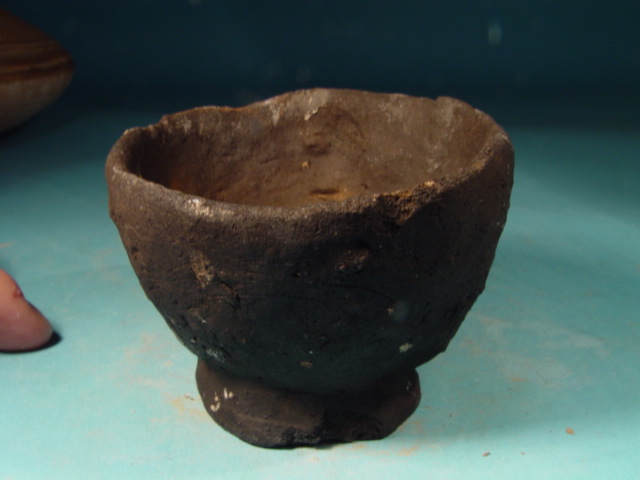
I'm not sure which of the latter two categories to place this one. A British seller has an item on sale in his online gallery, he calls it a "European Pre Celtic Bronze Age Hand Made Pot 600 BC!". Now "pre-Celtic" is an interesting concept, sort of makes the primitive wonky pot on sale sound primevally attractive. I also had words in the past with this seller about some central European pot he was selling as "Bronze Age" which was Iron Age (or was it the other way around?), so "pre-Celtic" could be fluff term to avoid being specific.

The sales spiel is wonderful, conjuring up a vision of primeval forests and the noble savage struggling to control the environment. In the work on artefact hunting which I wrote with Nigel Swift we call this "narrativisation" and its an important part of collecting, but also marketing the goods.

So where does it come from? It was, the seller assures us "found in Germany near the Danube river", so that's anywhere along a 400-km long line... It also apparently was "Formerly in the collection of an English gentleman". Well, how could it be otherwise? (Are all collectors automatically "gentlemen"?)

The seller assures customers that his firm "employs a number of experienced consultants who specialize in authenticating ancient art to offer you the necessary protection". I think we all should know the name of the experienced consultant that authenticated the object shown in the photos as a "very rare, late bronze age Cremation pot or cooking pot", as it is clear they know next to nothing about Late Bronze Age pottery of central Europe.


The photograph shows a handmade vessel, yes. The vessel has clearly been bonfire-kiln fired, yes (it still has the ash on it). The form however is an imitation of a teacup on a raised footring. The fabric of this piece is nothing like that of ancient ceramics of the period and region suggested as its origin before it got to the "gentleman's collection". I challenge the seller and the consultant to show us a similar form vessel from an excavated Late Bronze Age settlement or cemetery with the same surface finish and fabric.

Any archaeologist who has handled any ancient pottery from central Europe will be able to see that this is a modern piece, it still has the ash on it, and clearly has never been buried in the ground, probably this was produced as "experimental archaeology" (maybe during an excavation as many archaeologists have had the opportunity to partake in). As such there is no reason why it cannot be collected, but it should not be being sold as an authentic Late Bronze Age artefact. With three days to go, seven people are bidding on this.

The seller is a well-known antiquities dealer from Cambridge and a frequent contributor to artefact discussion forums. He also has a large number of objects on sale which in one way or another I would categorise as "dodgy", misdescription being just one of the problems.

There is an awful lot wrong with the no-questions-asked antiquities trade in Britain and elsewhere, while dealers are unaccountable for the proper description of what they sell, and there is a total lack of transparency, they can get away with a great deal, like selling illicitly-obtained items, or outright fakes.

Photo: Eftis Paraskevaides' "Bronze Age teacup". Although he says the images on eBay are his "copyright" I'm putting them up here as a public service, and if he wishes to challenge it we can discuss how he ascertained that the object(s) he bought from the gentleman as antiquities left Germany legally, has he seen an export licence for this? Otherwise he could be culpable under the 2003 Dealing in Cultural Property (Offences) Act. Not of course if he knew it was a fake when he bought it, but then why is he selling it as something else?

Wednesday, 12 August 2009

New blog

There is a new blog entitled Antiquities News & Topical Debate. Its author is Eftis Paraskevaides. Blogging thoughts on portable antiquities issues seems to be becoming very popular among collectors and dealers these days.

Friday, 5 June 2009

Sez it all, really

From Yahoo ancientartifacts forum:
"i myself only buy because i love the thought of holding and owning a piece of history.when i hold a corinthian helmet in my hands that coulde have been worn by a greek hoppolite at themopolye or marathon well that sends a shiver down my
spine that money cant buy
".
Yes, I imagine holding it really effortlessly takes one back to the days when the 'hoppolites' were hopping along to do battle with all those nasty opponents of 'truth, justice and the Spartan way' far better than reading any difficult book (no danger either of homegrown scholars of the past actually finding out from them what their real name was). But surely it is a mistake to say that "money cannot buy" these emotions, since the writer admits that is why they buy these things. Still, they are quite difficult to get on eBay now... some vague reproductions are available though. I guess its not the same "shiver" though.

Vignette; "hoppolites" by Frank Miller in a comic book.

Saturday, 4 October 2008

Paraskevaides on Nighthawking

Stalwart Unidroit-L contributor Eftis Paraskevaides comments on the ideas embodied in the abstract of Derek Fincham's recent article. He writes:
When the compensation to the finder is realistic, the black market will be exterminated, with the exception of night hawks whose only avenue will still be the black market because of not having had permission from the land owner in the first instance. This is a more tricky problem, but there can be ways of addressing it if our body of archaeologists are realistic about the problem and come down from their high horse...
Two points. First the label "nighthawks" (it's one word Mr P.) is a strange coverall term conventionally (but inaccurately) used for illegal artefact hunting with metal detectors mainly in the UK. It would not apply to illegal artefact hunting in Cyprus for example. Secondly I am really not sure what "high horse" the dealers and collectors gathered on Unidroit-L think archaeologists should "come down from" over nighthawking. What these people are doing is trespassing and stealing and its as much a problem for the landowners as it is for all who care about the preservation and sensible use of the fragile and finite resource of the remains of the past. Most other dealers and collectors say (publicly at least) that they deplore such actions, so why does Mr P. seem to be suggesting that we should in some way "come down off our high horses" about illegal artefact hunting? (Perhaps he's suggesting we should reward them in some way?) The logic of this statement and its relationship to what Derek Fincham wrote escapes me and we await elucidation in further discussion on the Unidroit-L.

Thursday, 2 October 2008

Portable Antiquities According to Derek Fincham

"This article attempts to clear up any misconceptions of the cultural policy framework in England and Wales" writes Derek Fincham in the abstract of an article that has aroused much interest in the collecting world. It trots out the same old stuff about "adapting the cultural heritage policy (sic) of England and Wales to other nations of origin" as we have seen before - most recently see my recent discussion of Eftis Paraskevaides' comments on Unidroit-L and other posts here.

This notion is of course as simplistic and nonsensical as it is wholly impractical. The British legislation concerning so-called portable antiquities developed in a particular context, a particular legal and cultural situation, it cannot simply be implanted into (or "adapted" to)another country's system without changing other elements of the surrounding context. Like driving on the left.

Fincham is wrong when he writes that the laws of foreign countries on ownership of archaeological artefacts and export restrictions are "the default legal strategies currently used by nations of origin to prevent the looting of archaeological sites", they in fact exist for other purposes (too). Are all nations that are the currently fashionable sources of collectables to change their laws to take into account the collecting trends and needs of an exploitive minority in the so-called 'market countries' (exploitive countries)? How much will this cost the citizens of exploited countries and why should they be expected to meet these costs?

The key point for all these arguments like Fincham's is the system of compensation for "finders" in place in Britain. England and Wales is contrasted with Scotland which has a different legislative framework. Fincham, however, seems to be ignoring the fact that in Scotland too finders of archaeological objects who report them as the law requires also receive compensation at market value. So why is it not producing the same results as the system in England and Wales? (For it is not.) It is NOT simply a matter of whether somebody gets compensation or not, there is obviously an element missing from the pro-collecting arguments, one they do not actually want to admit to. So what actually is it that would have to be adopted from the cultural heritage policy (sic) of England and Wales "to other nations of origin"?
He surmises: "compensating finders of antiquities may even preclude an illicit market in antiquities" but of course that is NOT what the system in England and Wales does ! It only compensates a small minority of them. The rest just get to keep to do what they like with the goodies, sell them on eBay, make earrings out of them, throw them in a skip or whatever, and they do not have to report any of this to anyone, and frequently (90% of them) don't. Fincham is confusing the system of England and Wales with that of Scotland - which he seems to be saying is less efficient than that of England and Wales. Instead of clearing up any "misconceptions of the cultural policy framework in England and Wales" among collectors, Fincham seems from evidence like comments of some observers from that milieu to be adding to them.

Fincham suggests that this "leads to less looting of important archaeological sites". Really? That the Oxford Archaeology Nighthawking (sic) Survey with its flawed definitions and flawed methodology seems not to be getting very far in identifying the real scale of this problem (though they are very tardy in presenting their results) should not be allowed to obscure the fact that there IS a LOT of illegal metal detecting and handling of archaeological artefacts going on in the UK, despite the best efforts of the PAS. Metal detectorists and British farmers know all about this, Mr Fincham apparently not.

As for "has produced more data and contextual information with which to conduct historical and archaeological research on an unprecedented scale"... I would certainly question that "contextual data". A six-figure national grid reference for an Anglo-Saxon grave find dug up with a metal detector is NOT "contextual" information. It is no information at all if we are to look at patterns of surface finds across a site which has been "done over" by metal detectorists. As for "more", more than what? It is very simplistic to take the PAS good news statistics out of their wider context of finds reporting by the British public in general over the past few decades and the context in which these data are currently being gathered (clue: "metal detecting clubs"). Without that context, there is no real possibility of adopting the English system in Iraq for example, nor even of adapting it. Mr Fincham seems not to have actually looked too closely at how the PAS actually gets their hands on the quantities of data that he extols. Neither does he take into account the other side-effects of the "policy" (sic).

Is the English and Welsh system concerning the protection of the archaeological heritage and so-called "portable antiquities" in particular a "coordinated legal and policy approach"? Not by any means whatsoever. It is an utterly flawed ad-hoc "better than nothing" compromise, and in terms of its relationship to the collecting of "portable antiquities", the only archaeological "policy" embodied in it is of "letting sleeping dogs lie" and "not rocking the boat".

In any case, would importing something like the British Portable Antiquities Scheme into southern Iraq, a liberalisation of the antiquities protection legislation there and and a system of "full market value" rewarding of artefact diggers to hand over what they've freshly dug up actually in any way stop or even curb the looting problem? That is a rhetorical question, it's patently obvious that it is a stupid idea, quite unsuited to the local conditions (though actually was even seriously suggested by one US academic). Almost certainly the diggers of Iraqi tells since 1990 have not been getting "full market value" from the local middlemen who sponsor them. Putting Mr Fincham's suggestion into operation in the region would not stop the looting, I suspect it would get many more people reching for their spades. So how would Mr Fincham "adapt" that system to the benefit of Iraq's archaeological heritage?

Anyway, the PAS is under review, the report was due out "in September", let's see what that has to say about the current "policies" and the way they are to develop. Eight million pounds its cost us already, where is it going? How much more is it going to cost?

Tuesday, 30 September 2008

Rewarding "finders" to stop looting of archaeological sites?

On the Unidroit-L discussion list appeared the news item Macedonian police seize stolen antiquities
SKOPJE, Macedonia: Authorities have seized dozens of stolen ancient artifacts after raiding the homes of two suspected antiquities smugglers in southern Macedonia. Police confiscated about 70 archaeological items, including coins, terracotta figurines, pieces of silver and bronze jewelry and amphora dating from the Hellenistic and Roman periods in the 4th and 3rd centuries B.C. [...]They are believed to have been stolen from Isar, one of Macedonia's largest archaeological sites in the south [...]The artifacts were found in the homes of two brothers who had previous convictions for antiquities smuggling [...] Macedonia has some 6,000 registered archaeological sites. Experts warn that since the country gained independence from Yugoslavia 17 years ago, the antiquities have become increasingly vulnerable to looters who use sophisticated navigation and excavating equipment.
Discussing this case one of the major contributors to the Unidroit-L discussions antiquities dealer Eftis Paraskevaides added:
This is a typical example of what happens in poor nations in the Near and Middle East. Peasants and the such often have to resort to digging up and selling antiquities to the Black Market, in order to make a living.
This statement is a typical example of the sort of arguments used by collectors to justify their buying artefacts which have been excavated from archaeological sites in disregard of the laws which are established by cultural nations to protect the archaeological heritage from needless destruction. Collectors pretend its an act of charity, they soothe their consciences that they are putting money into the pockets of needy subsistence diggers among the disadvantaged peasantry of the developing world. They are deluding themselves. Studies show that most of their money goes into the pockets of the dealers, and the middlemen and smugglers whose anonymity the former are careful to shield. Some of the latter clearly have close connections with organized crime and are involved in other criminal activity too. These shady middlemen and fat US dealers are in no danger of starving if nobody bought looted antiquities from them.

According to Paraskevaides when these criminals are caught the authorities of the country whose archaeological heritage is being looted "embark on their spectacular punishment of such individuals" which they allegedly do "in order to save face to the outside world.....What a fruitless exercise!". Is punishing law-breakers fruitless? what makes it less effective as a deterrent is that regardless of the punishment of foreigners for such offences, western dealers will buy undocumented and contextless archaeological material from them knowing full well the likely origin of most of it will have been in clandestine digging and illicit export. They do so knowing that careless collectors will continue to buy such dodgy commodities no-questions-asked.

Paraskevaides, along with almost all western dealers in portable antiquities has his own suggestion how the problem of looting can be resolved:
Would it not be more appropriate to provide financial support and renumeration to antiquity finders in particular, thus negating the illicit trade?!
He seems not actually to have read what this so-called typical case involves. What was apparently being traded here were not the odd accidental find made by a toothless Macedonian peasant by the chicken coop in his own backyard and sold in the market in the nearby town alongside free-range eggs. These are alleged to be objects deliberately looted from a known and registered site in southern Macedonia and sold by diggers with "sophisticated navigation and excavating equipment" to two brothers who are known to have been previously involved in supplying theme to the foreign collectors' market. Why would Mr Paraskevaides wish the individuals involved in this case to be rewarded by the cash-strapped Macedonian state? Would this really stop the looting of sites like Isar (or Isin in Iraq)? Would such a system really put an end to the international trade in clandestinely excavated antiquities? Of course not, because if the Macedonian government was buying looted antiquities from the looters at fair prices (market value), like the UK's various Treasure laws it would be so that they could be curated in public collections in that country. It would not be so they could then be bought and sold by Mr Paraskevaides (Bidancient) and his foreign antiquity dealing associates. The legitimate antiquities for which the "finders" received a reward would stay in Macedonian museums, and foreign dealers would have to seek their goods elsewhere. Nothing in fact would change, western collectors would continue to buy artefacts of unverified provenenience just as before but due to a system of rewarding artefact hunters the Macedonian state and the Macedonian archaeological heritage would both be progressively the poorer.

Wednesday, 27 August 2008

"Collectors' Responsibilities" as seen in Ohio

The Portable Antiquities Scheme exists to promote a responsible attitude towards collecting of portable antiquities in England and Wales. It helps ensure that collected items and those offered for sale come from a known and licit sources and have been recorded. This aims to curb the market in illicit goods without unduly hampering legitimate collecting. The US portable antiquity collecting lobby has until now openly expressed admiration for this scheme. It has been one of the kingpins of its lobbying ‘program’ that creation of similar systems of dealing with collecting would greatly benefit collectors.

In the past few weeks, ACCG officer Dave Welsh has recently been regaling members the Council for British Archaeology’s Britarch discussion forum with his assorted thoughts on collecting and how bad it is that certain “extremists’ have unreasonable ideas that responsible collectors should stop buying artefacts of undocumented origin. In his opinion, indicating that the responsible collection of artefacts would be to stick to those that are properly provenanced and have a documented licit history is “an extreme, completely impractical and unreasonable approach."

The Chairman of Heritage Action, Nigel Swift asked him recently about his attitude as a dealer to the PAS "Advice for people buying archaeological objects from the UK”, pointing out that they propagate a similar approach to provenance as those who Welsh labeled as “extremists”. The self-appointed spokesman for US collectors stressed his "support" for the PAS and made his position clear "I regard a "full provenance" as essential insofar as that term applies to acquiring objects which British law requires to be reported". One presumes he has in mind the Treasure Act. This completely ignores the fact that the PAS and their advice are independent of the Treasure laws, but are to do with encouraging voluntary responsible behaviour in accordance with best practice. Ignoring the fact that this is the primary aim of the PAS really does not qualify one as a “supporter of PAS”.

Pressed for an answer, Mr Welsh then said "I do support PAS and its advice. However, there is an essential difference between that which applies to British subjects governed by the Treasure Act and PAS, and that which applies to all buyers in other nations". That is simply not the case. The PAS is entirely a voluntary scheme for responsible collectors and does not "govern" anyone. It asks collectors them to act in a particular way as a matter of personal responsibility - nothing to do with the law. The text of the “Advice” was however addressed to buyers abroad too requesting the same degree of personal responsibility as British citizens.

In the course of this discussion, Welsh revealed that as a US antiquities dealer he regards himself exempt from any compunction to follow PAS advice for responsible buyers of portable antiquities on the entirely spurious grounds that he is not British and therefore postulating that the advice wasn't meant to refer to him and his fellow collectors abroad. According to this view, Britain cannot possibly have any opinion on or wishes about what others should do when acquiring ancient objects of cultural interest from its soil. Surely this is something that Britons do have a right to decide themselves and not, Mr Swift correctly argued, a subject of negotiation over the other side of the Atlantic. There is no question of the foreigners having a different relationship to portable antiquities coming from British soil than Britons. Either buyers agree with PAS's advice about responsible purchasing of portable antiquities and conform, or they don't.

Referring this discussion over the Portable Antiquities Scheme and the "Advice for people buying archaeological objects from the UK” on the Unidroit-L list, Welsh was greeted by fellow antiquities dealer Eftis Paraskevaides with the words “Congratulations for exposing this verbal excrement”. Iranian chemical engineer Farhad Assar asked “Who is this "Mr. Swift"? Is he part of human race?”. John Rieske a collector who hails from Ohio (calling himself ‘Lysimachos’) however was more forthcoming about his attitude to PAS urging to collect British artefacts responsibly:

Mr. Swift (via Unidroit-L) So you think that everybody, no matter where they live should abide by your laws (British, I presume) even though I live in different country from yours. Oh! how wonderful! Now I guess we must abide by your traffic laws (driving on the left? How reprehensible!) and your court
system (which sucks BTW, [not that ours is great.]) It is the job of the citizens of a country to enforce their own laws through the establishment of responsible law enforcement, rather than shifting the onus upon citizens of other countries. You are in violation of many of my countries laws, possibly including libel and certainly in driving left of center. Do I have the right to demand that you cease and desist because I and my nation disagree with your laws? Of course not.
So keep you laws to yourself and place your blame where it truly lies: with the criminals.


So there we have it, according to the Ohio collector addressing Nigel Swift's remarks, there is no reason for the PAS to try to encourage good practice among buyers of portable antiquities. He says if the British cannot stop sales of illicitly obtained artefacts through responsible (sic) law enforcement, the US collector is entirely justified in buying any of it they want because it is the fault of the British for not looking after it properly. This collector too seems unaware that the PAS is not a "law".

Does the blame for irresponsible collecting lie as Mr Rieske asserts “with the criminals” or those that aid and abet the criminals by buying illicit property from them without asking any questions?

The PAS advice seems quite straightforward to me:
Five things to ASK :
Have you legal title to sell? Where was the object found? When was the object found? Was there a legal obligation to report the find? Has the object been recorded?If a seller cannot satisfactorily answer all or any of these questions or if you have doubts whether an object is illicit or not, then our advice is do not buy it”.
Oh and they remind foreign buyers they need an export licence to legally export archaeological finds from the UK.

What actually is so unreasonable about that when seen from Ohio?

Friday, 18 July 2008

Eftis Paraskevaides on the new eBay regulations

In a message on the Unidroit-L list, the indefatigable contributor to the debate going on there, Eftis Paraskevaides delivers his verdict on the new regulations of German, Swiss and Austrian eBay:"These new eBay regulations will have tremendous implications on buying and selling antiquities on eBay. I predict that if they are implemented in a stringent fashion, this will finish off the antiquities trading on eBay. In many ways this was quite predictable, as eBay have in my opinion been very careless with their sales of ancient art. On the UK site for example, I have periodically seen over the years, English treasure material offered for sale...". Well the material falling under the scope of the UK's Treasure laws is being dealt with (well at least as far as material from England and Wales are concerned) by the Portable Antiquities Scheme.
Well, to check out Mr Paraskevaides' predictions I took a look at german ebay, and there were a number of auctions of what seem to be genuine antiquities WITH photos of the required documentation. There were also a lot without, most of them recognisably tourist fakes and other suchlike modern pseudo-antiqui-fantasies. Possibly the beginner collector looking for a 'bargain' may not even realise that the lack of documentation is now a clear warning sign (either that in bidding they are getting involved in a potentially illegal transaction, or buying an out-and-out fake). So far from "finishing off" the legitimate antiquities trade, these regulations can only have the effect of highlighting it and introducing new standards which it is hoped responsible portable antiquity collectors will value and demand elsewhere. What will of course find it harder to keep its head above water in such a market is the element of the antiquities market peopled by the cowboys who have no doocumented proveneince for the objects they peddle. Here we can all hope Mr Paraskevaides is right. Let us see such a system applied in the UK too.
 
Creative Commons License
Ten utwór jest dostępny na licencji Creative Commons Uznanie autorstwa-Bez utworów zależnych 3.0 Unported.