Showing posts with label Fake Antiquities. Show all posts

Monday, 27 February 2012

British "Smugglers" Return Home - Minus Their Tourist Souvenirs

.
Red faces all around it seems:
A British couple arrested in Egypt on suspicion of trying to smuggle priceless artifacts out of the country will return home tonight after it emerged that the objects had in fact been purchased at a local tourist bazaar. Michael Newey, 65, and his wife Angela, 62, were stopped at Luxor International Airport by officials trying to clamp down on the burgeoning illegal trade in looted antiquities. According to international news agency reports the couple, who are believed to have lived in Egypt for the past nine years, were carrying 19 objects in their luggage.[...] The seized pieces are now being prepared to be transported to the Egyptian Museum in Cairo where they are due to be examined by a specialist committee. However it has emerged that the couple were released after it became clear that the objects were almost certainly cheap fakes purchased in the local market where convincing reproductions – often made in China – are openly on sale to tourists.[...] A spokesman for the Foreign Office in London said the couple were on their way home. “I can confirm the arrest of two British nationals at Luxor International Airport. They have been released and are travelling back to the UK,” he said. The arrests were announced by antiquities minister Dr Mohamed Ibrahim, and Hassan Rasmi, head of the central administration of ports.
It's almost as if the Egyptian authorities at the moment were doing their best to discourage tourists from coming to Egypt...


The photo accompanying the "Luxor Times" blog article is captioned "Captured (sic) +antiquities+at+Luxor+Airport+by+Luxor+Times.jpg", which seems to suggest it was taken at the airport by a Luxor Times reporter, but it seems in fact to be a stock photo created to illustrate the article. It shows 27+ artefacts not 19, the three lamps are not smashed, there is no pot with a face, no sixteenth century Bible. Where is this photo supposed to have come from? Certainly it does show - where the fuzzy details can be made out - some pretty obvious tourist fakes, as well as some items more ambiguous.

Let us note that the items Mr and Mrs Newey are reported to have been trying to export included a "sixteenth century Bible" and (according to Nevine El-Aref) "Coptic manuscripts" - it remains to be seen if that is true, and if so, whether they too were fakes or whether they are subject to Egyptian export legislation.

[A "sixteenth century English Bible" would be either bits of the Tyndale Bible, the Henrycian Great Bible or the Elizabethan Bishop's Bible of 1568, one wonders where copies of any of them would be knocking around in a Luxor secondhand bookshop- though there are lots of British ex-pats there, many of whom will have taken their libraries there].

Anyway the controversial pieces will soon be in the Egyptian Museum in Cairo and 28-January-robbery-survivor Tarek Al-Awady and his staff will be telling us what they are, let's hope. Let us also hope that Dr Mohamed Ibrahim takes a few moments from his busy schedule to examine these items at first hand too and reflect on whether the whole affair should not have been handled a little differently. Would Zahi Hawass have claimed a shabti with Isis on the front mentioned in a report on his desk as national cultural heritage?

Source: Jonathan Brown, 'British couple released as priceless artifacts they were smuggling out of Egypt turn out to be cheap market fakes The Independent, February 27, 2012.

Friday, 9 September 2011

Swiss Exhibitition Features World-Class Archeological Forgeries

.
stewarth99 has sent me the link to this article Matthias Schulz, 'Swiss Exhibit Features World-Class Forgeries', Der Spiegel 09/02/2011 (translated from the German by Christopher Sultan):
A current exhibition in Neuchâtel, Switzerland features the most outrageous frauds from the world of archaeology, from fake skulls to dragons made from the remains of sting rays. [...] The show at the Laténium archeology museum includes busts of pharaohs produced in the winding alleys of Cairo, imitation Etruscan vases and gilded druid sickles, all made with the intention to deceive. "L'âge du Faux" ("The Age of Forgeries") brings one into a shadowy world of criminal artists, dealers in stolen goods and scientists so filled with ambition that they quickly allowed themselves to be fooled. [...] Hundreds of forged artifacts and works of art lie hidden in the cabinets of museums in Europe and the United States. The list of fakes is long, and in most cases curators have managed to conceal their embarrassing mistakes.
There is mention here of the Quai Branly crystal skull (probably made in Idar-Oberstein, about 1890), Piltdown Man, the Saitaphernes tiara (made in Odessa by the Jewish goldsmith Israel Rouchomovsky around 1890).

Says one dealer: "The number of forgeries on the art market is constantly increasing, while their nimble-fingered creators almost always remain in the dark."

Thursday, 5 May 2011

What happened to the metal codices?

.
The Christian Science Monitor has an article by Taylor Luck, ('What happened to the metal codices that promised Christian revelations?', May 5, 2011). This warns
"the tiny books have stirred debate over the Christian 'secrets' they could contain and who can sell them. Now, they may never be decoded".
Not one word in the article that there may not be anything there to be 'decoded' because many scholars have concluded they are silly fakes. The problems, apparently, are being caused by that intransigent source country from which, by all accounts, these objects were taken (illegally if they are genuine antiquities). The very idea ! How can a country ask that illegally exported items are returned? What spoilsports! Now:
the looming legal battle may prevent the books from ever reaching a museum. With mounting pressure from the Jordanian government and the media exposure generated by the claims, Elkington and Mr. Saad say Saeda is looking to make a quick and easy sale. "If these books are sold to private collectors, the world will never see them," says Elkington.
Make a quick and easy sale of what? Fake antiquities sold to a lorry driver by Jordanian con-man, or illegally exported antiquities? It seems to me neither is particularly saleable, well - not at least without kicking up a bit of media hype...

I suppose also they have a greater value as "mysterious books yet to be decoded" than "obvious fakes once you start to look at them" which I think may explain why the owner has reportedly stopped showing them around.

UPDATE: Please see David Gill's comment below and follow the link for some useful discussion of the objects.

Vignette: Israeli transport company and lead codices owner Hassan Saeda wants (you) to believe the objects are authentic antiquities.

Wednesday, 27 April 2011

Jordanian Police Recover Ancient Manuscripts: Oh, What?

.
There is an odd article being duplicated in a lot of places today (Associated Press: Jordanian Police Recover 7 Ancient Manuscripts, Art Daily April 28, 2011). According to this, Jordan's archaeology chief Ziad al-Saad has announced that security police have recovered seven ancient manuscripts from local smugglers. It then asserts that:
The writings are part of 70 manuscripts that Jordanian archaeologists discovered five years ago in a cave in the north. Later, they were stolen and most were believed to have been smuggled into Israel. Jordan has demanded Israel return the manuscripts but has gotten no response. Ziad al-Saad says the manuscripts were reportedly found by a Bedouin. He says the relics could be among the earliest Christian writings in existence but tests are under way to date them and check their authenticity. Al-Saad said on Tuesday that if verified, the relics could be the most significant find in Christian archaeology since the 1947 discovery of the Dead Sea Scrolls.
And if they are not, is going to look pretty stupid. So, let's get this right, now the Jordanians are claiming it was archaeologists who discovered these? If they are the same as those in Israel which David Elkington is plugging, then it was Jordanian archaeologists who claim to have discovered these palpable fakes? Perhaps we may learn the names of these scholars who discovered such world-shattering finds and then rather carelessly for professionals left them on a bus or something? Go on Jordan, give us a laugh, sell the photos of your tablets to the Daily Mail.

Cartoon Relief the Centre of International Repatriation Effort?


.
"After three years in custody at the customs office in Mexico pending bureaucratic paperwork and permissions, Egypt is soon to recuperate one of its genuine artefacts" says Nevine El-Aref ('Looted Egyptian artefact due to return this week from Mexico', Ahram Online 27 Apr 2011). "Ahmed Mustafa, head of the retrieved antiquities department, said that as soon as it arrives the relief would be restored in order to be put on display at the Egyptian Museum". Apparently
"The object is a New Kingdom limestone relief depicting an unidentified face of a private individual. The relief, which was illegally smuggled out of the country, is now at the Egyptian embassy in Mexico waiting to be brought back to Cairo as a diplomatic package. According to Zahi Hawass, minister of state for antiquities affairs, the relief was caught in the possession of a Mexican male who tried to enter Mexico with it. The police caught him red-handed and informed the Egyptian embassy in Mexico of the incident.
Well, if the pictured one is the items concerned, it seems to me the Mexican police have not got much of an eye. It looks like a dreadful tourist fake to me. Or is this a stock photo?

Photo from Al-Ahram (the best I could find)

UPDATE: Christine Fößmeier has posted elsewhere a link to this article from a Mexican newspaper with a better photo ('México devuelve pieza histórica a Egipto'). Sadly, it appears this was not a stock photo.
Sadly clearly a tourist fake.

Sunday, 3 April 2011

"Lead Codices" Saga continues: the Jordanian Response

.
On Sunday, the Jordanian government announced that it was beginning moves to retrieve dozens of artefacts believed to have been stolen from sites in north Jordan and smuggled to Israel by an Israeli merchant.
"The Jordanian government has obtained data and documents from a British expert which prove that an Israeli merchant has illegally smuggled important artefacts from northern Jordan to Israel,” Director of the Antiquities Department Ziyad Saad told a press conference. He said that the stolen antiquities included 70 lead codices, scrolls and copper plates, all of them date back to the early Christian era of the 1st century A.C. The artifacts are believed to have been stolen from Jordan between 2005 and 2007, officials said.
The identity of the "British expert" was not revealed. Thus the sorry saga of the so-called "Lead codices" which have been in the news recently gets even more complicated. The current owner Hassan Saida, an illiterate Israeli Bedouin truck company owner from the northern Israeli village of Um-al-Ghanam (now) claims that the artefacts were originally found about five years ago in a cave in the village of Saham in Jordan, close to where Israel, Jordan and Syria’s Golan Heights converge and near to the site at Umm Qais (ancient Gadara/ Antiochia Semiramis), a popular tourist destination. Allegedly
a flash flood scoured away the dusty mountain soil to reveal what looked like a large capstone. When this was levered aside, a cave was discovered with a large number of small niches set into the walls. Each of these niches contained a booklet. There were also other objects, including some metal plates and rolled lead scrolls.
So, a story like many which account for the appearance of decontextualised artefacts on the global antiquities market. Accidental discovery not reported to the authorities, objects smuggled out of the country, various attempts to authenticate them and market them. A writer David Ellington has got involved in attempting to prove their authenticity as ancient objects. His efforts are hindered by the appearance of the codices themselves. Already in March, as news was breaking about what the press was hailing as a momentous discovery, the Israel Antiquities Authority (IAA), dismissed the books as a forgery and as being a "mixture of incompatible periods and styles … without any connection or logic. Such forged motifs can be found in their thousands in the antiquities markets of Jordan and elsewhere in the Middle East". So they are, many of the images that can be seen on the photos released to date look as if they are drawn from coins and pictures in books of antiquities (including a garbled legend obviously miscopied from the tombstone of a certain Abgar [note the name] in Amman Museum).


Photo: a comedy codex (Yahoo news)


Photo: Some of the imagery on a copper plate apparently part of the cache being studied by David Elkington: (Elkington via Palaeojudaica)

Of course none of these doubts would exist if the objects had been reported to the authorities upon discovery as Jordanian law requires and the alleged findspot immediately examined by archaeologists, and the objects subjected to proper study. Instead they were smuggled out of the country and now apparently are on the market with various scholar being approached to offer opinions on selected aspects of the objects. Those that do so obviously have no scruples about dealing with smuggled antiquities.

According to the Telegraph, Saida's Bedouin business partner:
met a villager in Jordan who said he had some ancient artefacts to sell. The business partner was apparently shown two very small metal books. He brought them back over the border to Israel and Saida became entranced by them, coming to believe they had magical properties and that it was his fate to collect as many as he could. The arid, mountainous area where they were found is both militarily sensitive and agriculturally poor. The local people have for generations supplemented their income by hoarding and selling archeological artefacts found in caves. More of the booklets were clandestinely smuggled across the border by drivers working for Saida – the smaller ones were typically worn openly as charms hanging from chains around the drivers’ necks, the larger concealed behind car and lorry dashboards. In order to finance the purchase of booklets from the Jordanians who had initially discovered them, Saida allegedly went into partnership with a number of other people – including his lawyer from Haifa, Israel. [...] The artefacts have been seen by multi-millionaire collectors of antiquities in both Israel and Europe – and Saida has been offered tens of millions of pounds for just a few of them, but has declined to sell any.
when David Ellington's book comes out maybe Saida (photo right from Daily Mail) was planning on changing his mind.

If we follow the recent Telegraph and Mail stories, we may attempt a reconstruction of events. Is it the case that a truck driver working for Saida saw a business opportunity when approached by a dodgy dealer in Jordan who proffered what he took to be ancient artefacts with the story about them being discovered in a cave (the cave somebody showed a journalist and is pictured in a Daily Mail photo looks to be artificial, perhaps a tomb) and there being more available for purchase? Did he then take them across the border where his employer agreed that there was an opportunity to make money from 'liberating' what they took to be genuine artefacts from getting into the hands of Jordanian archaeologists? Is it the case therefore that over a period of time these objects were bought from the Jordanian - unaware that the man was in fact peddling fake artefacts recently made in Jordan probably with an eye to the tourist market? Were they then smuggled piecemeal across the border in the normal manner in which small illicitly obtained ancient artefacts are removed from their country - either hidden about the person of the smuggler, or hidden away in a place hard for customs and border officials to locate and search? Then the new owner would presumably have started looking about for a buyer, Sotheby's approached in 2007 was reportedly not interested due to the problems of the origins and nature of the objects and the owner's title to them. Then writer David Ellington became interested and after a while there was an initial flurry of international interest. Then when the nature of the objects became clear, questions started to be raised. Meanwhile is it not the case that a Jordanian artefact faker is counting the money he got from two Israeli truckers, and Mr Saida is going to find himself with some unsaleable lead scrap on his hands? If these things had been bought from a "reputable dealer", at least the buyer could sue for his money back when the fraud came to light.

The only people who have not yet had a chance to examine this material thoroughly are precisely the people who should have been the first, the Jordanians on whose territory these objects were allegedly found. They are now forced to attempt to get full access to them by legal means, which would be difficult enough if they were real, I suspect there could be serious legal problems when the verdict is out that they are not necessarily so, and so in point of fact no offence would necessarily have been committed in moving them across a border. I hope if they have been recently smuggled out of Jordan, the Jordanians do get the artefacts back. I hope they publish photos of them all and the results of the examination which I am confident will show they are a modern pastiche and act as a warning to all who try to pull a fast one and attempt to invest in illicit antiquities. (Let Mr Ellington go ahead by all means and publish his reasons for deducing they are not, though bearing in mind that he is describing what seem likely to be illicitly obtained artefacts). Let the Jordanians question the truck driver(s) mentioned by the Telegraph, who reportedly illegally failed to declare what he had bought as dug-up antiquities, and let everybody learn that the no-questions-asked buying and selling and transporting of dugup artefacts across international borders carries a multitude of risks of many types, of which falsification of history is one.

See:
Rogue Classicism (David Meadows): Lead Codices Silliness (March 30th 2011) and Lead Codices – Once More into the ‘Reach’ (April 3rd 2011)

Palaeojudaica (Jim Davila): Hebrew-inscribed-metal-codices watch, a fake (April 1st 2011), quoting a letter by Peter Thonemann.

Olga Craig: 'Could this couple's Bible 'codices' tell the true story of Christ's life?', Telegraph 3rd April 2011.

Nick Pryer, 'Is this the first ever portrait of Jesus? The incredible story of 70 ancient books hidden in a cave for nearly 2,000 years', Daily Mail 3rd April 2011.

Abdul Jalil Mustafa, 'Jordan in bid to regain artifacts stolen by Israeli merchant', Arab News Apr 3, 2011.

ADDENDUM:
See now Tom Verenna, 'New Roundup on Lead Codices and Additional Information', April 3, 2011,

Robert Deutsch: "A Follow up by Robert Deutsch on the ‘Lead Codices’" on the 'Zwinglius Redivivus' blog, 5 April 2011

and Peter Thonemann, "The Messiah codex decoded", Times Literary Supplement, 6 April 2011.


Vignette at top:Ziad al-Saad at an April 3 conference about the bid to retrieve the artefacts (India Times).

Wednesday, 5 January 2011

Illinois Collector shows Objects from Alexander's Tomb?

.
Incredible: Iuka Man Wants County Help in Finding Potential Hidden Ancient Treasures. This is in darkest Illinois -
An Iuka man who believes the lost Tomb of Alexander the Great may be located in Romine Township in extreme southeast Marion County...
Here we see in very clear form the results of amateurish study outside of established methodologies and procedure of decontextualised artefacts palmed off on them by their unscrupulous "finders" - resulting in a distortion of history.

This is the Burrows Cave story revived. Lots on this in the literature and in t'internet (such as here).
The Community Relations committee thanked Hubbard for his information and agreed to ask State's Attorney Matt Wilzbach about how the county could proceed.
What is the matter with these people? Never read a book?

Wednesday, 15 December 2010

Conservation-Friendly TV Programme on British Portable Antiquities?

.

With reference to the post above, it is not as if the PAS could not find material for a series of programmes full of "shocks, twists and turns" by sticking to what it surely should be presenting to the British public as archaeological outreach instead of "hopeful prospectors" with their 'ow much is it werth then? questions.

Article 10 of the 1970 UNESCO Convention on the Means of Prohibiting and Preventing the Illicit Import, Export and Transfer of Ownership of Cultural Property states that:
The States Parties to this Convention undertake: (a) To restrict by education, information and vigilance, movement of cultural property illegally removed from any State Party to this Convention and, [...] (b) to endeavour by educational means to create and develop in the public mind a realization of the value of cultural property and the threat to the cultural heritage created by theft, clandestine excavations and illicit exports.
It seems to me that the Portable Antiquities Scheme is the official public-funded body through which Britain should be putting those words into concrete and coordinated action, as part of its obligations as a state party to that Convention. That is surely only logical. Certainly, in the form in which it was apparently presented to PAS staff on the 10th December 2010, the TV programme it seems to have been involved in the creation of does not go anywhere near doing that.

The British antiquities market and collecting milieu is full of situations that could be exploited by the techniques of informed investigative television journalism to produce some interesting (at times entertaining) and thought-provoking programmes which could be presented in a manner to appeal even to lowbrow tastes. Here are a few ideas that I've come up with. If anyone has any more please send them. I'm sure the FLOs have access to some wonderful material, but I bet they are forbidden to reveal it. Some possible 30 minute episodes built around themes like:

- The true face of so-called "metal detecting", the link with collecting and the antiquities trade, why does Britain have laws completely the opposite from the rest of the world? The pros and cons of having such laws (interviews with antiquity dealers and conservationists), commercial artefact hunting rallies (outdoor shots, guys in anoraks, combat fatigues and wellies, drunken antics in the the beer tent in the evening), interview with whistle-blowng metal detectorist (interview with whistle-blowing FLO?)

- The Icklingham bronzes, still in New York. Interview with farmer, nighttime filming of nighthawks in action on adjacent farms. Attempted capture on film - exciting high speed night-time car chase? Interview with oikish nighthawk, face blacked out to protect identity

- The story behind the Sevso Treasure, accidental discovery, murder mayhem, smuggling, false provenances, ending up being bought as an "investment" by a British lord who cannot now sell it.

- Just what place does Britain occupy in the international market in looted and tainted antiquities? Why does the 1993 British Dealing in Cultural Property (Offences) Act not actually work (at all)? Plenty of scope here for some wonderful hidden camera filming. Plush auction house and West End gallery footage, elegantly dressed shoppers, contrasted with grubby north of England coin shop with greasy-haired proprietor in denim.

- the trade in bulk lots of coins and artefacts on UK internet portals, where do they come from, where do they go? How much is this trade worth and for whom? Filming of transaction with hidden camera. This would be a good place to do a journalistic expose of the "no-questions-asked" aspects of collecting. Disapproving coverage of what the US ACCG dealers are up to, link to British finds sold by V-Coins, before coming back to metal detectorist in England putting coins in the post to them.

- Private collection as curation: Visits to a few metal detectorists to see just what they have in their sheds and how it is curated. How easy is following the collecting histories of metal detected items? The Heritage Action Artefact Erosion Counter, true or false? The plough/artificial fertiliser justification, a TV journlist investigates whether true or false (guest appearancs of mythbusters' Jamie Hyneman and Adam Savage?).

- The true story behind the Crosby Garrett helmet, the discovery, removal to a London saleroom, its restoration in an ill-lit garage below a railway arch in Hackney, the PAS called in midway through the process, the dramatic sale (interview with the lovely Georgiana Aitken a must) and mystery of the buyer. Where did it really come from and what happened to any missing bits of the assemblage? Interview with disappointed Tullie House museum staff and local residents. Discussion of need to reform Treasure Act.

- Following a typical Treasure case through the system with commentary by somebody from the NCMD (complaining about the valuation process and suggesting deliberate undervaluation - try Trevor Austin) and somebody representing heritage interests (Nigel Swift voiceover?). The difference between accidental finds and deliberate searching. To what degree is this material coming from undisturbed archaeological deposits below the topsoil on unthreatened sites? Debate on the rights and wrongs of rewarding this kind of deliberate erosion of the record. Put the two sides in the same room and film the acrimonious discussion that develops.

- Many British sellers are involved in the dishonest trade in fake antiquities, an investigation of the phenomenon, what damage it does, the financial aspects, who makes them where and how, who buys them and why? Interview with ebay seller Tim Haines. Sellers' responsibilities.

- The highjacking of the arguments about conservation of sites to become one of "who owns" objects ripped from them. Plenty of scope for revealing the slippery arguments of collectors avoiding the issue of the connection between looting and no-questions asked collecting. Confront bolshy collector with looted site on camera.

- The erosion of archaeology by metal detectorists searching sites legally, could look at battlefields, interviews with detectorists who throw scrap lead into jamjars and battlefield archaeologist. Link to US work on battlefields, British initiatives. Mudlarks ripping huge holes into waterfront archaeological layers. Plenty of opportunities for filming mudcaked larks. Effete male presenter gets stuck in mud (could fall over?) and has to be rescued.

- the disturbance and looting of underwater sites (shipwrecks, aircraft) in British coastal waters by souvenir hunters. Opportunity for underwater shots, spooky music etc etc. Subplot, the activities of treasure hunting firm Odyssey off the coast of Britain and Gibraltar. The market for the loot.

Now I am no TV producer, but I bet someone who is could commission some decent writers to get eight half-hour programmes out of this sort of material with no problems. Give it a decent title (something like "Secrets of Britain's Heritage Thieves" comes to mind) and I bet you could sell it and do archaeology a favour rather than the damaging dumbed down pseudoarchaeological brain-pap the PAS seems to be increasingly getting itself involved in. Let us remember the first PAS post to go when the cuts started biting was their Education Officer, which I think says a lot about the Scheme's current profile.
.
Public information TV

Wednesday, 14 July 2010

Timeline Originals and its Certificate of Authenticity


Coiney Cliff Laubstein notes that Timelineoriginals is an "honest & respected dealer" and also notes that as guarantee of this is that it is a
member of the British Numismatic Trade Association, American Numismatic Society, Trustworthy & Transparent Trading, American Numismatric Association, & Ancient Coin Collectors Guild
but nevertheless, despite all these alleged "safeguards"
has this well known eastern european cast fake crap Lysimachos Tetradrachm for sale, Buy It Now for a mere $678 including an "Illustrated Certificate of Authenticity".

He suggests the Timeline coin (the same coin on their website) should be compared to two exactly the same, with the same defects as well, on the coin forgery network, here and here. He adds that he is sure this is an "honest mistake", though how honest is it to issue a certificate of authenticity for an object you cannot say where it came from and when you do not have the expertise to spot what Laubstein says is a "well known east European" fake, and one which is cast and not struck? In fact there are a number of issues with where precisely a number of items being sold by this dealer are coming from, some of which have previously been mentioned on this blog.


Saturday, 12 June 2010

Is the Kalmakara ('Western Cave') Griffin a Fake?

.
Oscar Muscarella in a thought-provoking post on SAFECorner ( Cultural Heritage in Danger: The Griffin in Queens: Its Modern History ) reveals that he thinks (and has already published the reasons why) the Kalmakarra Cave griffin is a modern fake.

Of course it does not surprise anyone that the clandestine don't-ask-me-to-tell nature of the trade in newly-"surfaced" artefacts would allow fakes to be passed off as real looted artefacts. We see it daily in ebay, and here we see a suggestion that this is happening at the upper end of the market too. I guess buyers involved in an elaborate process of self deception are easily deceived.

Photo: Now I look more carefully at J.C. Rice's photo of the Kalmakarra Griffin, it does look decidedly improbable.

Friday, 11 June 2010

More Plugging of the ACE

.
Once again the ACCG in a press release (and see here) is plugging its pet project the scandalous "Ancient Coins for Education". This uses free gifts of ancient coins donated by coin dealers in what purports to be an "educational" scheme, but in fact has a less altruistic agenda. It is quite clearly intended to create a future market for ancient coins and support for no-questions-asked trade in ancient artefacts by ensnaring young children in the hobby. A hobby which as I have shown numerous times on this blog shoves aside discussions of ethical considerations, is riddled with self-deception, and which in part is based on the market being supplied by those doing business with those who break cultural property protection and export laws (for example in the Balkans), a hobby which closes its discussion forums to outside view. A hobby that as a parent I certainly would not approve of my child taking up, mixing with people of this calibre, and would advise other parents against letting their kids get involved in. There are other ways of encouraging an interest in, and knowledge about, the past.

I've expressed my opinion on the ACE and what lies behind their activities before and really cannot be bothered to do so again (see here in particular). I am not alone in looking askance at their methods and agenda, and particularly the material used in these lessons (here and here).

I was however interested in one section of the ACCG press release which (falsely) claims that as well as lessons in loot appreciation these coineys are giving their captive audience "archaeology" lessons in the form of "simulated digs where they can excavate authentic ancient coins". (Whoopee.) But:
The coins used in this project are mostly in poorer condition than the coins used as inspiration and prizes for the essay contests or in the museum displays. Though actually quite common, they are typical of the coins also found at most Roman period archaeological sites.
So where do they come from then? Are these coins used in this simulation not in fact actually from foreign archaeological sites? If so, how insulting that they were looted and then used by the ACE to show kids how they should have been recovered from the ground inswtead of reaching the no-questions-asked market. Is this actually pointed out to the kids in the ACE "educational" packs that accompany these decontextualised archaeological artefacts (and if not, what kind of an education" are they providing)?

Secondly, note the implied dichotomy, the crappy coins are the ones that come from archaeological sites, but it is hinted that the "nicer ones" used as "inspiration and prizes [...] or in the museum displays" do not. They come from elsewhere? So where? Coin elves?


Photo: Wendy Owens, 15-year old schoolkid from Linganore High School (just down the road from Peter Tompa's office) won a denarius (of Trajan ?) for an essay that she wrote in her Latin class. Lots of writing on the label, but I bet it does not say where it came from, how it got on the market and how it got to America, but we can guess. (Bill Ryan/The Gazette). Wendy without the coin, you look just like my niece, currently studying to be a nurse.

Sunday, 25 April 2010

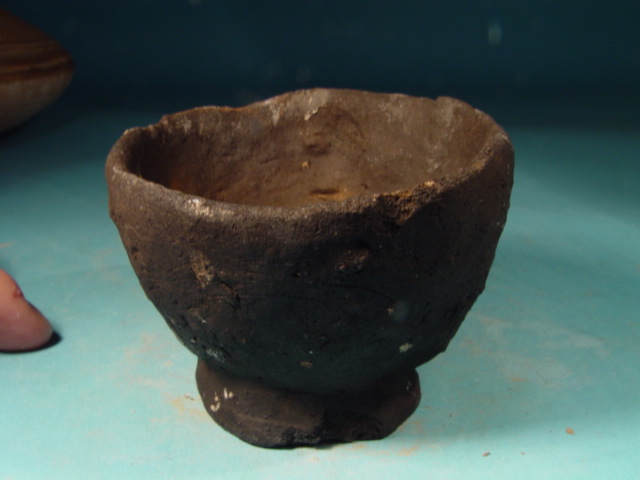
European Pre Celtic Bronze Age Tea Cup 600 BC!

.
The no-questions-asked antiquities trade is a frustrating place, on the one hand one's blood boils when we see archaeological artefacts obviously freshly ripped from their contexts on sale to anybody who is not too concerned about the damage caused and selfish enough to want to buy them. On the other one's blood boils when faced with some pretty bare-faced cheatery and total ignorance among sellers and buyers.

I'm not sure which of the latter two categories to place this one. A British seller has an item on sale in his online gallery, he calls it a "European Pre Celtic Bronze Age Hand Made Pot 600 BC!". Now "pre-Celtic" is an interesting concept, sort of makes the primitive wonky pot on sale sound primevally attractive. I also had words in the past with this seller about some central European pot he was selling as "Bronze Age" which was Iron Age (or was it the other way around?), so "pre-Celtic" could be fluff term to avoid being specific.

The sales spiel is wonderful, conjuring up a vision of primeval forests and the noble savage struggling to control the environment. In the work on artefact hunting which I wrote with Nigel Swift we call this "narrativisation" and its an important part of collecting, but also marketing the goods.

So where does it come from? It was, the seller assures us "found in Germany near the Danube river", so that's anywhere along a 400-km long line... It also apparently was "Formerly in the collection of an English gentleman". Well, how could it be otherwise? (Are all collectors automatically "gentlemen"?)

The seller assures customers that his firm "employs a number of experienced consultants who specialize in authenticating ancient art to offer you the necessary protection". I think we all should know the name of the experienced consultant that authenticated the object shown in the photos as a "very rare, late bronze age Cremation pot or cooking pot", as it is clear they know next to nothing about Late Bronze Age pottery of central Europe.


The photograph shows a handmade vessel, yes. The vessel has clearly been bonfire-kiln fired, yes (it still has the ash on it). The form however is an imitation of a teacup on a raised footring. The fabric of this piece is nothing like that of ancient ceramics of the period and region suggested as its origin before it got to the "gentleman's collection". I challenge the seller and the consultant to show us a similar form vessel from an excavated Late Bronze Age settlement or cemetery with the same surface finish and fabric.

Any archaeologist who has handled any ancient pottery from central Europe will be able to see that this is a modern piece, it still has the ash on it, and clearly has never been buried in the ground, probably this was produced as "experimental archaeology" (maybe during an excavation as many archaeologists have had the opportunity to partake in). As such there is no reason why it cannot be collected, but it should not be being sold as an authentic Late Bronze Age artefact. With three days to go, seven people are bidding on this.

The seller is a well-known antiquities dealer from Cambridge and a frequent contributor to artefact discussion forums. He also has a large number of objects on sale which in one way or another I would categorise as "dodgy", misdescription being just one of the problems.

There is an awful lot wrong with the no-questions-asked antiquities trade in Britain and elsewhere, while dealers are unaccountable for the proper description of what they sell, and there is a total lack of transparency, they can get away with a great deal, like selling illicitly-obtained items, or outright fakes.

Photo: Eftis Paraskevaides' "Bronze Age teacup". Although he says the images on eBay are his "copyright" I'm putting them up here as a public service, and if he wishes to challenge it we can discuss how he ascertained that the object(s) he bought from the gentleman as antiquities left Germany legally, has he seen an export licence for this? Otherwise he could be culpable under the 2003 Dealing in Cultural Property (Offences) Act. Not of course if he knew it was a fake when he bought it, but then why is he selling it as something else?

Monday, 5 April 2010

caveat emptor

.
EBay seller Ray-Chris seems to sell mostly old crockery, so we'll have to give them the benefit of the doubt I guess when they write that they have for sale: 120553156323, INTERESTING COINS OR TOKENS A METAL DETECTOR FIND OF 7 ITEMS THEY WERE MUDDY SO I GAVE THEM A WASH IN SOAPY WATER BUT I DID NOT POLISH THEM THEY RANGE IN SIZE FROM 3 cm WIDE DOWN TO 1.7 cm WIDE. WHAT I KNOW ABOUT COINS YOU COULD WRITE ON THE BACK OF A POSTAGE STAMP THEY WERE DUG UP NEAR SHERBOURNE IN DORSET. So did Ray-Chris dig them up himself, or did he buy a handful of muddied coins from a dishonest metal detectorist for resale? Now these are obviously fakes, they have the WRL stamped in them, but how many less obvious fakes get onto archaeological databases through being represented as dug up by UK artefact hunters out to make a quick sale? Or genuine objects with false provenances?
(Auction spotted by Ramon Saenz de Heredia)

UPDATE: After being informed by coin dealer Tony Jaworski that the objects were not as he said, we learn that "The seller ended the listing and relisted them as tokens ...". He also dropped the story tyhat they were "dug up near Sherbourne". To judge from the new description Mr Jaworski seems not to have drawn the seller's attention tyo the WRL stamp - otherwise in a truthful descruiption, this information would be mentioned.

Monday, 8 March 2010

Tourist Trinkets in Cyprus Relic Bust?

.
Antiquity collectors were in stitches over a BBC report "Cyprus smuggling ring broken up" at the end of January. Let us remind ourselves the gist of the story:
Police in Cyprus have broken up a smuggling ring that was trying to sell stolen antiquities worth more than 11m euros (£9.6m), officials say. Artefacts for sale include urns, silver coins and figurines, some of which are thought to be 4,000 years old. Police are investigating whether an international network was involved. Ten people have been detained and five others are being sought in what analysts say could be the largest such ring ever discovered in the country. While many of the objects found came from Cyprus, others were thought to have been made elsewhere, antiquities officials said.
The article was accompanied by two photos, one a big box full of intact pottery vessels probably ripped from graves.

The other photo was what caused the hilarity. The bright shiny mummy case with the removable pointy-head alien figure is clearly a tourist trinket. It has a little "AP" on it which suggests the BBC got it from Associated Press, who would have got it... where? Is this a photo supplied by the Cypriot authorities? Was it a stock photo of an "antiquity" popped in as a space-filler? Or do the ACCG have a sympathiser in the Associated Press who put it in to discredit the Cypriot government at their bidding ? (Oops, I feel a little conspiracy theory of my own coming on....).

On the other hand, what actually is so improbable in the people who are accused of supplying looted Cypriot antiquities to the international market also being involved in the trade in fake artefacts? Bulgarian dugup relic suppliers and dealers freely mix the two. The suppliers of the antiquities market do not have to be experts - just law-breakers out to make a quick buck to plough into other dubious "business ventures" and eager to get their hands on any old saleable collectable item. The items allegedly prepared for export by these suppliers need not all have been intended to be offered to the same dealer.

I suppose that raises the question for collectors, do they know who the man their dealer bought his items from bought them from and what else he trades in?

Anyway to come back to the Cyprus bust, I suppose to find out what artefacts were involved we must wait for those responsible to be hauled over the coals, together with all (I repeat all) of those that have been attempting to import illegally exported items of Cypriot origin into foreign countries.

Photos: BBC/AP

Sunday, 21 February 2010

No Honour Among Thieves

As we know, metal detector users tend in general not to be particularly skilled lingustically, whether in the written or spoken word. The reader then may not be particularly surprised by this particular egregious example from eBay found by the Rev Paul Bulgerin being offered by a seller from Wayne, PA, USA:


GREEK OR ROMAN SILVER COIN, FIND IT WITH METAL DETACTORE, FROM OVER SEE, THE SIZE OF IT THE SIZE OF HALF DOLLAR, I DIDN'T CLEEN IT THEY TOLD ME BATTER NOT TO DO, I JUST TEST THE SIDE TO NOW IT'S SILVER YOU CAN CALEEN IT IF YOU WANT TO SHOW ALL THE SILVER IN IT, I AM NOW OVER SEE SO I WILL SHIP IT WITH IXPRESS MAIL, I WILL SEND IT ANY WHERE IN THE WORLD, YOU WILL GET IT WITH SIGNATURE, 100% SILVER, I DO HAVE OTHER COIN YOU CAN SEE MY LEST, I DO PUT THE ADD EVERY TIME I FIND ONE NEW. YOU CAN C THE FIRST PIC LOOK LIKE IT'S SMALLER THAN THE 2ND BUY IT'S THE SAME COINE JUST WITH THE SCAN ONE LOOK BIGER THAN THE OTHER, IT'S THE SAME COIN FROM THE FRONT AND THE BACK.
The coin is pictured below, it sold for 47$. There is another auction ongoing at the moment from the same seller. This is described as a "roman or greek" bronze coin:
I SOLD ONE THE SAME, I HAD 2 OF THESE. THIS IS ROMAN OR GREEK COIN, I GOT FROM THE GROUND OVER SEE WITH MY METAL DETACTOR, THE SIZE OF THE QUARTER, I TRYED TO GET GOOD PIC OF IT THROW THE SCANER, I DIDN'T CLEEN THE COIN, I AM OVER SEE NOW SO I WILL SHIP IT INTERNATIONAL MAIL WITH SIGNATURE, AND SEND THE TRACK #
The same studiously laboured language. Yet the seller's feedback shows he does not have these problems with formulating a sentence in English when he is selling gold bullion, cosmetics, mp3 player or a mobile phone. The coins offered are fakes, the first is a copy of a bronze sestertius of Maximinus I, probably Bulgarian in origin, the second is a tourist souvenir fake of a Ptolemaic coin. If one looks back at the seller's feedback he has sold a number of such items as from the "Middle East". It seems from the way the seller moves to a different written style to convince people that they are what he asserts, suggests he is well aware that these are not what he says they are. When was he going "overseas" to do this metal detecting, and has he got an export licence for the proceeeds? Apart from the fact that the current no-questions-asked market allows anyone to pass themselves off as a finder and legitimate owner of an ancient object, which could in fact have come from anywhere, and which allows abuses like this. What is particularly interesting here is the social perception of the metal detectorist in Pennsylvania. Both seller and buyer expect a metal detector using artefact hunter to be semi-literate and write as though he has a total of nine months in school to his name. Even fake coin sellers are poking fun at the tekkies' spelling.

Thursday, 18 February 2010

Bad Pennies

A new issue of Robert Matthews' Counterfeit Coin Newsletter (CCN) has appeared online. This is number 13. It begins with a short presentation of the new batch of Serbian fake LRB (Late Roman Bronze) coins which I discussed here earlier. After presenting the history of the discovery of this highly interesting group of coins, Matthews writes:
The emergence of this "hoard" illustrates the need for dealers and collectors to only purchase material that is well provenanced and has appropriate export licences. Without these records such coins are likely to have been smuggled or counterfeited. It continues to amaze CCN that people who would not contemplate breaking the domestic laws of their country are happy to buy and sell such material from a probable illegal origin.
Well, it does not "amaze" me, but speaks volumes for the ethics of coin dealers and traders. If dealers lose money and their reputations by buying fake coins thinking they are buying looted and illegally exported coins from law-breakers, then I for one have no sympathy whatsoever for them. Nor for collectors that place their trust in such dealers without ascertaining where the coins they peddle are actually coming from. The Newsletter also has an interesting article British one-pound coin counterfeiting which, like looting of archaeological artefacts "reaches a "level of political significance""

Tuesday, 16 February 2010

Fascinating Text on Coin Collecting

It is not often I am moved to use the word "fascinating" when it comes to what is written by collectors of coins, but Reid Goldsborough is a good writer and always worth heeding - even when I think he is wrong. In a text he has published on Moneta-L last night he frankly discusses the period when he re-began collecting coins, and it is good reading. In fact (though the bottom bit is of more specialist interest and may not be to everyone's taste) it is an exceptionally good text, so much so that it appears to me that Mr G. should be snapped up by a numismatic publisher and asked to write a book. Let me pick out some quotable quotes the first not quite in the context the author intended, I admit):
Most dealers appear to adhere to the maxim that if asked, you disclose, if not, you don't. But some, it appears, don't even when asked. [...] some dealers, even those at the top of the profession, don't disclose what they should...
I particularly liked this paragraph on the appeal of collecting numismatic material.
But what most does it for me, with coins, is what I've described as the "glom." With the background information in your head that you've uncovered through your research, you seize upon a coin with your eyes, marveling at its physicality, the beauty or quirkiness of its design, strike, and state of preservation, following the coin's lines and curves, its raised devices and depressed fields, tilting the coin for different perspectives on the pristine or worn surfaces, awed by the light's aesthetic revelations of how the metal was shaped and how it has interacted with its environment over what's often a very long time.
Most of Goldsborough's text considers the
"dialectic of truth and falsity [which] plays itself out in numerous ways in ancient numismatics, but two are primal: 1) The dispersal of new finds of ancient coins (and artifacts) into collections, and 2) Forgeries.
Both of these areas are ones which interest me very much too, so Mr Goldsborough's comments are of great interest. He promises to discuss the first issue at more length elsewhere (he has done so on his website already and I've discussed this on this blog earlier) but the text on forgeries is also worth a read, though the bottom (with his wants list and discussion of strategies for dealing with eBay scammers) gets a bit specialist in scope. Moneta-L (unlike most collectors' forums which obviously feel they have something to hide) has an open archive. Excellent stuff.

Wednesday, 9 September 2009

Felix Salmon on the "antiquities-on e-bay debate"

Felix Salmon's blog on the Charles Stanish story on e-Bay fakes which is still going the rounds is not remarkable in itself. The comment by Charles Stanish however is. Well worth a read.

The blog was occasioned by a somewhat aggressive post made elsewhere ("Cheaper by the Millions") by an arrowhead collector, one Bill Stelzer from Portsmouth, New Hampshire. He said that Charles Stanish was wrong because he's bought lots of arrowheads on eBay and they are "all genuine" (he even sent the journalist one smuggled out of some Saharan country to "prove" it). He says: "There are no fake Neolithic arrowheads. Nobody even wants the real ones". I say he's deluding himself. he is also misleading everyone when he writes:
The eBay sites that auction antiquities are among the most vetted sites on the Internet. [...] EBay demands that the detailed description accompanying each item explicitly state that the piece is authentic, or it is not [...] If the collectors and dealers monitoring the sites suspect a fake, they can and do contact eBay. If there is agreement on the issue, the seller is required to revise the description and remove the word "authentic" and the fraudulent date or withdraw the piece from the sale.
Nonsense. Collectors' forums are full of posts complaining that until Stanish's article drew attention to this problem, eBay was exceptionally unwilling to cancel auctions that they were being informed by concerned individuals were of fakes.

Wednesday, 22 July 2009

Well Organised "Mafia" Business


The attempt to clear internet sales portal eBay of as many sellers of forged archaeological finds goes on. There is (as collectors well know) a large centre involved in the production of fake antiquities in Bulgaria. Some of the sellers of such items however are proving difficult to get rid of. As soon as one account is deleted, dormant accounts are reactivated. Some of these sellers operate from bases in the UK, where the products are lost among the numbers of material coming (their sellers claim) from legal artefact hunting on local archaeological and other ‘productive’ sites.

Christian Rizzo (near Villefranche sur Mer on the French Riviera, eBay seller "shams06") writes:
The problem with the bulgarian dealers it's that they seem are working all together (or alone with several pseudo[nym]s ) with the same fake makers ( we can find some of these fake makers on the web looking for "art foundry" in Bulgaria where they show their models ). It's why we use to see at the same time from different sellers exactly the same items. And they use the same agents for collecting the money and sending the sold items. It's why you cannot have a direct contact with the seller and why a lot of sold items never arrive to the buyer ( see the feedback of Annaatana37 for example) or when they arrive they need more than 1 month shipping because the do grouped shipping. Unregistered you can find them some time later with an other pseudo[nym], in another country but with the same items. It's a very well organised " mafia " business.

The significance of the evidence is clear to dealers and collectors - as it should be to eBay who've been happy to take money from these people for providing a sales place for their activities all these years. All know that their no-questions-asked approach favours the use of the antiquities market as a source of funding for organized crime through fraud, the selling of forgeries. Yet they still refuse to even contemplate doing anything about it. I presume they treat it as “somebody else’s problem”, nothing to do with them. Like looting of archaeological sites.

Sunday, 5 July 2009

Ridding the field of whistleblowers: "in your dreams"

Cultural Property Observer reports, apparently gleefully, that critic of no-questions-asked collecting policies Oscar White Muscarella curator of ancient art and archaeology of the Near East “has taken a recession driven voluntary retirement” from the New York’s Metropolitan Museum. He notes that due to his role as a whistle-blower:

If Muscarella had been in private industry, he would have been sacked long ago. However, in the not-for-profit world of the Met, he managed to hang on for 44 years...
Perhaps employees of one of New York's premier museums have a strong trades union behind them – or perhaps (unlike no-questions-asked collectors) the Metropolitan regards participation in public debate on ethics and the preservation of the cultural heritage part of a museum’s public role. This extraordinary ad hominem statement is however given significance in the context of the fact that, although he does not like us mentioning it, Peter Tompa is an employee of Bailey & Ehrenberg PLLC, the core of whose activities concern providing legal representation in the areas of employee benefits law, employment law, and litigation. Frankly I am amazed that a lawyer in such a firm would be so glibly suggesting that whistleblowers can be summarily sacked. Somehow, apart from other factors, I do not think I'd be seeking his firm's help in any conflict with my current employer.

If the Metropolitan had threatened to sack Otto Muscarella after writing of the false provenance of Ziwiye ("Ziwiye" and Ziwiye. The Forgery of a Provenience, in: Journal of Field Archaeology 4, 1977), or the publication of his “The Lie Became Great” (2000), both about the no-questions-asked market in antiquities, would Bailey and Ehrenburg have refused to represent him? Just curious.

It is also interesting that Peter Tompa is among those who claim (falsely) that supporters of collecting of portable antiquities are somehow "black-balled" by the archaeological community (this is to expain away why so few voices are raised in the defence of the no-questions-asked market in the archaeological milieu which collectrs say are solidly behind them, it being just "a few radicals" [sic] that are not). Yet Tompa himself is obviously advocating archaeological black balling of heritage professionals who are anti-looting and confronting the issues caused by the no-questions-asked market. Where is the consistency in that standpoint?

How many more people critical of the no-questions-asked market would ACCG activists like Mr Tompa like to see "sacked" from their workplace, or perhaps in the case of younger academics prevented from being employed there at all?

I wish Dr Muscarella a long, happy and fruitful retirement and long may he continue to spread the word among the public about the damaging effects of the no-questions-asked market in decontextualised artefacts on the preservation and integrity of the world's archaeological record. That is what basically this is about, integrity and truth.

Photo: Oscar Muscarella (SAFE)
 
Creative Commons License
Ten utwór jest dostępny na licencji Creative Commons Uznanie autorstwa-Bez utworów zależnych 3.0 Unported.