Showing posts with label V-Coins. Show all posts

Thursday, 9 February 2012

Issues of Homs on V-Coins

.
Homs is being shelled to smithereens and thousands of people trapped in the city are either dead and injured or about to become so. Houses and public buildings are being destroyed and their contents scattered. Soon the city will be overrun by its attackers. I was interested to see just how many coins minted in this city are on V-Coins at the moment. The search feature (under "Emesa") revealed 69. Fifty eight are Roman (many Severan) coins, mostly silver issues, nine are Byzantine or Arab/Byzantine issues. Those I looked at were accompanied by zero information on how they left the source country or when and where they had been since. I wonder whether it will dawn on dealers and collectors that in this difficult period for the countries around the south and east shores of the Mediterranean, there really should be information on these topics there. Searching for "Syria" gives 1597 items (603 priced over 100 dollars, 34 of which were priced at over 1000 dollars).

The Barakat Gallery has a whole (?) hoard of 508 6th century Byzantine gold solidi illustrated on their website as spilling out of the top of a narrow-necked jug. The origin is cited as "Syria" and the location as the United States. One would be very interested to know by what route this group of objects left Syria and ended up on sale in a Beverly Hills gallery. If it left the country recently (and no details are given on the website), what links between the gallerista and his middlemen and the Homs-shelling, people-murdering Assad regime might have been activated to get it through Syrian customs?

How many of the coins coming onto the US market in 2012 are there as a result of the current conflicts in the Islamic world? How many dealers are in fact selling "blood antiquities"? Do US dealers and coin buyers have any intention of showing that they even care about the answer to that question?


Illustration: My map from an earlier post, red are US-MOU-countries, brown are countries which have seen serious conflict in recent months. The coloured dots are where coins sold in a recent ACCG auction were originally issued.

Wednesday, 14 December 2011

More Freshly-Surfaced V-Coin Cunies for Sale

.
Edgar Owen also has on his V-coins store a group of ten middle eastern antiquities which he says have the same (latter part of their) collecting history. As "provenance" for all of them, he gives (only) the following information:
"From the collection of a New York City professional entertainer acquired in the 1980's".
No more, nothing about how they left the source country. There are currently on offer seven "Mesopotamian cuneiform tablets, ca. 3rd millennium BC."

6689. clear cuneiform both sides. 1.9 x 2 inches.

6693. 1.5 x 1.8 inches. Clear cuneiform both sides. Intact.

6695. .9 x 3 inches. One side covered with cuneiform. corner chip [where it has been belted by a pickaxe in excavation].

6696. 1.8 x 2.8 inches. Considerable cuneiform both sides. Intact.

6701. 1.3 x 1.8 inches. Considerable clear cuneiform both sides. Reattached at middle.

6703. 1.9 x 2.5 inches. Roughly glued but with considerable clear cuneiform both sides.

6704. 1.8 x 2.5 inches. Several lines of cuneiform on the back which is intact, and covering the front which has chips with glue traces. [it also has a huge pickaxe scar across the front]

6707. tablet with cuneiform both sides. 2 x 2.6 inches. Repaired.

6708. tablet with cuneiform on one side. 2.25 x 2.25 inches. Repaired.

There are also two other objects:

9599. Syrian Bronze Calf Head, ca. 5th-3rd century BC. [...] pierced ears for earrings and attachment tenon at rear. 1.2 inches. Described as "rare".

9611. Ancient Holy Land Bronze Stamp Seal, ca. 1st millennium BC. [...] with a clear deep pattern, break to tip of handle. 1 inch in diameter. [described as "rare" and the suggestion made that the squiggles on the front "could be three letters in which case the seal might be traceable to a particular person". Or not of course].

The first thing that strikes the reader is the odd lack of any kind of translation of the cunies, many items on the market nowadays come with this, and this sometimes gives the name of the site they came from. The second is that several of the cunies are of similar appearance, colour, clay and the same crude glueing. Were these bought by the anonymous "New York City professional entertainer" as single items or a group? What other items were available on the New York market in the "1980s" and where did they come from? How and when did they leave "Mesopotamia" and why (if my suspicion about several of them being from the same discovery is correct) when they were bought by the collector, were these items still together?

Certainly tracing their presence on the collectors' market only as far back as the 1980s makes them "freshly surfaced". It does not take them back to before the institution of the heritage protection laws of Iraq (the probable source country), nor the 1970 AAMD "safe" date, so what documentation is there for where they were before then? Mr Owen neglects to say on his V-Coins portal. Why?

Friday, 15 July 2011

Two Dealers Vanished - Which ones?

.
I have learnt that when one tries to follow up certain links on some earlier posts here, the computer screen flashes up: "The specified request cannot be executed from current Application Pool". That's an odd error message which I admit I'd not seen before. What it means apparently is;
"an error has occurred (database not accessible, poor connection / timeout, server too busy / doesn't want to play anymore, etc), the Website tries to fetch the custom error page, the page isn't accessible because it's on a different part of the server running in a different application pool (all Websites can have their own application pool), Web server throws a wobbly".
The badly designed web service that is generating this message is V-coins ancient coins. It says on the front page: "153 Ancient Dealers, 110,258 Items, $23,292,539 Value"
That's funny, two days ago there were 155. The broken links from my posts indicate which two dealers have currently gone underground.
.
Vignette: problems in the trade in antique objects?

Thursday, 14 July 2011

Egyptian Antiquities Allegedly Smuggled From Dubai to US

.
"This office will continue to vigorously enforce cultural property laws that restrict the unauthorized movement of antiquities, Antiquities dealers and collectors are on notice that the smuggling of cultural patrimony will not be tolerated." U.S. Attorney Loretta E. Lynch

Four people have reportedly been charged by US authorities today with illegally trafficking in Egyptian and Greco-Roman antiquities (as well as money laundering). The antiquities concerned were allegedly smuggled past US Customs and Border Protection officers including a Greco-Roman style Egyptian sarcophagus, a unique three-part coffin set belonging to Shesepamuntayesher from the Saite period (26th Dynasty, c. 664-552 B.C.) as well as Egyptian funerary boats and limestone figurines. In addition to Egyptian antiquities, other Middle Eastern and Asian artifacts along with more than a thousand antique coins have been recovered. They were exported from Dubai in the United Arab Emirates in a scheme that spanned from October 2008 to November 2009 and packed to avoid official scrutiny at American ports, officials said. US customs law allows for less stringent inspection standards for goods valued at under $2,000. Although the artifacts were worth more than that, the consigners lied to customs officials about their origin and value. They were mislabelled as “antiques", "wood panels” or as a “wooden painted box”. A middle sarcophagus and part of an outer sarcophagus arrived on board a cargo ship at Port Newark in 2009 where they were seized by law enforcement agents, officials said. A civil complaint seeking forfeiture of Egyptian sarcophagi, Iraqi artifacts, cash, and other items seized in connection with the government's investigation was also unsealed this morning in Brooklyn federal court.

Unusually for cases of this nature, the four people charged by Brooklyn federal prosecutors with conspiring to smuggle antiquities into the US have been named. Several sources state that the allegations concern:
Mousa Khouli, Salem Alshdaifat, Joseph A. Lewis, II and Ayman Ramadan
Mousa "Morris" Khouli, 37, is the owner of Windsor Antiquities (website currently offline?) on E. 56th St. in New York. The gallery specializes in Etruscan, Roman, Egyptian and Near Eastern antiquities and ancient coins dating back to 1000 B.C. This dealer features on the recommended dealers list disseminated through Tim Haines' Yahoo "Ancient Artifacts" discussion group - recommended for what though? Readers of this blog might recall the dealer selling one of the "Wenneb" shabtis I was discussing a while back, that story potentially takes on a new significance now, especially as one of the other defendants in this case was also selling them at the same time.
Agents recovered a sarcophagus in Khouli's Brooklyn home, which he falsely claimed was part of his father's collection and "that he had owned it for a long time," court papers state. Federal prosecutors say Khouli purchased that coffin from Ramadan in 2009 and are seeking the forfeiture of all the items so they can be returned to Egypt.
Khouli, 37 will be arraigned Thursday before Magistrate Judge Andrew Carter in Brooklyn federal courthouse. The case is U.S. v. Khouli, in the U.S. District Court for the Eastern District of New York, no. 11-340. (For the U.S.: Assistant U.S. attorneys Karin Orenstein and Claire Kedeshian. For Khouli: Gerald Shargel of the Law Offices of Gerald Shargel.)

Joseph A. Lewis II, a collector from Virginia has been mentioned in this blog (and Looting Matters) as the individual that is reported to have attempted to import an Egyptian sarcophagus (of Imesy) from Spain, and when it was challenged, apparently abandoning it (the coffin has now been returned by US authorities to Egypt). See here, and here. Initially the man was named (by two Florida lawyers) as Joseph A. Lewis III, but in a later draft of their paper they amended it to Joseph A. Lewis II, their carelessness leading to some confusion). A search of his home in Chesterfield Virginia by ICE agents reportedly revealed a Greco-Roman sarcophagus, Egyptian funerary boats and limestone figures, these were seized.
"Lewis allegedly purchased a Greco-Roman style Egyptian sarcophagus, a nesting set of three Egyptian sarcophagi, a set of Egyptian boats and Egyptian limestone figures (collectively, "Egyptian antiquities") from Khouli, who purchased those items from Alshdaifat and Ramadan. Each of these antiquities was exported from Dubai, United Arab Emirates, and smuggled into the United States. Khouli allegedly provided Lewis with false provenances which stated that the Egyptian antiquities were part of a collection assembled by Khouli's father in Israel in the 1960's when, in fact, both Lewis and Khouli knew that Khouli acquired the Egyptian antiquities from other dealers"
This is precisely why collectors who buy objects trusting they are from an "old collection" are unwise to even consider the transaction before ascertaining that this claim can be verified, documented and proven. Lewis will apparently be arraigned Thursday before Magistrate Judge Andrew Carter in Brooklyn federal courthouse. It is reported that he is represented by Peter Chavkin and Bridget Rohde of Mintz, Levin, Cohn, Ferris, Glovsky and Popeo.

Now Salem Alshdaifat is an interesting name. He is a V-Coins dealer (Holyland Numismatics, West Bloomfield, MI), also an ACCG Benefit Auction donor dealer. I have raised the question here of where the coins he deals in have come from, and it is interesting to see his name brought up in this context. With or without his name figuring in court, one might legitimately wonder about for example about a recent offer on V-Coins (you know, the "ethical" one?):
"500 uncleaned coins from the Middeleast and Egypt,
1,000.00 COINS available.


uncleaned coins, Greek, Roman, Judaean, Provencial, Byzantine, Islamic, and some rings. some small coins might have some Rare Emperors, we found befor Johannes, Leo, Zeno, Marcian and rare Vandalic coins in such lots, this lot is mostly uncleaned completly and some are cleaned in the edges or completly cleaned. plz note that just for this lot, we will ship only to USA, shipping will be Via Registred mail only.
Old collection, no doubt. As are the other bulk lots of Alexandrian and Ptolemaic coins he has on offer tonight. Some other Ptolemaics here too. None of the ones I looked at say which old collection they were in before they arrived in the coin shop - so where and how did they "surface"? Alshdaifat was arraigned Wednesday before a federal judge in Detroit Federal Court.

Now "Holyland" is a "wholesaler", that is somebody who has supplied bulk lots of soimilar coins to dealers. A number of his offerings on V-Coins are clearly marked dealer lots, and the "items sold" section of his V-Coins shopfront contains many more. So basically, if a dealer has bought one of these bulk lots and split them up into individual sales, sometimes sharing them with business partners, there must be a large number of collectors who have in their homes and cabinets coins originating in "Holyland Numismatics" dealer lots, and therefore sharing with them any issues of the provenance. Alshdaifat quite clearly has had access to high volumes of antiquities, especially coins, so where did they come from? A lot of them (but not all) are types that could well have been found in Egypt, particularly in the northern part of the country. The question has to be asked, how would they have left the source country in bulk?

Ayman Ramadan, a Jordanian national living in the United Arab Emirates, is a bit of a shadowy figure. He is noted by the newspapers as "an antiquity dealer from Dubai, United Arab Emirates". It turns out he runs the outfit I mentioned in an earlier post here, Nafertiti Eastern Sculptures Trading Co " (P.O Box: 111301 Bar Dubai, Dubai. United Arab Emirates). He is now is considered by (US) authorities to be a "fugitive".

Of course at a time when the question of artefacts looted from Egypt in the wake of the recent political disturbances there is very sensitive, this is not a good time for somebody to be caught with freshly-surfaced Egyptian antiquities on their hands. Note that also seized seem to be some from Iraq.

ICE Special-Agent-in Charge James Hayes, Jr., called the investigation "ground-breaking", he says this is "the first time an alleged cultural property network has been dismantled within the United States". Indeed it probably is. Most of the time antiquities stopped at the border are seized and sent home with fanfare, reaping political and foreign relations kudos, but rarely investigating the sender or addressee to any degree that would comprise any kind of investigation of the links in the illicit transfer of ownership of the artefacts concerned. Let us hope this case is a harbinger of a more pro-active policy on prosecuting the illicit artefact trade. It is gratifying to see that it involves coin dealers, as it is this milieu that has been most vociferous in recent years about so-called "collectors' rights" to material obtained and transported in defiance of cultural property laws. I doubt though that the investigation and seizures will give them pause for thought (indeed, I'd be very surprised to find them even discussing it at all on their forums and blogs). In any case, although "if convicted, the defendants each face a maximum of 20 years in prison", we all know that the four will just get slapped wrists from the court and told (asked nicely) not to do it again, like the Four Corners two dozen - if the American judicial system can't even deal with archaeological looting in their own country, what hope is there that they will actually deal with a case involving looting and smuggling outside the US? I do not see how Mr Ramadan can be brought to a US court.


Sources:
ICE News Release: July 14, 2011 - "ICE makes arrests and seizes cultural artifacts stolen from Egypt Set of Sarcophagi more than 2,000 years old" 14th July 2011.

Mitchel Maddux, 'Feds bust 4 in Brooklyn-based Egyptian antiquities trafficking ring', New York Post 14th July 2011.

John Marzulli, 'Feds bust group trying to smuggle Ancient Egyptian mummy coffins', New York Daily News, 14th July 2011.

Jessica Dye, 'Feds accuse 4 of smuggling Egyptian artifacts', Thomson Reuters News & Insight, 14th July 2011;

Kate Tayl o r, '4 Charged in Smuggling Egyptian Antiquities', New York Times July 14, 2011;

Keith Johnson, 'Alleged Antiquities Smugglers Busted', Wall Street Journal, July 15, 2011.

See Also: Looting Matters, Dealers Charged Following Egyptian Seizures

Vignette: A pair of bronze inlays (from a sarcophagus?) representing eyes sold by
Holyland Numismatics, where did they come from?
[yes, the dealer photographed them upside down]
.

Saturday, 11 December 2010

US Dealer with Oodles of Exported UK Metal Detected Stuff

.
I was looking up the name of somebody who'd earlier warned collectors against believing anything they read in my blog (quite right guys, check what I say out for yourselves) and came across his V-Coins shop. Then I realised I'd been there before, Ron Bude's "Roman Lode Ancient Coins" Plymouth, MI, an ACCG Benefit Auction donor as I recall. Quite an "interesting" selection of stuff; where does it all come from? Let's have a look through it. Very little of it is provenanced, even to a previous collection. So we have to look at the typology and refer to what we know about the composition of coin assemblages in various parts of the ancient world.

Well, as most US dealers in ancient dugups, there is a large amount of material that very probably comes from the Danubian provinces and Balkans. This is the product of the shunting of huge quantities of material onto the US and European markets from looting on an industrial scale in the Balkans and especially Bulgaria, where at least part of the process was in the hands of organized criminal groups. I think that Hungarian sources may also have been involved to a greater degree than has been previously suspected, and may have been gaining in prominence more recently as the Balkan sites become increasingly unproductive (because already looted out). The market that sprang up on the back of this sudden influx of the results of Balkan looting now has to seek other sources to maintain its expansion.

Then Mr Bude has a little group of items for which a Near Eastern origin seems likely. How did that get to Michigan?

I however was rather taken aback by the amount of material in Mr Bude's -Coins shop which really can only have come from metal detectorists in the United Kingdom. While late Anglo-Saxon pennies turn up in Continental assemblages, the source of the sceattas he is selling is most likely English. Rather worrying is the inclusion of a gold solidus of Justin II ( 565-578) as a "British" find in his listings. If really a British find, this coin appears not to be known in the literature, and one wonders under what circumstances it was discovered and exported. Indeed one wonders under what circumstances any of those coins were discovered (not a single one I examined seems to have a PAS number attached) and exported (not a single one I examined mentions being accompanied by a British export licence). It seems quite a lot of the Roman coins could also have been British (or adjacent areas of the Western Empirer) in origin, but where exactly does it come from? Does Mr Bude possess any documentation of licit export for any, let alone all of these coins from Britain? Can we see it?

Or perhaps he will claim that he acquired all of this stuff from the splitting up of a pre-existing collection or collections made up of material that was, conveniently, all in the US before the AAMD cut-off date of 1970. This is the usual get-out argument used by dealers unable to show where material came from or document legal export. "Tradionally in those golden days of carefree collecting" they argue "nobody kept records like that", thus absolving themselves from having in their stock material, the actual origins of which they have no idea. They claim innocence until proven guilty, the onus being on the accuser to demonstrate in each specific case why anyone should be concerned about a given coin or group of coins. As cop-outs go, quite an effective tactic, since of course the clandestine excavation and smuggling of artefacts does not - by its nature - leave much of a paper trail by which a given group of coins could be challenged once it is anonymously in a dealer's stock trays.

There is however now another tool, and paradoxically the first example was provided by UK metal detectorists and a coin dealer from the UK. Professional Numismatist Peter D. Spencer is looking into the way metal detecting is affecting the types of coins coming onto the UK market. He has found that coin collections created before the explosion of metal detecting differ quite markedly (especially in the types and relative quantities of material from the post Roman periods) from those of the past four decades. This he gauges as a result of his own handling of the coins as a dealer active on the market for a number of decades and a study of old catalogues. Some types were uncommon in collections in the past, but today they are much better represented as a result of new finds. Part of this is caused by the sort of coins that were used in making up hoards, which before 1970 was the way coins were most easily noticed by being discovered accidentally (several kilos of silver coins in a restricted area is pretty easy to spot in the ploughsoil, while a single corroded and muddy hammered coin less easily so). Post 1970 the bulk of the coins coming onto the market was now from metal detecting finds of single coins found for the most part on so-called "productive sites" and is thus reflects coin loss (rather than coin tesauration) patterns in both on-site and off-site contexts. Spencer has a chapter in Suzie Thomas' and Peter Stone's book on Metal Detecting and Archaeology setting out what he has found. It is too much to summarise here, but the long and short of it is if one looks at the typology and nature of Mr Bude's offerings, the composition of the assemblage as a whole looks like it is made up of items taken from the pool of post 1970 finds rather than what Spencer would describe as a typical assemblage of pre-1970 collected material. In other words, it looks likely that somebody has been buying relatively fresh metal detecting finds made in the UK (ones apparently not documented to have been reported to the PAS to boot) rather than making up the stock from old collection material.

It seems to me that Spencer has provided us with a means to assess the degree to whether coin assemblages currently on the market contain material which by its nature was accumulated in collections pre-metal detecting, or post-metal detecting. His model needs refining, maybe in the form of an algorithm based on a closer statistical analysis. It also needs expanding, looking at changing compositions of local collections right across the ancient world. It is however a start in the process of verifying and challenging the "old collection" claim so often evoked as an excuse for a lack of transparency in the antiquities market.


Reference: Peter D. Spencer 2008, "The Construction of histories: Numismatics and metal Detecting", pp. 125-136 in: Thomas, S and P. Stone (eds) Metal Detecting and Archaeology, Newcastle University/Boydell and brewer Stowmarket.

vignette: Did a coin like this really come from metal detecting in the UK?

Saturday, 4 September 2010

Keeping an Eye on the ACCG donors (1): Holyland Numismatics, Michigan and Dubai

.


I am looking through the ACCG Third Benefit Auction (a post on this coming up soon) and paying attention to who is giving what and the possible implications of this. There are several interesting things coming out (how could there not be?) but one of the donors of items in particular caught my attention this morning in relation to another long-running thread on this blog, but of that in a moment. First, let's take a look at this, from a forum which has open access, so please look through the whole thread. This was posted by a coin-collecting designer from Houston Texas calling himself "Drusus" on 1st August 2007 and he is extolling the benefits (sic) of collecting ancient dugup coins. the point he is making is that there are already lots and lots on the market (I think he means the US market):
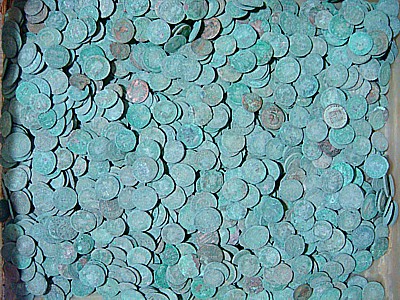
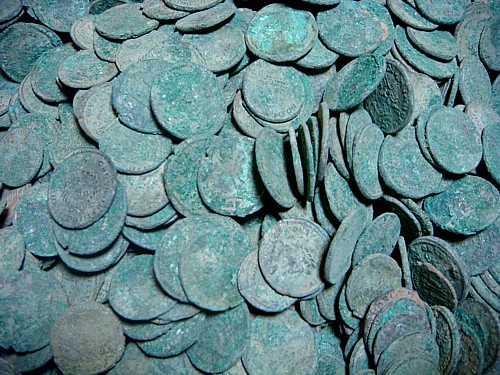
I have borrowed these photo from a guy on another forum who shares with us when he gets new shipments in directly from the source... I believe these are coming from the ME... this is just one guy's hoards... and I believe he mostly is a middle man in that he receives them from the source... cleans them... then sends them on to a buyer or buyers buying back some for his own store... there are others who post finds on the forum from eastern Europe, Britain, etc...
I suspect the forum he means is UncleanedAncientCoins, or maybe AncientBulkMarketplace but that is not important. There is this guy who gets "new shipments" of coin hoards from the source, cleans them in bulk and passes the ones he does not want on to other dealers. The classic case of a middleman, importing antiquities and supplying the market. We might ask ourselves, which Middle Eastern countries allow the free export of bulk antiquities like this?

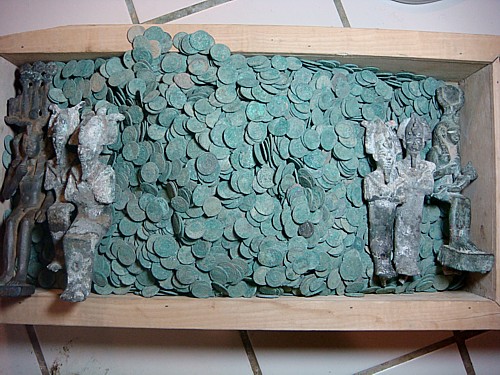
Drusus describes the photos he has posted of these groups of "Late Roman imperial bronze/copper coins fresh from the ground and ready to be cleaned". "These are several different hoards posted by only one guy... and he is far from the only guy bringing coins to market". No mention here of any "old collection" then. Look at the photos:


So what "Middle Eastern" country might they have come from then? Well...


The Egyptian style bronze statuettes might give a clue (let's keep an eye open for them later)... So where did these coins come from? Who recorded these finds (and where can we see this record) before they were released for sale? Who is importing them and how? Well "Drusus" at least answers the first question further down the thread, when we see the same (?) coins after cleaning:
Because I used his hoard pictures to illustrate... if its okay I would like to say that these coins are courtesy of Salem Alshdaifat and Holy Land Coins and examples can be seen here: http://www.vcoins.com/ancient/holylandcoins. At that link you can find hoards of Roman, Greek, and Persian coins...most are sold as fast as they come in...
yes, I bet they are. So Salem Alshdaifat (apparently of Jordanian origin with Canadian citizenship) the importer of these multiple groups of dugup ancient coins from somewhere in the Middle East has a store on ACCG president Bill Puetz's V-coins has he? He'll abide by the "V-Coins Code of Ethics" then, won't he? Let's have a look at the Holyland Numismatics store on the "ethical alternative" V-Coins store. Its owner claims:
We are the best buyers for Hoards, as you see in our store we buy large Hoards and sell whole sale lots, Contact us if you have any Hoard of Roman, Greek and Byzantine coins. Our company has been actively involved in the market of ancient coins and antiquities for the past six years; selling to the major dealers in the industry [...] We are always looking to purchase ancient coin hoards from the source. Please contact us if you wish to do business in this field. We are American ancient coins dealer, locate and operate from Orchard Lake city, Michigan.
Let's have a look at what Mr Alshdaifat is selling; a REALLY interesting array of items... Like this apparent hoard of Byzantine solidi, fancy somebody issuing an export licence for that (not mentioned up front in the sales offer, not even mentions where it comes from - still, an oversight I am sure). But he does say where one group of coins comes from, the Middeleast and Egypt, 10,000.00 COINS available, (is that ten thousand, or a "million"?) with another group being sold in smaller lots "Middeleast and Egypt". Another large group here too. (He forgot to mention the export licence here too). There are some quite "interesting" assemblages in the "dealer lots". I wonder if ACCG dealers have a discount?

My eye was caught by some shabti assemblages, I am sure the vendor will not mind me using some of his photos from the ephemeral archives of his V-coins store for the delight and edification of shabti collecting afficionados wanting to use such auction catalogues to collect parallels:


1) V-coins store: "10 Ancient Egyptian Blue Faience Ushabti C.600 BC. Size around 3 inches high .(7 - 8cm long) Rare items in great looking blue Faience (paist clay and glazed) Mummyform ushabti (servant for the next life) . perfect condition for the type, a real rare chance to get them in this condetion, Guaranteed Authenticity. this lot will be shipped from our office in Dubai Nefertiti Eastern Sculptures Trading Co P.O Box: 111301 Bar Dubai, Dubai. United Arab Emirates". Price US$ 1,300.00

2) V-Coins store: 40 Ancient Egyptian Blue Faience Ushabti C.600 BC, all written in the back, Priced to sell !!!![...] this lot will be shipped from our office in Dubai...". Price US$ 4,800.00

3) V-Coins store: 5 Ancient Egyptian Blue Faience Ushabti C.600 BC, all written in the back, Priced to sell !!!! Price US$ 600.00

These look rather familiar, the form of the objects and the hieroglyphs on the back are awfully reminiscent of the inscription as on a group of objects discussed here a while back... Who remembers the Wenneb shabtis that ethical dealers in the UK sent back to their (unnamed) suppliers when it was pointed out that they were a totally newly-surfaced type and a collector suggested on the discussion list that there was evidence that they were a newly looted type? Where did Mr A's (unnamed) associate in Dubai who had a whole boxload of them until they were sold through the "ethical" V-Coins store get them from? Mr Puetz, ACCG President, where do you think these items came from? If these are more of the Wenneb-shabti group, why is V-Coins selling them after their fellows were withdrawn from sale by ethical British dealers after it was pointed out on a major collector's forum that they were probably recently looted? [Of course it is a hindrance in the transmission of information like this that the Yahoo AncientArtifacts list is a closed access one, but I am sure they would be glad to let V-Coins dealers register and take part in the discussions of the seamier side of antiquities collecting].

One wonders if Holyland Numismatics' collaborator was able to obtain other items from this tomb along with this sackload of shabtis. Interestingly Mr Alshdaifat is selling a " Pair of Egyptian Mummy Bronze Eyes C.600 BC. Size of each eye 8.7 cm long. A pair of Bronze eyes inlaid with bone with eyebrows. mounted. 26th dynasty C.600-700 BC very nice pair, and intact exept there is one of the eyebrows was broken in one place and fixed" (560$). The photo shows them upside down, but they are also tomb equipment of about the same date as the shabtis ... How and when did they leave Egypt?

And while in the same region... aren't these ["lot of 32 scarabs, mixed from all Egyptian Eras.Gurnteed authentic"] some of ZZAntiquities scarabs that I discussed on Tim Haines' Yahoo AncientArtifacts Forum? They look awfully like them, same types and carving, same patina everything.

[Who is "Nefertiti Eastern Sculptures Trading Co "? I cannot find anything about them in the Internet. They have also been selling some odd looking Luristan weapons in a job lot]

I think it is worth considering why dealers supporting the ACCG are so unwilling to have the US retain any law which means that the barrier of bubbles at the US border is in any way tightened up for antiquities. Mr Alshdaifat has donated several hundred dollars worth of coins (and where did they come from?) to support the ACCG in its efforts to stop the US ICE looking at the paperwork of imported antiquities any more closely than they do at present. And look what is coming through, bucketloads of freshly dugup ancient coins for example, and Mr Alshdaifat's company "is far from the only guy bringing coins to the US market".

UPDATE 8th Sept: It seems somebody at V-Coins is not too happy about transparency, several of the links I give above to shabtis and some (chemically ? [re]patinated) Luristan swords and stuff have been deleted "this item does not exist" it says - are V-coins selling imaginary artefacts now? These links all refer to the items being sold by the mysterious office in Dubai. What is going on? V-coins had no problems with them being there before I mentioned them, why do they have now? Mr Puetz?

Tuesday, 25 May 2010

Dug Up "Art"

.
There is an interesting article by US journalist Michael H. Miller discussing the "ancient art" trade in the New York Observer ('Digging Up the Past', May 25, 2010). Due to various factors, including, as he put it, the activities of "self-appointed looting watchdogs"(David Gill is named):
"never has the tension between collector, dealer and so-called "source" nation been higher".
Recent disputes over the "surfacing" (from "underground") of unprovenanced artefacts on the market:
have pulled in collectors and chilled the climate for buying certain works, regardless of quality, dealers and auctioneers report.
These "certain works" of course are those for which there is no evidence that they were licitly obtained and legally exported from the "source country", which is how of course it should be. Rather self-righteously Miller notes (utilising the art-market use of the term "provenance") that:
If an object's provenance - that is, its history of import, export and ownership - cannot be traced back to November 1970, many people in the U.S. antiquities trade won't deal with it.
Ha! Not so Mr Miller. Not so at all, unfortunately. You've not been reading what collectors and dealers themselves say about this. Take the ACCG for example. The collectors of Yahoo’s AncientArtifacts group who (despite labelling themselves unilaterally "responsible") prefer to ignore discussions of such issues "like the plague". Then there is ACCG President Bill Puetz’s V-Coins where currently 145 Ancient Dealers ("8 more Coming Soon") are offering 104,181 ancient coins and items valued at $20,021,412 with no more than a very small percent offering up-front any information about provenance or legal export. As Miller notes defensively the:
1970 provenance is merely an ethical standard, not a legal one.
Indeed, this is a discussion of the ethics of and in a trade that prefers to argue most vehemently against tightening up its own very loose definition of that concept. The antiquities trade is an area where we really do need more public watchdogs, whether "self appointed" or institutional (such as the PAS) to scrutinise the ethics of buying and selling archaeological evidence ripped from the archaeological record at both extremes of the continuum of the trade, from those that sell them like potatoes by weight, to those who when they've been tarted up sell them like exclusive special edition Rolex watches.

Worth a read, and then thinking about.
.
Vignette: Dealer! Watch out for those Looting watchdogs, because they might be watching you.
.

Thursday, 4 March 2010

Those "Old Collection" Provenances Again

Over on the Yahoo Ancient Artifacts discussion list, unapologetic North Carolina dealer in decontextualised artefacts Steve Minor has done a rapid investigation of the "provenances" of artefacts offered by antiquity dealers. He notes that apart from real verifiable provenances which are in the extreme minority on the market today, there are two different types of provenance offered. The first says something like "From a[n old] private collection". The second variant is that an object is said to be from an "Old [Insert Nationality] collection". He argues that the latter may in a few instances give a real piece of information, but his impression is that "mostly it is just a meaningless phrase used by a seller to add a sense of legitimacy and value to an item with no provenance". He adds:
If you want to test my assertion, go to vcoins or Trocadero and ask the dealers that make the "old collection" claim to offer a shred of meaningful proof. Don't sit by your computer waiting for a reply.
He reports that using the search facilty of the V-Coins (we remember that is suppposed to be the "strongly ethical alternative") he found the following. Among the 118 000 coins and artefacts being offered today (with a total worth of $25,200,000):
Only 134 vcoin artifacts and coins apparently mentioned a "provenance" [apparently to a named collection or site].
4,399 items are said to be from the generic "Old Collection" but apparently with no other information,
407 - are said to be from an unnamed "Old German collection",
18 - are said to be from an unnamed "Old English collection",
11- are said to be from an unnamed "Old American collection",
3 - are said to be from an unnamed "Old Spanish collection",
3 - "Old French collection",
0 - "Old Swiss collection",
0 - "Old Dutch collection".
None of vcoin dealers offering 118,000 coins and artifacts thought it was meaningful to specifically admit a lack of provenance.
The term "Bulgaria" by itself produced just 100 hits, primarily coins but few artifacts. He found that a search for "Found in Bulgaria" indicated that only 10 items were declared as having been found in Bulgaria ("mostly strangely mint condition Scythian trilobate points except for one Roman military diploma fragment and one key"), he notes however that "most of the European artifacts clearly are [from Bulgarian finds]".

Even though its author stresses that these results come from a totally unscientific investigation of just one auction venue, these are shocking figures, illustrating quite clearly the degree that passing through the antiquities market in its current form strips artefacts of their context. Some 95% of the objects on the market today have lost their context totally, while if we are concerned with meaningful context, more than 99% of the objects on V-Coins have become totally decontextualised through the way information about their origins has been "curated" (or not) by collectors and dealers.

It should be recorded that Mr Minor's posts about these figures have so far met with silence on the collectors' forum, I would like to think this is shocked silence rather than the apathetic shrugged shoulders type.
.

Monday, 1 June 2009

Lots of fresh ancient coins on sale today via the internet


Given the unseemly fuss I mentioned here which was being kicked up last week by some US dealers about just two lots of “English dugups” being discussed by Frankfurt University numismatist Nathan Elkins, I thought I would take a look to see how typical of the material being offered for sale this morning they actually are.

On Monday morning at 7.00 am CET on eBay there were 6875 items being offered in the “Ancient coins” section of eBay(US) of which 721 finish in the next 24 hours. Some of these coins are fakes, many are single offers of selected cleaned coins. Others however are similar to those being sold by the three dealers discussed in these pages and by Nathan Elkins earlier. These are multiple lots of coins of less select condition, many are roughly cleaned or still have layers of earth on them. Most of these seem likely to be the remains of bulk shipments to the seller from which more presentable coins have been selected for individual sale. Most of them are described as “lots”, which is the search term I used. The eBay search engine told me that this morning there were 446 bulk lots of coins on sale in eBay's "ancient coins" category. That is quite disturbing if we take into account that some of them are “1000” coins, “500 coins”, “hundreds of coins” or a “kilogramme of ancient coins”. Matters are not so simple however; looking through these 446 lots (and I did) shows that not all are multiple dugups, a number are single coins, two coins or three similar coins (usually semi-clean of cleaned, so potentially from the splitting up of old ordered collections). I decided to ignore groups of three or less coins. Most of the ones I saw though were considerably more.

The breakdown of these coins was interesting, there were a large number of lots of Roman coins. There were was 232 Imperial, 33 “provincial” and 34 “Republican” (though in the case of bulk lots the division between the three was somewhat fuzzy, judging from the photos, the sellers of these items do not really have any idea of what the word "Republican” means in Roman numismatics - which in itself is telling). In total, on eBay this morning there were thus 299 lots of Roman coins – mostly uncleaned and many cases the seller exclaiming they were “direct from the excavator” and not infrequently specifying a region of the Balkans as the source.

There were 18 lots of Byzantine coins listed and another 18 in eBay stores. The coins from “Biblical Times” (so from the area of modern Palestine) were scattered throughout several categories (primarily “Other" and "Greek") when collected together there were 22, mostly so-called “widow’s mites” (how could they not be?). What is interesting is the eBay seller definition of the word “Medieval”. Being a medievalist, I was particularly interested in this category, but although eBay reckons it is selling 19 lots, there were really only seven (including a group from Poland but these were post-Medieval in fact). We are constantly told that collecting coins is a "gateway to history" (or some such claptrap). Well, here is aperiod of coin-rich history about a thousand years long which does not seem to be eliciting much interest and are invisible to the homegrown numismoscholars of eBay-land.

More interesting still was the section labeled “Greek”. This encapsulates very nicely the extent of the problems with the ancient coin trade. Misrepresentations abounded here. The first lot I clicked on were egregious [Bulgarian] fakes of Istrian (Istros, Thrace) coins. The second were copper alloy Seated goddess/seated king coins of Kashmir (like these ) of which there were several lots by the same seller mislabeled “Greek”. As mentioned above there were some Judean in this category too. In the end I discovered there were seven lots of Greek coins, though this includes two lots of Athenian tetradrachms being sold from Dubai and looking for all the world as part of a hoard (similar lots have been sold from here in the past both on eBay and V-coins). There is a section of ancient coins called “Persian, Indian and Asian” which has three real “lots” but 80 in eBay stores, mostly from India (which as we know restricts export of such material). Again Dubai is a source of some of the bigger lots in this and the next category, Islamic, today 20 lots. China the subject of the ACCG coin import stunt is represented by 12 lots (six listed, six stores) including three which would be covered by the US MOU if no paperwork is provided. I am sure though it was/will be.

What is significant is that most of the larger lots are clearly being offered by US sellers. This is more evidence that large quantities of the erdfrisch coins now entering the market are going to the American market. We should remember that many bulk lots of “dugups” are sold outside ebay from bulk sellers to smaller dealers or advertised on lists like “uncleaned coins”.

ACCG President Bill Puetz’s V-coins hosts 138 dealers in ancient coins. Today the homepage says it has 92,238 items on sale (so that is 13 times the total volume on offer on eBay today) and the joint worth of them is over 18 million dollars (aver. 196 dollars a coin). Using the search engine to find “lots” indicates that V-coin sellers have 1455 “lots” of coins… but searching through them quickly reveals that the name covers a multitude of sins. Some of them are not coins, and many are not even artifacts. In the first page of 200 items brought up by the search 65 were not bulk lots of coins, so although I found it a depressing experience to look through the whole site, let us assume this is representative and which would mean that the number of bulk lots being offered here is somewhere about 940. That is still more than eBay.
 
Creative Commons License
Ten utwór jest dostępny na licencji Creative Commons Uznanie autorstwa-Bez utworów zależnych 3.0 Unported.