Showing posts sorted by relevance for query Wenneb. Sort by date Show all posts

Wednesday, 11 February 2009

Wenneb on the Bay


On this blog I’ve recently been discussing the 'Wenneb.. shabtis' which several top UK dealers are now refusing to handle because they are of highly dubious origin, and there is at the moment a strong suggestion that they are possibly from a recently-looted tomb. But that is just one part of the trade in portable antiquities. At the other end of the scale are petty and often ephemeral dealers who offload through internet auction sites various real and pseudo antiquities, primarily nowadays those that come from metal detecting. Nobody these days blinks an eyelid as Anglo-Saxon cemeteries are emptied onto eBay alongside material shipped (smuggled) en masse from the Balkans and Edwardian watch fobs. The trade in locally derived artefacts however acts as a cover for various types of abuse.

One seller (his first name is “Rob”) with a veritable Aladdin’s cave of varied metal detected tat (who buys this stuff?) and artfacts calls himself “ antiquebottledigger”. He has an online store called “digthatbottle” and he hails from Nottingham in the United Kingdom. Among the 473 “misc antiquities” he is offering today is a Wenneb… shabti, still with some soil on it. Two members of the AncientArtifacts Forum asked where he got it, apparently he replied: “I bought this about 6 months ago from a dealer who I believe bought it in France from a French auction of Ushbtis but I don't have further details of when and where it was held”.

This is a good illustration of one of the totally undesirable effects of treating the commercial exploitation of the archaeological resource by artefact hunters as in some way a socially beneficial phenomenon carried out by "unsung heroes of the UK heritage" and "partners" of archaeology. It is in fact none of these things (and it beats me why my colleagues over in Britain say such things, it must be something in the water).

Whatever the actual status of the 'wenneb-shabtis', we see here clearly the problem with (or for) the small dealer who is not bound by any professional codes of ethics and so do not have the need (and anyway do not have the resources) to do a proper due diligence check on this sort of item. He bought it from a bloke who got it from a guy and where he got it from... well, he does not seem to have been too interested. Now if the suspicion that these come from a freshly-looted tomb are correct, Mr Rob Bottle-digger could be in breach of the Dealing in Cultural Property (Offences) Act of 2003, but that need not worry him, as from past history that turns out to be about as effective as a dead haddock in fighting culture crime in the UK .
Whatever the actual status of the Wenneb-shabtis, this well illustrates how looted stuff will be moving through the UK market alongside masses of other antiquities generated by the exploitation of the British archaeological resource for pleasure and profit. There is no reason why this gentleman should be too concerned about establishing provenance and legitimacy of the items he is selling, in a few days the auction will end, by which time he might find someone who will give him 85 quid for it (it is quite unusual and collectable), and he’ll go back to selling old bottles, knocked-about flint flakes and metal detected tat.

While there is absolutely no regulation of the market in antiquities in the UK, it will continue to serve as the laundry for illicit antiquities that it is... while British archaeologists largely just watch on.
.
Photo: not a bottle, but a 'wenneb-shabti' on eBay.

Saturday, 20 March 2010

More Wenneb shabtis on Sale


One "Meechmunchie" (sic) reports on the Yahoo Ancient Artefacts discussion forum that:
It seems like ever since news broke that these objects might be looted there's been a firesale of sorts of Wenneb shabtis on Ebay. I guess ebay buyers are less discerning about that sort of things than customers at actual dealers. Anyway, I'd like to know why Paul Barford (I know this topic is going to attract him like a bug to a light...) thinks these objects have been looted from a newly discovered tomb. Has this been confirmed? Published? If not, why not? This information can only prevent the sale of looted objects if it's published and referable.
Also, I am pretty sure the "Opener of the roads exists" translation of the back of these shabtis is not correct. Why say "the opener of the roads"? The god's name is Wepwawet, which means "the opener of ways" but probably shouldn't be translated literally. It's irking me that people are quoting it, but that's neither here nor there. This post is prompted by the sale of a large lot of these shabtis on ebay currently.
"Bug to a light"? A better analogy for this business would be "a carrion crow to a rotting carcass".

Let's start with the translation of the hieroglyphic inscription. This was not mine, but as I said in my original post is that of some amateurs, collectors of Egyptian dugups who have taught themselves to read hieroglyphics. I am perfectly happy to see this as their mistake, perhaps they will take another look in the light of "Meechmunchie's" suggestions.

Those now being sold on ebay are being offered by seller JFF-Armarna who is based in Homberg, Germany and is quite new (33 feedback points). The sale in question is #250600498508 of "10 Egyptian Faience Ushabtis w. hieroglyphic Text, from my private collection ( previously London art market)" with a buy it now price of US $999.00. The two earlier auctions still visible in the seller's feedback are for a Fayencekette aus Mumienperlen 136cm (#250575104219) und "Ancient Egyptian Scarab of Thutmosis III from my private collection".
One might note that the ten shabtis now being offered for a relatively low price are pretty crude examples as these "Wenneb-shabtis" go. Whoever the person on the "London art market" had obtained this job lot from, the seller had perhaps already got rid of the best of the bunch.

There are a number of reasons why it may be thought that these objects have been looted from a newly discovered tomb and they are presented in several earlier posts on this blog: here , here , here and here for example. Basically, there have been quite a number of these items appearing on the market at the same time, one English dealer is reputed to have (had) "hundreds". None of the items being offered for sale has anything more precise offered as a provence than "from an old [insert country name] collection" type provenances. It is believed that there are no examples known in museum collections, or in old auction catalogues. If there had been a legitimate group of pre-year-X exports of a full tomb assemblage of 365+ shabtis being split up in recent years, collectors would have heard of it. And so on. While none of these features indvidually mean the objects are looted, the combination of several factors together makes this look very likely. So much so that when these objects were being discussed last year, two UK sellers who had them withdrew them from sale and returned them to their source (but see below).

Meechmunchie asks "Has this been confirmed? Published? If not, why not? This information can only prevent the sale of looted objects if it's published and referable". Well, I am not a policeman. It is not my job to confirm is a crime has been committed, or publish that information (I get enough trouble for the things I write on my personal blog!). As I have sais time and time again, I think it is up to collectors to establish for themselves whether any particular item they are ofered is of licit origins or not. Nobody is going to hold their hand while they do so. If they want to collect responsibly, then they need to take responsibility for their own actions. All of the points made above could be determined and confirmed by any collector (or dealer for that matter, but they have a vested interest in not looking).

I did make the point that there should be some kind of antiquities hotline where notifications can be made to the proper authorities. At the moment, since these shabtis are by now scattered all over western Europe as well as the US, who would investigate and prosecute? Who would they go after? But the hotline I am interested in would be to catch cultural criminals, not to prevent indiscriminate collectors becoming ("unwitting") accessories to a crime.

As for disseminating information about such potential problematic material, I have also made the point that antiquities discussion forums like Yahoo's ancient artifacts should have an open archive. Although a lot of discussion on Wenneb shabtis went on there a while ago, this is totally inaccessible to a websearch should anyone who is not a member of that forum (in Yellowknife Canada, for example) be interested in buying one and does a search for parallels before parting with their cash.

Who was the London dealer Mr JFF-Armarna says he bought these ten shabtis from? Information that was being passed round the collectors' grapevine about the origin of these "Wenneb shabti" was that "most of them are now comming from an English dealer who has hundreds of them. I asked dealers in Spain England USA and Italy, they all say that they came in the first place from England". Who is this mysterious dealer that several people are buying stuff from "in good faith" but nobody wants to talk about?

A little transparency from the dealers that have handled these items might be helpful in untangling the problem of the source of these items. After all, if they acquired them legitimately from a legitimate source with all due diligence required by the ADA code of conduct for example, why hide it? Where did these things come from, how did they get on the "London art market"? In the storeroom of which antiquity seller does the rotting carcass of Wenneb lie?

Monday, 22 March 2010

ebay Seller Tim3rexes Claims to be Wenneb Shabti Finder

.
I am not sure we should believe this, but over on the Yahoo Ancient Artifacts discussion list, ebay seller Tim3rexes based in the US confesses that he was the person who dug up the Wenneb shabtis and put some 300 of them on the market. He seems quite unrepentant about it. Whether or not the membership of this discussion list deserves the label "responsible collectors" who take the issue of looting seriously will be shown by the number of people who respond to that remark.

More seriously, the same tim3rexes (whose real name might be something like Tim Babb) is visible on the same discussion list "playing devil's advocate" in favour of "Cuneiform tablets/cone for sale". According to him, leaving them in the source countries endangers the artefracts which are better housed in the homes of western collectors (sic). In the same vein, this writer also suggested that the real artefacts should be retained in the west, but auction houses like Christies should collude in the selling of deceptive fake Chinese antiquities to China to keep them quiet. A months ago he wrote: "I guess the Nazi party is alive and well in Germany - although under a different name (cultural authorities=national socialists?)" which is just plain offensive, especially on a "responsible collectors'" discussion list. What was the reaction of the "responsible collectors"? I guess the ensuing silence of collectors was a stunned one, eh? (The same message appeared on that bastion of indiscriminate antiquity collection, Dave Welsh's Unidroit-L discussion list, and was not contested there either.)

From his feedback on eBay, we can see that Tim3rexes is a seller of coins, of course. How could it be otherwise? I wonder if he is a member of the ACCG, I think we should know.

Monday, 2 February 2009

Illicit Trade in Egyptian artefacts: a collector speaks

.
In the previous post I made a mention of what an antiquities collector said on Yahoo's ancient artifacts forum about the origins of some shabtis that have been appearing on the market in some quantities recently. In it we see the main problem is the no-questions-asked way in which artefacts like this change hands. Here is some more of what the collector said:
I know a very go[o]d friendthat lives in Egypt and sells Egyptain oranments to Austrila, South Africa and has had his fingers in the illegal trade too. He tells methat in the last 5 to 6 years dealing in antiques is a huge trade inEgypt esp[ecially] with tourism not being as good as it use to be. He tells me

that the main places of sale is to Germany and the Nordic countires, he says people pay the price and don't ask
q
[uestion]s. He says hundrends of "low" value objects
are discovered weekly. I was told that when locals are employed to work in the winter dig season they make sure they pocket a number of items for themselves to see themselves through times of no work etc. [...] He also pointed out to me that there a quite a few excavations going on in the delta parts of Egypt and a lot of pottery has been discovered and is being sold illegally to Europe. In desperate times people sell there hertiage next to nothing.

Well, no-questions-asked collectors buying these items stolen from excavations are no doubt are very happy to get their preciouses at such prices. Is Mr Seshan's friend implying that he thinks the 'Wenneb.. shabtis' we are discussing were stolen from an excavation by somebody temporarily employed to take part in the project?

Collectors so often try to justify themselves that by "giving artefacts a good home" they are in some way "saving" them. If they are being stolen from excavations in progress they are not, they are contributing to the destruction of knowledge. Some collectors suggest that if they did not buy the artefacts, the metal would be melted down, because - they claim - the real (sic) destruction of archaeological sites all over the world is not done by looters looking for artefacts to sell, but by scrap metal merchants, looking for metal to melt down. 'Wenneb...'s' shabtis however are in no danger of that, but what may have happened to any metal objects in his tomb equipment is another matter. Where is it? How does the collector buying a dodgy shabti on eBay know how the rest of the assemblage was treated? An assemblages that was dug up and dug into, divided and discarded in order to put a few brightly coloured and shiny pieces of mysteriously-marked faience onto the foreign markets. This is a very feeble (and object-centred) argument.

Mr Seshan's informant "has had a finger in the illegal trade" (it says a lot of portable antiquity collectors that there are not too many other milieus where somebody could write on a public forum that he has a good friend who engages in illegal activity and not attract negative comment). It is interesting that he is suggesting that the illicit trade is on the rise in Egypt.

The collectors would say that this is because "Egypt has restrictive laws" which prevent "finders" benefitting from a reward system like in the UK. But our informant is sugesting that many of the finds which are reaching the western markets come from theft, pure and simple, from excavations. Since no-questions-asked dealership is unable to tell us how many items reaching foreign markets were "found" and how many "taken", this argument really has no force.

It is interesting to learn that the "main places of sale" for illicitly obtained artefacts from Egypt are now "Germany and the Nordic countries" where there are collectors (or dealers?) who "pay the price and don't ask questions". Presumably though these countries are just as much staging posts for the movement of these items further afield.

Sunday, 5 July 2009

Wenneb... shabtis still on Sale, in New York this time

In February we were examining the sale of "Wenneb..." shabtis as a result of which several ethical British dealers withdrew them from sale because it looked likely that they were from a recently looted tomb. No new evidence has emerged to show that these were legitimately excavated and legally exported items, nor any securely provenanced to old collections, so it is therefore disappointing to see they are still on sale. In addition to the UK artefact hunter (still) offering one, we find Windsor Antiquities from New York offering one on eBay. Where did it come from? The seller says nothing.

Ancient Egyptian Faience Ushabti w/Hierogliph C.26th Dynasty 600 BC great details Size 2 1/2 inches high (6.3 cm long) Ancient Egyptian Faience Ushabti conditon perfect .Guaranteed Authenticity. coa available for a charge of $5 each.Shipping and handling $5.00 US and Canada $10.00 International. Combined shipping accepted for multiple lots. Windsor Antiques 1050 Second Avenue Gallery 16, New York, NY 10022 Tel 212-3191077

Instead of a "certificate of authenticity" for an additiona five bucks on top of the thirty or so which is how six eBay biddeers currently price this object, I am sure the ethical collector who knows what is what would far more appreciate copies of the documentation that the object has a verifiably legitimate provenance without which (and given the circumstances) that "authenticity" seems pretty damning. Anyway, any seller who says ths item has "great details" is patently stretching the truth suspiciously in at least that aspect of his description.

Where is Dr Hawass and his merry antiquity board men? Why has he not got a hotline set up so market-watchers can report suspicious things like this to his enormous staff so they can investigate? If this object is one of a group freshly looted and illegally transported out of Egypt as some UK dealers apparently suspect, then surely getting hold of those responsible is far more important in protectng the archaeological heritage than quarrelling about the partage of the 1912 Armarna finds or the other repatriation media storms the Egyptians are currently involved in.

Saturday, 16 July 2011

For "Wenneb...", read "Pa-Miw"

.
On this blog a while back I discussed a group of newly-surfaced shabti figures which it seems came from a newly-discovered tomb that had succumbed to the tender mercies of the artefact trade. The hieroglyphic inscription on the back was read by a collector as an extremely improbably long name which in referring to these groups I abbreviated to "Wenneb". The original reading however turned out to have been way off mark, as seems to be shown in a text I missed when it was posted at the beginning of April last year, Kea Johnston's discussion, 'The Internet, Mistaken Identity, and a Dog without a Tail' on her "Egyptological Geekery" web-page. I'm no hieroglyphics expert, but the argument looks convincing - certainly I was more than a bit dubious about the earlier reading being bandied about Tim Haines' Yahoo Ancient Artifacts collectors' list (what do they know?). So, the long and short of it is that instead of reading the scratchy inscription on the back of these objects as the mouthful: "Wennebpawepwaoetdjeseroeiamet" it should most probably be read as:
Wn-r p
A-miw sA n(y) jt

The Wn-r priest Pa Miw, son of It
The name actually means 'the Cat'. Johnston suggests that the title Wn-r (the first two hieroglyphs on the left)
can be translated from Late Egyptian as "opener of the mouth" [...] (Wainwright 1932, p160) This is a priestly title attested from at least the time of Djoser, and it is associated with the high priest of Letopolis. The inscription wn-r pA mjw makes grammatical sense on a shabti.
She points out though that it is difficult to explain how other titles of High Priest are omitted. Letopolis was a Hellenistic town in the southern part of the Delta, just 13 kilometers northwest of Cairo. The place is nowadays called Ausim but in ancient times it was called Khem, and was the capital of the second Lower Egyptian nome, going back like its principle god, Khenty-irty (Khenty-Khem) to the Old Kingdom. It is also mentioned in Middle Kingdom Coffin Texts as a centre of worship of the god Horus Khenty-Irty, or Horus Khenty-Khem, one of many local aspects of Horus. Very little of the old city has been discovered, not even the temple of Khenty, the whole area is now built over. There are however one or two inscribed items with the names of late pharoahs ( Necho II, Psammetichus II, Hakoris, Nectanebo I) of the 26th to the 30th dynasties which is about the date range the dealers selling them have offered for these shabtis.

These objects have appeared on the market relatively recently, there is a suggestion that a UK (London?) dealer was instrumental in the distribution of many of them, and we have seen Holyland Numismatics and its business partner Ayman Ramadan were also offering bulk lots a while ago. Johnston says the earliest record of their appearance is 2004. Could it be that these items come from a tomb discovered by a resident of Ausim in illegal excavations in the vicinity of the town?

Johnston is puzzled by the crudeness of these objects:
these shabtis are crude and overfired. You can see the burnt bubbling on the back [...] It seems suspicious that a high-priest as important as the wn-r priest of Letopolis would have gotten such a shoddy burial assemblage.[...] I'm in the process of researching the social status of this type of priest in the Ptolemaic or Late period in which this piece would have been fired. Perhaps the holder of this ancient title was less exhaulted as native Egyptians lost power.
She then raises the fundamental problem afflicting those who pay a lot of money for decontextualised ancient things without knowing were they actually came from:
Finally, there is also a definite possibility that this piece is a fake--support for this is in the clumsy firing, the lack of provenance, the fairly recent appearance of these shabtis on the market, the crudeness of the workmanship [...] and the difficulty of the inscription.
The lack of provenance and recent appearance could both mean the objects are faked, or they could mean they are freshly looted. Late Period shabtis can be very crude (as can some of the earlier ones) and not all would have been made in the best workshops. It is worth noting that some dealers with "good reputations" (in the collecting milieu that is) as suppliers of authentic antiquities have been offering them without qualm, they presumably trust the supplier who sold them as genuine dugups, and they saw nothing wrong in them. My feeling is that they are not fakes.

There are two more on eBay at the moment: "Ancient Egyptian faience ushabti, Circa: (600 B.C. - 400 B.C.) with hieroglyphic. Size : 6.4 cm x 2.5 cm. Good condition" being offered with absolutely no collecting history or supporting documentation by Adamantiquities1 ("USA, United States");
and
"Egyptian Ushabti 30th Dynasty /Late Period, Pale blue Ushabti 6.2 cm high with a panel of heiroglyphics impressed on the back. Sold genuine as described and comes complete with a certificate of authenticity" being offered by dic.caesar (Clive Sawyer, Kent TN15 6XD, UK) with absolutely no collecting history or supporting documentation. This one has a variant inscription.

Let's have a look at them before they disappear into a personal collection somewhere:


So, where did these two dealers get these items from?

Saturday, 4 September 2010

Keeping an Eye on the ACCG donors (1): Holyland Numismatics, Michigan and Dubai

.


I am looking through the ACCG Third Benefit Auction (a post on this coming up soon) and paying attention to who is giving what and the possible implications of this. There are several interesting things coming out (how could there not be?) but one of the donors of items in particular caught my attention this morning in relation to another long-running thread on this blog, but of that in a moment. First, let's take a look at this, from a forum which has open access, so please look through the whole thread. This was posted by a coin-collecting designer from Houston Texas calling himself "Drusus" on 1st August 2007 and he is extolling the benefits (sic) of collecting ancient dugup coins. the point he is making is that there are already lots and lots on the market (I think he means the US market):
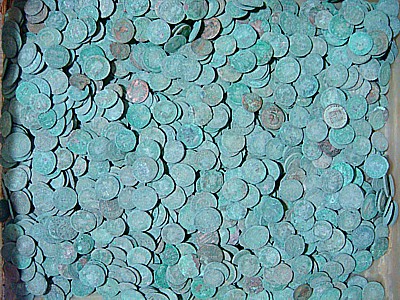
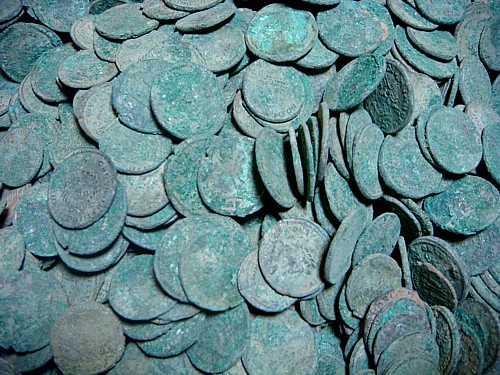
I have borrowed these photo from a guy on another forum who shares with us when he gets new shipments in directly from the source... I believe these are coming from the ME... this is just one guy's hoards... and I believe he mostly is a middle man in that he receives them from the source... cleans them... then sends them on to a buyer or buyers buying back some for his own store... there are others who post finds on the forum from eastern Europe, Britain, etc...
I suspect the forum he means is UncleanedAncientCoins, or maybe AncientBulkMarketplace but that is not important. There is this guy who gets "new shipments" of coin hoards from the source, cleans them in bulk and passes the ones he does not want on to other dealers. The classic case of a middleman, importing antiquities and supplying the market. We might ask ourselves, which Middle Eastern countries allow the free export of bulk antiquities like this?

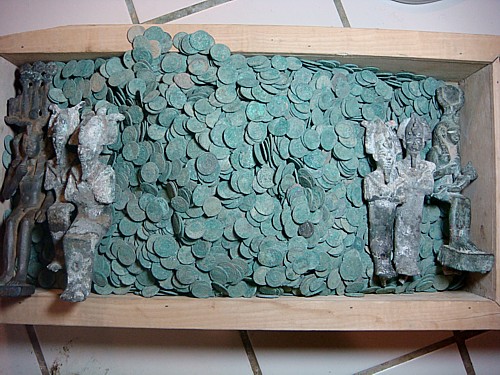
Drusus describes the photos he has posted of these groups of "Late Roman imperial bronze/copper coins fresh from the ground and ready to be cleaned". "These are several different hoards posted by only one guy... and he is far from the only guy bringing coins to market". No mention here of any "old collection" then. Look at the photos:


So what "Middle Eastern" country might they have come from then? Well...


The Egyptian style bronze statuettes might give a clue (let's keep an eye open for them later)... So where did these coins come from? Who recorded these finds (and where can we see this record) before they were released for sale? Who is importing them and how? Well "Drusus" at least answers the first question further down the thread, when we see the same (?) coins after cleaning:
Because I used his hoard pictures to illustrate... if its okay I would like to say that these coins are courtesy of Salem Alshdaifat and Holy Land Coins and examples can be seen here: http://www.vcoins.com/ancient/holylandcoins. At that link you can find hoards of Roman, Greek, and Persian coins...most are sold as fast as they come in...
yes, I bet they are. So Salem Alshdaifat (apparently of Jordanian origin with Canadian citizenship) the importer of these multiple groups of dugup ancient coins from somewhere in the Middle East has a store on ACCG president Bill Puetz's V-coins has he? He'll abide by the "V-Coins Code of Ethics" then, won't he? Let's have a look at the Holyland Numismatics store on the "ethical alternative" V-Coins store. Its owner claims:
We are the best buyers for Hoards, as you see in our store we buy large Hoards and sell whole sale lots, Contact us if you have any Hoard of Roman, Greek and Byzantine coins. Our company has been actively involved in the market of ancient coins and antiquities for the past six years; selling to the major dealers in the industry [...] We are always looking to purchase ancient coin hoards from the source. Please contact us if you wish to do business in this field. We are American ancient coins dealer, locate and operate from Orchard Lake city, Michigan.
Let's have a look at what Mr Alshdaifat is selling; a REALLY interesting array of items... Like this apparent hoard of Byzantine solidi, fancy somebody issuing an export licence for that (not mentioned up front in the sales offer, not even mentions where it comes from - still, an oversight I am sure). But he does say where one group of coins comes from, the Middeleast and Egypt, 10,000.00 COINS available, (is that ten thousand, or a "million"?) with another group being sold in smaller lots "Middeleast and Egypt". Another large group here too. (He forgot to mention the export licence here too). There are some quite "interesting" assemblages in the "dealer lots". I wonder if ACCG dealers have a discount?

My eye was caught by some shabti assemblages, I am sure the vendor will not mind me using some of his photos from the ephemeral archives of his V-coins store for the delight and edification of shabti collecting afficionados wanting to use such auction catalogues to collect parallels:


1) V-coins store: "10 Ancient Egyptian Blue Faience Ushabti C.600 BC. Size around 3 inches high .(7 - 8cm long) Rare items in great looking blue Faience (paist clay and glazed) Mummyform ushabti (servant for the next life) . perfect condition for the type, a real rare chance to get them in this condetion, Guaranteed Authenticity. this lot will be shipped from our office in Dubai Nefertiti Eastern Sculptures Trading Co P.O Box: 111301 Bar Dubai, Dubai. United Arab Emirates". Price US$ 1,300.00

2) V-Coins store: 40 Ancient Egyptian Blue Faience Ushabti C.600 BC, all written in the back, Priced to sell !!!![...] this lot will be shipped from our office in Dubai...". Price US$ 4,800.00

3) V-Coins store: 5 Ancient Egyptian Blue Faience Ushabti C.600 BC, all written in the back, Priced to sell !!!! Price US$ 600.00

These look rather familiar, the form of the objects and the hieroglyphs on the back are awfully reminiscent of the inscription as on a group of objects discussed here a while back... Who remembers the Wenneb shabtis that ethical dealers in the UK sent back to their (unnamed) suppliers when it was pointed out that they were a totally newly-surfaced type and a collector suggested on the discussion list that there was evidence that they were a newly looted type? Where did Mr A's (unnamed) associate in Dubai who had a whole boxload of them until they were sold through the "ethical" V-Coins store get them from? Mr Puetz, ACCG President, where do you think these items came from? If these are more of the Wenneb-shabti group, why is V-Coins selling them after their fellows were withdrawn from sale by ethical British dealers after it was pointed out on a major collector's forum that they were probably recently looted? [Of course it is a hindrance in the transmission of information like this that the Yahoo AncientArtifacts list is a closed access one, but I am sure they would be glad to let V-Coins dealers register and take part in the discussions of the seamier side of antiquities collecting].

One wonders if Holyland Numismatics' collaborator was able to obtain other items from this tomb along with this sackload of shabtis. Interestingly Mr Alshdaifat is selling a " Pair of Egyptian Mummy Bronze Eyes C.600 BC. Size of each eye 8.7 cm long. A pair of Bronze eyes inlaid with bone with eyebrows. mounted. 26th dynasty C.600-700 BC very nice pair, and intact exept there is one of the eyebrows was broken in one place and fixed" (560$). The photo shows them upside down, but they are also tomb equipment of about the same date as the shabtis ... How and when did they leave Egypt?

And while in the same region... aren't these ["lot of 32 scarabs, mixed from all Egyptian Eras.Gurnteed authentic"] some of ZZAntiquities scarabs that I discussed on Tim Haines' Yahoo AncientArtifacts Forum? They look awfully like them, same types and carving, same patina everything.

[Who is "Nefertiti Eastern Sculptures Trading Co "? I cannot find anything about them in the Internet. They have also been selling some odd looking Luristan weapons in a job lot]

I think it is worth considering why dealers supporting the ACCG are so unwilling to have the US retain any law which means that the barrier of bubbles at the US border is in any way tightened up for antiquities. Mr Alshdaifat has donated several hundred dollars worth of coins (and where did they come from?) to support the ACCG in its efforts to stop the US ICE looking at the paperwork of imported antiquities any more closely than they do at present. And look what is coming through, bucketloads of freshly dugup ancient coins for example, and Mr Alshdaifat's company "is far from the only guy bringing coins to the US market".

UPDATE 8th Sept: It seems somebody at V-Coins is not too happy about transparency, several of the links I give above to shabtis and some (chemically ? [re]patinated) Luristan swords and stuff have been deleted "this item does not exist" it says - are V-coins selling imaginary artefacts now? These links all refer to the items being sold by the mysterious office in Dubai. What is going on? V-coins had no problems with them being there before I mentioned them, why do they have now? Mr Puetz?

Thursday, 14 July 2011

Egyptian Antiquities Allegedly Smuggled From Dubai to US

.
"This office will continue to vigorously enforce cultural property laws that restrict the unauthorized movement of antiquities, Antiquities dealers and collectors are on notice that the smuggling of cultural patrimony will not be tolerated." U.S. Attorney Loretta E. Lynch

Four people have reportedly been charged by US authorities today with illegally trafficking in Egyptian and Greco-Roman antiquities (as well as money laundering). The antiquities concerned were allegedly smuggled past US Customs and Border Protection officers including a Greco-Roman style Egyptian sarcophagus, a unique three-part coffin set belonging to Shesepamuntayesher from the Saite period (26th Dynasty, c. 664-552 B.C.) as well as Egyptian funerary boats and limestone figurines. In addition to Egyptian antiquities, other Middle Eastern and Asian artifacts along with more than a thousand antique coins have been recovered. They were exported from Dubai in the United Arab Emirates in a scheme that spanned from October 2008 to November 2009 and packed to avoid official scrutiny at American ports, officials said. US customs law allows for less stringent inspection standards for goods valued at under $2,000. Although the artifacts were worth more than that, the consigners lied to customs officials about their origin and value. They were mislabelled as “antiques", "wood panels” or as a “wooden painted box”. A middle sarcophagus and part of an outer sarcophagus arrived on board a cargo ship at Port Newark in 2009 where they were seized by law enforcement agents, officials said. A civil complaint seeking forfeiture of Egyptian sarcophagi, Iraqi artifacts, cash, and other items seized in connection with the government's investigation was also unsealed this morning in Brooklyn federal court.

Unusually for cases of this nature, the four people charged by Brooklyn federal prosecutors with conspiring to smuggle antiquities into the US have been named. Several sources state that the allegations concern:
Mousa Khouli, Salem Alshdaifat, Joseph A. Lewis, II and Ayman Ramadan
Mousa "Morris" Khouli, 37, is the owner of Windsor Antiquities (website currently offline?) on E. 56th St. in New York. The gallery specializes in Etruscan, Roman, Egyptian and Near Eastern antiquities and ancient coins dating back to 1000 B.C. This dealer features on the recommended dealers list disseminated through Tim Haines' Yahoo "Ancient Artifacts" discussion group - recommended for what though? Readers of this blog might recall the dealer selling one of the "Wenneb" shabtis I was discussing a while back, that story potentially takes on a new significance now, especially as one of the other defendants in this case was also selling them at the same time.
Agents recovered a sarcophagus in Khouli's Brooklyn home, which he falsely claimed was part of his father's collection and "that he had owned it for a long time," court papers state. Federal prosecutors say Khouli purchased that coffin from Ramadan in 2009 and are seeking the forfeiture of all the items so they can be returned to Egypt.
Khouli, 37 will be arraigned Thursday before Magistrate Judge Andrew Carter in Brooklyn federal courthouse. The case is U.S. v. Khouli, in the U.S. District Court for the Eastern District of New York, no. 11-340. (For the U.S.: Assistant U.S. attorneys Karin Orenstein and Claire Kedeshian. For Khouli: Gerald Shargel of the Law Offices of Gerald Shargel.)

Joseph A. Lewis II, a collector from Virginia has been mentioned in this blog (and Looting Matters) as the individual that is reported to have attempted to import an Egyptian sarcophagus (of Imesy) from Spain, and when it was challenged, apparently abandoning it (the coffin has now been returned by US authorities to Egypt). See here, and here. Initially the man was named (by two Florida lawyers) as Joseph A. Lewis III, but in a later draft of their paper they amended it to Joseph A. Lewis II, their carelessness leading to some confusion). A search of his home in Chesterfield Virginia by ICE agents reportedly revealed a Greco-Roman sarcophagus, Egyptian funerary boats and limestone figures, these were seized.
"Lewis allegedly purchased a Greco-Roman style Egyptian sarcophagus, a nesting set of three Egyptian sarcophagi, a set of Egyptian boats and Egyptian limestone figures (collectively, "Egyptian antiquities") from Khouli, who purchased those items from Alshdaifat and Ramadan. Each of these antiquities was exported from Dubai, United Arab Emirates, and smuggled into the United States. Khouli allegedly provided Lewis with false provenances which stated that the Egyptian antiquities were part of a collection assembled by Khouli's father in Israel in the 1960's when, in fact, both Lewis and Khouli knew that Khouli acquired the Egyptian antiquities from other dealers"
This is precisely why collectors who buy objects trusting they are from an "old collection" are unwise to even consider the transaction before ascertaining that this claim can be verified, documented and proven. Lewis will apparently be arraigned Thursday before Magistrate Judge Andrew Carter in Brooklyn federal courthouse. It is reported that he is represented by Peter Chavkin and Bridget Rohde of Mintz, Levin, Cohn, Ferris, Glovsky and Popeo.

Now Salem Alshdaifat is an interesting name. He is a V-Coins dealer (Holyland Numismatics, West Bloomfield, MI), also an ACCG Benefit Auction donor dealer. I have raised the question here of where the coins he deals in have come from, and it is interesting to see his name brought up in this context. With or without his name figuring in court, one might legitimately wonder about for example about a recent offer on V-Coins (you know, the "ethical" one?):
"500 uncleaned coins from the Middeleast and Egypt,
1,000.00 COINS available.


uncleaned coins, Greek, Roman, Judaean, Provencial, Byzantine, Islamic, and some rings. some small coins might have some Rare Emperors, we found befor Johannes, Leo, Zeno, Marcian and rare Vandalic coins in such lots, this lot is mostly uncleaned completly and some are cleaned in the edges or completly cleaned. plz note that just for this lot, we will ship only to USA, shipping will be Via Registred mail only.
Old collection, no doubt. As are the other bulk lots of Alexandrian and Ptolemaic coins he has on offer tonight. Some other Ptolemaics here too. None of the ones I looked at say which old collection they were in before they arrived in the coin shop - so where and how did they "surface"? Alshdaifat was arraigned Wednesday before a federal judge in Detroit Federal Court.

Now "Holyland" is a "wholesaler", that is somebody who has supplied bulk lots of soimilar coins to dealers. A number of his offerings on V-Coins are clearly marked dealer lots, and the "items sold" section of his V-Coins shopfront contains many more. So basically, if a dealer has bought one of these bulk lots and split them up into individual sales, sometimes sharing them with business partners, there must be a large number of collectors who have in their homes and cabinets coins originating in "Holyland Numismatics" dealer lots, and therefore sharing with them any issues of the provenance. Alshdaifat quite clearly has had access to high volumes of antiquities, especially coins, so where did they come from? A lot of them (but not all) are types that could well have been found in Egypt, particularly in the northern part of the country. The question has to be asked, how would they have left the source country in bulk?

Ayman Ramadan, a Jordanian national living in the United Arab Emirates, is a bit of a shadowy figure. He is noted by the newspapers as "an antiquity dealer from Dubai, United Arab Emirates". It turns out he runs the outfit I mentioned in an earlier post here, Nafertiti Eastern Sculptures Trading Co " (P.O Box: 111301 Bar Dubai, Dubai. United Arab Emirates). He is now is considered by (US) authorities to be a "fugitive".

Of course at a time when the question of artefacts looted from Egypt in the wake of the recent political disturbances there is very sensitive, this is not a good time for somebody to be caught with freshly-surfaced Egyptian antiquities on their hands. Note that also seized seem to be some from Iraq.

ICE Special-Agent-in Charge James Hayes, Jr., called the investigation "ground-breaking", he says this is "the first time an alleged cultural property network has been dismantled within the United States". Indeed it probably is. Most of the time antiquities stopped at the border are seized and sent home with fanfare, reaping political and foreign relations kudos, but rarely investigating the sender or addressee to any degree that would comprise any kind of investigation of the links in the illicit transfer of ownership of the artefacts concerned. Let us hope this case is a harbinger of a more pro-active policy on prosecuting the illicit artefact trade. It is gratifying to see that it involves coin dealers, as it is this milieu that has been most vociferous in recent years about so-called "collectors' rights" to material obtained and transported in defiance of cultural property laws. I doubt though that the investigation and seizures will give them pause for thought (indeed, I'd be very surprised to find them even discussing it at all on their forums and blogs). In any case, although "if convicted, the defendants each face a maximum of 20 years in prison", we all know that the four will just get slapped wrists from the court and told (asked nicely) not to do it again, like the Four Corners two dozen - if the American judicial system can't even deal with archaeological looting in their own country, what hope is there that they will actually deal with a case involving looting and smuggling outside the US? I do not see how Mr Ramadan can be brought to a US court.


Sources:
ICE News Release: July 14, 2011 - "ICE makes arrests and seizes cultural artifacts stolen from Egypt Set of Sarcophagi more than 2,000 years old" 14th July 2011.

Mitchel Maddux, 'Feds bust 4 in Brooklyn-based Egyptian antiquities trafficking ring', New York Post 14th July 2011.

John Marzulli, 'Feds bust group trying to smuggle Ancient Egyptian mummy coffins', New York Daily News, 14th July 2011.

Jessica Dye, 'Feds accuse 4 of smuggling Egyptian artifacts', Thomson Reuters News & Insight, 14th July 2011;

Kate Tayl o r, '4 Charged in Smuggling Egyptian Antiquities', New York Times July 14, 2011;

Keith Johnson, 'Alleged Antiquities Smugglers Busted', Wall Street Journal, July 15, 2011.

See Also: Looting Matters, Dealers Charged Following Egyptian Seizures

Vignette: A pair of bronze inlays (from a sarcophagus?) representing eyes sold by
Holyland Numismatics, where did they come from?
[yes, the dealer photographed them upside down]
.

Thursday, 8 September 2011

Ayman Ramadan and "Nafertiti Eastern Sculptures Trading"

.
Rick St Hilaire has a post today on a topic which interests me too: 'Ayman Ramadan and Nafertiti Eastern Sculptures Trading' and he refers to an earlier post here on the subject. I think it is worth noting that I drew attention to a dodgy-looking assemblage of 'Luristan' bronzes that Nafertiti had been trading as well as they were A source of the shabtis I christened (wrongly) wenneb shabtis which I certainly think would be worth following up to find out more links of these traders to the UK and northwestern continental Europe.

St Hilaire has found out that:
There is information to suggest that Ayman Ramadan may go by the name of Ayman Libzo. A Facebook profile bearing the name Ayman Libzo describes this named individual as the owner and president of Nafertiti Sculptures Trading L.L.C. It also lists Dubai as the place where this individual lives.
(The facebook page is illustrated by a photo of a young child rather than a 39 year old Jordanian adult.) St Hilaire finds that "Nafertiti Eastern Sculptures Trading" has disappeared (in fact it disappeared and the items I referred to vanished from the internet shortly after my post on the topic - but this was also the time when the US authorities were beginning to get their teeth into this alleged ring).
There is information on a web page, nevertheless, that an “Ayman Libzo for Ancient Antiquity” existed. What remains of the now inactive and sparsely archived web page, copyrighted 2008, is a ‘browse catalog” link, a generic Dubai business location, and a Dubai-based cell phone number. The catalog link is inaccessible. The other information listed on the web page states that the company is part of the Trocadero network, which is a fine arts and antiques online selling platform. The Ayman Libzo for Ancient Antiquity web site once bore the web address of www.trocadero.com/aylibzo/, as suggested by archived internet records.

There apparently was also an online store bearing the name “Ayman Libzo for Ancient Antiquity” at one time. It was likely located on eBay.es, the Spanish eBay. That page does not exist today and is not archived. It was referenced, however, in an eBay “arqueologia y falsificaciones” (archaeology and forgery) discussion group during a 2008 conversation about Egyptian artifacts.
Now that is awfully embarrassing for Trocadero ("Authentic antiques and art offered by credible American, European and Asian antiques dealers on one online mall").

PS I am not sure about the spelling of the firm's name; everybody likes highlighting the 'a', I am sure I saw it with an 'e' when the firm was active, though could have been mistaken.

Vignette: Dubai

Thursday, 14 July 2011

Further Details of the Brooklyn Antiquities Bust

.
Although I think the horse figure in one of the pictures is nothing whatsoever to do with Thursday's antiquities bust, the CNN report has some interesting details not found in earlier accounts:
ICE Special Agent Brenton Easter said his team initially was looking for one piece -- a terracotta head uncovered in Iraq in 2000 -- when investigators stumbled upon a multinational network. "This is one of the first times in the U.S. that we've actually dismantled an entire network. What we've done is identified the person in the Middle East who was the conduit, we've identified the broker, we've identified the individual providing false provenance, and we've identified the end-all collector," Easter said [...] In addition to items from Egypt, Easter said investigators also seized artifacts from Libya, Iraq, and Afghanistan. "As an investigator here I've seen looting from all different regions, but specifically with this case, we actually have information, and we know for a fact, that they were using metal detectors to actually find and locate some of the pits where they would dig and loot." [...] Easter said the recent political upheaval in the Middle East where ancient artifacts abound accounts for an increase in the illegal trafficking of antiquities. "There has definitely been an escalation in Iraq. There appears to be an escalation in Egypt, but these networks and these rings were pretty well established even prior to what's going on right now in the Middle East," he said.
[Source: Kiran Khalid, 'Global antiquities smuggling ring dismantled, authorities say', CNN July 15, 2011.]

Back in Egypt, the Luxor Times gives some other interesting information. The alleged smuggling ring involved, apart from the three arrested in the US, "a Jordanian nationality holder who lives in the UAE" but also "An Iranian, Palestinian and Iraqi persons". Zahi Hawass is quoted as saying that the antiquities he saw (when? Was the trip to the US a front for his employment as an expert witness in this operation?) in "the confiscated collection includes antiquities from Egypt, Iran, Iraq and Palestine"
“based on the agreement with the security authorities in the U.S. it was agreed that confidentiality of the proceedings as to arrest the international gang members and find out the names of those who helped in the smuggling the antiquities from Egypt and that he only informed Dr.Essam Sharaf, Egyptian Prime Minister on the details of this issue ... Also it is expected within hours to retrieve other Egyptian artefacts at one of the defendants’ home.

Dr. Hawass said that he was supposed to attend an international press conference with the U.S. side to announce the details of this case, however the escape attempt of one of the members of the gang and arresting him shortly precipitated the announcement today about the details of the case, which was followed up and tracked in Egypt, UAE, England and Iraq and other countries to reach the members of this international network specialised in smuggling antiquities to the United States.[...] Zahi Hawass [...] said that U.S. authorities will inform Egypt within days with the names of the involved Egyptians in the smuggling of antiquities and in money laundering.
Does this mean we can expect more arrests? What is the link in ENGLAND (and does it have anything to do with my "Wenneb" shabti story: here and here)? Who had tried to escape, and from whom did he receive a tip-off? Was the plan to lure Ayman Ramadan to the US like the tarantula guy Sven Koppler, or Roxanne Brown in order to arrest him, and he got wind of the plan? Or is that part of the story yet another Hawassan elaboration, to explain why he was not asked to be at the announcement in the US?

At the end of the Luxor Times text there is an interesting snippet of an allegation, a misprint, or something that had slipped below the radar? Can this be documented?
The American sources mentioned that in 2003 the New York gallery has acquired more than 1000 artefacts from all over the world. About 77% of these artefacts were found to be stolen from Middle Eastern countries.
Is this a garbled version of the incantation bowls story? Or something else?

[Source: Luxor Times, 'Two years work led to expose an international network of antiquities smugglers', Friday, 15 July 2011.]
.

Monday, 22 March 2010

The Thuggish Culture of Collectors


One might have thought that given the noble traditions going back to the Grand Tour, one might have met a better class of people among artefact collectors. Not so unfortunately, there is a lot of blatant thuggery in the milieu. "If you ever need someone to seriously slap some sense into you Paul, just let me know" is the latest comment on the Yahoo Ancient Artifacts discussion list in a thread which began with a discussion of the newly-surfaced Wenneb shabtis.

I had a look at some other forums yesterday, they exist for collectors of all sorts of things, from Barbie dolls, My Little Pony figurines and Care Bears, oriental carpets, bonsai growers, antiquarian books to vintage cars. Oddly enough on none of them was the prevelance of bad language, aggressive behavior and downright thuggishness that one sees on forums connected with collecting. We see this on UK metal detecting forums, on sites like Yahoo's Ancient Artifacts forum, on the Unidroit-L discussion list. Why is that? What is it that divides antiquity collecting from other types of collecting and causes it to attract a different kind of people? Or are these people normal until they come in touch with the shady side of the indiscriminate trade in antiquities? The guy that threatened to knock some sense into me is (he claimed earlier) an ordained minister. Of the Church of Hate no doubt.

But we need not be surprised, I suppose. Is it not thoroughly thuggish in itself to condone the wholesale dismantling of archaeological assemblages, deposits and sites to feed the indiscriminate market in "portable antiquities"? Dealers that do not take precautions against buying looted and smuggled items from lawbreakers are no better than thugs. The people who buy these objects without ascertaining anything are no better than thugs. In the old days collecting was the "hobby of kings", now through the continuation of the indiscriminate market into the era of te internet and credit card, it seems it has become a "hobby of thugs".

If any readers of this blog are interested in the real nature of the folk for whom the archaeological evidence of our planet's past is being looted to satisfy, please register on some of these forums and just ask them a few questions. Have a look at the Ancient Artifacts discussion group archives for example and you'll pretty soon find a reason why they are so concerned to keep them closed and out of the public eye.

Vignette: Thug with a ("passionate") "interest in the past"?

Thursday, 30 August 2012

The London Connection

.

Coffin lid, surfaced in Jerusalem
There is some more information on the pieces of the sawn-up painted anthropoid coffin lid seized by the Israeli Antiquities Authority (IAA) from a shop showroom in Jerusalem's Old City in  2011. It is reported to be that of an "unidentified 16th Dynasty nobleman". The Times of Israel (Gabe Fisher and Asher Zeiger, 'Israel to return stolen sarcophagi' (with the tagline: "Coffin it up") The Times of Israel, August 30, 2012 ) states that: 
the owner of the shop where the sarcophagi were found had claimed to have bought the artifacts in Dubai and legally transferred them to Israel by way of London.
The mention of the involvement of a London intermediary is interesting. Readers may remember that when the 'Brooklyn' bust occurred, in which a dealer from Dubai was sought (is still being sought), Zahi Hawass let slip that the investigation was intended to be broader, involving somebody in England, which looks rather like the unintended (unauthorised) leaking of operational information. Also the Pa-Miw (aka "Wenneb") shabtis that I discussed here (not a few of which were in the hands of a dealer accused of being involved in that network) were reportedly being distributed piecemeal to other dealers by a central figure in London (to whom when the discussion on them seemed to be indicating they were most likely looted, dealers like Bron Lipkin returned them without revealing the person's name). One London dealer (an AIAD one at that) however is still offering them, regardless.


The current investigations of the Kapoor case are reported elsewhere now to be investigating a route of some objects through the UK on their way from Asia to New York. 

Some time ago the British government made the announcement that they were going to "do something" about the market in illicit antiquities. All they actually ever coughed up was the "Dealing in Cultural Property (Offences) Act" which has proven to be totally ineffective as a tool, serving [like the US CCPIA] purely decorative purposes. Do the British authorities intend to take this problem seriously? Or are they quite content to allow a constant flow of dodgy artefacts to be 'laundered' under their noses? 


Monday, 9 February 2009

'Wennebpawepwaoetdjeseroeiamet' is going back - but where?

A few days ago I posted here the sad story about what seems to be a textbook example of the relationship between no-questions-asked collection of unprovenanced antiquities and what appears from the available (necessarily anecdotal) information gathered to be a probable case of recent looting. As a result of the contradictions in the stories about where these items come becoming clearer, Dr Bron Lipkin one of the dealers mentioned on this blog posted the following this evening on the AncientArtifacts Forum (quoted with permission):

As we now know that more of these shabtis have turned up on the market and with different apparent provenances I think it has to be admitted that the provenance issue has become very blurred indeed! I have emailed Cedric and asked him to return the few he bought from me. I have removed the other four I had on my website and will return them and those that Cedric has, from whence they came. Perhaps each dealer in the chain will do likewise. Certainly I know that the dealer from whom I obtained these will do as I do, as the information he had does not appear to be as reliable as we would want it to be. I would say very firmly to all collectors, that the background of these little shabtis is now so uncertain that they should NOT buy them. There is simply not enough information now to be able to say that they are not recent finds! I'm sorry that my information has turned out to not be as solid as I initially thought.I had not mentioned a specific provenance when I previously showed the four on my website as it was not that I could name a specific collection. I was relying on the good faith and judgment of another dealer whose previous provenance information was very reliable, to the extent of being able to double check some of it. By the way Cedric had posted that I had said that I knew where hundreds were. I didn't and don't. I was told by another dealer that quite a few more were available elsewhere a few months ago [...].

Several points, first of all it is very gratifying to see such prompt action to attempt to untangle to some extent the penetration of these items onto part of the market while their origin is so unclear and suspicious . In addition, a warning has been issued by one of the dealers in the chain to collectors to heed or disregard as they see fit. Dr Lipkin expresses his belief that his wholesaler too was duped. We note however that we still have no name for the UK dealer which apparently - despite the denials in hindsight - had a substantial number of them.

Now dealers have declared that they will be returning these items to their original suppliers, it will be interesting to see where these shabtis turn up in future, since the starting point of that new chain will presumably indicate the point in the previous chain of ownership at which a buyer knew that what he was aiming to sell was of dubious origin and thus he is unable to return them to his supplier. None of us are naive enough to imagine that these objects will end up back in the hands of the original supplier in Egypt, or that at some stage the ethics of the antiquities trade will prompt any of the gentlemen in this sorry chain to alert the Egyptian Antiquities Service so they can investigate. Nevertheless it is an indication that dealers can and should take responsibility for any failure in diligence to establish whether items have a secure provence which shows they do not derive from recent looting and illegal export.

I should mention that I have also received a message from Rolf Kiaer who has also withdrawn his Wenneb shabti from sale and is considering returning it to the vendor (who turns out to be an "antiques dealer in Copenhagen") as "its not in my interest to have legit stock contaminated with recent plunder!" Quite. It's in nobody's interest in fact that any antiquities dealer should have "recent plunder" in their stocks. [Dr Lipkin's link still works at the moment, but he assures me this is a temporary web design problem and the objects are now no longer on sale]

To come back to the main point of my original post, the lack of immediate enthusiastic praise on the forums of the gesture of these two dealers withdrawing these items from sale reinforces what I was saying about the current prevalence of a could-not-care-less attitudes among collectors. I get the feeling that many of them in fact suspect that if the flow of recently looted and recently smuggled artefacts to the market was substantially reduced by this kind of responsible behaviour by dealers, there would in fact be very little for them to actually buy and collect. This is at odds with their unproven claims that all the currently unprovenanced items on it are of legitimate provenance because "Petrarch collected coins" and other such arguments. We need more transparency about where the archaeological artefacts in the market today are coming from and where they are going.

Monday, 12 April 2010

A Collector (above) and Her Unprovenanced Shabti

.
In the above post I discuss where collector Meechmunchie says she disagrees with me over the best way to protect the archaeological heritage from looting. Now I'd like to discuss why what she says is doing nothing to protect the archaeological record from continual looting for collectables. This involves the sale of a shabti figurine on ebay last week. Sold by Barry and Darling "Bits of History" of Point Pleasant, New Jersey. They previously had had this shabti for sale on their V-Coins portal for 200 dollars recently. Nobody would touch it for that price, perhaps because there was no information offered about where it came from and when and how it had left Egypt. Like many of the artefacts offered by that dealer one might add. So they decided to cut their losses and put it on the venue where many collectors go in the hope of picking up cut-price looted artefacts. This is the description from the eBay sale.

Egyptian Faience Ushabti, 21st Dynasty, 1077 - 943 BC "Pale blue faience ushabti wearing a black painted seshed headband (tied at back) and carrying the usual flail and hoe. 6.0 cm tall. 21st Dynasty, Third Intermediate Period (TIP), 1077 - 943 BC. Not freestanding (will tip over). It has been repaired at the foot and there is a chip missing from the bottom, both are not visible in the image. Cute with nice coloring. cf Petrie "Shabtis" # 388 [...] All of our artifacts are guaranteed to be genuine. The items pictured is the ones that the winning bidder will receive. COA available on request. Item number AR0909-004.

There then follow two paragraphs saying what shabtis are for, the usual dealer stuff, followed by... well, nothing. No provenance, not even a "purchased from an unknown seller in 1953 and then kept in two New York collections since then, documentation will be supplied to purchaser". Nothing. For all we know from the description, the bloke Barry and Darling bought it from might have not long before that got it from Lyon F. Agin, loot suppliers to the well-heeled - who lied when he said "got it from a bloke just after the War, been in the family years mate" when in fact it came in a box of bananas from Egypt a few months before. The sales offer contains nothing whatsoever to contradict such a scenario, simply no information is provided whatsoever.

A responsible collector surely would not be buying such stuff "hoping it is not recently looted" or "to give it a good home anyway" (what is so "good" about their home relative to anybody else's?). Let it stay on the dealer's hands long enough for him to realise that it is no longer a viable proposition buying unprovenanced stuff, material which cannot be truthfully advertised as vefifiably legitimate in accordance with all considerations. Sadly 14 people bid for the item, and the winner paid 69 dollars for this item. Guess who.

The same person also has on her flickr photos website a scarab bearing the name of Tuthmosis III "When I stop being lazy I'll ask around and see if I can find out anything about its history!" (there we have that notion that context can be reconstructed just by "asking around"; no it cannot and I think from the poor photo there is a fair chance its a fake anyway - serves you right). She also first appeared (under a different name) on my blog having freshly bought herself a "Wenneb" shabti. Now that same somebody not so long ago was holding forth on my blog on buying dodgy artefacts:
I have absolutely no sympathy here. I think more collectors need to care about provenance on "small objects". Dealers seem to view the influx of a few who care as an inconvenience and lament the death of the "discreet deal between gentlemen"* nature of the profession. It seems like the privacy of the previous owner is valued more than the legality of the object, which is a shame. I've definitely gotten some snarky replies inquiring about provenance on Ebay..."if you don't like that it came from a 'german collection', don't bid." And they can afford to do this because I'll not bid, but a jillion other people who don't care will. [...] This fellow bought stolen goods and did no due diligence, and the galleries that sold it to him are no better than black-market dealers and back-alley fences for stolen goods.This is an attitude amongst collectors that MUST CHANGE, and perhaps if an example was made of a collector or dealer, it would help.
Fine words. But collectors just cannot stop themselves from carrying on collecting this stuff regardless, don't they? And they think up a jillion reasons why its OK, it's not their fault, it does not apply to this "one object" which they are "only giving a good home to".

This was the argument used by Robert Hecht, that provenance was not important, it was "preserving the object" by the prvate collector that was important. But see where that has got him and US collecting.

Now tell us, what are you going to do with that "cute" object? What are you going to learn from it? Do you not feel guilty about buying it, or proud of yourself that you beat the competition? A bit of one-upmanship. How much of your 69 dollars is Mr Barry going to send to the family of the man who dug it out? Let's ask him shall we? Mr Barry, do you have an export licence for that object or any documentation whatsoever that it actually left Egypt legitimately after, or before such export controls were in place? If so, why was it not mentioned in your ebay advert instead of all that junk about what shabtis were for? Is that not just a smokescreen, to make it look as if you are giving the gullible buyer a "lot of information" when in fact the most important information is missing? Do Barry and Darling sell many Egyptian antiquities without any actual documentation how and when they left Egypt?

Perhaps it should be made clear that I believe that by no means is the buyer of this shabti alone in this. In fact probably well over ninety percent of transactions involving antiquities which are daily bought and sold on the global market are being bought and sold in exactly the same way. I imagine each concerned buyer looks a bit ruefull when they realise once again that the seller is not going to cough up the details ("trade secret, client confidentiality, sorry") of how they actually know that this particular object is not recently looted from a site in, or recently smuggled out of, a source country. No documents, but he "has checked" and "knows" it is legitimate. The dealer puts on a hurt expression that their client "will not trust them". All aimed at persuading them to give up this provenance silliness: "of course it is OK, don't you trust me?" they wheedle. The client almost invariably gives in and buys, its all part of the game.

Almost certainly, each buyer persuades themselves, this one is legitimate. Look, it has a browning paper label on it, must be old, surely... yes. Only other people buy the looted stuff, this one I am sure is OK. Its the other dealers who buy from looters, not my favourite dealers (Ken Grabkesh and Donny Runn). They say it's OK to buy it and I trust them, they would not deceive me, surely... Not after all the money I have spent in their shop... Anyway, even if its not really all that legal, its going to a good home, I will look after it, poor cute little shabti....it's better off with me than lying unseen in the earth or with those awful foreigners in the source country. Yeah, that feels good, nice, speak to me shabti, my shabti, tell me about the past.

I think that some people buying dodgy artefacts do so because of the frisson of doing so, cocking a snook at authority, expression of rebellion (what are you going to do about it archie? No American law was broken so there!). Most however I suspect persuade themselves that in their specific case, they are not really doing anything bad, that most probably the artefacts they buy are not tainted, just a little orphaned, just a little bit separated from their provenance. Or another common theme is that by possessing them, they are in some way a heritage hero saving the object from something. Perhaps there is a sense that the individual collector is in a sense deserving to be the curator of the object. Most of them would be appalled to it be even suggested that in consistently buying unprovenanced artefacts they might have touched looted goods. Yet the statistical chance of them doing so increases with every such purchase. A statistic most I suspect would prefer not to think about, or even deny.

These are all implications of some of what we see these people saying on the collectors' forums. Most of them of course do not discuss motivations, let alone ethics, so we have only oblique references to try and understand this phenomenon.

Sunday, 14 June 2009

Egypt to prove Germany stole Nefertiti bust

Over the past few days, various news outlets have been carrying stories about a new (?) fuss brewing about the Nefertiti bust (AFP):

Egypt will soon provide evidence that the 3,400-year-old bust of Queen Nefertiti was taken illegally out of the country by Germany, Egyptian antiquities chief Zahi Hawass said on Sunday. "We are still gathering information, but I expect we will shortly have enough to place a formal request to the Berlin Museum for the return of the bust," Hawass told the Tagesspiegel in an interview”.

I suspect this is nothing more than an extension of the news story covered here a few weeks back. If so this seems more likely to be aimed at public opinion than building a case to be solved by international law. One wonders whether this type of posing and strutting is not ultimately harmful. Eternally playing the victim does not do the wider cause any good. Sure, lots of antiquities left Egypt under highly dubious and regretable circumstances, this bust perhaps being one of them. In my opinion though the Egyptians cannot expect every single Egyptian antiquity to end up back in Egypt, even if questions arise how they were removed. Even though the Egyptian Antiquities Service has huge numbers of staff, concentrating on the wrongs of the past may well be taking energy and resources from dealing with problems of the present, and those matters which certainly need to find a resolution.

For example, instead of gathering documentation about the Nefertiti bust, it is suspicious that nothing much seems to be happening on the Ka Nefer Nefer front, Dr Hawass seems to find more possibilities in engaging in a paperchase with what may be seen as a partage gone wrong at the beginning of the century than displaying the paperwork proving a theft from a museum storeroom in the 1950s. Have they got such documentation or not?

Every so often the antiquities showman Hawass brings out into the light of publicity a royal mummy or some such item which had lain forgotten in a dusty corner of a museum somewhere or other. Perhaps the Egyptians should first concentrate on getting the archivisation of what they have already got in order before trying to accumulate more. In my opinion, Hawass should be chasing up items on the market now (like the Wenneb... shabti discussed here a few weeks ago) and finding out how they got there than worrying at the moment what went wrong in 1912. Protecting the archaeological resource which is threatened now rather than chasing objects safely archived in museums. Of course there is less easy publicity in that...

Perhaps like Athens, Hawass should go through the old spoilheaps and museum storerooms (or perhaps now search among the private collections) to find the missing eye from the famous bust, and then display it in an otherwise empty showcase to make the point.

Photo: the one-eyed Queen seems calm in the knowledge that she'll be staying in Berlin for a while yet (AFP).

 
Creative Commons License
Ten utwór jest dostępny na licencji Creative Commons Uznanie autorstwa-Bez utworów zależnych 3.0 Unported.