Showing posts with label education. Show all posts

Saturday, 7 April 2012

SLAM Bumper Sticker

.
The  Malibu office of the Association for Museum Professional Excellence  (AMPE) has brought out a bumper sticker to publicise the damaging effects of museums retaining artefacts which they know are of dodgy provenance.


The St Louis city fathers evidently see it as a source of pride to exhibit stolen objects in their art museum. This ignores the feelings of good decent folk having the stigma attached to admitting that they are a citizen of such a place. This campaign will hopefully lead to the Museum Trustees becoming more aware of the damage they are doing to the image of their city by refusing for so long to do the right thing. In the coming weeks, these bumper stickers will be available from a AMPE office near you, except in St Louis of course (SLAM does not belong to the AMPE).

Sunday, 1 April 2012

Historic Discovery by the PAS, An Unknown Pope


In their search for objects made of more precious metal, most treasure hunters tend to ignore archaeological artefacts made of lead discovered. Metal detectorist Alun Tussle from Gaer Diffymawr, Gwent was only prevented from putting a small disc of lead in his scrap pouch when he saw two faces peering out of the mud while metal detecting a Roman site in Caerleon near his home. When he got it home and washed it, he realised that it had writing on it and to find out whether he had found something valuable, he took it to his good friends, amateur historians Baran Blackheart and Callan Titwit (world-famous authors of "Britain's True History from Authentic Documents" and discoverers of the Holy Grail, grave of King Arthur and the Ark of the Covenant all within walking distance of their little town in South Wales). Realising at once the true significance of the object and where it was found, the two instructed him to take it to the Potable Antiquities Scheme (PAS) to claim his reward.

 The region's Finds Liaison Officer Fionella Sloan-Squarre says "when Mr Tussle showed me what he'd got in his trouser pocket, I was flabbergasted. It is not every day that you see such a valuable item - historically, that is. I immediately phoned my bosses in London to inform them". Mr Tussle was disappointed to learn that despite the value of the find, which is purely historical, because the find is not gold or silver nor a hoard, he is not entitled to a reward. "It's not a about the money", he smiled wryly.

What Mr Tussle had found metal detecting in the southwest corner of the walled Roman town at Caerleon is what is known as a "papal bull". It is a lead seal that was placed on documents issued by the Papal Chancellery in and sent to dignitaries of the early Church. The representations on one side of two saints show St Paul and St Peter with the inscription SPA[ul] SPE[eter]. The reverse bearing the name of the issuer is what excited Blackheart and Titwit . It bears the name of ELEVTHERIVS, followed by the numeral "I" and the title PP [pontifex].

 As Ms Sloan-Squarre explained, reliable historians such as Geoffrey of Monmouth make reference to an early mission to England sent by a Pope Eleutherus to King Lucius of Britain. William of Malmesbury records that he sent SS. Fugatius and Damianus (rather Dumianus or Duvianus) over to Britain. These missionaries baptized King Lucius and many others, and "the Britons enjoyed the light of faith in peace till the reign of Diocletian". Lucius therefore was the first Christian king in Europe.

 The problem is Bede (Hist. l. 1. c. 4) dates the mission to 167 when there was no Pope Eleutherus in Rome. The pontif in that year was Anicetus (150-167) and foreign historians say he was followed by Soter whose short pontificate was followed by that of Saint Eleuterus (Greek: Ελευθέριος), much later than the historical date of the conversion of Lucius. On these grounds, professional historians have attacked the validity of these earliest records of The True British History. Now, this new discovery rewrites history. It seems there were in fact two Popes called Eleutherius, the first of which was the one to whom Lucius had sent his embassy in 167, but he had later been written out of history in an effort to hide The True British History which made Britain the earliest Christian nation in Europe.

What is more, Blackheart and Titwit explain, the findspot shows that the Pope was sending letters to the bishops of Lucius in Caerleon, not London - so probably during the Roman occupation of the eastern parts of the Island, this small town now in Wales was the capital of all of Britain at the time.

Ms Sloan Squarre stresses that it seems once again, in partnership with the PAS, the discovery of an amateur proves the so-called "experts" totally wrong. "In a year when we’re all celebrating what it means to be British, finds like this made by amateur searchers show how they can reveal the hidden events that have shaped our past and made our great nation what we are today".

It is interesting to note that coins or medals of King Lucius were recorded by early collectors, such as one mentioned by Archbishop Usher (Antiq. Britain, c. 3, p. 22. Guthrie, Hist. of England, b. 1. ), and one by the French connoisseur Bouterue. They had been disregarded as fakes by professional historians but the discovery of the Caerleon Eletherius I bull suggests we should look at the issue of their authenticity again. The problem is nobody knows what has happened to these privately-owned items, they never made it down the ages to a public collection. No bulls of (Saint) Eleutherius II have so far been discovered, Mr Tussle is out in the fields of South Wales looking for them now.

UPDATE:
to better understand the context of this text, note that it was posted on April 1st (April Fool's Day). OK, too long and involved to be funny - better luck next year.

Photo: Potable Antiquities Scheme

Sunday, 26 February 2012

Focus on Metal Detecting: Well, What do They Know? The Disappearing Beech Copse

.
Following on from my earlier post (above) about the FOI request to English Nature of metal detectorist John Stokes (Senior Countryside Officer at Sandwell MBC, Walsall, UK), it seems there is a problem in the UK deciding what in terms of the rural landscape an archaeological site is and how it can be damaged. The information supplied 15th June 2011 in reply to the request (Request No 1146; RFI#1146) by one Jez Bretherton, Historic Environment Senior Specialist in English Nature was pretty thought-provoking. Fittingly, the reply was published on the "What do they Know?" website (WhatDoTheyKnow.com). He says:
Metal detecting is not banned on land under an Environmental Stewardship (ES) Scheme, it is facilitated in appropriate circumstances.
One wonders what the "appropriate circumstances" there might be for the recreational destruction of archaeological evidence. What are they and do they apply only in rural England, or can one generalise and create guidelines for the stripping of collectable artefacts from sites in Iraq, or maybe the sands of the Sahara Desert (see here also), or the ancient sites of the Four Corners region of the USA?

Anyway, English Nature has its Handbook which:
clarifies the person with the ES Agreement must ensure that no damage is caused to (known environmental) features, and any additional features of which you are subsequently advised in writing by Natural England, wherever metal detecting takes place.
What it does not say is that when clusters of archaeological artefacts removed from ES Agreement land for collection or sale by artefact hunters start to appear in the records of the PAS, that there is any mechanism whatsoever that leads to their assessment as (now) known archaeological suites and whether their preservation is desirable. It basically looks as if in typical british-muddling-through manner, a half-baked system has been set up which would make sites 'known' but in fact nobody gets to know about them or stop their depredation under the ES Agreement which should be protecting them. Now, why is that?

Even more startling is the definition of "damage to archaeological sites". In the view of the government environmental conservation agency English Nature this:
is taken to mean disturbance of previously undisturbed deposits in and on archaeological sites and monuments, and any removal, loss and/or disruption of standing masonry or other upstanding structural material.
The bit about "any removal, loss and/or disruption of standing masonry or other upstanding structural material" on an archaeological site is a bit of a no-brainer, but wholly unclear is the nature of surface evidence. What English Nature are saying is the equivalent to saying that a copse of 100-year old beech trees is damaged, not when eight out of ten of the trees are cut down and carted away for firewood, but only if the roots are dug out. In the case of the English landscape (as across most of lowland Europe) many sites are represented only or mainly by the patterns of artefacts and other material resulting from or modified by human activity in the past in the topsoil layers. The study of landscape use in the past consists to a large degree in many landscapes in the study of those patterns, with only limited sampling by excavation. These are techniques that have been developing since the 1960s/1970s with a huge literature going back many decades and yet wholly ignored by English Nature definition of "archaeological site" and its definition of "damage to archaeological sites". English Heritage's policy document "Our Portable Past" is one of the places where policy is laid down how these types of sites are to be examined and treated, one would have thought that in the case of sites which lie on land the conservation of which is supposed to be assured by English Nature-administered environmental schemes, such a manner of data-gathering would be the minimum required.

It should be pointed out that this definition of "previously undisturbed deposits in and on archaeological sites and monuments" is not precise enough to be used. For example a site may consist of active modern ploughsoil overlying a fossil ploughsoil (for example accumulated at the base of a slope or on a lynchet) which is also "previously disturbed" (how "previous" is "previous"?). By definition, most of the layers forming an archaeological site are "disturbed", they've been put there by human or natural agencies on top of the undisturbed geological substrate.

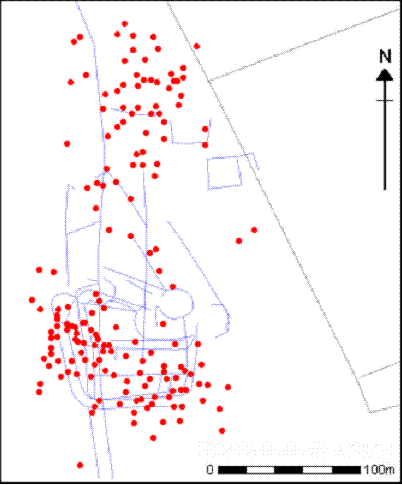
The plot of metal finds (versus cropmarks) at Cottam from the VASLE project is a clear illustration that the distribution of material in ploughsoil is not random, but contains several levels of archaeological information which can only be interpreted properly when the data are collected systematically and properly. Removing these artefacts from the topsoil without following that data gathering procedures destroys for ever not only the information content of the removed artefacts, but our ability to interpret the site itself from which they were taken. Like somebody stealing the murder weapon and other 'souvenirs' from a crime scene before the cops' forensic team arrives. Damage IS done to the archaeological record by the improper removal of items from patterned asemblages in the topsoil and ploughsoil. It is a shame that English Nature does not know it, or acknowledge it. Scandal.

Vignette: top VASLE project, Cottam metal finds distribution in ploughsoil

Thursday, 12 January 2012

Coiney Talk on the New York Coin Bust

.
Just to get an insight into the mindset of some of these collectors, take a look here, bearing in mind the actual reasons why under US law a coin might be seized for further investigation by law enforcement officials. Quite remarkably the discussion on the Forum coiney discussion list goes on largely in the same, 'fourth amendment' etc vein.* It seems to me that the US is not doing a terribly good job in educating its own citizens about these matters (1970 UNESCO Convention: Article 10b, Article 5 f - the lack of attention to the first part of article 5 by the US may have something to do with that).

* It is quite amazing isn't it that many coiney Americans obviously think that theirs is the ONLY country in the world where the principle "innocent until proven guilty" exists (indeed they seem to think the US invented it). News for you guys, it goes back to Roman Law (Digest of Justinian) and even Revolutionary France and communist Poland had the same legal principle.

Saturday, 27 August 2011

What is the matter with these people? (2) - the PhD

Comment by an Eaton Square archaeologist, supporter of the Portable Antiquities Scheme to Dave Welsh's anti-academic "Who owns Numismatics?":
I agree with you - there are many numismatists that know the physical coins better than academics. [...] It just seems slightly ironic you say Barford wants people to have paper qualifications, as he doesn't have all that many himself [...].
The irony of course here is the good doctor has not actually done her own research here, merely expressing an opinion based on what somebody has told her. Equally, I would not mind betting her "knowledge" of how many paper qualifications I have goes no further than her avid reading of seconary sources like the blogs of "Candice Jarman" and Steve Taylor. It's probably quite easy to get a PhD in Britain these days, a superficial questionnaire, apparently no extensive first hand contact with the material, forming opinions on the basis of what somebody else says rather than going to the primary evidence... No wonder British archaeology has gone to the dogs.

If PhDiva would take the trouble of reading what it is she is discussing, she will find that "Barford" (sic) "wants people to have paper qualifications" - is far from an adequate summary of what I actually said in that discussion. But superficiality is of course endemic in the mindset of the supporters of collecting and collectors, even if they have PhDs from British universities.

Vignette: PhDiva from PhDiva.

Wednesday, 17 November 2010

We Don' Need No Edukashun

.
English Heritage is one of the British cultural institutions about to face the consequences of heavy government cuts. In response, according to the Museums Association, they have decided they may have to close entire outreach department. That is what used to be called the Education Department and they did fantastic work among the public, including the highly important task of encouraging teachers to incorporate ancient monuments and archaeology in their teaching and generally encouraging the educational use of the nation's heritage. [A bit of dislosure here, I did some contract work for them a while back, preparing artefact on-site handling facilities with teacher's information packs and some writing for them.] At the moment they have just 14 people engaged in outreaching to 49 million members of the English public, one to 3.5 million people. They will now it seems lose those people.

We of course do have another form of public-funded educational outreach about archaeology at least - the PAS. This too will no doubt be affected by the cuts, but probably not (yet) wholesale closure. They have 50 people engaged mainly in some vague kind of "outreach" to around 8000 English metal detectorists (after the last cuts-that-were-not-cuts readers may recall that Roger Bland announced that this would affect the ability of the PAS to reach the non-collecting public. So at the moment they have one member of staff to 160 members of the collecting public. So what is now happening is that, if these plans come to fruition, the Great Experiment is leading inexorably to a situation where the main source of education about archaeology and the heritage in general in England and Wales is the FLOs talking to metal detectorists in their clubs and rallies and the rest of the public can go whistle. And of course the PAS closed THEIR education Department ages ago. The dumbers-down are rubbing their hands in glee, no more "elitist" education for the Brits, 'nuff 've that.... jes' aiming fer the lowist commen denominator, eh?

Of course probably the no-questions-asking "Internationalist" collectors would be against the use of the heritage in national education programmes:


.

Sunday, 20 June 2010

US Artefact Hunters in Partnership with Museum

.
The Southampton Historical Museum in New York State now has a metal detecting club, called grandly an "Artifact Detecting Team" (ADT). The idea is that it will arrange access to privately owned land with historical sites on it and then charge metal detectorists a fee to search it and the artefact hunters get to keep what they find. Apparently, there is a lack in the USA of "places where a metal detecting enthusiast could potentially make a relic find such as a coin, button, buckle or other item that dates back to the period of pre and post Revolutionary America. Any item found within this time frame is typically a once-in-a-lifetime discovery for these metal detecting hobbyists". Barry Small, a Long Island resident and metal detecting artefact hunter who will be running the scheme for the museum says: "The unique combination of the colonial history in the Southampton area and the potential access to historically significant sites, large private estates and undeveloped pristine farmland makes for a metal detecting dream opportunity".

"Barry approached the museum with a unique and detailed proposal to help raise funds" said Tom Edmonds, executive director of the museum. By gathering fees from artefact hunters for arranging access to land, the museum hopes this way to raise funds for "historical preservation" (that means maintaining its own assets). This is achieved however at the expense of the preservation of the historical resources of other historical sites in the region (ones which are not formally part of its own assets). The museum refers to this scheme with that horrible cliche as a "win-win situation". But it is not a win for the archaeological record of those historical sites still surviving rampant redevelopment in Southampton's backyards and farm fields, some going back to the colonial period. That is compromised rather than being preserved. That does not seem like a "win win" situation to me.

The museum describes this dismantling of parts of the region's archaeological resource as "getting creative" and boasts of its ability to "tap into a heretofore unknown source of funding driven by the passion to uncover local history". Not at all "unknown", commercial metal detecting rallies are a well-known feature of the landscape of archaeological destruction in other countries.
"My proposal was to create an annual dues paying, membership-driven Team of metal detecting hobbyists who would pay daily detecting fees directly to the non-profit Southampton Historical Museum for the opportunity to metal detect on various historical and estate sites and plowed farmlands which date back to their settlement in the early 1700s," said Small. The museum would be getting the appropriate permission from the landowners, as necessary. [...] "This past fall I had the opportunity to metal detect on some Southampton area farmland and made some great 1700's era finds. I was immediately hooked," said Small. "After such a great opportunity I was racking my brain for months trying to figure out how to gain access to these historically rich properties. I knew that I would be willing to pay at least $100 per day to detect these pristine farm sites and even more for access to significant historical or estate properties that had never seen a metal detector before and believed that others around the country would feel the same way too".[...] Edmonds added, "We will be recording the specific locations of any significant finds that are made by the Team members for further examination and investigation by the museum's trustees".
So in other words, the metal detectorists knows that if he knocked on the door of a conservation conscious landowner and asked if he could loot historical sites on their land for collectable (and possibly saleable) items, they could well meet with a refusal, but if the museum asked, permission might be forthcoming. Another advantage for the hobbyist is that it craftily places all the administrative costs (drawing up and signing agreements with landowners, third party liability insurance etc) as well as the task of documenting significant finds on the museum. The detectorist just pays a reasonable fee for which they can carry off as many archaeological treasures as they can find. Should not museums be educating the public about the destructiveness of the commercial exploitation of the archaeological resource by artefact collectors, and not themselves profiting from it? What are they thinking of?

[We Europeans might find it hard getting our heads round the idea that finding something from before the 1770s as a "once in a lifetime experience"! Still, whatever turns you on... Anyway if the culture hooligans are only trashing sites with post-1600 metal objects in the search of collectables, they are only damaging a small part of the archaeological record of the long history of mankind on the North American continent].

Vignette: more archaeological deposits damaged for the benefit of garden shed collectors.

Friday, 11 June 2010

APE - Artistic Photography for Education

.
The California-based Adult and Artistic Photographer's Association (AAPA) is excited to announce a new educational initiative, Artistic Photographs for Education (APE). This is a project which "Puts Anatomy Into the Hands of Children". The work of APE and all of its teachers brings new dimensions to learning about human biology and human relationships in the classroom through the use of artistic photography in publications donated by dealers affiliated to the organization.


APE projects create a new learning experience for many young students on the threshold of adulthood, through the use of highly detailed colour artistic photographs of male and female anatomy for home and classroom study. There are specially prepared lesson scripts and volunteers are available to come into the classroom and talk to pupils about common misconceptions about the adult photographic industry and guide students through the illustrated material, and also to develop their latent interests in what is available online through the work of many enthusiasts now collecting this kind of material and making their collections available to others (both commercially as well as free). Students will be encouraged to join online closed access discussion groups to develop their interests and communication skills and make contact with others with similar interests.

Bunny Anne Tanlines, an APE director and Californian 'adult' model based in Santa Barbara, pioneered the Artistic Photo Showins which has brought displays of artistic photography to a growing number of schoolchildren. Parents at the first opening in Paloma were amazed to see the exhibits and many said they wished that they had such an opportunity when they were at school.

APE students are not only learning about anatomy and marital relations, but are also introduced to artistic photography in the form of simulated model shoots (only available in the South California area), where they can photograph volunteer models and experiment with different kinds of lighting etc. Each year APE holds essay contests for students concerning the material offered in APE 'showins'. The prize is a year's subscription to a nationally known restricted access adult photographic discussion list. Last years national winner, high school student Randy Boyes, from Santa Barbara West trailer park was celebrated in his local newspaper for his essay on "Julia Domina".

Artistic Photographs for Education Inc., entirely run by volunteers, was established in 2010 as a registered non-profit organization to encourage learning about human anatomy and marital relations. APE is supported by groups involved in the adult literature industry, both professional and amateur, which have donated illustrated literature for the students and their time and knowledge as classroom mentors. APE Director and owner of one of California's leading adult store chains "Big Mick" Raubmann says: "We profoundly hope these publications will serve, as intended, to broaden childrens' minds and inform them in a way not normally possible in the classroom environment, and act as a sort of "dragons' teeth" seed, sown in the hope and expectation of raising a whole new generation of customers ".

Adult bookstore Owner Dave Scott praises the scheme on his Youdrool-L discussion forum:
One of the best ideas that has been developed to interest young people in the world of adult relationships is APE, which has achieved significant success in using inexpensive and commercially available material donated by dealers to help develop a sense of discovery and research skills in students. It is amazing how much interest and motivation one magazine with a value of only a few dollars can create. Are there other types of publications that could similarly be used to expand horizons? Archaeology books, for example?
Scott dismissed critics who insisted that such themes were best explored within the context of mature and well-established relationships based on responsibility and trust as retentive "elitists". Furthermore he discounted as "mere propaganda" the claims that many models in these photographs were illegal immigrants who were lured from their homelands by false promises by criminal elements. In any case, he said, calls to stop or regulate such processes were "nationalist" and contrary to the spirit of what Scott called cosmopolitan "internationalism".

Photo: Dylan Squint studies human anatomy.
.

Monday, 12 April 2010

Collector: "Where I disagree with Paul Barford"

.
There is an antiquities collector calling herself "Meechmunchie", who seems to be the same person as the individual calling themselves scrabcake - another computer gaming nick - who has been posting comments here, she runs the Egyptologygeek blog.

Anyhow, whoever she really is, she has several times hinted on collectors' blogs that although she agrees with a lot of what "Barford" says (Phew, eh?) she thinks that I take "a rather black and white stance on a topic that seems to be more ethically complex than he gives it credit". Now she feels the time is right to explain at more length what she means by that:

Barford is right that antiquities looting takes an object out of context destroying almost all of what we could learn about it. This is a crime against both the descendants of the people who made the object, who have been robbed of their own history and against anyone who would want to know about the object for any research. I think there is a lot more potential in science and research to restore parts of this provenance than does barford. These objects are not historically worthless out of context. For example...
[For the record, it is a gross oversimplification to say that I believe antiquities belong to "the descendants of the people that made the object". Apart from the fact it is nonsense.] There then follows a suggestion that chemical analysis can "restore context" because it can say where some objects were made. Well, that may apply to a few object types, but in general that approach gets us nowhere. There was a programme of thin sectioning all Neolithic stone axes in Britain, and identifying the source of the rock. This only gave information about exchange patterns when that information could be linked to where the axe was found - where it ended up. Without that information the axe was just a piece of worked stone. Bronze Age metalwork (well, actually most ancient metalwork) was produced from melting down older tems, so analysis can only say what kind of alloys went into the crucible, not where the finished object was used and lost, or what it was then found in association with. An archaeological context lost is in many cases - Renfrew's recent suggestions notwithstanding - indeed a context completely and irretrievably lost. The only "complexities" here are produced by attempts by indicriminate collectors to say that this is not true or that it does not matter.

She then admits that instead of trying to restore context to decontextualised items, "it is better to prevent looting". Sadly, we then have the ritual trotting out of the "harsh punishment has never worked" mantra. Now this seems to be regarded as one of the "complexities", even though I have never advocated reliance on it alone. I think most of us are aware that merely banning something and punishing people for disobeying does not stop that thing happening. Which is why this is not what is being advocated by preservationists, who are not stupid people on the whole and have much more nuanced ideas about curbing the illicit trade in antiquities than it seems this collector gives credit for.

Anyway, Meechmunchie then suggests the reason why we cannot stop looting by harsh legislation (which is what she seems to think is all that I am proposing). This is next "complexity" is that - and here she refers to a text of mine - that the need to make money is the reason people sell artefacts for the money (duh). She reckons I could have dealt "with a little more empathy" in my blog post with an Egyptian would-be seller of looted artefacts and a little boy peddling sherds because, and here's the crux of the matter:
A lot of our looters and the merchants who resell their wares are crushingly poor, and many feel no connection to the past that they are hawking except as a way to put the food on the table. [...] So, you are struggling to feed your kids and you have a potential goldmine in the field across the road or the desert out back.

("our" looters?) Let me tell her that the man behind the counter in a tourist shop right in the tourist centre of Luxor is unlikely to be "crushingly poor". The guy hawking antiquities to foreign tourists on the sites there is not doing at all badly. One of them by the Tombs of the Nobles jubilantly showed me in January the 200 Euros he'd just got ten minutes earlier from a German tourist for a shabti... fake of course, he has nothing else.

We have here the "subsistence digger" model again beloved of collectors. The indiscriminate collector of looted antiquities kids himself that he is "doing good" by buying looted antiquities because they can pride themselves that they are "putting food on the table" of some "crushingly poor people" for whom they feel some empathy. This is simply self-delusion as well as patronising. Firstly, encouraging the less well-off to earn money by infringing the law is not a way many would recognise as a legitimate way to help them out of poverty. Why stop at antiquities, when they can strip lead off other people's roofs, copper cables from alongside railway lines (belong to nobody in particular), brass crosses from gravestones (not your own family of course)? There will always be a buyer. The money can put food on the table and its easier to strip unguarded copper cable from signal boxes than dig in the dust and dirt. The second thing is that of course none of the money that a buyer pays a dealer never gets to the digger. Robin Symes sold some of his objects for millions, and how much did the finder get?
In fact a number of cases are discussed in the literature of dealers going along to indigenous communities, showing them what they will pay money for and showing them where to dig, and they start digging where there had previously been no such a tradition of looting ancient sites for scrap metal or anything else. As the Bible says, the poor were always with us, but its the antiquities market that is the damaging new development.

Nevertheless, on the basis of her victimised subsistence digger model, Meechmunchie concludes:
that using the big stick is not going to work until the standard of living is high enough that there is no excuse for looting, and people have a respect for if not identification with the past which they are depleting. This can only happen with education. Only with these improvements will locking a person up in a deep dark dungeon for 25 years for hawking a potsherd be morally justifiable.

That sounds nice and progressive doesn't it? One complexity then in that neat model, how do we explain the looting which is taking place not in the countries where browner-skinned people squat on the ground eating beans, but in western Europe? In the Four Corners area of the US? In the National Parks around the Ozark mountains? In Canada? In Germany (Nebra Skydisc) and France? These are not countries where there is a particularly low standard of education, nor low standard of living. Nor indeed are these countries where the population as a whole is "alienated from the past". On the contrary, these are the very countries where the finds looted in other ("source") countries are most often ending up. The buyers of these objects moreover claim that they are doing so in the name of education (let us not forget the looted coins ending up being used in America in the Ancient Coins for Education project). Basically therefore merely blaming on world poverty the fact that there are looted artefacts on western markets is rather simplistic. If we look at the US however we find that while the majority of citizens do not take a shovel to the nearesdt native American burial ground or midden, BLM officers are increasingl pointing to one particular segment of society that is involved in this activity. It is not just that certain populations "have no money" that leads them to culture crime, it is in some cases a poverty of morals too. I wonder then if "Meechmunchie" really thinks locking people up in a deep dungeon for looting and trading in looted artefacts should be regarded as "morally justifiable" in the US and Britain? Then she has a go at the Brits and the PAS:
Which brings us to the situation in Britain where people ought to know better. If only the British government was so hard assed as the Egyptian one! I shall defer to Barford on this situation since I don't know much about it, but there should be a punishment for looting Roman coins in the UK because there is really no excuse. Ideally they would stay in the ground where they've been for over a millennia for future generations to study. Having them dug up by metal detectorists and sold on eBay only benefits the buyer and seller to the potential detriment to the entire scholarly community, and having them stuck in a museum basement in a shelf next to 100 other roman coins which have been judged by the museum to be worthless to the cause of bringing in revenues while being too mundane to publish doesn't do much good either.

That is the end of her attempted explanation where I've got it all wrong and cannot see the"complexities" which she does. It seems to be a rule in discussions with artefact collectors that when they accuse the other side of "extremism" and that issues "seem to be more ethically complex", that in fact when they set about explaining how, we get a wholly simplistic set of views. This lengthy post is no exception. The "complexities" boil down to a few simple points. Before discussing them however let's deal with the bit on the Brits.

Here we are in relative agreement, the Brits indeed "ought to know better", a position I have always held with regard artefact hunting. That they do not is entirely due to the uncritical approach of the media and the campaign conducted by the supporters of artefact hunting. I think it would be very good if the British government was so concerned "as the Egyptian one", but that is due entirely to strong leadership. The British archaeological community is acephalous and weak-willed and will not stand up to the artefact collectors. As for "a punishment for looting Roman coins in the UK because there is really no excuse" there is no excuse and the punishment should be for more than just illegally obtained "Roman coins" of course. But again, this comes down to what society and the judiciary regards as acceptable - the US has the same problem. In most cases that end in a conviction, the sentence is little more than a slap on the hand. I have also long maintained, including on this blog, that the Treasure Act is doing very little that is archaeologcally worthwhile if stuff is just going into museums (and it makes no difference if it is to a brightly lit showcase or the darkness of the conservation store) and not being published. Part of the cost of obtaining these archaeological Treasures for the nation should go on its conservation and publishing and the proper investigation and protection of the findspot.

The complexities that "Meechmunchie" wanted to talk about are not such complex matters. Basically she suggests (1) that decontextualised artefacts can have their context "restored" by some analytical method that nobody has invented or tested yet. Also (2) harsh punishment has never worked and we should be tender with subsistence looters. Then (3) the reason for looting of archaeological sites is poverty and lack of education, and some kind of "alienation" from the past. That, rather disappointingly, seems to be about it.

Well, what can I say? The first point is I think just nonsense and self-serving. The collector says that it does not matter if we throw away information now, we must trust that one day we'll be able to get it back again "somehow". Well, Meechmunchie, that is not how conservation works. We cannot allow all the tigers to be killed justifying this because "anyway we will be able to clone more one day from the DNA in the hairs of an old tigerskin rug" (well, you can say it if you like, I will not). This fluffy bunny "its not their fault they are looters because they are poor" really does not wash. What in fact is being said by collectors who use this argument is that it is the fault of the governments of "source countries" that sites are looted because they have not given good jobs and employment to every citizen. In other words, the collector is saying it is not their (collectors') faults that sites are looted, but "somebody else's".
Now this really is odd logic. Take Nigeria and those dinky little dug-up clay sculptures sold as "tribal art". They were very fashionable to collect not so long ago, the figures had a powerful "primevalness", slightly comic with bulging eyes and misshapen figures. They were dug out of archaeological sites at the behest of foreign dealers. Yes, subsistence diggers existed in Nigeria, but this only started because there was already a market for them. There was no "tradition" of digging stuff up to sell until dealers appeared offering the prospect of easy cash for a bit of digging. The same thing is happening in Southeast Asia, a while ago the only people taking hammers to places of worship to smash off a Buddha head were brutal white colonial adventurers. Today young locals are setting off to smash the sites of worship of their own cultures because getting money from foreign dealers is more important to them than respect for these old sites. The "alienation" which Meechmunchie talks of is not always endemic, but created by contact with the commerciality and lack of morals of the foreign buyer. This also was in fact the case in Egypt too. Neglect and reuse of elements of monuments is one thing, looting another. It was only the appearance of mass tourism and the antiquities market that led to the modern looting of, for example, the Theban necropolis, which led to the locals' perception of the holes in the hills as "a goldmine".
Most of the specious arguments applied to justify collecting really fall flat when examined critically and objectively. As far as I am concerned the complexities actually come down to one simple fact. If there were no possibility of making money by selling unprovenanced antiquities, if responsible collectors stopped buying them, then there would be no market for looted Nok terracottas, looted egyptian scarabs, mummy masks and shabtis, knocked-off buddha heads, dug up tetradrachms, or bulk lots of metal detected artefacts from sites like Archar and suchlike (this also goes for poached ivory and body bits of other endangered species). It is because collectors shut their eyes to where finds come from, and simply buy indiscriminately what comes along, that the looters can push unlimited amounts of stuff onto the market.

Wednesday, 31 March 2010

PAS Announcement: This blog now closing

.


Closure of Portable Antiquities Collecting and Heritage Issues Blog.

LONDON 31/03/10: In a surprise announcement this evening to coincide with the end of the 2009/10 financial year, Roger Blend, the Head of the Potable Antiquities Scheme (PAS) indicated that at there would be no more funding for the continuation of the highly unpopular Portable Antiquities Collecting and Heritage Issues blog, and that it would now be closing.

The blog had been a collaborative effort of members of Department of Public Education and Outreach of the PAS and had been appearing since 12th July 2008. The format of the project was intended to resemble the personal blog of a fictional archaeologist, a “Paul Barford” who was a serious opponent of certain traits in artefact collecting. “The idea”, explained Michael Lewes, deputy Director of the Scheme which is based in the Brutish Museum in central London, had been "to show collectors in the United Kingdom what kind of ideological opposition collecting could soon be up against, in order to encourage them to work more closely with the Scheme, in a partnership which would serve to create a form of legitimization of this archaeologically useful hobby”.

Lewes said the project had certainly done much over the past two years to cement relations within the hobby and to some extent between hobbyists and archaeologists, “but it outran its usefulness”, he confessed. “We found that some collectors, particularly the younger ones were taking the rants too seriously and were being induced to leave the hobby, and this was leading to the fall in numbers of objects recorded”.

Another factor which Lewes said had led to the decision to call a halt was the sheer amount of work that was needed to keep up the pretence. The problem that nobody had ever met its author was resolved by making him an ex-patriate, but the lack of material to write about was a problem. “We were let down by our own side” Lewes admitted, “very little useful counter-debate was emerging from the collectors, who seemed to find nothing to say in their own defence”. Much of the writing was actually done by Adam Doubney, Finds Liaison Officer for Huntingtonshire helped by the PAS information technology specialist Dan Peat working from home. Dr Roger Blend thanked them tonight for all their hard work and added that the blog had been a useful exercise not only because it had helped cement relationships within Britain's archaeological-artefact collecting partnership, but also showed members of the UK public "how ridiculous and illogical are the claims of the conservationists who decry collaboration with collectors which is going swimmingly, we are seeing more objects removed from archaeological contexts than ever before".

Note for editors:
1) The Potable Antiquities Scheme is a voluntary scheme to record archaeological objects found by members of the public in England and Wales. Every year many thousands of objects are removed from their archaeological contexts by by metal-detector users. Such discoveries, properly recorded can offer an important source for understanding our past, and since September 1997 the Potable Antiquities Scheme Finds Liaison Officers have examined over 544163 such objects, but many more are removed which go completely unrecorded.

2) Dr Roger Blend has an OBE for "Services to Heritage".

Not for release before 18:00, Wednesday 31st March 2010.


.

Sunday, 14 February 2010

Education: It's Not Just About Coins Though, Is It?


In the post (Ancient Coins and the Corruption of Youth ) to which I referred in the post above discussing the Ancient Coins for education programme, ACCG's Peter Tompa takes issue with my statement that it is a totally false argument to suggest that one can be "educated" by collecting decontextualised artefacts potentially stolen from the archaeological record of another region. He goes on to say that
I'm all for using ancient coins ("decontextualized" or not) to help teach our children about ancient history. In that regard, ACE is only doing in the classroom what museums themselves have started to do-- give the public and particularly children-- the opportunity for some "hands on" experience with common ancient artifacts, like ancient coins.
Yes they are, many museums in Great Britain and Poland at least have schools outreach programmes, with specially trained staff and facilities for exactly this. I know a number of people who work in this area and have myself taken part in such events. Incidentally, this is not something museums over this side of the Atlantic have "just started" doing, this was going on when I was at school myself; if the USA is behind other countries in this field of education, I am sorry to hear that (and that might explain a lot). In my case I went to a little rural school out in the sticks which was part of a system of travelling exhibitions with material that was available for handling (for some reason, I still vividly remember handling a real chainmail shirt in one devoted to Medieval chivalry), so it was not necessary for the school to be in the town where the museum is to benefit. In the UK the Portable Antiquities Scheme also organizes numerous finds handling sessions for adults as well as kids in their classrooms.

Anyhow, there is a huge difference, is there not, in specially trained and appointed staff teaching kids about the past with the use of objects in a museum, and some fat middle aged bloke off the street showing some kids his coin collection. There is a difference in approach, between something collected for public benefit and something collected for personal use and - let's face it - bragging rights. Between something which is in common ownership and that which has been appropriated for his own personal use by a private individual. In a museum (and here's that asinine 'Universal Museum' argument being used more appropriately) the objects seen and handled by the kids can also be seen in the wider context of other exhibits in the museum, taking the experience from the narrower to the more general. The use of museums in this way also encourages kids to go into museums and shows them what they can get out of such a visit. This is no bad thing.

From my own experience, I sincerely doubt one can teach as much about the past showing kids "just coins" as one could showing them other object types, Roman keys, knives, pots, personal ornaments and so on. Using just coins to illustrate a lesson forces one to concentrate on the aspects we learn of from written sources, the "kings and battles" model of history, focussing on the deeds and aspirations of the elite (which they can read about in books anyway) and not the experiences of the common man. Using other sources and the other types of archaeological evidence gives a more rounded picture of "what it was like" in all periods of the past (not just those served by coinage). I am convinced that ancient coins alone are severely limited as educational material.

At least, instead of being "Ancient Coins for Education", the organization would give a better service (better, more rounded, education) if it was called "Ancient Objects for Education", and included visits to classrooms of specialists with returnable handling collections of ancient pottery, personal ornaments, keys, knives from a museum collection - perhaps one specially created to fulfill such a purpose. I am sure handling even a replica gladius and scutum (or Hoplite weapons or whatever) would be very welcome in a US classroom, coupled with a video of a re-enactment group in action (better still of course would be seeing a GOOD one live). How about a session with the kids writing (in whatever language) on replica ancient writing materials (clay tablets, wax tablets, papyrus - now obtainable in notepad form, maybe even with a bit of effort, parchment)? All sorts of projects can be invented by the good teacher, without the need to handle a single potentially looted artefact from the no-questions-asked market. This should then be followed up by a "how do we know?" session, and the topic of conservation of the archaeological record can be introduced here and linked to the issues of preservation of any finite and non-renewable resource.

This of course would complely remove the stigma that the main purpose of ACE is (by giving out free authentic ancient coins) to try and persuade children to develop an interest in collecting ancient coins and thus become future customers of the coin dealers that supply the programme with coins ("sowing the dragons' teeth" of an army of supporters for no-questions-asked collecting). So I guess we cannot expect the ACCG and those associated with it to be wholly enthusiastic about such an initiative.
Photo: PAS (I think its the FLO from Exeter?)

Saturday, 13 February 2010

Treasure hunting 101 in America's classrooms


Nathan Elkins' article "Treasure hunting 101 in America's classrooms" (2009, Journal of Field Archaeology 34 (4):482-9) is about the Ancient Coins for Education programme about which I have written on this blog before (here and here for example). It is good to see it being discussed in the serious archaeological literature too. The idea that one can be "educated" by collecting decontextualised artefacts potentially stolen from the archaeological record of another region really is a totally false argument. There are books and other resources that can be used for education, and a skilled teacher needs no props, especially not those derived from the destructive exploitation of a fragile and non-renewable resource. As I have pointed out before, the young US citizen should be educated to respect and help preserve the archaeological record and not become just another thoughtless exploiter of it and another customer of the no-questions-asked internet commerce in archaeological artefacts. Funnily enough that is precisely the aspect that is totally missing from the "educational" material produced by the ACE. Indeed, it is precisely that aspect of the collecting of dugup ancient artefacts that ACE promoters are specifically advised not to talk to people about. ACE's Mark Lehman wrote about Answering Ethical Questions: "My first, and most important advice is to you is to avoid these discussions like the very plague - I cannot possibly stress this strongly enough". Elkins' text shows quite clearly however that whether the supporters of the ACE want to discuss them or not, there are serious ethical questions that need answering. Perhaps it is time to let the parents of the kids approached have the information to allow them to decide whether or not they want their kids exposed to such indoctrination and handling coins that have been acquired from unknown sources no-questions-asked? From that point of view, it would be useful to have this text available online. Heritage Action has also recently drawn attention to the cynical use of children under the guise of their "education" in deflecting criticism of other somewhat dubious activities.

Vignette, what about the children of the countries  that are exploited as the source of the "educational material" for US schools? Photo by China Daily.

Tuesday, 14 July 2009

"Doing the Romans", while doing no damage

A practical exercise designed by teacher Philippa Holden at Brushwood junior school, Chesham, Buckinghamshire (Alice Woolley Extreme pots, the Guardian, Tuesday 14 July 2009) seems an imaginitive way to help people learn about the past and how we know what we do about it. It was done in a totally sustainable manner without damaging archaeological sites and assemblages.

It certainly makes the ACE’s “archaeological simulations” over in the USA with decontextualised foreign coins of dubious provenance buried in sandboxes look a bit tame and futile. Ms Holden said:
"The aim was to give the children the means to think for themselves, to discover things and then figure out what they might have been used for, and what room they were in, [...] I'm into not just teaching them facts. I wanted them to think about it".
In other words using evidence. I guess that is why the ACE will not be doing anything like this for a while. After all, they cannot really have the kids, the new ancient coin collectors of the future thinking too carefully (about the contexts those coins might have been found in and what that might tell us, and what is lost when we lose that information), can they?
 
Creative Commons License
Ten utwór jest dostępny na licencji Creative Commons Uznanie autorstwa-Bez utworów zależnych 3.0 Unported.