Showing posts with label export licenses. Show all posts

Monday, 5 December 2011

"The most amoral and dangerous individuals in the world"

.
"the most amoral and dangerous individuals in the world" is how a Californian dugup dealer characterises those who wish to impose restrictions on the import into the USA of archaeological and ethnographical artefacts without documentation of lawful export. In other words take away "from the longstanding and traditional rights of US collectors -- without any compensation whatsoever". Long-standing RIGHTS to import illicitly exported artefacts? Surely any such illusions ended when the USA became a state party to the 1970 UNESCO Convention back in 1983? What are these dealers thinking?

Peter Tompa continues his incessant moaning about how hard-done-by are US collectors (already in possession of a huge chunk of the above-ground resources of portable antiquities from all over the ancient world - but still want "more and more"). He attempts to assign "winners and losers" to the Greek Import Restrictions (restrictions, let us remind ourselves on illicitly exported items).

"Winners" according to Tompa are:
The Greek Cultural Bureaucracy ("poorly managed" and "corrupt")
The Greek Government ("poorly managed" and "corrupt")
"The Obdurate State Department Cultural Bureaucracy" ("obdurate", "entrenched")
"The AIA and its Archaeological Fanatics" ("anti-collecting", "fanatics")
"Wealthy Greek Collectors".

One wonders just how long the buffoonery of pretending that the archaeologists (institutional or otherwise) are all "fanatics" (was "radicals") who are to a man rabidly "anti-collecting" can persist. The evidence is very clear that the AIA is not against collecting per se, but - in line with US legislation since the early 1980s - against collecting of ILLICITLY exported cultural artefacts. No more, no less - and it is all in black and white for any dealer, lawyer or collector with more brain cells than my cat to check. Of course such nonsense suits well the yapping dogs that try to frighten, huddle and herd as many ovicaprid collectors onto the barren thistle patches of indignant opposition as possible, but it is not the truth. But then what evidence has there been from the ongoing dialogue of the deaf that dealers' lobbyists or collectors are even a bit concerned about the truth?

According to Tompa:
These fanatics hold that the only legitimate exchange of archaeological artifacts is a museum loan.
Well, since the law stipulates documentation of licit importation, it would be more truthful (see above) to say that they hold that the only legitimate exchange of archaeological artefacts is with documentation of licit export.

As for those "Wealthy Greek Collectors" (where the adjective wealthy magically become pejorative...). Surely there is a huge faultline running through the ACCG logic here. The whole point the collectors opposed to import controls are making is that the vast majority of the artefacts affected are too cheap (on the US market) for it to be at all "economical" to get documentation of licit origins and transfer. So they are not the kind of things one has to be inordinately "wealthy" to buy.

How shocking to the American psyche that:
Greek collectors will gain a competitive advantage over their American counterparts who can no longer import undocumented cultural goods.
They will stay in Greece, rather the best items being constantly and illegally siphoned off to a voracious and well-financed foreign market. How curious though that an American collector (and Peter Tompa, who is if I am not mistaken of Hungarian Jewish stock, collects dugup ancient Greek coins) feels he has MORE right to Greek cultural property than the citizens of that country (even if these items are illicitly exported?) and considers it a matter of regret that fellow collectors (though of a different nationality) will be able more easily to collect items which reflect their own cultural heritage.

For Tompa, the "losers" are:
"Greece's Cultural Patrimony" [too much stuff to look after as it is],
"The CPIA and the Process Congress Contemplated" back in 1983 (sic)
"The Small Businesses of the Antiquities and Numismatic trade" [who are now going to have to document licit export to allow legal import into the US: "This is particularly a problem for the small businesses of the numismatic trade". This is because the objects available for import are typically lacking such documentation]
"US Collectors" [who will be forced to buy material which has been licitly exported, rather than the other type that was on the market formerly].
"US Museums" who will not be able to carry on purchasing items without any kind of documentation of licit export [not, I think that they are likely to be wanting to in the coming years anyway].
"US Customs" [because they are going to have to do something connected with the fact that in 1983 the USA became a state party to the 1970 UNESCO Convention, too bad, but the idyll of US hypocrisy in this regard could not go on for ever]

What is not explained is the manner in which having mainly material which has passed scrutiny with regard to licit export on the US market as a matter of course is allegedly a "bad" thing for collectors, museums, and responsible (responsible) dealers. What is clear that the persons who have lost (not mentioned for some reason by Tompa) are the smugglers (possibly related in some way to organized criminal groups) and looters, who will have their US markets fundamentally curtailed by these measures if they are applied effectively by all involved. These people are on the losing side and among those who actively regret that we'd expect to find a number who are "amoral and dangerous". What nasty company the no-questions-asked antiquity dealers keep.

Thursday, 8 September 2011

Ayman Ramadan and "Nafertiti Eastern Sculptures Trading"

.
Rick St Hilaire has a post today on a topic which interests me too: 'Ayman Ramadan and Nafertiti Eastern Sculptures Trading' and he refers to an earlier post here on the subject. I think it is worth noting that I drew attention to a dodgy-looking assemblage of 'Luristan' bronzes that Nafertiti had been trading as well as they were A source of the shabtis I christened (wrongly) wenneb shabtis which I certainly think would be worth following up to find out more links of these traders to the UK and northwestern continental Europe.

St Hilaire has found out that:
There is information to suggest that Ayman Ramadan may go by the name of Ayman Libzo. A Facebook profile bearing the name Ayman Libzo describes this named individual as the owner and president of Nafertiti Sculptures Trading L.L.C. It also lists Dubai as the place where this individual lives.
(The facebook page is illustrated by a photo of a young child rather than a 39 year old Jordanian adult.) St Hilaire finds that "Nafertiti Eastern Sculptures Trading" has disappeared (in fact it disappeared and the items I referred to vanished from the internet shortly after my post on the topic - but this was also the time when the US authorities were beginning to get their teeth into this alleged ring).
There is information on a web page, nevertheless, that an “Ayman Libzo for Ancient Antiquity” existed. What remains of the now inactive and sparsely archived web page, copyrighted 2008, is a ‘browse catalog” link, a generic Dubai business location, and a Dubai-based cell phone number. The catalog link is inaccessible. The other information listed on the web page states that the company is part of the Trocadero network, which is a fine arts and antiques online selling platform. The Ayman Libzo for Ancient Antiquity web site once bore the web address of www.trocadero.com/aylibzo/, as suggested by archived internet records.

There apparently was also an online store bearing the name “Ayman Libzo for Ancient Antiquity” at one time. It was likely located on eBay.es, the Spanish eBay. That page does not exist today and is not archived. It was referenced, however, in an eBay “arqueologia y falsificaciones” (archaeology and forgery) discussion group during a 2008 conversation about Egyptian artifacts.
Now that is awfully embarrassing for Trocadero ("Authentic antiques and art offered by credible American, European and Asian antiques dealers on one online mall").

PS I am not sure about the spelling of the firm's name; everybody likes highlighting the 'a', I am sure I saw it with an 'e' when the firm was active, though could have been mistaken.

Vignette: Dubai

Sunday, 25 April 2010

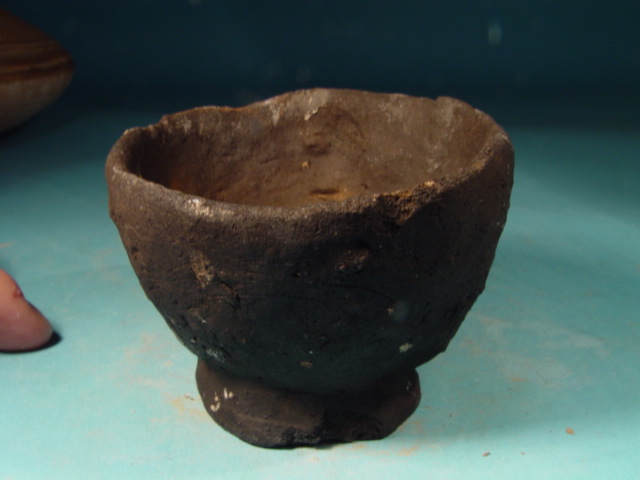
European Pre Celtic Bronze Age Tea Cup 600 BC!

.
The no-questions-asked antiquities trade is a frustrating place, on the one hand one's blood boils when we see archaeological artefacts obviously freshly ripped from their contexts on sale to anybody who is not too concerned about the damage caused and selfish enough to want to buy them. On the other one's blood boils when faced with some pretty bare-faced cheatery and total ignorance among sellers and buyers.

I'm not sure which of the latter two categories to place this one. A British seller has an item on sale in his online gallery, he calls it a "European Pre Celtic Bronze Age Hand Made Pot 600 BC!". Now "pre-Celtic" is an interesting concept, sort of makes the primitive wonky pot on sale sound primevally attractive. I also had words in the past with this seller about some central European pot he was selling as "Bronze Age" which was Iron Age (or was it the other way around?), so "pre-Celtic" could be fluff term to avoid being specific.

The sales spiel is wonderful, conjuring up a vision of primeval forests and the noble savage struggling to control the environment. In the work on artefact hunting which I wrote with Nigel Swift we call this "narrativisation" and its an important part of collecting, but also marketing the goods.

So where does it come from? It was, the seller assures us "found in Germany near the Danube river", so that's anywhere along a 400-km long line... It also apparently was "Formerly in the collection of an English gentleman". Well, how could it be otherwise? (Are all collectors automatically "gentlemen"?)

The seller assures customers that his firm "employs a number of experienced consultants who specialize in authenticating ancient art to offer you the necessary protection". I think we all should know the name of the experienced consultant that authenticated the object shown in the photos as a "very rare, late bronze age Cremation pot or cooking pot", as it is clear they know next to nothing about Late Bronze Age pottery of central Europe.


The photograph shows a handmade vessel, yes. The vessel has clearly been bonfire-kiln fired, yes (it still has the ash on it). The form however is an imitation of a teacup on a raised footring. The fabric of this piece is nothing like that of ancient ceramics of the period and region suggested as its origin before it got to the "gentleman's collection". I challenge the seller and the consultant to show us a similar form vessel from an excavated Late Bronze Age settlement or cemetery with the same surface finish and fabric.

Any archaeologist who has handled any ancient pottery from central Europe will be able to see that this is a modern piece, it still has the ash on it, and clearly has never been buried in the ground, probably this was produced as "experimental archaeology" (maybe during an excavation as many archaeologists have had the opportunity to partake in). As such there is no reason why it cannot be collected, but it should not be being sold as an authentic Late Bronze Age artefact. With three days to go, seven people are bidding on this.

The seller is a well-known antiquities dealer from Cambridge and a frequent contributor to artefact discussion forums. He also has a large number of objects on sale which in one way or another I would categorise as "dodgy", misdescription being just one of the problems.

There is an awful lot wrong with the no-questions-asked antiquities trade in Britain and elsewhere, while dealers are unaccountable for the proper description of what they sell, and there is a total lack of transparency, they can get away with a great deal, like selling illicitly-obtained items, or outright fakes.

Photo: Eftis Paraskevaides' "Bronze Age teacup". Although he says the images on eBay are his "copyright" I'm putting them up here as a public service, and if he wishes to challenge it we can discuss how he ascertained that the object(s) he bought from the gentleman as antiquities left Germany legally, has he seen an export licence for this? Otherwise he could be culpable under the 2003 Dealing in Cultural Property (Offences) Act. Not of course if he knew it was a fake when he bought it, but then why is he selling it as something else?

Monday, 12 April 2010

Urgent Request from CNG

Classical Numismatic Group, Inc. (CNG) "Serving the World in Classical, Medieval & British Numismatics Since 1975" has sent out to all its subscribers (150 quid a year) an "urgent request" for help. It probably does not take much imagination to guess what it is about. "The Staff at CNG, Inc." are asking their supporting customers "to come to the aid of the industry". The coin importing industry (interesting phrase, no?). They justify this appeal saying that "[t]he industries primary lawyer, Peter Tompa", contacted them over the weekend to alert them of the problem. It would have been more convincing I guess if they'd spelt it right. Peter Tompa, eh?

Well, what is the problem? CNG says "We believe [that,]as a collector [,]you will want to oppose any expansion of the MOU with Italy to include coins". But then, the CNG is less than frank concerning what the MOU is about. CNG says: "The entire hobby is being challenged". (No actually it is not, just the bit that wants to move ancient items of Italian provenance illegally across international borders.) Once again, oddly, Roman coins ("at the very core of the cultural experience that we all treasure") is the only type of ancient coin mentioned. Now where on earth the CNG got the following alarmist statement from is anyone's guess: "Requiring an export permit from Italy on a coin found and legally exported from Britain would not only be impractical, it would not have any legal foundation". Certainly not from any official source. They are right, this invented problem would not have any legal foundation, the MOU is signed with Italy, not the UK. I wonder whether the numismatists of the CNG's Lancaster office and London office saw that text before it was sent out? If they did, perhaps they should look up what are the export licence requirements for ancient coins exported from the UK, as this passage suggests that they do not currently know.
Apparently CNG considers that "import restrictions are [...] an idealist panacea that cause far more harm to society than any possible good". Now I expect there are many kiddie porn peddlars, ivory poachers and weapons dealers who would say the same thing, but perhaps not so publicly as ancient dugup coin dealers. They tell their international clientele that insisting on export licences for imported antiquities from Italy "would certainly be against the interests of American citizens and their traditional freedoms". (Yeeehahhh!! Time for the flaming torches and pitchforks.)
While archaeologists are rightly concerned about looting of archaeological sites, the guilty until proven innocent remedy suggested represents overkill and will only act to punish those who want to abide by the law. If you are concerned about this as we are at CNG, you need to make your views known to CPAC before April 22
Interestingly another US coin dealership, Harlan J. Berk, Ltd. has sent out a similarly worded message to its clients.
"We need thousands of faxes to make it clear to DOS and CPAC members that there are passionate collectors of ancient coins, and LOTS of them. This is an extremely important matter, please take it seriously".
In an earlier post here I discussed the observations of a collector of ancient coins on what Berk Ltd sell and had a look for myself. I refer readers to that post and ask them to consider just why this dealer would be concerned about the necessity to show that cpoins imported from Italy have export licences? Beats me, but perhaps readers can see something I cannot...

This is the text which lists the types of objects from Italy whose import into the US is being scrutinised under the MOU, it is published in the Federal Register by the Department of the Treasury on January 23, 2001, and extended in 2005 Archaeological Material From Italy Representing Pre-Classical, Classical, and Imperial Roman Periods Ranging in Date Approximately From the 9th Century B.C. to the 4th Century A.D. It covers just about every kind of "ancient art" object that can be imagined coming from the soil of Italy. Obviously if the CNG is right, we should find that there are currently very few examples of this kind of material on sale in the United States, as the existing import restrictions would have led to the "collapse of the industry".

In fact we probably all remember the dealers' marches on Washington of the winter of 2001, the hunger strikes. The shameful way the police broke up the peaceful "antiquity love-in" demonstration in Central Park behind the Metropolitan Museum. The hilarity caused by the boxer shorts somebody put on Michaelangelo's David when it was on tour in five major US cities. The unsuccessfull petitioning of the outgoing President which gathered over 50 000 signatures. The televised mock court case in Maryland. We remember Marion True's passionate defence of the liberties that were being eroded by the MOU. Then we remember the sad sight of so many antiquity dealers put out of business when it came in, the Asagio Gallery, the Canelloni brothers, R. Avioli, Alfabetti Spaghetti, the end of the Toccetti Emporium and so on. The many art dealers that were forced into the used car business by the passing of this legislation ... a shameful end to a once noble industry. No wonder the coin dealers are so worried about the prospects. Would you buy a used car from an ex-coin-dealer? ("no documents sir, but take my word for it, not stolen, no way, you can trust me")


Vignette: The protest of the US Fine Art Auctioneers Association in November 2000 drawing attention to the plight of the Industry that the signing of the MOU was to cause. The gentleman in the foreground (left) later became the Director in a major US art museum and successfully fought off repatriation claims of objects in the collection from Albania and Panama.

Thursday, 18 March 2010

The Association of International Antiquities Dealers Code of Ethics


The Association of International Antiquities Dealers Ltd. is a not-for-profit trade association, a company limited by guarantee, registered in the United Kingdom. It is an association of dealers in antiquities (including fine art, coins, metallic and ceramic objects) whose aim is
"to promote the benefits of artefact collecting and of the antiquities trade", but also "to promote responsible antiquities dealing and to provide a support network and means of exchanging relevant information about fakes, forgeries, fraudulent misrepresentation and stolen goods with a view to identifying such items offered for sale and notifying the appropriate authorities".
The AIAD Secretariat
"provides a service to Member companies and individuals dealing in antiquities by helping to establish a favourable trading and operating environment, by providing a forum for discussion on non-competitive issues, and by providing information to assist them in the achievement of their aims [...]. AIAD promotes responsible trading which necessarily includes meeting all legal requirements concerning reporting and documentation. Antiquities and ancient art dealers within AIAD apply the code of conduct set out in this website".
What a change from the attitudes of certain trade and antiquity collecting organizations over the other side of the ocean supporting robber-baron attitudes and moralities.

The AIAD Code of Conduct "is intended to provide a guarantee of responsible behaviour by Members in dealings with their customers".
1. GENERAL. The Member agrees to support the aims of the Association as set out in the constitution.
2. The Member agrees to conduct his business at all times with due regard to all pertinent current legislation and with utmost good faith.
3. Breach of the terms of this Code may result in the expulsion of the Member.
4. PROVENANCE. The Member agrees to maintain full and accurate records of relevant sales and purchases. Provenance of any item offered for sale is to be established to the extent that this is reasonably achievable, and the description thereof is to be as full and accurate as possible.
5. The Member agrees not knowingly to sell stolen items, fakes or forgeries nor to pass off as genuine items which have been restored, repaired or otherwise altered without clearly describing them as such. The Member agrees to take all reasonable steps to ensure that he has legal title to any item offered for sale.
6. The Member agrees to apply for all relevant legal permissions in respect of the supply of any item, including but not limited to export permits where applicable. A reasonable charge may be made to the purchaser for this service.
7. The Member agrees to offer appropriate written certification of items offered for sale, on request.
8. DESCRIPTION. The Member agrees to adhere to the relevant standards of best practice in advertising.
9. The member agrees to include in the item’s description the following information: (i) period and/or culture of origin; (ii) material(s) from which the item is made; (iii) any significant repair or restoration.
10. The Member agrees to take all reasonable steps to correct any errors in description or ascription in respect of any item offered for sale, and to deal promptly with any subsequent claim in respect of such an error.
11. APPROVAL. The Member agrees to provide items upon payment in full on 14 days’ approval for authenticity and grading. [...]
12. The Member agrees to offer to refund the purchase price of any item in full if the description is found to be significantly incorrect or misleading. [...]
13. VALUATIONS. The member agrees to provide written valuations for items, on request. A reasonable charge may be made for this service.
The Code does not affect the customer’s statutory rights in the United Kingdom
.
Interesting. It's a bit too good looking though isn't it? Point 9 omits any mention of the provenance/legal origin doesn't it? I liked the bit about reporting criminals to the relevant authorities, but wonder how many times it happens.
.

Monday, 8 February 2010

January meeting of ACCG in New York

.
Apparently at the Jan. 12th meeting of the ACCG during the New York International Numismatic Convention, participants were given a pep-talk characterised by hapless numismatic journalist Richard Giedroyć as "a cautious but upbeat assessment of the Ancient Coin Collectors Guild and its impact on people outside the coin collecting hobby who would demand certain coins be returned to their place of origin due to their being cultural patrimony". ACCG Director Wayne Sayles is quoted as saying "through the year we really got good publicity [...], we finally have an even playing field and the ability to push back." Giedroyć adds helpfully: "By pushing back Sayles meant against foreign governments and professional archaeological groups that have demanded coins these groups deem to be "ancient" of Cyprus, Italy, and China be returned to those countries because the coins are their cultural patrimony. Similar demands have been made in recent years regarding antiquities as well".

This seems a twisting of the facts, the criticism is of the no-questions-asked antiquities trade as a whole which is allowing and encouraging the commercial erosion of the world's archaeological record. The ACCG argues that the no-questions-asked coin trade should be regarded as exempt from such concerns because they claim coins are not artefacts. This is untrue of course.

But most interesting of all is that phrase "be returned to their place of origin". What nonsense. The MOU with China and Cyprus merely require exporters who want to remove certain types of object from the country to do so through the appropriate procedure and requires US law enforcement agencies (such as the ICE) to ensure that this was the case. MOST antiquities and art dealers can comply with the extremely liberal requirements of the US CPIA. Maybe they do so with bad grace, I don't know, but so far only one minority group has said it will not comply and has staged a seizure of illegally imported coins to make the point and force a test case. That is the collectors of ancient dug-ups supported by the IAPN and PNG.

The facts that coineys will not admit are that only if the import of items restricted by the CPIA and related MOUs are not accompanied by one of TWO different types of pieces of paper will the objects be returned to the country they came from. That is any items where an attempt was made to illegally export them will be returned to the place they came from. That seems fair enough. What, actually would truly RESPONSIBLE dealers (and collectors) have against that? Why do the dealers want to present to their clients a version that this means that some unnamed bogeymen want "all" artefacts returned? Is that an admission that most of the items they import from abroad (and the US has very few ancient coins of its own in its soil) are in fact illegally exported? Is this why they claim that "nationalists" are trying to destroy the "licit trade" by imposing import restrictions on illegally exported material? What kind of a "licit" trade is that?

"Coin dealer Harlan Berk of Chicago [...] said he was told an archaeologist told a school teacher it was a bad thing to give ancient coins to children [...] Speaking at the NYINC meeting Berk said, "I am angry at the archaeologists and I want to beat them". I bet he missed a word out there, "bad to give potentially looted coins to children". Beat them Mr Berk? Why actually is somebody supportive of a programme to use archaeological artefacts in education "angry" at archaeologists?

ACCG member and Washington lawyer Peter Tompa sounded the alarm that any future demand by Italy that coins be considered as artefacts bound by export laws and international agreements "could impact the entire ancient Roman coin collecting community". Surely an excagerration. Those collectors who accumulate, study and preserve only those coins legitimately on the market with PAS numbers will not be affected. This argument can only (and only at a stretch) be applied to those who buy them from dealers who cannot show their goods were from licit excavations. Once again the ACCG shows itself more aligned with the no-questions-asked dealers than truly responsible collectors.

Success was announced in awarding "ACCG Friends of Numismatists awards to influential people" like Roger Bland and culture law opponents in Congress.

Tuesday, 6 January 2009

"Flawed analysis" of a Stanford "Saddamite"?


The Stanford Archaeology Center seems to be planning to run a series of pieces on research into different sectors of the antiquities market. As may have been expected, the naysayers in the antiquity collecting world are not best pleased to see Neil Brodie’s account of what he found when he looked into "The Market in Iraqi Antiquities 1980-2008." Washington lawyer and portable antiquities collector Peter Tompa raisesa number of “issues that become readily apparent even after a rather cursory reading” and Californian artefact seller Dave Welsh accuses the scholar of having conducted a “flawed analysis” (though adducing no information of his own – simply relying on the Washington lawyer’s opinions). Let’s have a look at them referring to Tompa's original seven points.

I am not quite sure what Peter Tompa is accusing Neil Brodie of (point 2) when he writes:

Brodie appears to be one of those willing to overlook Saddam Hussein's crimes just because he spent lavishly on archaeology.
What is that supposed to mean? The paper is not a history of Iraq 1980-2008, or the reasons for G.W. Bush Junior’s deadly military jaunt over there. I fail to see where in Brodie’s paper Tompa expects to see his obliging denunciation of the Iraqi president deposed by US aggression. Tompa seems to have a chip on his shoulder about archaeologists who worked in Iraq, and this seems to have rubbed off in his assessment of Neil Brodie - unfairly I think.

Point 3 (“tales of looting of Iraqi sites post 2003 have been greatly exaggerated”) is a moot point. Tompa in his blog and elsewhere places more credence on these reports than many other observers. In any case Tompa misunderstands here, as elsewhere, the purpose of Brodie’s analysis.

Tompa reckons (point 1) that “large numbers of cuneiform tablets were sold in department stores around the United States during the early years of the last century”. To explain this, the reader should know that US department stores like Macey’s used to have collectors’ departments. I wonder if the Hecht stores also did? Anyhow, Tompa reckons that “Presumably, many of these tablets have lost their provenance by now”. This makes two assumptions, the first is that the lumps of clay bought in the early twentieth century and scattered in homes all over the USA actually survived (and were not thrown out unrecognized by heirs of the original purchaser), secondly that the collectors who bought them did not take care to preserve that information. This is important as the ACCG [of which Tompa is or was the president] stands firm on the position that the collectors of ancient antiquities are responsible people who curate information about the antiquities of which they are stewards. The department store antiquities argument seems to me a red herring in the context of Brodie's analysis.

Tompa questions whether sales figures of Christies’ and Sotheby’s represent an increase in the number of antiquities coming onto the market at the turn of the 1990s because “shouldn't we see that spike in the same year?” (point 4). It seems that the lawyer is here (as in the last point) a victim of his own “rather cursory reading”. If he had read Brodie’s “efforts” (sic) more carefully, he might appreciate that his own interpretation is at fault. In his point five Tompa suggests that the figures and tables showing a “limited number of lots available for sale” and their “generally modest value” belie an “oft heard claim” that he cannot be bothered to reference. I suggest that Tompa spends a little more time reading the captions to those figures and tables and putting them in the context of the whole market in antiquities in the whole period covered by Brodie’s paper. Modest? I hardly think so in the circumstances.

Point seven explains away a problem for the antiquities market - which is said (by those who participate in it) to be largely in “legitimate objects” and the cowboys selling illicit material are a “minority which gets the trade a bad name”. Brodie shows (p. 2) that after the adoption of UNSCR 1483 the number of Iraqi items on the market in general dropped sharply. Brodie suggests that this is because “a large part of the unprovenanced material on the market really had been illegally exported”. Not so, says Tompa, the answer is simple: “In the climate of the times […] many dealers were scared to sell any Iraqi antiquity provenanced or not”. Let’s get this straight, a US dealer has provenanced artefacts with clear documented pedigrees going back to the 1950s… and they resist the temptation to sell them to knowledge-hungry collectors in Bush’s America, out of fear? As Mr Tompa says: " I am not sure this follows logically”.

Point seven about the “the increased popularity of the Internet as a sales tool” really is pointless, one cannot have increased sales of (authentic) Iraqi antiquities if there are not actually more such antiquities on the market – no matter how they are sold.

Peter Tompa restricts his attention to the first part of Brodie’s text, misses out totally the points made about Barakat Gallery cuneiform tablets and the Larsa Nebuchadnezzar bricks (Larsa being one of the sites which was “not looted” according to information in the art world given much credence by Tompa). I suggest that antiquity collectors should give Brodie’s text more than a “rather cursory reading” and reflect more deeply on its implications than lawyer and antiquity collector Peter Tompa seems willing to do. Rather than a "flawed analysis" I think we have here the products of a flawed reading.

Photo: cuneiform tablet (Richard Benson)

Friday, 22 August 2008

Who needs Export Licences?

In his comments on an earlier post here Ed Snible suggests that it would be helpful if this blog could explain the rules about UK and EU export licences. It is not the purpose of this blog to provide legal advice, but perhaps a few points might be made about the UK system, which by no means exhaust the topic.

The regulations on this are indeed very involved and complicated by the fact that the UK follows the EU in most areas, but not in the case of (for example) archaeological material.

I think we should keep in mind the purpose of export licences. Portable antiquity collectors see it from their own point of view as something which is “restrictive” (in other words restricts their “freedoms”), fortunately not all collectors on the British art market see it that way, US portable antiquity collectors (and coin collectors in particular) seem to be a breed alone in this regard. In effect, the purpose of the British export licencing system (like any other of course) is that the British authorities would like to see what is being removed from the country before it goes. This is to make sure nothing is going out that the British people might feel should in fact be in the national collections. If something is regarded as required for the national collections, import is temporarily halted (by non-issue of the required licence) while the object is offered to national collections which can attempt to raise the money to purchase it. This is not always possible even despite the inevitable media campaigns, and the item ends up being exported anyway. Surely it is not too much to ask of exporters that they ask politely if the British do not mind this or that piece of cultural property being exported instead of being made available in British collections? The number of items refused permission is actually very slight in comparison to the immense scale of the movement of cultural property (both ways) across the borders of the UK.

Ed is a coin collector and asks in his comments to the earlier post,

If I buy a Roman coin minted in Rome found in Britain is it a "UK object"?
and

The flow chart doesn't mention coins

As we have seen, there is a curious opinion in the coin-collecting world in the US (where ancient coins do not as a general rule come out of the ground) that “ancient coins are not archaeological finds”. In the UK (one of the countries where ancient coins do indeed form part of the archaeological record) there is no such opinion. In the eyes of British law and public opinion and of course the professional view is that coins are archaeological finds and need an export licence to the same degree and under the same conditions as other archaeological finds.

Basically any archaeological material found in UK soil or UK territorial waters, more than 50 years old and regardless of monetary value, requires an individual export licence to leave the UK. That's what the law says. So regardless of whether the coin was “minted in Rome” or not, and whether coins were generally "originally made to to be exchanged between regions", if it formed part of the archaeological record in the UK and was dug from it, it needs an export licence. In fact of the many thousands (yes) of export licence applications made in the UK each year for archaeological finds, only a handful of objects are refused export permission. They are published in a series of nicely written and illustrated ("look how well we are doing") reports. I must say that on looking through them, the archaeological objects retained on the basis of the criteria applied in making the decision are rather a motley bunch of items.

So basically in the majority of cases, getting the required documentation is a matter of filling in the forms properly and waiting. Some exporters though (perhaps at the instigation of impatient clients) obviously cannot be bothered to do this, they put the item in a padded envelope and clandestinely send it across the UK’s (and EU’s) borders in that way, counting on the fact that Her Majesty’s Customs and Revenue only open and inspect the contents of a random selection of the many millions of postal packages sent abroad daily. It would seem that most times these exporters get away with it (that says a lot about HM Customs, because it must mean that far worse cases than a few ancient coins or brooches are also getting through the “net”). It is worth noting that many sellers of ancient and historic objects in the EU (for example metal detectorists) write clearly in their sales offer that they “do not send items abroad”. In other words, they are aware of the export regulations, and feel obliged to comply with them, but don’t want the bother of filling in the paperwork, so rather than export artefacts illegally they sell only within the borders of their own country.

A few weeks ago, I had a frustrating discussion on the Yahoo ‘Ancient Artifacts’ forum with a dealer who thought that by the seller putting metal detected archaeological artefacts in a padded envelope and writing on the outside “old coins” the customs formalities had been “satisfied” because, his argument ran, if customs had “had any objections” to their export they would have stopped the package. If they did not, these items were in his opinion legally exported.

Probably the person who carries a few old coins mixed with other coins in a purse and walks through customs with them can say the same thing "they could have stopped and searched me but they did not, so what I did is obviously OK with them".

This "Customs Had No Objections" Argument is a very dubious self-justification indeed. Firstly it ignores the fact that customs only enforce (or not) the requirements, while decisions on what is and is not to be exported (ie the issue of an export licence) in most countries are the domain of a specialist service set up for the purpose. Secondly, there are a number of reasons why archaeological items might pass through customs undetected, and none of them is connected with the legality of the activity.
Objects exported by these means without an export licencew where one is required have unquestionably been illegally exported. They have been “sneaked through the system” in other words – lets call a spade a spade – smuggled out. The purchaser who surely knows there are export restrictions on such items and cannot produce a valid individual export licence for them should surely be accountable for it. The dealer who buys these objects is buying illegally exported items and in doing so is dealing with a criminal. The collector buying from the dealer should have access to the documentation that shows the offered artefact was not originally purchased from a criminal, the "reputation" of the dealer must be grounded in their ability to demonstrate this.

I have been unable to find out whether there are any international postal agreements which cover the use of the postal service for the transfer of cultural property like this. If not, there should be.

There are also complications in that most of the legislation covering this concerns illegal export, while a serious loophole is that import into many countries is not restricted, even when the object is illegally exported at the other end of its journey a few hours earlier (unless certain conditions exist, like the US import restrictions on archaeological material of Cypriot or Iraqi etc. origin – but it should be stressed that these are exceptions). While I am sure there are many good reasons (and a few less salubrious maybe) why this should be so, it places the struggle against illegal transfer of cultural property at a disadvantage.

Mr Snible asked:
What if I purchase a Greek coin that wasn't found in the UK? If an object receives an Export license can it be re-used if I want to carry the object around with me while visiting the UK or is a new one needed each time?
Here we are getting into the more complicated areas, Greece is in the EU and the questioner lives outside the EU and here all sorts of other things come into interplay, and really it would take a lot of words and time to set out the various options (I've got a book coming out soon, and in its current draft it has a long and boring appendix which sets all this out with a bit of help from colleagues). There are situations when Britain is required to issue an export licence, there are situations when it is not.

It seems to me that if somebody sets out to be a collector of, or even dealer in, in a commodity which is by its nature controversial and often subject to various restrictions, they are honour-bound (if nothing else) to investigate the various regulations that govern its use and transfer. It would be at the least irresponsible to take a car on the road without knowing the rules and regulations which govern not only your own behaviour, but that of other road users. If you drive in several countries, you need to know how the movement of traffic is regulated in these different countries. I do not see where collecting antiquities or any other type of item should be different. I have suggested on collectors’ forums that creating a database of these national and international laws and regulations would be a useful task. It should not take much work, as no doubt the ethical and responsible dealers will already have determined them for their own use. Maybe Mr Snible and other collectors will join me in requesting that responsible dealers in portable antiquities set up a resource for the benefit of their clients setting out the laws which they have already researched and which govern the acquisition, export and import of archaeological finds in the various ‘source countries’.

The UK law at the basis of the rather complex series of export regulations is SI 2003 No. 2759, The Export of Objects of Cultural Interest (Control) Order 2003.
 
Creative Commons License
Ten utwór jest dostępny na licencji Creative Commons Uznanie autorstwa-Bez utworów zależnych 3.0 Unported.