Saturday, 4 September 2010

Keeping an Eye on the ACCG donors (1): Holyland Numismatics, Michigan and Dubai

.


I am looking through the ACCG Third Benefit Auction (a post on this coming up soon) and paying attention to who is giving what and the possible implications of this. There are several interesting things coming out (how could there not be?) but one of the donors of items in particular caught my attention this morning in relation to another long-running thread on this blog, but of that in a moment. First, let's take a look at this, from a forum which has open access, so please look through the whole thread. This was posted by a coin-collecting designer from Houston Texas calling himself "Drusus" on 1st August 2007 and he is extolling the benefits (sic) of collecting ancient dugup coins. the point he is making is that there are already lots and lots on the market (I think he means the US market):
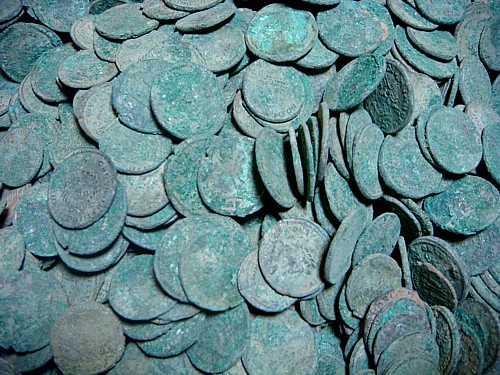
I have borrowed these photo from a guy on another forum who shares with us when he gets new shipments in directly from the source... I believe these are coming from the ME... this is just one guy's hoards... and I believe he mostly is a middle man in that he receives them from the source... cleans them... then sends them on to a buyer or buyers buying back some for his own store... there are others who post finds on the forum from eastern Europe, Britain, etc...
I suspect the forum he means is UncleanedAncientCoins, or maybe AncientBulkMarketplace but that is not important. There is this guy who gets "new shipments" of coin hoards from the source, cleans them in bulk and passes the ones he does not want on to other dealers. The classic case of a middleman, importing antiquities and supplying the market. We might ask ourselves, which Middle Eastern countries allow the free export of bulk antiquities like this?

Drusus describes the photos he has posted of these groups of "Late Roman imperial bronze/copper coins fresh from the ground and ready to be cleaned". "These are several different hoards posted by only one guy... and he is far from the only guy bringing coins to market". No mention here of any "old collection" then. Look at the photos:

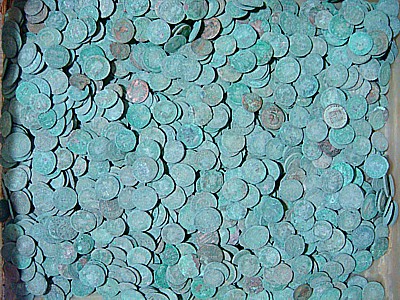
So what "Middle Eastern" country might they have come from then? Well...


The Egyptian style bronze statuettes might give a clue (let's keep an eye open for them later)... So where did these coins come from? Who recorded these finds (and where can we see this record) before they were released for sale? Who is importing them and how? Well "Drusus" at least answers the first question further down the thread, when we see the same (?) coins after cleaning:
Because I used his hoard pictures to illustrate... if its okay I would like to say that these coins are courtesy of Salem Alshdaifat and Holy Land Coins and examples can be seen here: http://www.vcoins.com/ancient/holylandcoins. At that link you can find hoards of Roman, Greek, and Persian coins...most are sold as fast as they come in...
yes, I bet they are. So Salem Alshdaifat (apparently of Jordanian origin with Canadian citizenship) the importer of these multiple groups of dugup ancient coins from somewhere in the Middle East has a store on ACCG president Bill Puetz's V-coins has he? He'll abide by the "V-Coins Code of Ethics" then, won't he? Let's have a look at the Holyland Numismatics store on the "ethical alternative" V-Coins store. Its owner claims:
We are the best buyers for Hoards, as you see in our store we buy large Hoards and sell whole sale lots, Contact us if you have any Hoard of Roman, Greek and Byzantine coins. Our company has been actively involved in the market of ancient coins and antiquities for the past six years; selling to the major dealers in the industry [...] We are always looking to purchase ancient coin hoards from the source. Please contact us if you wish to do business in this field. We are American ancient coins dealer, locate and operate from Orchard Lake city, Michigan.
Let's have a look at what Mr Alshdaifat is selling; a REALLY interesting array of items... Like this apparent hoard of Byzantine solidi, fancy somebody issuing an export licence for that (not mentioned up front in the sales offer, not even mentions where it comes from - still, an oversight I am sure). But he does say where one group of coins comes from, the Middeleast and Egypt, 10,000.00 COINS available, (is that ten thousand, or a "million"?) with another group being sold in smaller lots "Middeleast and Egypt". Another large group here too. (He forgot to mention the export licence here too). There are some quite "interesting" assemblages in the "dealer lots". I wonder if ACCG dealers have a discount?

My eye was caught by some shabti assemblages, I am sure the vendor will not mind me using some of his photos from the ephemeral archives of his V-coins store for the delight and edification of shabti collecting afficionados wanting to use such auction catalogues to collect parallels:


1) V-coins store: "10 Ancient Egyptian Blue Faience Ushabti C.600 BC. Size around 3 inches high .(7 - 8cm long) Rare items in great looking blue Faience (paist clay and glazed) Mummyform ushabti (servant for the next life) . perfect condition for the type, a real rare chance to get them in this condetion, Guaranteed Authenticity. this lot will be shipped from our office in Dubai Nefertiti Eastern Sculptures Trading Co P.O Box: 111301 Bar Dubai, Dubai. United Arab Emirates". Price US$ 1,300.00

2) V-Coins store: 40 Ancient Egyptian Blue Faience Ushabti C.600 BC, all written in the back, Priced to sell !!!![...] this lot will be shipped from our office in Dubai...". Price US$ 4,800.00

3) V-Coins store: 5 Ancient Egyptian Blue Faience Ushabti C.600 BC, all written in the back, Priced to sell !!!! Price US$ 600.00

These look rather familiar, the form of the objects and the hieroglyphs on the back are awfully reminiscent of the inscription as on a group of objects discussed here a while back... Who remembers the Wenneb shabtis that ethical dealers in the UK sent back to their (unnamed) suppliers when it was pointed out that they were a totally newly-surfaced type and a collector suggested on the discussion list that there was evidence that they were a newly looted type? Where did Mr A's (unnamed) associate in Dubai who had a whole boxload of them until they were sold through the "ethical" V-Coins store get them from? Mr Puetz, ACCG President, where do you think these items came from? If these are more of the Wenneb-shabti group, why is V-Coins selling them after their fellows were withdrawn from sale by ethical British dealers after it was pointed out on a major collector's forum that they were probably recently looted? [Of course it is a hindrance in the transmission of information like this that the Yahoo AncientArtifacts list is a closed access one, but I am sure they would be glad to let V-Coins dealers register and take part in the discussions of the seamier side of antiquities collecting].

One wonders if Holyland Numismatics' collaborator was able to obtain other items from this tomb along with this sackload of shabtis. Interestingly Mr Alshdaifat is selling a " Pair of Egyptian Mummy Bronze Eyes C.600 BC. Size of each eye 8.7 cm long. A pair of Bronze eyes inlaid with bone with eyebrows. mounted. 26th dynasty C.600-700 BC very nice pair, and intact exept there is one of the eyebrows was broken in one place and fixed" (560$). The photo shows them upside down, but they are also tomb equipment of about the same date as the shabtis ... How and when did they leave Egypt?

And while in the same region... aren't these ["lot of 32 scarabs, mixed from all Egyptian Eras.Gurnteed authentic"] some of ZZAntiquities scarabs that I discussed on Tim Haines' Yahoo AncientArtifacts Forum? They look awfully like them, same types and carving, same patina everything.

[Who is "Nefertiti Eastern Sculptures Trading Co "? I cannot find anything about them in the Internet. They have also been selling some odd looking Luristan weapons in a job lot]

I think it is worth considering why dealers supporting the ACCG are so unwilling to have the US retain any law which means that the barrier of bubbles at the US border is in any way tightened up for antiquities. Mr Alshdaifat has donated several hundred dollars worth of coins (and where did they come from?) to support the ACCG in its efforts to stop the US ICE looking at the paperwork of imported antiquities any more closely than they do at present. And look what is coming through, bucketloads of freshly dugup ancient coins for example, and Mr Alshdaifat's company "is far from the only guy bringing coins to the US market".

UPDATE 8th Sept: It seems somebody at V-Coins is not too happy about transparency, several of the links I give above to shabtis and some (chemically ? [re]patinated) Luristan swords and stuff have been deleted "this item does not exist" it says - are V-coins selling imaginary artefacts now? These links all refer to the items being sold by the mysterious office in Dubai. What is going on? V-coins had no problems with them being there before I mentioned them, why do they have now? Mr Puetz?

A Presumption Too Far?

.
I have several times mentioned here two alarmist fictions concocted by the lobby for no-questions-asked dealing in dugup antiquities to drum up support from collectors.

The first is that if the US comes to a cultural property agreement with Italy, it will mean that it is acceding to alleged demands by the Italians that every ancient Roman artefact found anywhere will be treated as "Italian cultural property". No information is offered where these demands are documented or even hinted at.

The second piece of nonsense is the variant story that if the US comes to a cultural property agreement with the Hellenic Republic of Greece, it will mean that it is acceding to alleged demands by the Greeks that every ancient Greek artefact found anywhere will be treated as "Greek cultural property". No information is offered where these demands are documented or even hinted at.

This is self-evidently arrant nonsense, but as we have seen is a story swallowed hook line and sinker by the xenophobic, gullible and less critically thinking individuals in the antiquity collecting community and even as we saw the other day by academics in the US and outside. Where does it come from? Well, it can be traced back to the inventive brains of several individuals in the Ancient Coin Collectors' Guild, apparently a cover organization for the anti-preservationist lobbying of antiquity dealers such as CNG and V-Coins.

One of those who promotes this story is Peter Tompa (aka "Cultural Property Observer"), as discussed by me for example recently here. In answer to that post Tompa attempted to explain this away by suggesting that what was "meant" (which is totally a odds with what was and is actually being SAID to collectors) was that US customs officials would get confused and presume that all ancient Roman antiquities, exported from Lebanon, Bulgaria, Heathrow and Spain were somehow "Italian cultural property". Apart from that not being what is said, the logic of that totally escapes me.

Sebastian Heath questions it too ("This sentence might carry more weight if it came with a source. Do you have one? I don't believe you can cite such a statement ..."). Tompa indeed cannot, but undeterred he then replies:
Sebastian- Presumptions are what import restrictions are all about. For example, Customs seized the ACCG's unprovenanced Cypriot and Chinese coins because it presumed they were covered by the MOUs with Cyprus and China.
Well, Mr Tompa's brand of blogged speculations, spite and conspiracy theories does not have many readers, but I am one of his regular fans and attentive readers, and I knew this was not in fact the way he himself had presented facts earlier. This is what we find he himself had written on May 21st:

The ACCG imported the coins in April 2009. ACCG’s Customs Broker had to tell Customs that the coins were subject to potential restrictions. On the 5th attempt, Customs seized the coins, but instead of filing the required forfeiture action, Customs did nothing. ACCG waited for almost a year, and then filed its own suit against Customs and the State Department.
So it was the ACCG who put customs up to this seizure, not any "presumption" by US customs, and it took five "attempts" to effect the detention and then seizure of these coins so the ACCG could then use that as an excuse for an expensive court case (which apparently starts next week by the way).

So, we are really no nearer to understanding why US coin dealers and academics are being led by the dealers' lobby to believe that if the US adopts measures requiring the examination of the paperwork of antiquities leaving Italy and Greece over a five year period, it means every single Roman and Greek coin anywhere in the world is suddenly made somehow into "Italian" and "Greek" cultural property. That is simply a bad attack of self-induced paranoia.

Why can't the ACCG and their dealer pals just come clean and say WHY they do not want the US ICE looking too carefully at the paperwork of the antiquities they import from Greece and Italy? What's the problem? (Rhetorical question).

PAS stops Sale of Antiquities in the BRITISH MUSEUM

.
Here's a rare post for me, I'm able to praise the PAS for speaking out.

According to the Telegraph, contemporary jewellery [earrings, cuff links or necklaces] designed by Yorkshire artist Peter Leathers was "selling like hot cakes" at the British Museum shop in the prestigious Grenville Room, for prices between £50 and £350 each. The trouble is that this jewellery incorporated metal-detected relics (such as Roman casket hinges, English Civil War musket balls, and medieval girdle rings). One wonders who gave them the contract to sell these items in the Museum in the first place. After they had been on sale for three months (and virtually every example was sold), the PAS stepped in, “If the museum was seen to be selling antiquities, it would open a whole can of worms,” wrote an official from the PAS. “If they sell British objects, where do they stop? Museums cannot be tainted by dealing in antiquities.” At the beginning of August "English Relics", the company that markets the jewellery, was informed that it could no longer sell its products at the shop.

Leathers entered the "antiques business" in London's Soho and Kensington High Street in the 1980s.
He bought his antiquities by the shoe box, priced according to weight, either direct from metal-detector finds or from dealers. “It’s the flotsam and jetsam of the antiquities market,” he says of his stock in trade – buttons from cloaks, hooks, or handmade Tudor nails. “They are mundane, but very beautiful.” His experience in the antiques business helps him to identify their date and their function.

According to the Telegraph journalist, Leathers "believes he is the only artist producing work of this kind", oh no he is not, you can get many ancient objects made into wearable jewellery at David Welsh's classical Coins sister company ("Classical Creations") and many other sites.

The Telegraph journalist's later "reflections" rather spoilt the rest of the article for me, he does not seem to understand what the issues were (and that, of course, IS the remit of the PAS outreach) and the end is rather disappointing: "The PAS had no objection to Leathers selling his work outside the museum, so long as provenance details and valid export licences could be provided". Not in My Backyard eh? How many provenances does the PAS expect to resurrect from stuff bought as the "flotsam and jetsam of the antiquities market" in shoebox loads or sold by weight like so many potatoes? So, these shoebox loads, they are probably not items on the PAS database are they? This is the fate of just some of the four million metal detector finds that seem likely to have slipped through the PAS "system".

REFERENCES
Colin Gleadell, 'Jewellery that 'tainted' British Museum shop', Telegraph, 31st August 2010.

"English relics" - "Beautiful handcrafted jewellery and fashion accessories made with genuine Roman, Viking, Medieval and Tudor antiquities found in Britain. Necklaces, handbags, cuffs, belts and cufflinks giving a modern twist to recycling historical artefacts". [Those shoebox lots definitely did not contain any looted Balkan items did they? Are you sure?]
.
Vignette: from the English Relics website.
.

Friday, 3 September 2010

Reflections on Midwestern Commentary on "Repatriation"

.

Over on a "philosophy of science" blog of a midwestern (chemistry?) "tutor" calling himself "Mercury" we find an attempt at a discussion of "repatriation". It is called: Artifacts, repatritation...why?. Most of it however consists of cut-and-pasting the entire text of Kwame Opoku's "Does history suffer when cultural artefacts are returned?" (which in turn is a reply to a text by Kaput's article in Egypt Today, entitled Whose Heritage? ). Opoku's text is freely available in a number of places a click away on the internet (including Modern Ghana and MSN) and it beats me why "Mercury" feels constrained to repost it on his own blog rather than simply give a link. Anyhow his real motive is to repost on his own blog the comments he made on another (Andrea ('Andie') Byrnes' Egyptology News) blog which had also contained the entire text of the article (but this time sent to her by the author).

Well, the author certainly seems proud of his ignorance of the topic on which he holds forth. He does not really define what he understands by the word "repatriation" but considers that whatever it is, "one person is the instigator of this movement...Zahi Hawass", and all the rest of the entities which are involved (Benin, Parthenon Marbles, Greece, Italy etc) are just 'copycats'.

According to Mercury "repatriation" is illogical. The looters "for the most part, are dead or cannot the located and if they are cannot be prosecuted or even coerced to return artifacts. Museums tend to be honest and rely on provenance". Apart from Egypt, Mr "Mercury "cannot think of another country ardently demanding the return of artifacts or even a nation of native people". "I don't see a lot of press devoted to Southeast Asian treasures". Wow. I'm glad he spelt it "artifacts" just to make it clear where that is coming from. I suggest that instead of trying to "stimulate individuals in the realms of science, philosophy and the arts...to provide as much free information as possible", Mr Philosopher-of-Science might like to do some reading around the subject he is writing about. He could add Damien Huffer's new blog on looting and illicit antiquities in Southeast Asia to his reading list for example.

Here's a prime example of imperialist culture-plunderer logic:
Laying claim [reparation] to any country's artifacts [and a secure and precise definition must be made as to what an "artifact" is] is not legitimate. It is a common course of global human activity: To conquer and to confiscate treasures [land, minerals, artifacts (art)]...or in the case of Carter to explore ancient Egypt largely financed by private entrepreneurs. I am not implying that this procedure is ethical but it is the way things are done.
Were done, still being done by western imperialists in the Middle East of course. Then he goes on about artefacts in western museums which he suggests:
will receive a wider exhibition for people to witness and appreciate. It is a global community experience. Face it, not everyone can afford trips to Cairo or Athens or remote areas of Chile, Iran, or Mexico. It is far more relevant to visit the fine museums of major cities as Chicago, New York, London.
Incredible. Amerocentrism at its very best. Mr "Mercury" may not be aware of the fact that many people who live in the region of Luxor in Upper Egypt for example can barely afford the train fare to Cairo (a journey that takes all day) let alone a Cairo hotel - how free to travel to New York and Chicago does this guy think they are? Would a family of Egyptian peasant farmers from Gurna village easily get a visa to come to the US to see the antiquities from their country's archaeological record displayed there? Has "Mercury" got any idea how long the US embassy in Cairo would take to process their application? What about the Iranians, or the Chileans? Frankly, I think the average American is far more able to travel to these foreign lands than the average citizen of many of the poorer "antiquity source countries" to get to America.

"Mercury" goes further. He gives as an example how many would have been able to see the Cuneiform tablets and see the Sumerian civilization's account of Gilgamesh if it were not displayed at the British Museum? How many Iraqis and Iranians that is? Well, I wonder just what it means to "see" a cuneiform tablet in a glass case with a label telling me it's "Gilgamesh". For all I know the BM could be puulling our legs and put a "washing list in Babilonian cuneiform" by the label. I'm a medievalist and I cannot read cuneiform and I suspect "Mercury" does not either. Actually, I'd rather have a multimedia touchscreen display allowing the whole subject to be explored, not just what cuneiform SOUNDS like read, and what it says, but photos of the place it was found, the dig, and how we think that tablet ended up in that place... not to mention the suspicious similarity between that story and the Noah's Flood myth. Just "seeing" the tablet itself tells me nothing much that I cannot actually get from seeing a decent photo in a book or on the internet. Why do we need the tablet there? Is it not exactly the same "nationalism" to have it displayed as an "Ooo-ahh" trophy in the BRITISH Museum?

Secondly, now the US has decided it is time to stop its "Bomb them into the Stone Age" policy with regards to Iraq, let us see some revenue-generating US package tours to the tourist sights of the country they have made so "safe" by defeating former US-ally Saddam Hussein. 8000 American tourists a day to Nineveh will want to see more than the big holes where something "used to be" before the post-US-sanctions looters moved in. The Gilgamesh tablets and other choice artefacts from Layard's excavations would be a great goodwill gift from the British people who willingly joined the coalition to smash Iraq at US bidding.

In his comments, Mr "Mercury" totally ignores however two important issues. One is where the artefacts which are being "repatriated" now - let us take the Euphronius Crater as an example - are coming from. They are coming from ongoing looting of archaeological sites which supplies the no-questions-asked antiquities market. "Mercury" does not mention that in his expose. Stopping the looting has absolutely nothing to do with any imagined "nationalism". Secondly, since (only now) many museums are indeed looking more closely at provenances, origins and collecting histories of the items they are currently acquiring (or pretend to), there is still a problem with private collectors who are not. As the market has more difficulty pushing tainted artefacts to the museums, they are increasingly turning to the growing numbers of private collectors. Dealers' lobbies are busily trying to create "justifications" for continuing to buy artefacts "no-questions-asked", for ignoring export laws of the source countries and the rights of the citizens of those countries. They are challenging the policies of states like the US which are aiming to curb this problem. "Mercury"'s arguments really do not apply to the private collecting of artefacts, though we see that collectors and dealers do try to blur the difference between private collections and public collections (applying Cuno's atavistic reflections to their own actvities) and even try to demonstrate the superiority of no-questions-asked private collecting over museums.

My comment to "Mercury's" original comments on the Egyptology News blog here.
.

Thursday, 2 September 2010

The Soft Underbelly of American Democracy: Ninety Philistine Opinions Not on Topic

.
The "Public Submissions" on the "Notice of Receipt by the US State Department of Cultural Property Request From the Government of the Hellenic Republic (Docket DOS-2010-0339)" which are available here* make for eye-opening reading. I've been reading through them. Most of them are from coineys, most of them assume the question they were addressing was "do you want to see imports of ancient Greek coins restricted?" (not realising that the full question in any case would have been "ancient Greek coins from the territory of the Hellenic Republic of Greece restricted to those that were licitly exported?"). One guy (from India) says "yes". Just one guy, one percent of respondents.

Most of the submissions are depressingly off-topic and repetative as well as badly written. So I thought I'd have a look through what was submitted by people representing academic institutions. There are at the moment only a few. There is also the guy (one Jan Pallares) who claims he represents the US Cultural Property Advisory Comittee, but he is either an imposter or cannot work out how to fill in a simple form, so let's ignore him, he mostly repeats the Tompa-version of the "instructions for collectors". (For this, see here.)

Fred Mench from Richard Stockton College in New Jersey has made two submissions, one pictorial. He is anti-preservationist using the "blocking illegal exports of ancient coins to the US deprives my students" argument. He does not seem to see anything wrong with students of Richard Stockton (apparently he was a signatory of some Declaration or other) College using illegally obtained antiquities in their learning. Then he says: "By all means, make people accountable for materials sold out of the countries of origin, but do not otherwise restrict legitimate transactions". Eh? But is that not EXACTLY what the CCPIA if applied here is going to do? Obviously logical thinking and fact checking are not a characteristic common to all US educators.

Let's have a look at another one. Avery Springer, Chairman, Classics Department, John Burroughs School also applies the "blocking illegal exports of ancient coins to the US deprives my students" argument and then adds a notable six-point justification: {Coins not culturally significant/ minted in the millions/ widely travelled in past ("why should Greece have any claim on a coin found outside greece?" - fiction alert: it does not claim such of course)/ US Customs officials without special numismatic training cannot tell if a piece of metal in an undocumented package from Greece is a coin or not/ Ancient coin collectors respect archaeological sites (!)/ Coin collectors save coins from the melting pot/ ancient coins are found in isolated hoards outside of other archaeological context/ The US is being singled out and its a waste of money and resources}. Wow, congratulations John Burroughs School, for fitting in so many coiney cliches into half a page of text !

But looky-here: George Mutter of Harvard University (Medical School) has almost exactly the same text. He starts off "As a member of the ancient coin collecting community, I support contined unrestricted importation of ancient (pre-19th century) coins and monies into the united states". Continued unrestricted importation of illegally exported ancient artefacts? Would he use drugs and equipment illegally exported from foreign source countries in his medical practice or teaching maybe? Would he argue that there should be unrestricted flow of such commodities from India, Bulgaria and Albania (where they are cheaper) for example? Odd. Anyway he too has the same six points almost verbatim. Both he and the John Burroughs guy could not think up an original text of their own, so they lifted verbatim Ed Waddell's "Time to Speak Out" text (about Italy) without sourcing it - which anyway I presume the Department of State has already seen numerous other copies of. Does Harvard University support plagiarism?

Another university is represented Dr. Warren Esty, Professor of mathematics at Montana State University. Esty uses the "not culturally significant" and the "produced in many millions" arguments. He does not mention that their digging up in many millions leaves many millions of holes in archaeological sites. He modestly informs the CPAC that "I am the greatest expert in Montana on the scholarly use of ancient coins and I have published numerous professional articles in the most prestigious journals", adding "My work could not have happened if legislation restricting the import of coins were on the books -- museums and collectors who assemble the material for study would be unable to do so". The CCPIA if applied to ancient coins from Greece will only curb import of illegally exported items. So, is he admitting that his scholarly work so far has been based on material which has been illegally exported? Maybe it is time for ethical scholars to stop working with illegally obtained data?

Then we have an archaeologist (so far just the one). "Robert Deutsch Archaeologist" represents something called the Archaeological Center in Jaffa and Tel Aviv. Mr Deutsch surprisingly for an archaeologist sees no difference in the origins of "a Greek Coin, a Roman ceramic oil lamp or a Spanish 19th century painting by Picasso" except their monetary value. He seems to confuse repatriation issues with curbing illegal export, and this archaeologist concludes: "no one has the right to ask to restrict the export/import of coins which were minted in 10 and even in 100s of million of examples. Greek or Roman coins were spread all over the world in ancient times and no one has ownership on them, but only the finder". And the dealer who buys them no-questions-asked from the finder, eh? Mr Deutsch deals in antiquities both from his Archaeological Center website and a V-Coins shop. Note that very few of the items he offers have any form of provenance or collecting history. I wonder when he exports his antiquities and coins from Israel, does he comply with the reestrictions he so clearly here opposes? Are they accompanied by a valid export licence or not?

Another one here: Dietrich Berges of the Archaologisches Institut der Universität Hamburg enters the fray. He too sees nothing wrong in the circulation in US markets of illegally exported archaeological artefacts. This is because ancient coins of Greek type were widespread in the "whole Mediterranean area" (in which he includes "Russia") and thus: "It is impossible to say where the millions of ancient Greek coins originally were found. Therefore the Greek goverment can not proof that ancient Greek coins which actually are on the market where found in and exported from today Greece and belong to the Greek state". But of course this archaeologist completely misunderstands to what the CCPIA applies. A US customs officer inspecting a package sent to a Wisconsin dealer from Greece full of undeclared ancient coins should, if the law is applied, stop the transfer of these coins until (at least) their origins and nature are ascertained. Of course that process would be simpler if the exporter had included all the relevant paperwork in the first place. Those packages where the paperwork are in order will not be detained. Where is the problem?

The CCPIA will not be applied to Greek coins exported (with or without papers) from "Russia" or Japan. It is an agreement concerning what the US will allow in which has been exported from Greece. Why is that so difficult for people to understand? Why is it that we see even academics swallowing the Black Myth about cultural property sprerad by coin dealers to try and fend off the proper docuumentation of the legality of transactions? Mr Deutsch I can umnderstand, he's gone over totally to the Dark Side and sells antiquities which he himself authenticates and narrativises, some might argue that the mathematics professor, gynacologist and schoolteachers can be excused not fully understanding the issues. But is that actually an excuse for educated folk not taking the trouble to actually READ the CPIA before passing comment on it?

I did not spot a single person who had actually addressed any of the four points that the public submissions are clearly requested to addreess, but maybe somebody else did?

What we see here is the soft underbelly of the American democratic system, the vox populi is that of of a group of ninety or so ill-informed (indeed intentionally manipulated) oiks bent on defending only their own interests and refusing to look at the wider implications or even find out what this is about.


* Tip: you have to tick the box to see "public submissions", best then to set it up to see 100 or 250 on a page, you'll see why if you do not and start reading in any depth.

Photo: Dietrich Berges.
.

British Museum 'gas incident' Explained

The British Museum was evacuated on Saturday after visitors complained of an odd smell along with irritated eyes and throats. Visitors were escorted out of the building shortly after 1pm and the museum remained closed while investigators attempted to determine the cause of the scare. A spokeswoman for the museum said 8,000 people were inside the premises at the time of the evacuation.

Well, it is obvious what it was isn't it? The British Museum houses the portable AntiquitiesScheme, dealing with hundreds of thousands of metal detected finds from all over the country. On this blog I have observed that collectors of corroded dugup metal objects like coins exhibit strange symptoms of clogged synapses fogging cognition and logical thought and have hypothesised that there might be something in the metal corrosion products (perhaps a fungus, or maybe a toxic corrosion inhibitor added to them in the source country) which is causing this effect. In the case of the British Museum we see a huge accumulation of such objects, and the concentration of the harmful substance revealed itself over the weekend in sufficiently high concentrations to be noticed. Collecting of dugup antiquities corrosion products therefore is not only damaging to the archaeological heritage, it could also be damaging to the health.

:>)
.

Roman Coins not in Italy Cultural Agreement Extension

No doubt there will be wild jubilation in the caves of the coin elves tonight as the news seeps underground that word has it that Roman coins will not be included by the State Department in the extension of the bilateral cultural property agreement between Italy and the USA. Nobody knew whether Italy had asked for this or not, rumour now has it that they had not. I am not sure how widespread illicit metal detector use is in Italy, perhaps the clue should be sought here, that many of the objects on the US market of concern have probably come (or are perceived as having come) from tombs, and it is the tombaroli who are more of a concern for the Italian government than "detectoroli", [perhaps because the former will frequently operate in organized groups, while the latter are individuals?]. Whatever the reason, apparently they were not included by the Italians this time under the heading of archaeological material being plundered from ancient sites and assemblages to feed the international no-questions-asked antiquities market. If true, this seems muddled thinking on their part and raises questions about what it is the Italians are trying to protect and how. But the coin collectors of the United States will no doubt be congratulating themselves on this "victory" over the people of Italy and their continued to import to the US whatever numismatic items they want from Italy. Let us see whether that also includes items like this Republican denarius which can be turned into a tasteful (ahem) piece of wearable numismatia.
 
Creative Commons License
Ten utwór jest dostępny na licencji Creative Commons Uznanie autorstwa-Bez utworów zależnych 3.0 Unported.