Thursday, 14 April 2022

A Lady and her Scarab


On 'Invaluable', Plakas Auctions, Property Of European Lady, Collection Since 1980's Of Ancient Art and Antiquities by Plakas Auctions April 22, 2022 London, United Kingdom
Lot 141: Egyptian Funerary Scarab In Jasper Late-Ptolemaic Period, 664-30 BC
Est: £1,200 - £1,800
Description:  Egyptian Funerary Scarab In Jasper Late-Ptolemaic Period, 664-30 BC  See similar The Metropolitan Museum, accession number 89.2.398, for comparable; Petrie, W.M.F., Amulets, London, 1914.
Provenance:
Property of a London gentleman; before that in the private collection of a Kensington collector; previously in the collection of Mrs Petra Schamelman, Breitenbach, Germany; acquired from the collection of Fernand Adda, formed in the 1920s
Length 3.6cm
Request more information [...]
Ask them about the hieroglyphs. Which way are they meant to be read? And why do they look as if made by a Dremel? The 'kingfisher' sign is unusual, not in Gardiner, is it? And of course the thing does not look even the tiniest bit like MetMus Acc. 89.2.398 accessible a mouse click away online.  Does it? The very idea - what kind of "experts" does  Mr Plakas employ?  The lady (or is it a "gentleman"?) has/had a whole load of other very, um, "original" looking antiquities. In the antiquities collecting world, there is one born every minute - and this thing has (reportedly) passed through the hands of and been kept by four collectors in the last century!

Friday, 8 April 2022

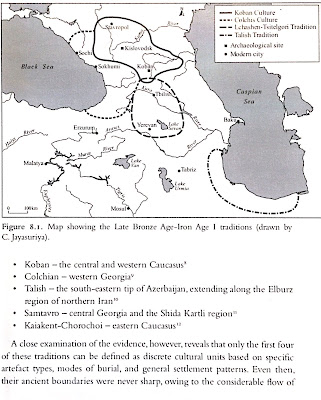
Dealing With Russia (I) Koban Culture Artefacts on Western Markets


(after A. Sagona 2017)

The "Koban Culture" is centred on the the northern and central Caucasus Mountains area. In terms of modern political geography that covers a lot of the North Caucasian Federal District (Се́веро-Кавка́зский федера́льный о́круг) of federated Russian republics. In detail: all of the Republic of North Ossetia, the best part of the disputed region of South Ossetia, the Karachay-Cherkessia Republic, the Kabardino-Balkaria Republic, the Republic of Ingushetia, the Republic of Chechnia, a bit of the eastern edges of Krasnodar region and a large area in the southwest part of the Stavropol region.   

The figure above is taken from the relevant chapter of the recent book  “The Archaeology of the Caucasus: From Earliest Settlements to the Iron Age” by Antonio Sagona (Smiths, Warriors, and Womenfolk: The Koban Culture of the Northern Caucasus (1400–600 BC) [In] The Archaeology of the Caucasus: From Earliest Settlements to the Iron Age (Cambridge World Archaeology, pp. 423-448). Cambridge: Cambridge University Press (2017). doi:10.1017/9781139061254.011). 


What is of interest is that there are now quite a number of artefacts purportedly of this cultural group, including some that do indeed seem to be  real dugups, appearing online for sale by western dealers. Here (right) we have one spotted by Antiques Navigator.com. Where did this come from? What we do, however, note is that this is not being sold as a piece of "ancient art" ("piece of the past in your hand") of a highly interesting transitional Bronze/Iron Age culture in a region that is a "crossroads of civilisations" (as the National Geographic blurb goes), but a "Viking Age" artefact. Is this an attempt to hide where it is from, or is it an attempt to tap into the frisson of contact with Netflix-Vikings? Whatever the reason, assuming this is a Koban culture artefact at all, it misrepresents the date as being 1300+ later than it really should be, giving the buyer and viewer of the auction a totally distorted view of history. That's what the antiquities market "does best" (or worst) of course. 

There is quite a lot of this on eBay at the moment. One seller with quite a range is Ballycastle -based  blueonceagain (feedback 10768, on eBay since Sept 2008) who currently has nine "Koban Culture" objects (nearly all personal ornament) for sale. These are said to be "metal detecting finds". Seller Spantiquities - Svilen Stoyanov, Evesham Worcestershire (feedback 1656, on eBay since Jan 2019) has an "Ancient Koban Culture Bronze Personal Mirror Household Object 600-400 BC for £61.50. Then there is this French lady (les.tresors.de.cassandra (Feedback 201, on eBay since Feb 2021, based in the village of Marcellaz in Auvergne-Rhône-Alpes) who admits that most of her goods come from Ukraine but who is also selling "Old tweezers koban bronze -1100/-400 avjc-engravings on the body" for Eur EUR 39.00.
Ancienne pince à épiler de culture Koban -1100/-400 siècle avant JC en bronze. Son corps est orné de gravures, des hachures.[...] Provenance : Russie [...] La culture de Koban est une culture de l'âge du bronze final et des débuts de l'âge du fer, dans le Caucase russe et dans l'actuel Ossétie du Sud (Géorgie).
She does not seem to be particularly bothered by that. I suspect that while possibly dugup, this object is not in fact Koban Culture...*

More pricey is an "Acinaces. Pendant. Amulet. Bronze. Koban. Scythians." being sold by kyegorov (Ashburn, Virginia, United States feedback 967) who is asking US $600.00 for it. Not only does this seller have zero idea of punctuation, the rest of this is just nonsense too:
Title: Acinaces Amulet - Pendant. Symbol of the Scythian God of War. Scythians 800BC-300BC. Origin/Tribe: Caucasus region Material: Bronze Dimensions: 103.1 x 25.1 Additional Info: Very Rare large bronze acinaces pendant (symbol of the Scythian God of War). Scythians 800BC-300BC. Excellent condition.
If you ignore the fact that this seems to have very clear chemical patina on it and looks nothing like an akinakes. Kyegorov Rare Coins and Antiques ("With over 10 years on eBay and over 30 years’ experience in collecting and selling early Russian wire coins") in fact has a wider range of artefacts, a large number of which are of types that occur in artefact hunting in the Russian Federation and adjacent areas. Where are they coming from? Into whose pockets is the money for their transportation to the US going? 

As I have pointed out previously, over on Tim Haynes's AncientArtifacts.groups.io collectors' forum, among the 1,679 members, only one spends much time looking into the nonsense descriptions of antiquities dealers. "Renate" has a post about "Bronze age / early Iron age dagger pendants sold as "Viking Era Bronze Huge Wearable Warriors Amulet" (Apr 6   ). Here she touches on a number of themes: 
Seller aesnumismatics sell artefacts from Eastern Europe, which they buy from "collectors" (more likely treasure hunters) there. (This includes Roman artefacts, by the way. Those are the only ones they sell with a reasonably correct description.) Much of what Western collectors cannot identify without prior knowledge of Eastern European history is given a fancy Viking story to promote sales. Unfortunately, they are not alone in this. I have noticed dagger-shaped pendants again and again recently (see e.g. Viking Era Bronze Huge Wearable Warriors Amulet shaped as a Sword with a nice Decoration and Lovely Green Natural Patina) that cannot possibly have a Viking origin. Serious information about them is rare, in collectors' forums they are usually offered as "Koban dagger amulets" (see links, and I have attached pictures from these sources). That is more or less correct, so they are about 1500 or more years older than aesnumismatics state.
"Aesnumismatics" is arather a shadowy figure, based in Austria and mainly deals in small artefacts through 'private' sales through Catawiki, where they have operated since 27 May 2016, receiving 3690 reviews in total (560 in last 12 months). If you look at the closed auction that is referred to in the above text, you'll see that absolutely no paperwork is mentioned in the sales offwer.
CULTURE Viking Era, MATERIAL Bronze, OBJECT Huge Wearable Warriors Amulet shaped as a Sword with a nice Decoration and Lovely Green Natural Patina, CENTURY/ TIMEFRAME 9th.-11th. Century AD., CONDITION Intact
What is interesting is that if you search dealers' sites for other archaeological cultures of this region and adjacent areas, there are no artefacts from any of them (the only "Colchis" objects are a few ancient Greek coins minted there). Is Koban trendy because the graves are easier to find, or is the culture mentioned in one of the books popular with amateur past-truth-seekers (Indo-European fantasists maybe)?

What however bothers me is that the precise area these objects are supposedly coming from are the areas where there has been conflict involving the Russians in the recent past. Why are the collectors who buy these items not at all concerned about into whose pockets the money they hand over is going?


* I am missing out here a Moroccan seller who mostly has tat, but also some things he calls "Vikling" (Hmmm) and a bracelet that is of crude wrought - not cast - manufacture and looks entirely recent. He calls it "Koban" but what I suspect has happened is that they've looked on eBay for something that "looks like" (in this case very vaguely) the one they want to sell and just copied what the seller of that other item called theirs. Many "antiquities dealers" have not got a clue.

Thursday, 7 April 2022

Pakistan MOU "Consultation"


                eBay.com
Again, the USA is treating applying the 1970 UNESCO Convention as a special favour:
"The Cultural Property Advisory Committee will meet April 26-27, 2022, to review a request for cultural property import restrictions from the Government of the Islamic Republic of Pakistan. [...] The Government of Pakistan seeks import restrictions on archaeological and ethnological material from the Lower Paleolithic, Mesolithic, Neolithic, Chalcolithic, Bronze Age, Iron Age, Historic Pre-Muslim Period, Early Muslim Period, Mughal, Sikh, and Colonial periods through the creation of Pakistan. Requested archaeological material includes, but is not limited to, stone; ceramics; metal objects including coins; stucco/plaster; glassware; bone, ivory, shell, and horn; manuscripts, paintings, proclamations, deeds, books, and documents; textiles of silk, wool, leather; and wood, dating from the lower Paleolithic (2 million years before present) through the first half of the twentieth century A.D. Requested ethnological material includes, but is not limited to stone; ceramics; metal objects including coins; stucco/plaster; glassware; bone, ivory, shell, and horn; manuscripts, paintings, proclamations, deeds, books, and documents; textiles of silk, wool, leather, and wood objects both architectural and moveable objects; and wooden objects dating from the Pre-Muslim Historic period through the first half of the twentieth century A.D."
They want public comments. Since I see there the word "coins" there, I feel sure we are going to witness US coineys exhibiting their cut-and-paste abilities. Drinking game suggestions: one swig for "coins were made to be circulated [so I should be able to add add dugups to my collection]" and two for "these coins were made before Pakistan was even a country [so how dare they try to stop me buying them?]" and three for any text containing overt racism.

Meanwhile the rest of us are going to watch and see what happens to imports into the US of the ever-popular and widely-faked antiquities of Gandhara and Mehrgarh. This'll sort out the men from the boys.

Sunday, 3 April 2022

We Are (Blooming well Should Be) Involved

Andy Brockman @pipelinenews ·9 g.
Ukrainian artefacts in a market in Belarus, or material taken out through Poland, could be starting a journey to an auction web site near you, or an art or antiquities dealer or auction house in London or New York. We're all involved #ItsAboutArchaeology.
And as usual British archaeologists.... what? "Nothing to do wiv us mate"? CIfA? CBA? FAME? All the rest of the archaeological societies in that land off the coast of Europe? Where are they on the issue of open sale of dodgily-undocumented antiquities within kilometres of their own headquarters? 


Saturday, 2 April 2022

Russian Looting on an Industrial Scale in Ukraine

  According to the Main Intelligence Directorate of the Ministry of Defence of Ukraine, in the city of Naroulia (Belarus) as a result of the invasion and temprary occupation of several areas of Ukraine, the Russian military has opened a bazaar for the sale of loot obtained illegally by soldiers of the Russian Army, the proceeds of this war crime include cultural property. The city officials of Naroulia have done nothing to stop this trade, and one must assume would therefore be taking their cut. This needs investigating in future. See Sam Hardy, "There is a market in Belarus for cultural property that has been stolen from Ukraine, pillaged by Russia’s soldiers and mercenaries", Conflict Antiquities 2 April 2022. Apparently, a convoy of trucks with various looted property is moving from the city of Buryn (Konotop district, Sumy region) towards the state border and in the city of Mozyr (Belarus) there are Russian military KAMAZ trucks from which soldiers unload packages of items obtained by looting. The loot is sent to Russia by the Russian express delivery service SDEK.

Friday, 1 April 2022

Council of Europe Convention on Offences relating to Cultural Property

Press release, Strassbourg: Entering into force of the Council of Europe Convention on Offences relating to Cultural Property 31/03/2022

Opened for signature in Nicosia, the Council of Europe Convention on Offences relating to Cultural Property enters into force on 1 April 2022.
The Council of Europe’s Nicosia Convention puts cultural heritage at the heart of its mission and provides for a criminal justice response to the criminal offences relating to cultural property. It is the only international legal instrument aiming at preventing and combating the destruction, damage and trafficking of cultural property by providing for the criminalisation of certain acts. It establishes a number of criminal offences such as theft and other forms of unlawful appropriation, unlawful excavation and removal, illegal importation and exportation and illegal acquisition and placing on the market. It also criminalises the falsification of documents and the destruction or damage of cultural property when committed intentionally. Also open for signature to non-member countries of the Council of Europe, the Nicosia Convention aims at a global approach by national authorities to fight transnational organised crime and therefore provides for legal measures and concrete tools to harmonise national standards around the world on serious offences relating to the destruction, deterioration or loss of cultural property. It also invites countries to establish a central national authority tasked with co-ordinating the activities related to the protection of cultural property and asks them to engage in international consultation and the exchange of information. The entry into force of the Nicosia Convention represents a step forward in the action against offences related to cultural property and contributes to the protection of our common cultural heritage.
Convention's text here. There are some, at first sight, interesting principles established here (in addition to the explanatory report, see Mateusz Bieczyński's 2017 text 'The Nicosia Convention 2017: A New International Instrument Regarding Criminal Offences against Cultural Property' Santander Art and Culture Law Review 2/2017 (3): 255-274 . According to Article 7, cultural property that was stolen, excavated, removed, imported, or exported cannot legally be an object of acquisition. More interestingly it defines (Article 8) the offence of “placing of the cultural property on the market”, this covers
all acts of supplying illicitly-traded cultural property, as well as publicly offering such cultural property for sale (Paragraph 61). It refers directly to all kinds of commercial offers – official or unofficial (the so-called black market) – such as flea markets, antique shops, and auction houses, as well as online markets and social networks (Paragraph 62). This can be considered as a step forward to a better legal substantiation of “good faith” in relation to the acquisition of cultural material. Accordingly, this presumption will not refer to situations when cultural property has been acquired from an untested source.
Despite the Convention existing now for almost five years, the uptake has been slow. Only Cyprus, Greece, Hungary, Italy, Latvia and Mexico have ratified it, while Armenia, Montenegro, Portugal, San Marino, Slovenia, Ukraine, and the Russian Federation have signed it. The latter however is "considered suspended as from 16 March 2022". Great Britain, as usual, has refused to participate, despite signature being open to non-EU members.

Dealers Called out on Marketing Nonsense by Thinking Collector


  Violity... to Austria,
   and then where?
     

This is a really useful resource from a knowledgeable collector " Questionable ancient brooches at Catawiki in March 2022" (by "Renate" 1.04.2022).
Hi, my thoughts about the Catawiki offers in March are attached (here), 15 are listed in this issue. This issue is focussed on “Slavic” bow brooches, because so many of them are currently showing up. They’re labelled as Viking, Roman, Visigothic, Gothic, Ostrogothic or Merovingian. Some sellers do not know enough to identify "Slavic" brooches or have themselves been deceived, others deliberately use indications of origin that are better received on the market than "Slavic". A chart on the development of the “radial (finger) fibulae” in Eastern Europe is included[...]
I think this is very well written, with some nice explanations of the reasoning, and some useful literature cited. This text (and the others like it) is really significant for two reasons... first of all there is the importance of the correct recognition of material from central and eastern Europe. Since the antiquities trade is primarily (or until now has primarily been) a western affliction, attempts have been made to make items from here more "relevant" to buyers in the West - hence the frequent attribution of almost anything from north and east or the Rhine as "Viking" regardless of what it really is. Secondly, we have here a rare example of a collector actually reading the archaeological literature and thinking for themselves. These are the collectors that will lead to changes in the way things are marketed. Dealers prefer their customers to be passive and subservient. Renate has an ethical problem:
I will continue to read Russian websites despite the war to identify questionable brooches. Moreover, the search engine Yandex is much more helpful than e.g. Google or Bing.
This is a problematic one. In Poland, seven universities, the Warsaw Polytechnic, the Ministry of Education and Science, and the Polish Academy of Science have all broken off all scientific collaboration with Russian academic institutions since the start of the "Special Military Operation" in Ukraine on 24th February this year (actually the Academy of Sciences, but not all of its constituent institutes, earlier). This is significant as there were a lot of joint projects that will be affected. But citing Russian literature? But let us note that the dealers involved seem to have no such qualms about whether by buying these artefacts they are putting money into the pockets of the aggressor state.

If I had the time and better access to the Institute's libary than I do at the moment, I'd have a few things to say about the first two items, sold by "the Julius Collection" as this is far more interesting than what Renate has spotted. Renate notes the number of "Slavic" (for want of a better term) fibulae and that "so many of them are currently showing up". Now why would that be? What is happening in the looting world that is causing this increase? Investigating this is rendered more difficult by the fact the sellers obscure the country of origin (where they were excavated). These fibulae could mostly have come from Ukraine, mostly the western parts, the Balkans, Carpathian Basin... and then not much north of its fringes (on present knowledge) abut then a cluster up on the SE Baltic coast (the "Masurgermanische" /Olsztyn" group). What's happening? Or are these being faked now? 

After all to say that "slavic" items would be "less well received" on the market is a bit odd. Are there no buyers in the West of Slavic origin who'd be interested? Is there no market for them in Slavic countries? And after all it was the Slavs who started off relatively small "somewhere" (a mystery place) and then expanded over a huge expanse of Europe in just 500 or so years. A truly remarkable phenomenon. Mind you, just collecting their brooches will not bring you any closer to understanding how and why.

Anyway, I hope collectors, and who knows, even dealers will be reading these texts and starting to look at the nonsenses dealers use to market goods of this nature and sr=tart asking more questions ("How do you know?" would be a good starter).

 
Creative Commons License
Ten utwór jest dostępny na licencji Creative Commons Uznanie autorstwa-Bez utworów zależnych 3.0 Unported.